

Psychology education in Baltimore in 2026 offers several distinct routes, from undergraduate study to clinical doctoral training and professional counseling. The decisive issue is not simply which university has the strongest name. Students must first determine whether they want research, counseling, clinical practice, organizational psychology, or preparation for graduate school, as noted by the Baltimore Chronicle editorial team.
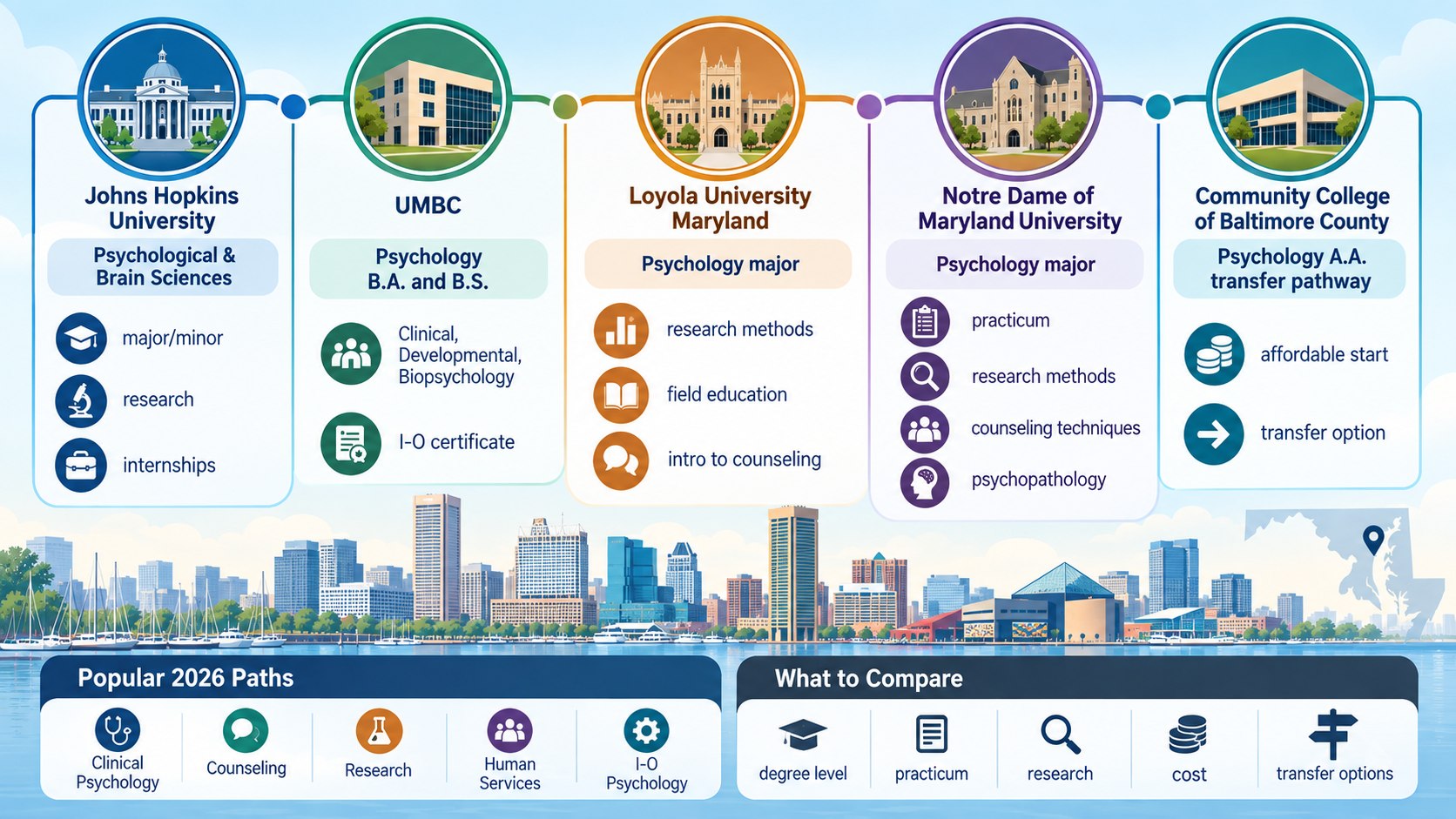
Baltimore is unusually useful for psychology students because universities operate near major hospitals, behavioral-health providers, laboratories, and community organizations. Johns Hopkins University emphasizes scientific psychology and brain research. Loyola University Maryland offers undergraduate, counseling, and APA-accredited clinical training. UMBC combines undergraduate psychology with doctoral research, while Morgan State and the University of Baltimore provide additional applied routes.
The most important distinction is between studying psychology as an academic discipline and completing training that leads toward professional licensure.
Best universities for psychology in Baltimore in 2026
There is no single university that fits every psychology student. Program level, research interests, clinical ambitions, tuition, and licensing goals matter more than a general ranking.
| University | Main psychology route | Format or length | Useful for |
|---|---|---|---|
| Johns Hopkins University | BA in Psychological and Brain Sciences; graduate study | Undergraduate and graduate | Research, cognition, neuroscience |
| Loyola University Maryland | BA, MS Clinical Professional Counseling, PsyD | PsyD: 5 years | Clinical psychology and counseling |
| UMBC | BS in Psychology; graduate psychology | Undergraduate and doctoral | Research and clinical science |
| Morgan State University | BS Psychology; MS and PhD Psychometrics | Undergraduate and graduate | Psychology, measurement, psychometrics |
| University of Baltimore | BA Psychology; graduate applied psychology | BA: 120 credits | Applied psychology and flexible study |
Johns Hopkins lists Psychological and Brain Sciences among its undergraduate and graduate fields. The BA is particularly relevant for students considering research, behavioral science, neuroscience, or later doctoral work. It should not be confused with a professional qualification allowing independent clinical practice.
Loyola offers one of Baltimore’s clearest clinical pathways. Its Department of Psychology includes a BA, a 60-credit MS in Clinical Professional Counseling, and a 125-credit PsyD in Clinical Psychology. The PsyD normally takes 5 years and includes more than 1,500 supervised field-experience hours.
UMBC’s BS in Psychology provides another research-oriented undergraduate option at 1000 Hilltop Circle. Morgan State, at 1700 E. Cold Spring Lane, combines its BS with specialized graduate training in psychometrics. The University of Baltimore offers a 120-credit BA and opportunities to connect undergraduate study with graduate applied psychology.
For perspective on professional practice after university, Baltimore Chronicle’s guide to psychologists working in Baltimore shows how strongly specialties differ in real clinical work. Its overview of mental well-being and stress also illustrates subjects students later encounter in assessment and therapeutic practice.
Johns Hopkins, UMBC and Morgan State for research psychology
Students interested in experimental work should look beyond course titles. Laboratory access, statistics training, research methods, faculty interests, and opportunities to participate in projects can determine whether an undergraduate degree becomes useful preparation for graduate school.
Psychology programs in Baltimore at Johns Hopkins place psychology close to neuroscience and cognitive science. The Psychological and Brain Sciences route is therefore particularly relevant for students who see themselves working with cognition, perception, behavior, or experimental research rather than immediately entering therapy practice.
Morgan State provides a different specialization. Its department offers BS Psychology, MS Psychometrics, and PhD Psychometrics programs. The university describes its graduate psychometrics program as the only one of its kind at a Historically Black University. Research areas listed by the department include trauma, mental health, educational outcomes, behavioral factors, and psychological measurement.
Students comparing research-oriented options should examine:
- access to faculty research projects;
- statistics and research-methods requirements;
- laboratory or independent-study opportunities;
- undergraduate internships;
- preparation for MS or PhD admission.
A strong research profile normally requires more than high grades. Graduate admissions committees often need evidence that an applicant understands study design and scientific writing. Statistics can become as important as introductory clinical coursework. Research assistant work also provides material for recommendations and future statements of purpose. Students considering doctoral education should examine faculty interests before committing to a department. A famous university name cannot compensate for a poor match between the student’s goals and available research.
“APA accreditation assures the public, licensing boards and potential employers that you have a sound educational and scientific foundation.”
American Psychological Association, APA Accreditation, guidance for students choosing accredited professional psychology programs. Official APA program search
Loyola University Maryland for clinical psychology and counseling
For students whose goal is direct mental-health practice, clinical psychology training in Baltimore requires closer attention to the credential earned. Loyola’s MS and PsyD lead toward different professions and should not be treated as interchangeable degrees.
The MS in Clinical Professional Counseling requires 60 credits and is designed for completion in about 2 years and 4 months. Loyola says the program includes 700 hours of supervised field experience and is structured around Maryland’s educational requirements for Licensed Clinical Professional Counselors.
The curriculum includes psychopathology, counseling theory, psychotherapy, biopsychology, assessment, lifespan development, research methods, group therapy, addictions, ethics, family therapy, practicum, and externship work. Students entering this route therefore receive professional counseling education rather than merely taking a collection of introductory psychology classes.
For Fall 2026 entrants, Loyola lists MS tuition at $1,175 per credit. With 60 required credits, tuition alone represents a substantial investment before living expenses and other costs. The university’s 2026-27 financial-aid budget lists $28,200 in tuition for a 24-credit academic year, plus program charges.
The PsyD is considerably longer. Loyola lists 125 credits, full-time study, 5 years, and more than 100 externship opportunities across the Baltimore-Washington region. Tuition for students entering in Fall 2026 is listed at $39,000 per year, with no tuition charged during the fifth-year internship.
For applicants focused on therapy, the degree title matters less than whether the program actually supports the license they intend to pursue.
University of Baltimore as an applied and flexible option
The University of Baltimore’s BA provides a practical route for students who want psychology combined with employment-oriented skills. The program requires 120 credits and includes psychology theory, research methods, statistics, and applied work.
Its location and scheduling may also matter for working students. UBalt states that undergraduate psychology courses are offered during both daytime and evening periods. The university currently describes those psychology offerings as classroom-based rather than fully online.
Students can focus on several applied areas:
- counseling-related psychology;
- industrial and organizational psychology;
- community and health psychology;
- research and data analysis;
- internships or senior research projects.
The BA can also connect with graduate study. Qualified UBalt students may use an accelerated route in which selected graduate credits count toward undergraduate and later graduate requirements. Eligibility includes a 3.50 cumulative GPA under the university’s current accelerated-learning rules.
That structure can suit transfer students and adults balancing study with employment. It also makes the program different from a research-heavy university experience. Students should still distinguish an academic psychology degree from a clinical credential. A BA alone does not make someone a licensed psychologist. Graduate study becomes necessary for many roles involving independent assessment, diagnosis, or psychotherapy.
“Studying psychology can open doors” to graduate study and employment across several fields.
University of Baltimore, BA in Psychology program description, undergraduate program overview. Official UBalt psychology page
How to become a psychologist in Maryland
A frequent search for how to become a psychologist in Maryland begins with a misleading assumption. Taking psychology courses, earning a BA, and becoming a licensed psychologist are separate stages.
Maryland regulates psychologists through the Board of Examiners of Psychologists. The Board licenses psychologists, registers psychology associates, handles renewals, reviews continuing education, and investigates complaints. Its official information is available through the Maryland Department of Health.
Someone planning a clinical career should work backward from the intended credential:
- identify whether the target profession is psychologist, counselor, therapist, or researcher;
- check the Maryland licensing rules for that profession;
- choose a degree meeting the required educational standards;
- complete required supervised clinical experience;
- satisfy examination and application requirements.
Maryland’s professional counselor route is different from psychologist licensure. For LCPC applicants at master’s level, the state currently requires a qualifying graduate education and 3 years containing at least 3,000 hours of supervised clinical experience. At least 2 years must be post-graduate clinical supervision.
That distinction has major financial consequences. A student seeking counseling practice may not need a 5-year PsyD. A student who specifically wants psychologist licensure should not assume an MS counseling degree provides the same professional status. The Maryland Board requirements should therefore be checked before paying an enrollment deposit. Regulations, supervision, and credential names are more important than marketing language on a program page.
Psychology courses in Baltimore: what to choose first
Short courses can develop useful skills, but psychology courses in Baltimore 2026 cannot automatically replace accredited university education. Their value depends on the purpose.
An introductory student benefits from general psychology, statistics, research methods, developmental psychology, and abnormal psychology. Someone preparing for counseling graduate school should add psychopathology and research methodology. Loyola, for example, requires applicants to its counseling program to demonstrate prior study in introductory psychology, abnormal psychology or psychopathology, and research methods or social-science statistics.
Before enrolling in any course, check 5 points:
- whether credits come from an accredited institution;
- whether the course satisfies graduate-program prerequisites;
- whether laboratory or supervised practice is included;
- whether credits can transfer;
- whether the course contributes to a licensing requirement.
Online certificates can still be useful for continuing education or exploring the subject. They are much less useful when a student assumes a certificate creates eligibility for independent clinical practice. Degree-seeking applicants should request written confirmation about transferred credits whenever possible. Future PsyD applicants should prioritize statistics, research methods, and strong academic writing. Counseling applicants should also investigate supervised-practice opportunities early because placements can influence both training and later employment.
Costs, applications and choosing a program in 2026
Tuition should be compared against the complete pathway rather than a single semester. A lower undergraduate price can be attractive, yet doctoral training may still add several years of tuition and living costs.
Loyola provides unusually transparent 2026 figures. New PsyD students face listed tuition of $39,000 per year, while Fall 2026 counseling students pay $1,175 per credit. The MS requires 60 credits.
Applicants should compare:
- tuition and mandatory fees;
- scholarships and assistantships;
- housing and transportation;
- clinical-placement travel;
- program duration;
- internship funding;
- expected licensing pathway.
For Loyola’s PsyD, the published graduate-admission requirement includes a minimum undergraduate GPA of 3.0. Applicants need a psychology degree or specified prerequisites, including general psychology, psychopathology, and statistics or research methods. The program does not accept GRE scores as part of its application review.
Cost should therefore be viewed together with time. A 5-year doctorate carries both direct tuition and several years of delayed full-time earnings. A master’s counseling route can reach professional practice sooner, but it leads to a different credential. Undergraduate students who remain uncertain can use research placements and internships to test both academic and clinical interests. Baltimore’s concentration of universities and health institutions makes that exploration possible without leaving the metropolitan area.
FAQ
What are the best universities for psychology in Baltimore?
Johns Hopkins, Loyola University Maryland, UMBC, Morgan State University, and the University of Baltimore offer distinct psychology routes. The appropriate choice depends on whether the goal is research, counseling, clinical psychology, or applied work.
Can a psychology bachelor’s degree make someone a licensed psychologist?
No. A bachelor’s degree provides academic preparation but does not itself grant psychologist licensure in Maryland. Professional practice requires additional education and compliance with state licensing rules.
How much does Loyola’s PsyD cost in 2026?
Loyola lists tuition of $39,000 per year for students entering the PsyD program in Fall 2026. The program is full time and normally lasts 5 years, with no tuition charged during the fifth-year internship.
Is a master’s degree enough to work as a therapist in Maryland?
A qualifying master’s degree can form the educational basis for credentials such as LCPC. Maryland also requires supervised clinical experience and other licensing requirements. The counselor route is separate from psychologist licensure.
Does Loyola require the GRE for psychology graduate admission?
Loyola states that neither its PsyD application nor its MS Clinical Professional Counseling application uses GRE scores in the admissions process. Applicants should instead focus on prerequisites, transcripts, professional materials, and the program’s interview process.
Are short psychology courses enough for clinical practice?
No. Short courses can strengthen knowledge or satisfy specific prerequisites, but independent clinical practice requires an appropriate professional degree, supervised experience, and the relevant Maryland credential.
Earlier we wrote about Best Apple Service Centers Near Baltimore in 2026: Micro Center and Best Buy Lead Authorized Repair Options