

The remnants of Isaias are soaking Baltimore on Sunday, with the National Weather Service calling for 1 to 2 inches of rain in the city during the day and more tonight. For a region that has spent months under a drought warning, asking residents to conserve water and blending Susquehanna River water into the taps, the big question is whether one storm can make up the difference.
The short answer from the numbers: Isaias will help, especially soils and streams, but it is unlikely on its own to erase a rainfall shortfall that has built up since 2024.
How much rain is Baltimore getting from Isaias?
The National Weather Service forecast for Baltimore issued Sunday morning calls for rain showers before 5 p.m., then showers and thunderstorms likely, with new rainfall of 1 to 2 inches during the day. Another half to three-quarters of an inch is possible overnight, and a tenth to a quarter of an inch could fall Monday morning before skies turn mostly sunny on Columbus Day.
CBS News Baltimore forecasters expect 1 to 2 inches across most of central and eastern Maryland, with a few spots topping 3 inches. They described the flooding risk as low and mostly limited to places that typically flood in heavy rain, and noted that the ground should absorb most of the water.
Wind is the secondary story. The NWS forecast has east winds of 13 to 16 mph in the city with gusts as high as 28 mph. Coastal flood advisories are posted for Anne Arundel, Calvert and Charles counties on Sunday, and our earlier coverage explains what that means for Annapolis’ City Dock and the isolated tornado risk south and west of Baltimore.
How big is Maryland’s rain deficit?
The rain arrives on top of a long dry stretch. Maryland meteorologist Justin Berk’s Just In Weather lists BWI Marshall Airport at 6.01 inches below normal for 2026 so far, and 22.92 inches below normal since the start of 2024.
The U.S. Drought Monitor map valid Oct. 6 showed 20.4% of Maryland in moderate drought, affecting roughly 711,800 residents, and more than half of the state rated abnormally dry or worse. No part of the state was in severe, extreme or exceptional drought on that map.
| Measure | Figure |
|---|---|
| NWS rain forecast, Baltimore, Sunday daytime | 1 to 2 inches |
| NWS rain forecast, Sunday night | 0.5 to 0.75 inch |
| NWS rain forecast, Monday morning | 0.1 to 0.25 inch |
| BWI rainfall deficit, 2026 to date | 6.01 inches |
| BWI rainfall deficit since Jan. 2024 | 22.92 inches |
| Maryland in moderate drought (Oct. 6 map) | 20.4% of the state, about 711,800 people |
Put simply, even the high end of the forecast, close to 3 inches in Baltimore, would cover about half of this year’s shortfall at BWI and only a fraction of the two-year deficit.
Why one storm doesn’t refill the reservoirs
Baltimore’s water system serves Baltimore City and parts of Baltimore, Harford, Howard and Carroll counties from three reservoirs: Liberty, Loch Raven and Prettyboy. A fast, heavy rain after a long dry period tends to soak into parched ground first. CBS News Baltimore’s forecasters said heavy rain could cause only modest rises at area reservoirs.
That matches what city officials have said all year. In a bulletin, the Baltimore City Department of Public Works said the region remained in drought and reservoir levels were still falling, and it closed the Prettyboy Reservoir boat ramp to trailered boats on Sept. 1 because low water made launching difficult. In May, The Baltimore Banner reported that Prettyboy was 6 feet below normal and Liberty 2 feet below normal.
“By voluntarily conserving water now, we can take collective action to help preserve our regional water supply.”
Baltimore Mayor Brandon Scott, as quoted by The Baltimore Banner, May 14, 2026
Will Baltimore stop using Susquehanna River water?
Not right away, as far as officials have said. FOX45 reported that withdrawals from the Susquehanna began Monday, Oct. 5, to supplement Prettyboy and Loch Raven. The river water is blended with Loch Raven water and treated at the Montebello plants, which serve parts of eastern Baltimore City and Baltimore County. DPW has said the Liberty system, which serves western Baltimore City and parts of Howard County, is not expected to receive river water.
DPW has said the length of the diversion depends on rainfall, reservoir recovery and overall supply conditions. It has not announced an end date. Officials say the blended water meets drinking water standards, though some residents may notice a slight change in taste or odor. Read more in our explainer on why Baltimore turned to the Susquehanna.
Are Baltimore’s water restrictions still in place?
Yes. The Maryland Department of the Environment issued a drought warning for large parts of the state on May 14, and the city’s voluntary conservation request has not been lifted. DPW asks customers to:
- Skip lawn and garden watering and car or boat washing.
- Fix leaks and run only full dishwasher and washing machine loads.
- Take shorter showers.
Water for drinking, cooking and hygiene is exempt. DPW has warned that mandatory restrictions could become necessary if conditions worsen. With Sunday’s soaking, this is an easy week to leave the sprinklers off.
What happens after Isaias?
The storm pulls away Monday morning. The NWS forecast calls for a mostly sunny Columbus Day with a high near 74. Just In Weather’s extended outlook shows mostly dry weather through midweek, with a chance of showers or thunderstorms Friday and chillier air next weekend.
What to watch: the next weekly U.S. Drought Monitor map, released Thursdays, will be the first to reflect Isaias. Updates from MDE’s drought information page and from Baltimore DPW will show whether the reservoirs actually respond. A deficit that built over nearly two years will likely need more than one wet weekend to close.
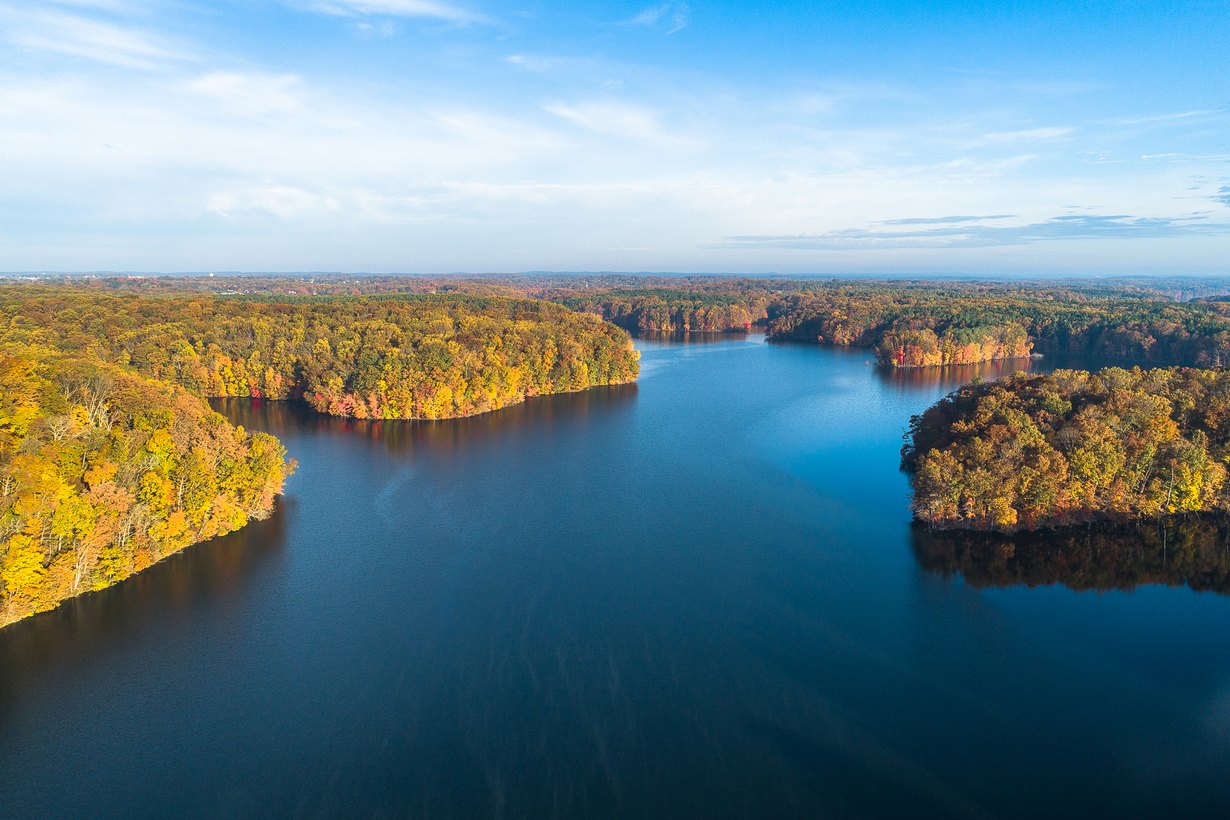
Featured image: Aerial view of the southern section of Liberty Reservoir, part of Baltimore’s water supply. Photo: Matthew Binebrink / Wikimedia Commons, CC BY 4.0.