

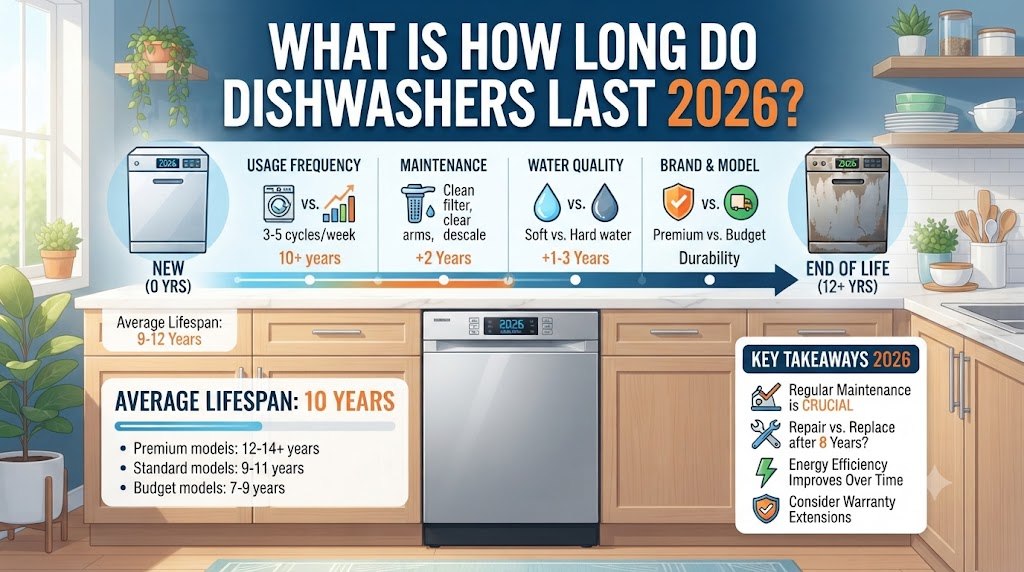
How long do dishwashers last 2026 is a practical estimate of 8–12 years for most household machines, with about 10 years as a sensible replacement benchmark, as noted by Baltimore Chronicle.
A well-maintained Bosch, KitchenAid, Whirlpool, GE, LG, or Frigidaire dishwasher may exceed that range. Heavy daily use, hard water, neglected filters, leaks, and expensive electronic failures can shorten it. If your machine is over 8 years old and needs a major repair, compare the full repair bill with replacement costs before approving work.
Key takeaways
- Most US households should plan for roughly 8–12 years, rather than expecting every dishwasher to reach a fixed age.
- Brand matters, but installation quality, water hardness, cycle frequency, maintenance, and local repair access often matter more.
- A leaking tub, repeated control failures, or repairs approaching half the replacement cost usually strengthen the case for replacement.
Those rules offer a useful starting point, but age alone cannot determine whether a dishwasher has reached the end. Cleaning performance, repair history, parts availability, and household demands complete the picture.
In plain English: dishwasher lifespan is closer to mileage than a birthday
A dishwasher does not expire when it reaches its 10th birthday. Its condition develops more like a vehicle’s mileage. A lightly used machine in a 2-person home experiences fewer cycles than one serving a family of 6.
A household running 3 cycles weekly places about 156 annual cycles on the machine. Daily use produces roughly 365 cycles. That difference affects pumps, door springs, seals, racks, heating systems, and electronic controls.
The brand name sets expectations, but the machine’s workload determines how quickly those expectations are tested.
Water conditions also change the calculation. Hard water can leave mineral deposits on heating components, spray openings, and internal surfaces. Homes in parts of Arizona, Texas, Nevada, Florida, and California may need more frequent descaling, depending on local water quality.
For a broader appliance comparison, see the Baltimore Chronicle guide to washing machine lifespan in 2026. Similar repair-versus-replacement principles apply, although dishwasher components and installation costs differ.
How long do dishwashers last 2026 by brand?
No public database guarantees an exact lifespan for every model. Product lines, components, installers, and user habits vary. The ranges below are planning estimates, not manufacturer promises.
| Brand | Practical planning range | Typical market position | What owners should check |
|---|---|---|---|
| Miele | 12–20 years | Premium | Local authorized service, parts pricing, installation quality |
| Bosch | 10–15 years | Midrange to premium | Filter, drain pump, error codes, hard-water buildup |
| KitchenAid | 9–13 years | Upper midrange | Wash motor, racks, spray arms, control panel |
| Whirlpool | 8–12 years | Budget to midrange | Pump, latch, heating circuit, local parts access |
| GE Appliances | 8–12 years | Budget to premium | Drainage, electronic controls, service availability |
| LG | 8–12 years | Midrange to premium | Motor system, electronics, authorized service coverage |
| Frigidaire | 7–11 years | Budget to midrange | Door seals, pump noise, rack wear, cleaning decline |
| Samsung | 7–11 years | Midrange and smart models | Sensors, controls, drainage, nearby service options |
Miele deserves separate context. The company states that selected dishwasher series undergo testing equivalent to 20 years of household use. Its test method simulates 5.6 weekly cycles across 20 years. That is a laboratory durability claim, not a warranty that every unit will operate for 20 years.
Bosch has a strong reputation for quiet operation and efficient cleaning. However, even a premium machine can fail early after poor installation or prolonged filter neglect. Regular filter and spray-arm maintenance remains necessary.
Whirlpool, GE, and Frigidaire often appeal to buyers seeking simpler designs and wider service access. Replacement parts and technician coverage may be easier to find in many US markets. Availability still differs between cities and rural counties.
LG and Samsung offer feature-rich machines with connected controls and specialized wash systems. Those features can improve convenience, but additional sensors and electronics create more possible failure points. Buyers should confirm authorized service coverage before purchasing.
The useful lesson is not that one logo always wins. Dishwasher life expectancy by brand depends on the specific model, household use, maintenance, and repair network.
How it actually works: what wears out inside a dishwasher
A dishwasher combines water pressure, heat, filtration, drainage, detergent, and electronic timing. The appliance fills with a measured amount of water. A circulation pump then sends that water through rotating spray arms.
Food particles collect inside the filtration system. The machine later drains dirty water through a pump and hose. Depending on the design, a heating system assists washing, sanitizing, or drying.
Each cycle stresses moving and heated parts. Door hinges support repeated loading. Seals face heat and detergent. Pumps move water containing grease, minerals, and small food particles.
Electronic boards manage sensors, cycle selection, temperature, and fault detection. A simple clogged filter can imitate a major failure. It may cause standing water, odors, weak spray pressure, or incomplete cleaning.
The following warning signs help separate routine maintenance from serious deterioration:
- Dishes remain dirty after the filter and spray arms have been cleaned.
- Water appears beneath the machine or around the door.
- The dishwasher stops repeatedly during normal cycles.
- Grinding, buzzing, or rattling continues after visible debris is removed.
- Rust develops inside the tub rather than only on removable racks.
- Multiple repairs occur within 12–24 months.
- Replacement parts are discontinued or delayed for several weeks.
A dirty filter should be addressed before assuming the circulation pump has failed. Bosch advises owners to remove the filter and clean it using water, mild soap, and a soft brush. The manufacturer also recommends checking spray-arm openings for blockages.
A leaking supply line, loose drain connection, or damaged door gasket may be repairable. Water coming through a corroded tub is more serious. Tub damage can create hidden cabinet, flooring, and mold costs.
Repeated electrical failures require professional diagnosis. Owners should not open live electrical components or bypass safety devices. Disconnect power and stop the water supply when an active leak threatens the surrounding kitchen.
For related household planning, Baltimore Chronicle also explains how top-load and front-load washers compare in 2026. The guide shows how usage patterns affect appliance costs beyond the purchase price.
Repair or replace a dishwasher in 2026?
Start with the dishwasher’s age, then assess the failure. A 4-year-old machine with a damaged latch usually deserves repair. An 11-year-old unit with a failed pump and control board presents a different decision.
Consumer Reports has reported a median dishwasher repair cost near $142 from member survey data. Actual 2026 bills may be considerably higher after diagnostics, labor, travel, and parts. Local rates in New York City, Los Angeles, Seattle, or Boston may exceed prices in smaller markets.
New standard 24-inch dishwashers commonly span roughly $400–$1,500 in 2026. Premium and panel-ready machines may cost $2,000 or more. Installation, haul-away, plumbing corrections, taxes, and cabinet work can add to the total.
Use this sequence before making the decision:
- Find the model and serial number on the door edge or frame.
- Check the original purchase date and warranty documents.
- Ask for separate prices covering diagnostics, parts, labor, and travel.
- Confirm whether the replacement part is new, rebuilt, or discontinued.
- Compare the repair total with a fully installed replacement price.
- Consider previous repairs and current cleaning performance.
- Check whether a leak has damaged flooring or nearby cabinets.
The 50% rule offers a useful screen. Replacement often makes sense when repairs approach half the installed cost of a comparable new machine. It is not an automatic rule.
A $350 repair on a well-installed premium dishwasher may remain reasonable. The same repair can be difficult to justify on an older $550 model. Parts availability and expected remaining life should influence the decision.
Do not compare a repair quote only with the advertised appliance price. Compare it with delivery, installation, required parts, taxes, and removal included.
Renters should document symptoms and notify the landlord or property manager. They should not authorize major repairs without written approval. Homeowners should photograph leaks immediately and inspect adjacent materials.
Who it matters to in 2026
Families running daily loads
Parents and large households may operate a dishwasher once or twice daily. High cycle counts accelerate wear, especially when racks are overloaded. These households benefit from robust racks, simple filters, and accessible local service.
Cleaning the filter frequently matters more than following a generic calendar. Inspect it whenever cleaning quality falls, drainage slows, or debris remains inside the tub.
Homeowners preparing to sell
An aging dishwasher can become a negotiation issue during a home sale. Buyers notice leaks, odors, rust, and loud operation. A functioning 9-year-old machine does not automatically require replacement.
Keep service invoices and disclose known defects where required. Replacement may improve presentation when the existing machine visibly damages the kitchen or fails during showings.
Renters and landlords
Renters need dependable operation without assuming ownership costs. Landlords must balance repair expense against repeated service calls and property damage. A persistent leak deserves faster action than a cosmetic rack problem.
Lease terms and state law determine responsibility. Rules may differ across Maryland, Texas, California, Florida, and New York. Tenants should report problems in writing and preserve dated photographs.
How to extend the average dishwasher lifespan
Maintenance cannot prevent every motor or control failure. It can reduce avoidable strain and reveal small problems earlier. The most useful tasks require little specialized equipment.
- Scrape solid food from plates without washing every dish under running water.
- Clean the removable filter according to the manufacturer’s instructions.
- Inspect spray-arm openings and remove visible debris carefully.
- Use detergent designed for automatic dishwashers.
- Avoid overfilling detergent compartments, especially with softened water.
- Keep tall utensils and cookware clear of rotating spray arms.
- Inspect the door gasket for residue, cuts, or deformation.
- Check beneath the sink for hose leaks and loose connections.
- Use an approved descaling method where hard water causes mineral buildup.
ENERGY STAR says a standard certified dishwasher costs about $50 yearly to operate under its assumptions. It may save about 5,800 gallons over its service life compared with a noncertified model. Household savings vary with utility rates and use.
Efficiency should not be confused with durability. A lower operating cost does not guarantee fewer repairs. Still, soil sensors, efficient jets, and improved filtration can reduce unnecessary water and energy use.
Avoid improvised chemical mixtures unless the manufacturer approves them. Strong acids, bleach, abrasive cleaners, and incompatible products can damage stainless steel, seals, or internal parts. Never mix bleach with ammonia or acidic cleaners.
Use the correct cycle instead of selecting the shortest program for every load. Heavily soiled cookware may need more time and heat. Repeated rewashing adds cycles without solving the original loading or detergent problem.
Maintenance should also include observation. A new sound, damp cabinet edge, or intermittent error code is easier to address early. Delayed attention can turn a hose or seal problem into water damage.
Common myths about dishwasher longevity
- Myth: Every dishwasher lasts exactly 10 years. Correction: 10 years is a planning benchmark, not an expiration date.
- Myth: The most expensive brand always lasts longest. Correction: installation, maintenance, water quality, and service access can outweigh price.
- Myth: Pre-rinsing protects the machine. Correction: scraping solids is usually enough, while unnecessary rinsing wastes water.
- Myth: A noisy dishwasher is about to fail. Correction: blocked spray arms or misplaced utensils may cause temporary noise.
- Myth: Smart features improve lifespan. Correction: connected features add convenience, but they do not guarantee mechanical durability.
Brand reputation remains useful when comparing similar models. It should not replace research into the exact product line. Two machines carrying the same logo may use different racks, pumps, controls, and drying systems.
Warranty length also needs careful reading. Full coverage may apply only during the first year. Separate limited coverage might protect a tub or selected components without covering labor.
Check who performs warranty work in your ZIP code. A strong warranty has limited value when the nearest authorized technician serves an area several hours away. This question matters in rural sections of Montana, Wyoming, Maine, and other low-density states.
The practical answer to how many years should a dishwasher last remains conditional. Expect around a decade, maintain it properly, and begin replacement planning after year 8.
FAQ
Can a dishwasher last 20 years?
Yes, some machines reach 20 years, particularly with moderate use and consistent maintenance. Miele tests selected dishwasher series for the equivalent of 20 years. That testing does not guarantee identical results in every home.
Is it worth repairing a 10-year-old dishwasher?
It may be worth repairing when the problem is minor and parts remain available. Replacement becomes more attractive after repeated failures, major leaks, tub corrosion, or an expensive pump-and-control repair.
Which dishwasher brand lasts the longest?
Miele frequently makes the strongest durability claim through its 20-year equivalent testing. Bosch also has a strong longevity reputation. Actual results depend on model, use, water conditions, maintenance, and repair support.
How do I know my dishwasher is dying?
Repeated breakdowns, worsening cleaning, persistent drainage problems, tub leaks, corrosion, and unavailable parts are strong indicators. Diagnose simple filter, hose, loading, and spray-arm issues first.
Should I replace my dishwasher before it breaks?
Preventive replacement can make sense before remodeling, selling a home, or hosting a major event. Most owners can continue using a safe, dependable machine while budgeting for replacement.
How often should I clean the dishwasher filter?
Follow the model’s manual because filter designs differ. Inspect it more often with daily use, visible debris, slow drainage, odors, or reduced cleaning performance. Bosch recommends cleaning its filters every few months.
Earlier we wrote about What Is ICF Construction 2026? US Costs, Energy Savings and the Real Price Premium