

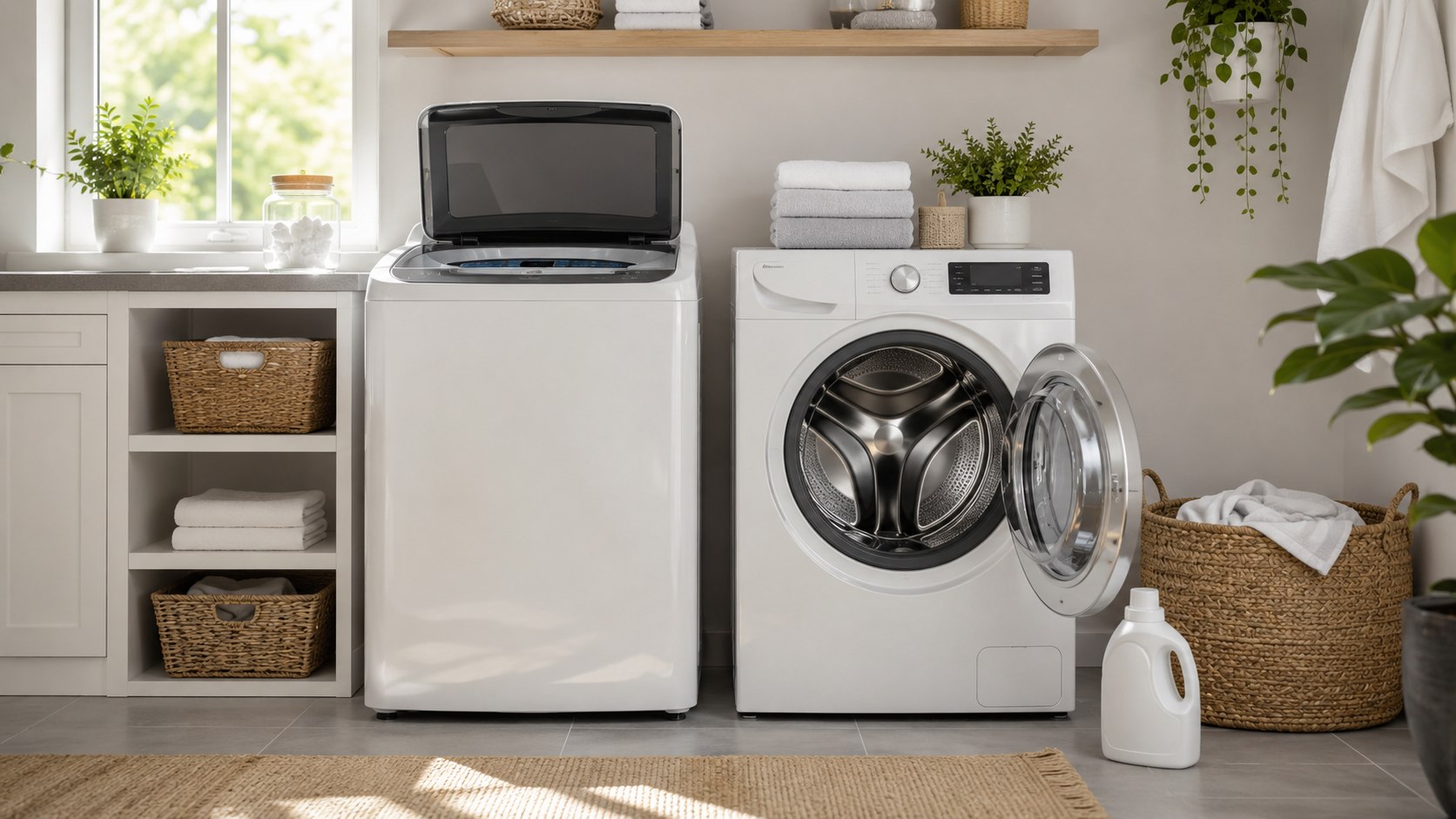
Top load vs front load washer 2026 comes down to 1 practical question: do you want lower water use and stronger stain removal, or simpler loading with less mold maintenance? Most US households should pick a front load washer for water savings and cleaning, but a top load washer is better if you hate bending, wash bulky items often, or live in a humid home where odor control is a daily fight, as noted by Baltimore Chronicle.
If mold is already your problem, the faster fix is not always buying a new machine. Clean the gasket, run a washer-clean cycle, switch to HE detergent, and leave the door or lid open after every load. If you are replacing the unit anyway, front loaders usually clean better with less water, while top loaders are easier to keep dry between cycles.
Key takeaways
- Front loaders usually win on water, energy, stain removal, and stacked laundry-room layouts.
- Top loaders usually win on comfort, faster basic cycles, odor control, and lower repair anxiety.
- For humid states like Florida, Texas, and Maryland, maintenance habits matter as much as washer type.
At a glance
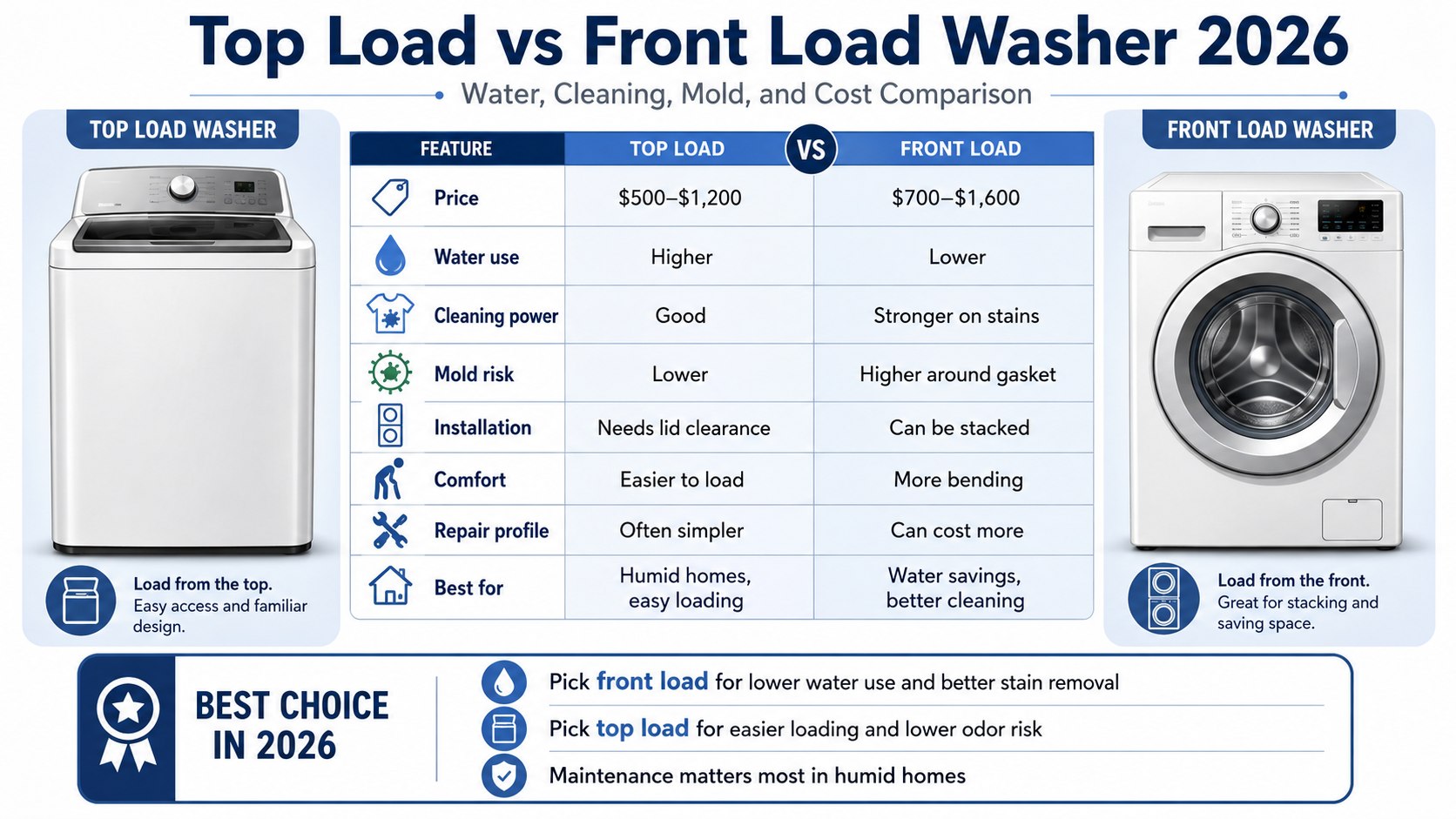
The right washer is not the “best” appliance online. It is the machine that matches your space, laundry volume, climate, budget, and tolerance for maintenance. Here is the practical comparison for US buyers in 2026.
| Factor | Front load washer | Top load washer |
|---|---|---|
| Typical 2026 price | $700–$1,600; premium LG, Samsung, GE Profile units can exceed $1,800 | $500–$1,200; large Maytag, Whirlpool, and Speed Queen models cost more |
| Water use | Usually lower, especially on full loads | Higher on many models, especially agitator designs |
| Cleaning | Strong on stains because clothes tumble through concentrated water | Good for everyday loads, weaker on deep stains in some models |
| Mold risk | Higher around gasket, drawer, and door glass | Lower because the drum dries more easily |
| Install | Can be stacked with a matching dryer | Needs overhead clearance for the lid |
| Comfort | Requires bending unless placed on a pedestal | Easier for many adults to load from standing height |
| Repair profile | Door seals, pumps, and electronics can raise costs | Often simpler, especially non-smart models |
| Best climate fit | Great in dry homes with good ventilation | Better for damp laundry rooms and humid climates |
Use this comparison as a screening tool, not a final verdict. A cheap front loader with poor drainage can smell worse than an excellent top loader. A modern HE top loader can also use far less water than an old agitator machine.
Before buying, check the yellow FTC EnergyGuide label. It shows estimated annual energy use and operating cost. That figure is not your exact bill, because California electricity and Texas electricity may cost different amounts.
If your current appliance is already old, read Baltimore Chronicle’s guide on how long washing machines last in 2026 before paying for another repair visit. The decision changes when a washer is near the end of its expected life and the repair bill approaches the cost of a replacement.
Top load vs front load washer 2026: water, cleaning, and mold
For water and cleaning, the front loader has the technical advantage. It does not need to fill a deep tub. The drum rotates sideways, lifting clothes and dropping them through a smaller pool of water. That action gives detergent more contact with fabric.
A high-efficiency top loader also saves water compared with older machines. The gap becomes larger when comparing a front loader with a traditional top loader that has a central agitator. US households with kids, sports gear, towels, pet bedding, or work clothes will usually notice the cleaning difference first.
Mold changes the argument. Front loaders trap moisture in the rubber gasket, detergent drawer, and door area. In Maryland basements, Florida laundry closets, and Gulf Coast homes, that trapped moisture can turn into odor fast.
Top loaders have fewer hidden wet zones. The lid opens upward, and the drum tends to breathe better. That does not make them maintenance-free, but it makes odor prevention easier for busy households.
Front load washer: pros, cons, and ideal user
A front load washing machine is the better choice when water savings, stain removal, and fabric care matter most. It is also the natural pick for apartments, condos, and narrow laundry rooms because many models are stackable.
Brands such as LG, Samsung, GE Profile, Whirlpool, and Electrolux offer 4.5–5.5 cu ft front loaders in the US market. As of 2026, expect many mainstream models to sit around $800–$1,400 before delivery, hoses, pedestals, or installation.
Pros
- Uses less water on many cycles than comparable top loaders.
- Cleans stains well because clothes tumble through concentrated detergent.
- Spins fast, so towels and jeans enter the dryer less wet.
- Can be stacked under a matching dryer in small spaces.
- Often gentler on fabrics than agitator machines.
Those strengths matter for families that run 5 or more loads weekly. A faster spin can also reduce dryer time, which helps in apartments with ventless dryers. In cities such as Baltimore, Chicago, Boston, and New York, stacked laundry can save valuable floor space.
The trade-off is maintenance. You must wipe the gasket, leave the door cracked, and avoid detergent overload. Too much soap creates residue, and residue feeds odor.
Cons
- Higher mold and mildew risk around the door gasket.
- More bending unless you buy a pedestal.
- Some repairs cost more because of electronics and door-seal parts.
- Cycle times can feel long on eco settings.
The ideal buyer is a homeowner or renter who wants lower water use and stronger cleaning. It also fits people who can follow a simple maintenance routine. If nobody in the home will leave the door open, think twice.
Top load washer: pros, cons, and ideal user
A top load washer is the practical choice for people who value easy loading, familiar controls, and lower odor risk. It can be a better fit for older adults, tall users, and households that wash bulky blankets often.
In 2026, basic top load washers commonly start near $500–$700. Larger HE models from Whirlpool, Maytag, LG, Samsung, GE Appliances, and Speed Queen can reach $1,000–$1,500. The final price depends on capacity, agitator design, smart features, and delivery fees.
Pros
- Easier to load without bending deeply.
- Lower mold risk because the lid and drum dry faster.
- Simple models can be cheaper to buy and repair.
- Many cycles feel quicker for everyday laundry.
- Good access for adding forgotten socks or towels.
Top loaders split into 2 types. Agitator models use a central post that moves clothes through water. Impeller models use a low-profile plate and usually create more usable drum space.
For cleaning, agitators can be rougher on fabrics. Impeller models are gentler but may require careful loading. If sheets twist into ropes, use the bulky cycle and avoid packing the drum tightly.
Cons
- Some models use more water than front loaders.
- Deep tubs can be hard to unload for shorter adults.
- Agitators can wear fabrics faster.
- Not stackable with a dryer.
The ideal buyer wants a dependable family washer with fewer smell problems. It is also a strong choice for garages, utility rooms, and humid homes where airflow is limited. For heavy stain removal, choose a quality HE top loader and use the right cycle.
Real 2026 costs: washer price, installation, and long-term use
The sticker price is only part of the cost. A washer purchase can include delivery, old-appliance haul-away, water hoses, stacking kits, pedestals, and installation. In many US stores, those add-ons can push the final bill $100–$400 higher.
Front loaders often cost more upfront. They may pay back part of that difference through lower water use and shorter drying time. The payback is strongest in homes with high water rates, electric water heating, or frequent laundry.
Top loaders are more attractive when the budget is tight. They also make sense when the home already has a working dryer and no need for stacking. A simple top loader without unnecessary smart features can be a rational 2026 purchase.
Check rebates before buying. Some utilities and state programs may offer efficiency incentives for ENERGY STAR models. Availability changes by ZIP code, so verify with your utility or the ENERGY STAR clothes washer product page.
For households replacing several major appliances at once, Baltimore Chronicle’s review of best refrigerator brands in 2026 is useful for comparing brand support, energy labels, and long-term value beyond the laundry room.
How to prevent washer mold and laundry odor
Mold is usually a habit problem before it becomes a hardware problem. The washer stays wet, detergent residue builds, and warm air does the rest. This is why 2 households can own the same model and have different odor experiences.
Use this checklist with either washer type:
- Leave the door or lid open after each load.
- Use HE detergent in the measured amount, not a full cap.
- Remove wet laundry within 30 minutes when possible.
- Run a cleaning cycle every month, or more often in humid homes.
- Wipe the front-loader gasket after towel and pet-bedding loads.
- Clean the detergent drawer and filter area on schedule.
- Do not overload the drum, because trapped fabric rinses poorly.
- Use hot water occasionally for towels, cleaning cloths, and whites.
After a list like this, the key is consistency. A front loader can stay fresh for years with simple drying habits. A top loader can also smell if the lid stays closed and detergent is overused.
If the machine already smells, start with a washer-cleaning tablet or manufacturer-approved cleaner. Then clean the drawer, gasket, lid area, and drain filter. If black residue returns quickly, check drainage and stop using fabric softener for several weeks.
Ventilation also matters. A washer in a closed hallway closet behaves differently from one in a dry utility room. If the room has no window or fan, leave the machine open longer and avoid storing damp towels nearby.
Which should you buy in 2026
This decision tree gives a clean answer for most US homes. Match the washer to the problem you actually have, not the feature list on the sales page.
- If your priority is lower water use and better stain removal, choose a front load washer.
- If your laundry room is humid or poorly ventilated, choose a top load washer or commit to gasket care.
- If you need to stack appliances, choose a front loader with a matching dryer kit.
- If bending is painful, choose a top loader or budget for a front-loader pedestal.
- If you wash comforters often, compare drum depth, capacity, and bulky-cycle reviews before buying.
The safest 2026 recommendation is narrow. Choose a front loader if you will maintain it. Choose a top loader if you want lower daily friction. For renters, the simpler top loader often wins because moving and repairs are less predictable.
For homeowners planning a laundry-room upgrade, a front-loader pair can be worth it. It can reduce water use and free vertical space. For parents with muddy sports uniforms, front-load cleaning power is hard to ignore.
If the washer purchase is part of a wider remodel, review Baltimore Chronicle’s guide to kitchen remodel costs in the USA in 2026. Appliance budgets often change once cabinets, plumbing, electrical work, delivery fees, and installation are counted together.
FAQ
Is a front load washer better than a top load washer in 2026?
Yes, if water savings, cleaning performance, and stackable installation matter most. No, if you want easier loading and less mold maintenance.
Do front load washers always get mold?
No. Mold usually appears when the door stays closed, detergent is overused, or the gasket stays wet. Good habits prevent most odor issues.
Are top load washers cheaper to repair?
Often, yes. Simple top loaders may have fewer expensive door-seal and stacking-related parts. Smart models can still become costly.
Which washer uses less water?
Front loaders usually use less water than traditional top loaders. High-efficiency top loaders can narrow the gap, especially impeller models.
What capacity should a US family buy?
Most families should compare models around 4.5–5.5 cu ft. Larger households need capacity, but overloading reduces cleaning quality.
Should I buy an agitator or impeller top loader?
Choose an agitator for familiar washing and tough basic loads. Choose an impeller for more usable space and gentler fabric care.
Earlier we wrote about How to Find My iPhone When Offline 2026: Find My Network Steps That Actually Matter