


How to claim child tax credit 2026 USA is a practical question for parents who want to know the amount, the refundable part, and the exact filing steps before they submit Form 1040. For the 2026 filing season, many families can claim up to $2,200 per qualifying child for tax year 2025, with up to $1,700 potentially refundable through the Additional Child Tax Credit, as noted by Baltimore Chronicle.
This guide shows what to check, what documents to gather, and how to avoid mistakes that can delay a refund. Most parents can review eligibility in 20–30 minutes, then claim the credit when filing federal taxes online or with a preparer.
The key point is simple: the Child Tax Credit can reduce federal tax owed, while the Additional Child Tax Credit may create a refund when the credit is larger than the tax bill.
Key takeaways
- Child Tax Credit 2026 filing generally means claiming the 2025 credit on a 2026 federal return.
- The maximum credit is up to $2,200 per qualifying child, but income and eligibility rules matter.
- The refundable portion, called Additional Child Tax Credit, can be worth up to $1,700 per child.
These figures are federal rules. States such as California, New York, Colorado, Minnesota, and Vermont may have separate family credits, but they do not replace the IRS claim. Check state revenue websites before filing, especially if you moved during 2025.
What you need before you claim the Child Tax Credit in 2026
Before opening TurboTax, H&R Block, TaxAct, Free File, or a CPA portal, gather the documents that prove income, identity, and dependency. Missing one Social Security number or custody detail can turn a normal refund into a review case.
You will need:
- Form W-2, 1099-NEC, 1099-K, or self-employment income records.
- Social Security numbers for the taxpayer, spouse if filing jointly, and each qualifying child.
- Birth certificates, adoption papers, school records, medical records, or custody documents.
- IRS Online Account access, if you want to check prior returns or notices.
- Bank routing and account numbers for direct deposit.
- About $0 if using IRS Free File, or a typical $50–$250 range for consumer tax software or basic paid preparation.
This list is short, but it prevents the most common filing problems. Parents who rent, drive for gig apps, freelance, or run a small business should also keep mileage logs and expense records. Those records do not prove CTC eligibility, but they affect adjusted gross income. A lower or higher AGI can change how much credit survives the phaseout.
Parents who want to keep filing costs low should compare free federal filing options before paying for commercial software. Baltimore Chronicle has a practical guide on how to file taxes for free in USA 2026, including IRS Free File, VITA, TCE, MilTax, and Free File Fillable Forms.
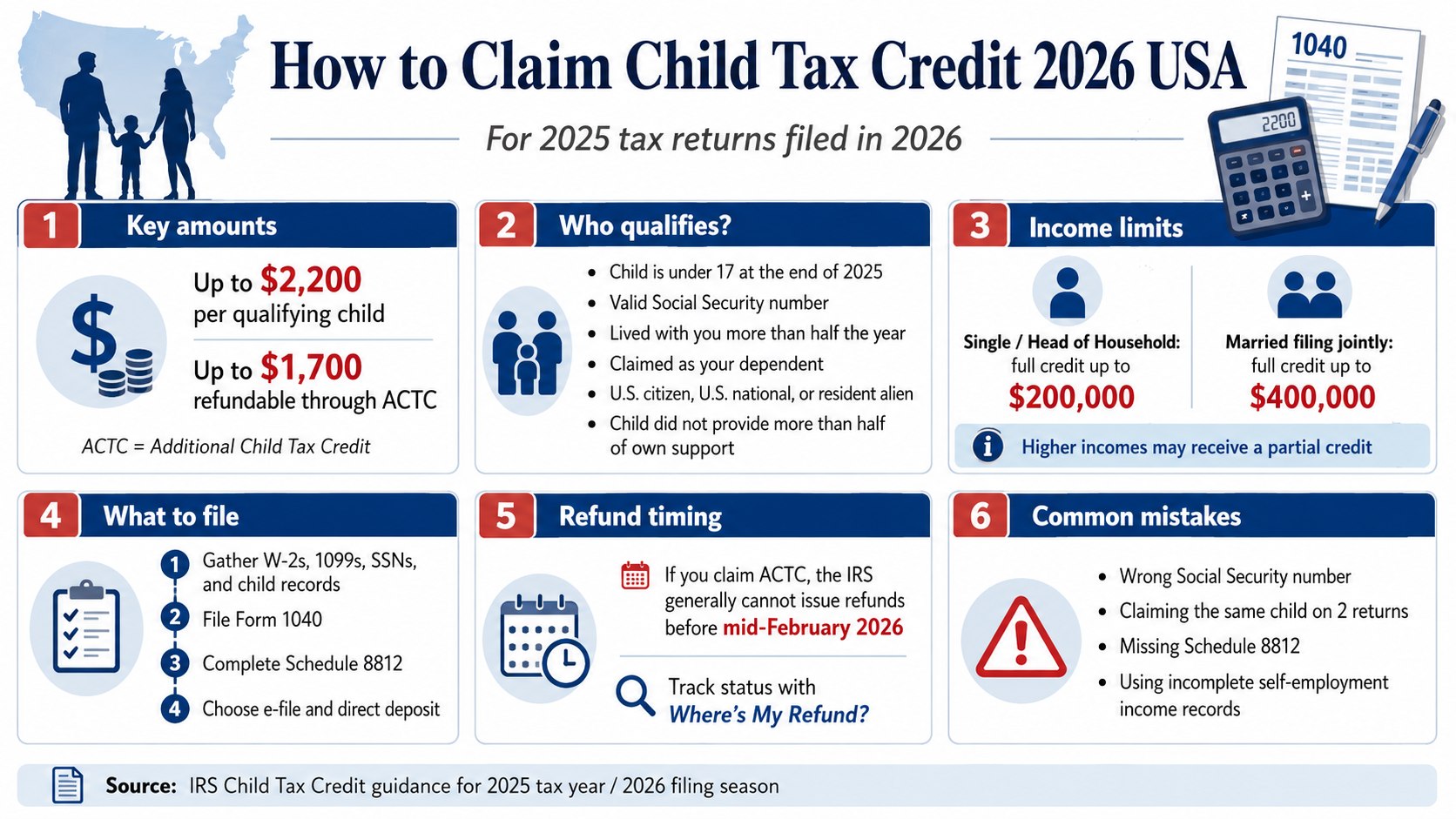
Step 1: Confirm the child qualifies under IRS rules
Start by checking age, relationship, residency, support, dependency, and citizenship rules. A qualifying child for the federal CTC must generally be under age 17 at the end of the tax year and claimed as your dependent.
Why it matters: the IRS does not approve the credit only because a child lives in your household. The child must meet the full test.
Common mistake to avoid: claiming a child who lived with another parent for most of the year without reviewing custody rules, Form 8332, or divorce documents. This is where many duplicate claims happen.
Step 2: Check the 2026 Child Tax Credit amount and refundable part
The federal credit for the 2026 filing season can be up to $2,200 per qualifying child for tax year 2025. The refundable child tax credit part is the Additional Child Tax Credit, which can be worth up to $1,700 per qualifying child.
Why it matters: “up to” does serious work here. The final number depends on income, tax liability, earned income, filing status, and whether the child meets every requirement.
Common mistake to avoid: expecting the full $2,200 as a cash refund. A portion reduces tax owed first, while only the ACTC portion may be refundable.
| Item | 2026 filing season reference | What it means for parents |
|---|---|---|
| Maximum CTC | Up to $2,200 per qualifying child | Can lower federal income tax owed |
| Refundable ACTC | Up to $1,700 per qualifying child | May increase the refund if eligible |
| Income phaseout | Starts above $200,000 single or $400,000 married filing jointly | Higher-income households may receive less |
| Required form | Form 1040 plus Schedule 8812 | Used to calculate CTC, ODC, and ACTC |
The numbers above are the practical starting point, not a guarantee. A married couple in Maryland with 2 qualifying children and moderate income may see a larger benefit than a high-income single filer in California. A freelancer in Texas may need clean business records before the software calculates the credit correctly. A parent in New York with no federal tax due may still care about the refundable ACTC.
Families should also separate federal credits from state-level benefits. A state child tax credit, renter credit, property tax rebate, or earned income credit may have different income limits and deadlines. That is why the federal Schedule 8812 result should not be treated as the full household tax picture.
Step 3: Estimate income before filing
Add wages, self-employment profit, taxable unemployment, investment income, and other taxable income before you file. The credit begins to phase out once modified adjusted gross income is above the federal threshold.
Why it matters: income can decide whether you receive the full CTC, a reduced credit, or only part of the benefit. For freelancers, business deductions can change the result.
Common mistake to avoid: using gross app income from DoorDash, Uber, Etsy, or PayPal as if it were final taxable income. Expenses, forms, and records matter.
Step 4: Use Schedule 8812 when filing Form 1040
Schedule 8812 is the IRS form used to calculate the Child Tax Credit, Credit for Other Dependents, and Additional Child Tax Credit. Most major tax software brands add it automatically when you enter dependents.
Why it matters: this schedule is where the additional child tax credit 2026 calculation appears. If the schedule is missing, the refund may be wrong.
Common mistake to avoid: rushing through dependent screens and skipping questions about residency, support, and Social Security numbers. Software can only calculate what you enter.
Step 5: File electronically and choose direct deposit
File electronically when possible, then choose direct deposit into a checking or savings account. Paper returns take longer and are easier to delay if handwriting, names, or numbers do not match IRS records.
Why it matters: refunds involving ACTC can be held under anti-fraud rules, even when the return is correct. E-filing reduces avoidable friction.
Common mistake to avoid: entering an old routing number or a closed account. If the bank rejects the deposit, the IRS may issue a paper check.
Timing also matters because the Child Tax Credit and Additional Child Tax Credit are claimed on the annual federal return. For deadline planning, see Baltimore Chronicle’s breakdown of when taxes are due in 2026 USA, including the April 15 federal deadline and the October extension date.
Step 6: Track the refund and keep proof for 3 years
After filing, use the IRS “Where’s My Refund?” tool or your tax software account to monitor status. Keep the return, Schedule 8812, W-2s, 1099s, custody records, and school records for at least 3 years.
Why it matters: the IRS can ask questions later, especially when the same child is claimed on another return. Good records make a response faster and less stressful.
Common mistake to avoid: deleting PDFs after the refund arrives. Parents who move, separate, or change filing status often need older records later.

How to claim Child Tax Credit 2026 USA if you are divorced, self-employed, or low income
Divorced or separated parents should decide who has the legal right to claim the child before filing. The IRS usually looks at where the child lived for more than half the year, but release forms and court agreements can change the filing result.
Self-employed parents should focus on net earnings, not payment app totals. A rideshare driver in Florida, a home daycare operator in Ohio, or an Etsy seller in Oregon may need receipts, mileage logs, and bank statements before the ACTC calculation is reliable.
Low-income parents should not assume they are excluded. The refundable part exists for families whose credit exceeds tax owed, but earned income rules still apply. Parents may also qualify for the Earned Income Tax Credit, which is separate from the CTC and can be more valuable for some households.
Troubleshooting: what can delay or reduce your Child Tax Credit
Most problems come from mismatched records, duplicate dependent claims, or wrong income entries. Review these issues before submitting the return.
- Another parent already claimed the child: wait for an IRS notice and prepare custody or residency documents.
- Wrong Social Security number: correct the dependent information before filing, not after rejection.
- Child turned 17 during the tax year: check whether the child still qualifies for another dependent credit.
- Self-employment income looks too high or too low: review 1099-K, 1099-NEC, receipts, and expenses.
- Refund is delayed: ACTC refunds can take longer because of federal fraud-prevention rules.
A delay does not always mean the claim is denied. It may mean the IRS needs extra time to match wage data or dependent records. Do not file a second return unless the IRS or a qualified tax professional tells you to do so. If you receive a notice, answer by the deadline and send only requested documents.
If your W-2, 1099, custody paperwork, or dependent records are not ready by the filing deadline, do not guess on the return. Baltimore Chronicle explains how to file a tax extension 2026 and why Form 4868 gives more time to file, not more time to pay.
FAQ
How much is the Child Tax Credit for 2026 in the USA?
For the 2026 filing season, the federal Child Tax Credit can be up to $2,200 per qualifying child for tax year 2025. The final amount depends on income, filing status, tax liability, and the child’s eligibility.
Is the Child Tax Credit refundable in 2026?
Part of it may be refundable through the Additional Child Tax Credit. For tax year 2025 returns filed in 2026, up to $1,700 per qualifying child may be refundable if the household meets the rules.
What form do I need to claim the Child Tax Credit?
You claim it on Form 1040 and calculate it on Schedule 8812. Tax software normally prepares Schedule 8812 after you enter dependent and income details.
Can I claim the Child Tax Credit if I am self-employed?
Yes, self-employed parents can claim it if they meet the same child and income rules. They should keep accurate records for 1099 income, business expenses, and net earnings.
Can both parents claim the same child?
No, the same child generally cannot be used by 2 taxpayers for the same federal credit. Divorced or separated parents should review custody rules and any signed release before filing.
Earlier we wrote about Front Load or Top Load Washer in 2026? Mold, Price, Water Use, and Real Buyer Trade-Offs