


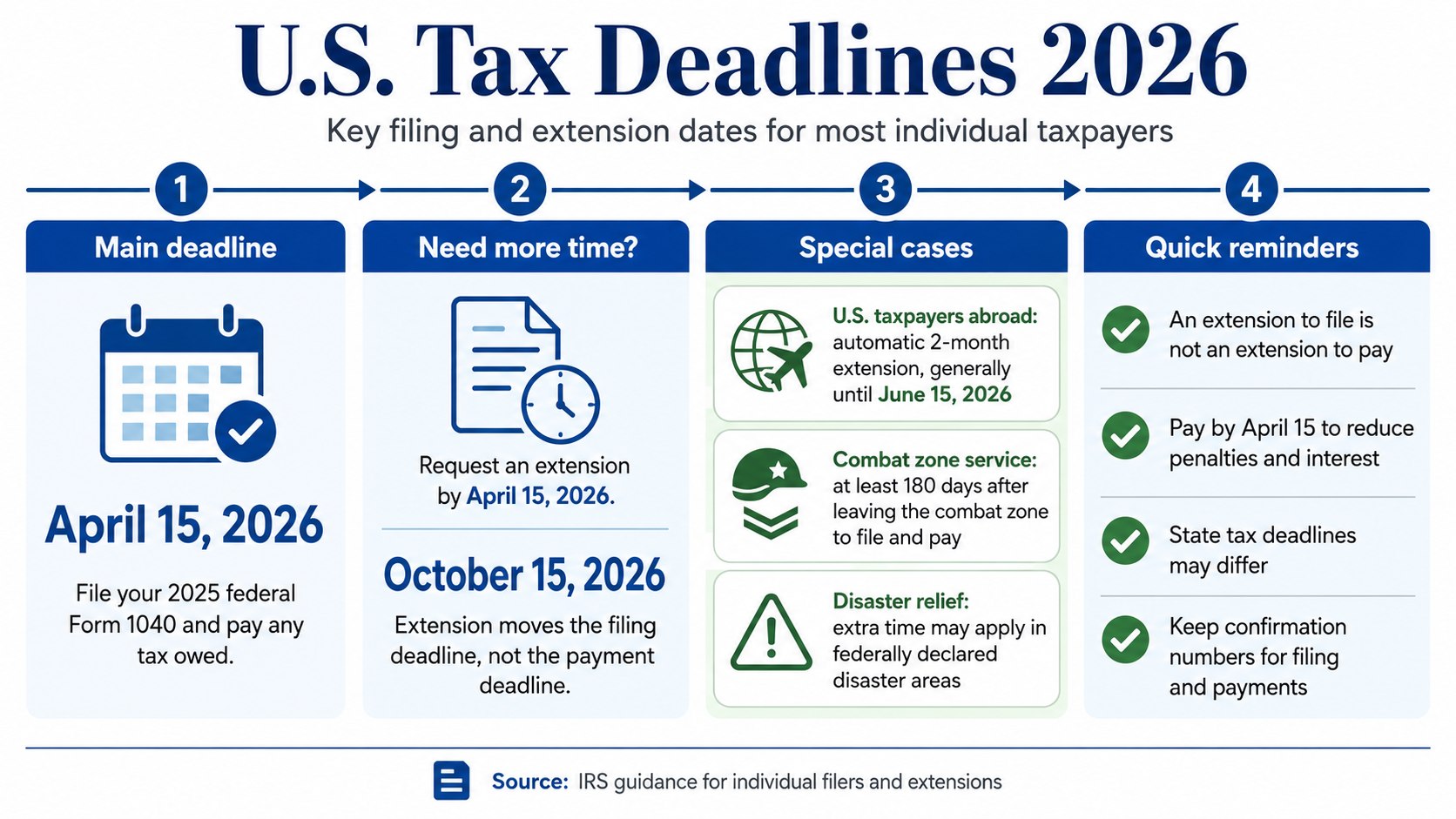
The headline answer: for most people asking when are taxes due in 2026 usa, the federal deadline is Wednesday, April 15, 2026. That is the date to file a 2025 Form 1040 and pay any federal income tax owed. If the return is not ready, request an extension by April 15, 2026, and the filing deadline moves to October 15, 2026, аs noted by Baltimore Chronicle.
An extension gives more time to file paperwork, not more time to pay. A homeowner waiting on Form 1098, a renter with several W-2s, a parent claiming credits, or a freelancer sorting 1099 income should still estimate the balance and pay by April 15 to reduce penalties and interest. The IRS explains the federal deadline and extension rules on its When to file page.
Key takeaways
- Most individual federal tax returns for tax year 2025 are due Wednesday, April 15, 2026.
- A federal extension must be requested by April 15, 2026, and generally moves filing to October 15, 2026.
- State deadlines can differ, so residents in California, New York, Texas, Florida, Illinois, and other states should verify locally.
Calendar at a glance
The 2026 tax calendar has two dates that matter most for individuals: April 15 for filing and paying, and October 15 for extended filing. Freelancers, landlords, gig workers, and retirees with investment income may also need estimated tax payments during the year.
| Month in 2026 | What to do | Who should pay attention |
|---|---|---|
| January | Gather W-2s, 1099s, mortgage interest statements, childcare records, and investment forms. | Employees, parents, homeowners, renters, investors |
| February | Compare documents against bank records and payroll portals before filing. | Workers with multiple jobs, freelancers, retirees |
| March | Prepare the return or schedule time with a tax professional before the April rush. | Itemizers, landlords, small-business owners |
| April | File and pay by April 15, 2026, or request a federal extension by that date. | Most individual taxpayers |
| June | Some taxpayers abroad and military members outside the United States may have automatic extra filing time. | U.S. citizens abroad, some military households |
| October | Extended federal individual returns are generally due October 15, 2026. | Taxpayers who filed Form 4868 or paid online as an extension request |
For broader household planning, related personal finance timing issues can overlap with tax season. A family comparing refund timing with regular bills may also want a practical guide on how to create a personal budget and save money, while a driver using gig apps should keep vehicle records separate from ordinary commuting expenses.
When are taxes due in 2026 USA for federal returns?
The main 2026 federal tax deadline for calendar-year individual filers is April 15, 2026. That date applies to most Form 1040 filers reporting 2025 income from wages, self-employment, interest, dividends, retirement distributions, rental income, and capital gains.
The deadline covers two separate actions: the return itself is due, and any tax still owed is due. Filing late and paying late are different problems, and the penalties can stack when a taxpayer owes money and misses both duties.
For mailed returns, the IRS generally treats a return as filed on time if it is properly addressed, has enough postage, and is postmarked by the deadline. E-filing is usually cleaner because the taxpayer receives an electronic acceptance or rejection notice.
The most practical move is to file electronically and pay electronically when possible. IRS Direct Pay, an IRS Online Account, debit card, credit card, digital wallet, and the Electronic Federal Tax Payment System are among federal payment options. Card processors may charge fees, so a bank-account payment is often the lower-cost route.
Taxpayers with simple returns should also compare free filing routes before paying for software. Baltimore Chronicle has a separate guide on how to file taxes for free in USA 2026, which fits workers with W-2 income, students, renters, and retirees who meet eligibility rules.
How tax extensions work in 2026
A tax extension 2026 request generally moves the federal filing deadline to October 15, 2026. It does not delay the tax payment deadline. The IRS states that taxpayers who need more time must request the extension by April 15, 2026, and should pay the estimated balance by that same April date through its extension guidance.
Taxpayers usually request the extension in one of four ways:
- File Form 4868 electronically through tax software or IRS Free File Fillable Forms.
- Mail Form 4868 to the proper IRS address listed in the form instructions.
- Make an online IRS payment and select “extension” as the reason for payment.
- Work with a tax preparer who submits the extension request before the deadline.
TurboTax, H&R Block, TaxAct, FreeTaxUSA, and Jackson Hewitt are familiar brand names in consumer tax filing, but pricing changes by return complexity and promotion. As of 2026, a simple federal return may be free through some options, while paid online packages for self-employment, investments, or rental income commonly run from under $50 to well over $100 before state filing fees.
The right question is not which brand is loudest in March, but which one supports the forms actually needed.
An extension is useful when documents are missing or the return needs review. It is not a strategy for delaying a known tax bill.

Why timing matters
Timing matters because the April 15 date affects money, records, and choices. A taxpayer who knows the deadline early can avoid rushed estimates, missed forms, and expensive last-minute filing decisions.
1. Late payment can add avoidable costs
If tax is owed, paying after April 15 can trigger interest and possible penalties. The exact amount depends on the balance, timing, and IRS rules in effect. A partial payment by the deadline can still reduce the balance on which charges accrue.
2. Missing documents can delay a clean return
A parent may need childcare provider information, a homeowner may need Form 1098 for mortgage interest, and a freelancer may need 1099-K or 1099-NEC forms from platforms and clients. Filing before those records are complete can lead to an amended return.
3. State returns may need separate action
The IRS deadline does not automatically settle state obligations. California, New York, Massachusetts, Maryland, Pennsylvania, Illinois, and many other states have their own revenue agencies and extension rules. Texas and Florida do not have state individual income tax, but residents may still have federal filing duties and business tax issues.
Households comparing state rules with monthly bills may find it useful to connect tax timing with broader financial habits, including Baltimore Chronicle’s guide on how to avoid the most common financial mistakes, especially when a refund is expected to cover insurance, childcare, debt payments, or a car repair.
Federal deadline vs state deadline
The IRS tax due date 2026 is national, but state filing dates can follow different rules. Some states automatically accept a federal extension for filing, while others require a separate state extension, a state payment voucher, or a payment by the original deadline.
| Issue | Federal return | State return |
|---|---|---|
| Main agency | Internal Revenue Service | State tax or revenue department |
| Typical 2026 individual deadline | April 15, 2026 | Often April 15, but not always |
| Extension effect | Usually moves filing to October 15, 2026 | Depends on state law and payment rules |
| Payment deadline | April 15, 2026 for most taxpayers | Usually original state due date |
| Common taxpayer mistake | Thinking an extension delays payment | Assuming the federal extension covers the state return |
A New York resident with W-2 income, a California freelancer with estimated taxes, and a Maryland homeowner claiming deductions can face different state paperwork even when the federal Form 1040 deadline is the same. Taxpayers who moved during 2025 may also need part-year resident returns in more than one state.
Who should file early and who should consider an extension?
Early filing is best when records are complete and the return is straightforward. A W-2 employee with standard deduction, no major investment sales, and no missing dependent information can usually file once wage and bank forms are ready.
An extension can make sense when the return is accurate but unfinished. That includes a freelancer waiting on corrected 1099 forms, a landlord reconciling repairs and depreciation, a divorced parent confirming dependent claims, or an investor waiting for final brokerage documents from Charles Schwab, Fidelity, Vanguard, Robinhood, or E*TRADE.
The most common April 15 tax deadline mistake is filing a guess just to be done. A wrong return can create IRS notices, delayed refunds, amended filings, and state mismatches. If a taxpayer expects to owe, filing an extension and paying a reasonable estimate can be safer than rushing an incomplete return.
For self-employed workers, tax timing also connects to quarterly planning. A driver, contractor, designer, consultant, or online seller may need a system for mileage, home office records, supplies, health insurance, and retirement contributions.
Edge cases in 2026
Most taxpayers can plan around April 15 and October 15, but several groups should use a more precise calendar. These cases often involve automatic extensions, disaster relief, or non-calendar-year filing.
U.S. citizens and resident aliens abroad
U.S. citizens and resident aliens living and working outside the United States and Puerto Rico may receive an automatic two-month filing extension, generally to June 15, 2026. Interest can still apply to tax paid after April 15, 2026. This rule matters for remote workers, military spouses, retirees abroad, and dual-status households.
Military service and combat zones
Some military taxpayers receive extra time under special IRS rules. Taxpayers serving in combat zones generally have at least 180 days after leaving the combat zone to file and pay. Military families should keep deployment records, orders, and correspondence with the Department of Defense or IRS in one file.
Federally declared disasters
Taxpayers in federally declared disaster areas may receive postponed filing and payment deadlines. These dates are not uniform nationwide. A storm, wildfire, flood, or hurricane relief announcement can apply to specific counties in states such as Florida, Texas, California, Louisiana, or North Carolina, while the standard April 15, 2026 deadline remains in place elsewhere.
2026 tax filing checklist
A clean file reduces the risk of paying for the wrong software tier, missing a deduction, or rushing into an extension that does not solve the real issue. Use this checklist before deciding whether to file, extend, or pay an estimate.
- Confirm every W-2 from employers and every 1099 from banks, apps, clients, and brokerages.
- Download mortgage interest, property tax, rent, childcare, student loan, and education records where relevant.
- Check IRS Online Account for payments already made and prior-year balances.
- Reconcile estimated payments made in 2025 and early 2026.
- Review state residency if the household moved during 2025.
- Estimate the federal balance due before requesting an extension.
- Keep confirmation numbers for e-filed returns, extension requests, and IRS payments.
- Store a final PDF copy of the filed federal and state returns.
Taxpayers expecting a refund usually want to file once the return is ready because an extension only delays access to that money. Taxpayers expecting to owe should prioritize payment accuracy and confirmation records.
For households deciding where to keep emergency cash before and after tax season, Baltimore Chronicle’s guide to high-yield savings accounts in 2026 explains how savings rates can affect short-term money planning.
FAQ
When is the 2026 tax filing deadline for most people?
The 2026 tax filing deadline for most individual federal tax returns is Wednesday, April 15, 2026. That is the deadline to file a 2025 Form 1040 and pay federal income tax owed unless a special rule applies.
Does a tax extension give me until October 15 to pay?
No. A federal extension generally gives until October 15, 2026 to file the return, not to pay the tax. The payment deadline remains April 15, 2026 for most taxpayers.
What if I cannot pay the full tax bill by April 15?
File the return or request an extension anyway, then pay as much as possible by April 15, 2026. The IRS offers payment plans, but interest and possible penalties can still apply until the balance is paid.
Are state taxes due on the same date as federal taxes?
Often, but not always. Many states use April 15 as the individual income tax deadline, but state extension and payment rules vary. Residents should check the revenue agency for their state.
What happens if I miss the April 15, 2026 deadline?
File as soon as possible and pay as much as possible. If a refund is due, late-filing penalties may not apply in the same way, but waiting can delay the refund and create recordkeeping problems.
Should I file early or wait until April?
File early when all forms are complete and accurate. Wait or request an extension when key records are missing, a corrected 1099 is expected, or a complex return needs more review.
Earlier we wrote about How to File Taxes for Free in USA 2026: IRS Free File, Direct File Alternatives, and No-Cost Tax Help