


Learning how to file a tax extension 2026 takes about 10 to 20 minutes if you have your Social Security number, estimated income, withholding, and payment information ready. The practical fix is simple: file IRS Form 4868 or make an electronic extension payment by April 15, 2026, then finish the full return by October 15, 2026, аs noted by Baltimore Chronicle.
A federal extension gives more time to file the paperwork, not more time to pay. If you expect to owe, estimate the balance and pay as much as you can by the April deadline to reduce penalties and interest. The IRS says taxpayers can request the extension online, through tax software, by IRS Free File, or by mailing Form 4868.
For taxpayers comparing dates before filing, Baltimore Chronicle has a separate guide to the 2026 federal tax deadline and extension calendar, including the April and October dates that matter most for individual returns.
Key takeaways
- A 2026 extension moves the federal filing deadline to October 15, 2026, for most calendar-year taxpayers.
- Form 4868 does not delay payment; tax owed for 2025 is still due April 15, 2026.
- An electronic extension payment can count as the extension request when marked correctly with the IRS.
What You Need Before You File
Most people can request a federal extension without finishing their full Form 1040. The harder part is making a reasonable payment estimate, especially for freelancers, homeowners with deductible mortgage interest, parents claiming credits, and people who changed jobs in 2025.
You should have:
- Social Security number or Individual Taxpayer Identification Number for each filer.
- 2025 W-2 forms, 1099-NEC, 1099-K, 1099-INT, 1099-DIV, or brokerage tax forms already received.
- Estimated business income and expenses for freelancers, gig workers, and sole proprietors.
- Federal withholding totals and 2025 estimated tax payments already made.
- Bank account, debit card, credit card, or digital wallet access if making a payment.
- About 10 to 20 minutes for a straightforward extension; longer if income records are incomplete.
- Money for any estimated balance due; IRS Direct Pay has no IRS fee, while card processors charge fees.
Tax software brands such as TurboTax, H&R Block, TaxAct, and FreeTaxUSA typically support extension filing, but the IRS Free File extension option is available regardless of income. Taxpayers who want to compare no-cost filing routes before choosing software can use Baltimore Chronicle’s overview of how to file taxes for free in the USA in 2026.
A state extension may require a separate step in California, New York, Maryland, Texas, Florida, or any other state where the taxpayer has filing obligations.
How to File a Tax Extension 2026 With Form 4868
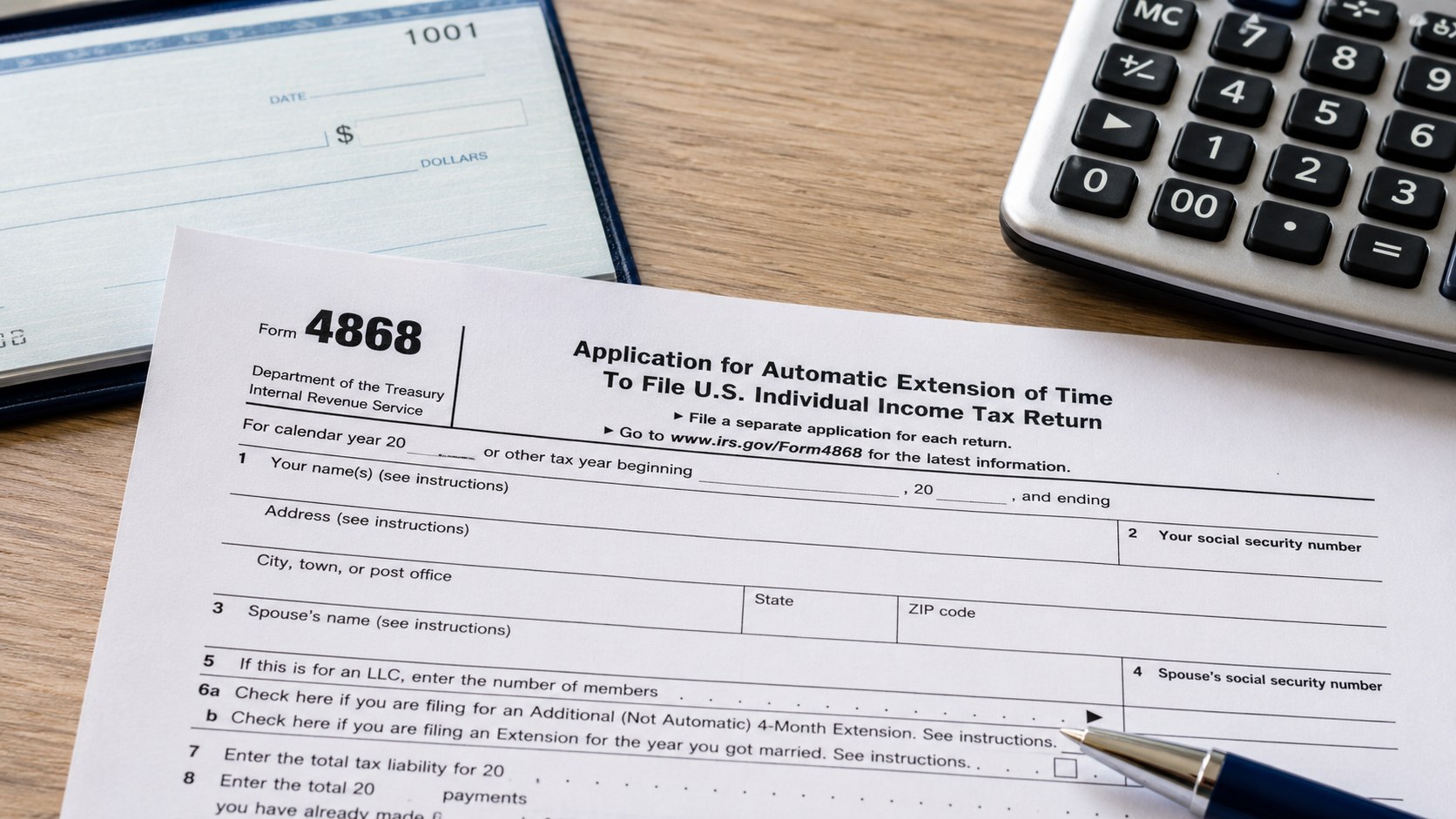
IRS Form 4868 is the Application for Automatic Extension of Time To File U.S. Individual Income Tax Return. It is used by individuals who need six more months to file Form 1040, Form 1040-SR, Form 1040-NR, or related individual returns.
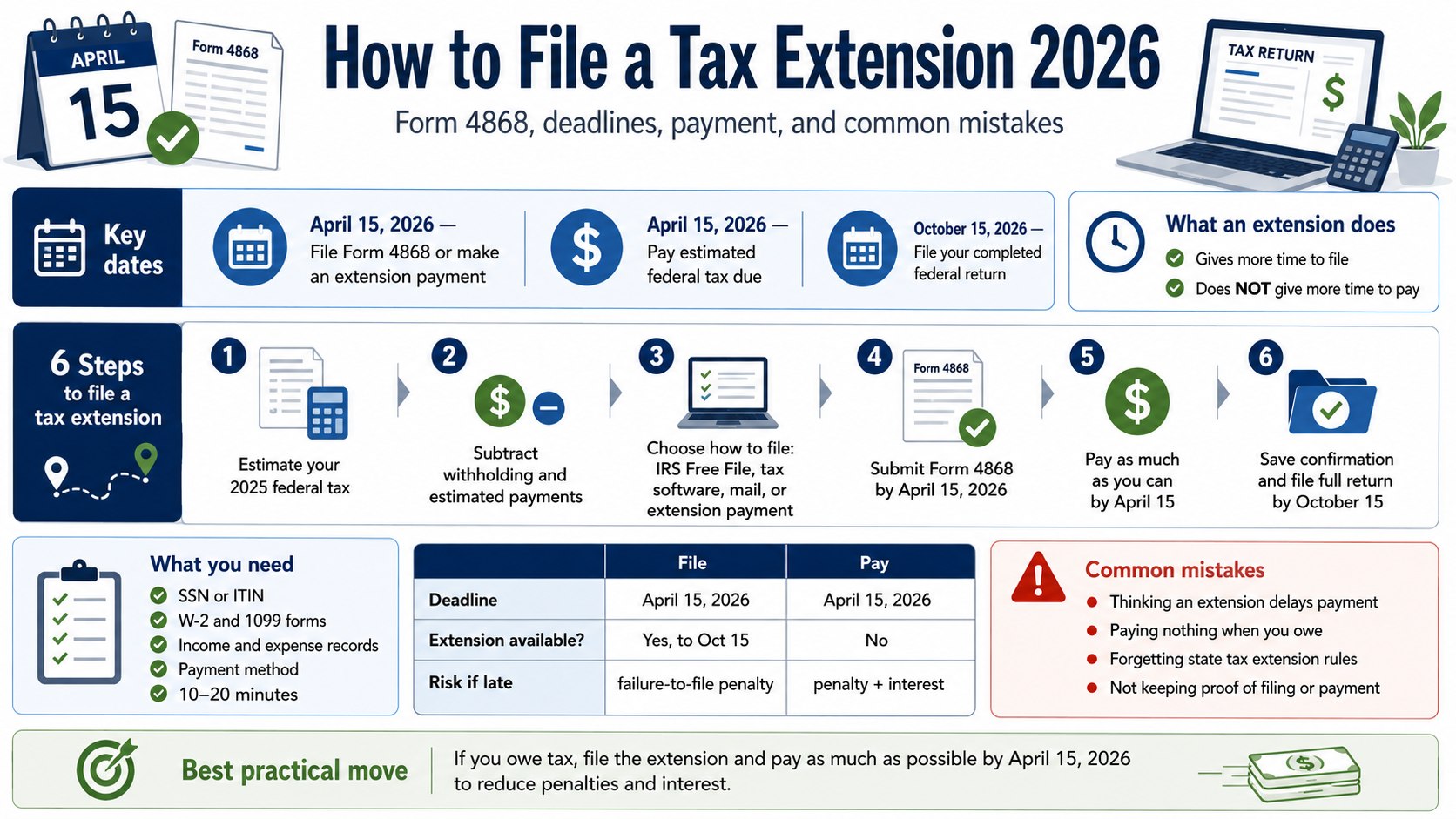
The 2026 federal deadline for most taxpayers is Wednesday, April 15, 2026. A properly filed extension generally moves the filing deadline to Thursday, October 15, 2026, but payment is still due April 15. The IRS also allows taxpayers to get an extension by making an electronic payment and selecting extension as the payment reason.
| Task | 2026 federal deadline | What it does |
|---|---|---|
| File Form 4868 | April 15, 2026 | Requests more time to file the return. |
| Pay estimated federal tax due | April 15, 2026 | Reduces late-payment penalty and interest. |
| File completed federal return after extension | October 15, 2026 | Completes the 2025 tax return filing. |
| Check state extension rules | Varies by state | Prevents a separate state-level penalty or notice. |
Step-by-Step Instructions
Step 1: Decide whether you need an extension
File an extension if you cannot complete an accurate federal return by April 15, 2026. This commonly happens when a 1099 is missing, a Schedule C is incomplete, a K-1 has not arrived, or a home sale needs more documentation.
Why it matters: an extension can prevent the larger failure-to-file penalty if tax is owed.
Common mistake to avoid: assuming that being due a refund means the return can be ignored indefinitely. A refund still requires a filed return.
Step 2: Estimate your total 2025 federal tax
Use your 2025 income documents, last year’s tax return, pay stubs, business records, mortgage interest statement, and estimated credits to approximate your full federal tax. The estimate does not have to be perfect, but it should be reasonable.
Why it matters: Form 4868 asks for an estimate of total tax liability, total payments, and the balance due.
Common mistake to avoid: entering zero because the final return is not ready. A weak estimate can leave a larger unpaid balance.
Step 3: Subtract withholding and estimated payments
Add federal income tax withheld from W-2s and 1099s, then include any 2025 estimated tax payments. Freelancers should include quarterly payments made in April, June, September, and January for the 2025 tax year.
Why it matters: the extension payment should target the unpaid amount, not the full annual tax.
Common mistake to avoid: forgetting the January 2026 estimated payment that applied to the 2025 tax year.
Step 4: Choose how to request the extension
Most taxpayers have three practical options: file Form 4868 electronically, mail paper Form 4868, or make an electronic payment marked as an extension payment. IRS Free File can be used to submit an extension request at no cost.
Why it matters: electronic filing gives faster confirmation, while mailed forms depend on a correct address and timely postmark.
Common mistake to avoid: mailing Form 4868 to the wrong IRS address, especially after moving to another state.
Step 5: Pay as much as you can by April 15
Use IRS Direct Pay, an IRS online account, Electronic Federal Tax Payment System, approved card processor, tax software, or a check with Form 4868. Select the correct tax year and payment type so the IRS applies the money to the extension.
Why it matters: a federal tax extension is not a tax payment extension, and unpaid tax can trigger penalty and interest after April 15.
Common mistake to avoid: filing Form 4868 but paying nothing when a balance is clearly due.
Step 6: Save the confirmation
Keep the e-file acceptance notice, IRS payment confirmation number, bank confirmation, certified mail receipt, or software receipt. Save it with the 2025 tax file.
Why it matters: the confirmation helps resolve IRS notices that claim no extension was received.
Common mistake to avoid: relying on a screenshot that does not show the date, amount, tax year, and confirmation number.
Step 7: Check state rules separately
Federal Form 4868 does not automatically solve every state tax issue. Some states accept the federal extension, some require payment only, and some require a separate extension form.
Why it matters: a taxpayer in Maryland, Virginia, New York, California, or another income-tax state may still owe state payment by the state deadline.
Common mistake to avoid: assuming a federal extension covers local or state filings for every jurisdiction.
Step 8: File the completed return before October 15
Use the extra months to gather missing records, reconcile income, complete deductions, and file the final return. The October 15 deadline is the extended filing deadline for most calendar-year individual taxpayers.
Why it matters: missing the extended deadline can restart failure-to-file exposure if tax remains unpaid.
Common mistake to avoid: waiting until October to request missing brokerage, rental, business, or childcare records.
Payment Rules, Penalties, and Real 2026 Costs
The payment issue is the main trap. The IRS can accept a timely extension and still charge penalties and interest if the tax balance was not paid by April 15, 2026.
As of 2026, the IRS failure-to-pay penalty is generally 0.5% of unpaid tax for each month or part of a month the balance remains unpaid, up to 25%. The failure-to-file penalty is generally 5% per month or part of a month, also capped at 25%, and the IRS applies special coordination rules when both penalties apply.
Interest rates can change quarterly, so taxpayers should verify the current IRS rate before relying on a payoff estimate. For many households, the practical move is to pay as much as possible by April 15 and then request an IRS payment plan if the balance cannot be paid in full.
| Option | Best for | 2026 cost notes |
|---|---|---|
| IRS Direct Pay | Checking or savings account payments | No IRS fee for direct bank payment. |
| Debit or credit card | Taxpayers who need card payment tracking | Approved processors charge fees; verify the fee before paying. |
| Short-term payment plan | Taxpayers who can pay soon | IRS online short-term plans typically have no setup fee, but penalties and interest continue. |
| Long-term installment agreement | Taxpayers needing monthly payments | Setup fees vary by payment method and application method; low-income taxpayers may qualify for reduced fees. |
A person who owes $2,000 should not skip payment just because the return is unfinished. Paying $1,200 with the extension leaves a smaller balance exposed to penalty and interest than paying nothing.
When Mailing Form 4868 Still Makes Sense
Electronic filing is usually cleaner, but paper Form 4868 still works for taxpayers who prefer mail, cannot access online tools, or need to include a check. The form must be completed, signed if required by the paper instructions, and postmarked by the deadline.
Use the mailing address listed in the current Form 4868 instructions, not an address copied from an old tax blog or prior-year form. IRS addresses can vary by state and by whether a payment is included.
Mailing is less forgiving because the taxpayer must prove timely delivery if something goes wrong. Certified Mail or another trackable USPS service is often worth the small extra cost when a tax deadline is involved.
Common Scenarios for Homeowners, Parents, Drivers, and Freelancers
A homeowner may need an extension because Form 1098 mortgage interest information, property tax records, or home sale documents are not ready. The extension gives time to file accurately, but it does not delay payment on income from wages, investments, or a taxable sale.
A parent may be waiting on childcare provider details, education credit documents, or custody-related information. The extension can reduce filing pressure, but the taxpayer should still estimate credits and payments carefully.
A rideshare driver, delivery worker, contractor, or freelancer may need more time to reconcile mileage, fuel, phone, insurance, platform fees, and 1099-K or 1099-NEC income from companies such as Uber, Lyft, DoorDash, Instacart, Upwork, or PayPal. The extension does not delay self-employment tax.
A renter with W-2 income may have a simpler estimate. If all W-2s are available and withholding covered the tax, filing the full return may be better than filing an extension because a refund cannot be issued until the return is filed.
Troubleshooting
- The IRS rejected the e-filed extension: correct the Social Security number, name, birthdate, filing status, or prior-year AGI issue, then resubmit before the deadline if possible.
- You cannot pay the full balance: pay what you can by April 15, file the extension, and consider an IRS payment plan rather than ignoring the balance.
- You live abroad: special rules may provide extra time to file, but federal tax payment obligations can still start from the April deadline.
- You moved states in 2025: check whether part-year resident returns are needed in both states and whether each state requires a separate extension payment.
- You expect a refund: an extension may prevent a late filing problem, but it will not speed up the refund; the IRS needs the completed return.
FAQ
Does Form 4868 give me more time to pay taxes?
No. Form 4868 gives more time to file the federal return. Tax owed for the 2025 tax year is still due April 15, 2026, for most individual taxpayers.
Can I file a tax extension online for free?
Yes. IRS Free File can be used to request a federal extension, and many tax software providers also support extension filing. Payment fees may apply if using a debit card, credit card, or third-party processor.
What happens if I estimate the wrong payment?
A reasonable estimate is better than no estimate. If the final return shows more tax due, the remaining balance may be subject to penalty and interest from the April deadline until paid.
Do I need to file Form 4868 if I make an IRS extension payment online?
Not usually, if the electronic payment is properly marked as an extension payment for the correct tax year. The confirmation should be saved with the tax records.
Does a federal extension cover my state tax return?
Not always. Some states honor the federal extension, while others require a separate state payment, form, or both. Check the state tax agency where the taxpayer lived or earned income in 2025.
Should I file an extension if I am getting a refund?
It can still be useful if the return will not be ready by April 15, but a refund is not paid until the completed return is filed and processed.
Earlier we wrote about What Is Escrow When Buying a House and How It Protects Buyers in 2026