

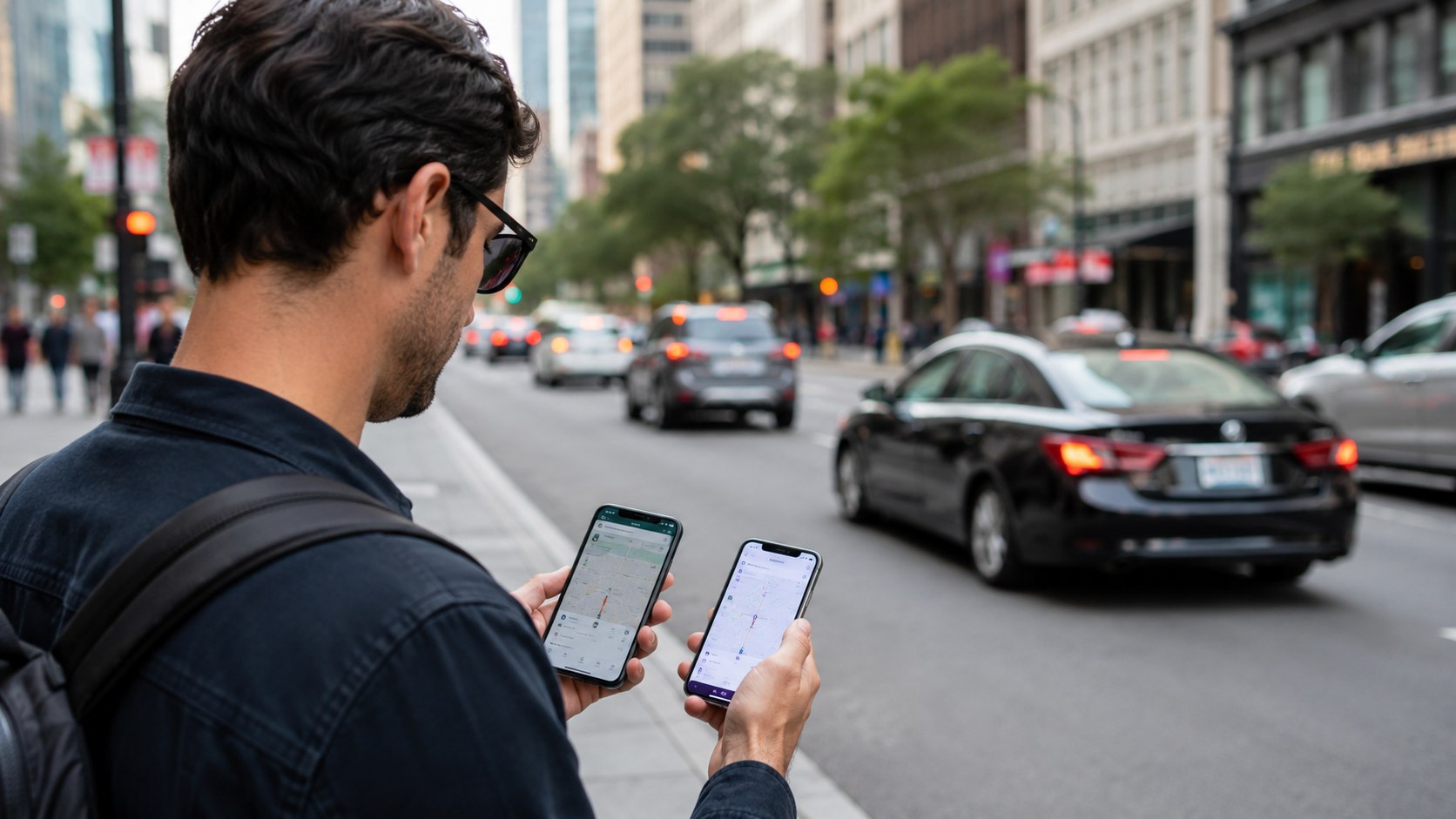
Most riders should check both apps before booking, but in 2026 Uber is often the safer first pick for airport trips, late-night rides, and cities where driver supply is deeper. Lyft is better if you can wait a few extra minutes, use Price Lock on a regular route, or catch a cheaper upfront fare before surge hits, аs noted by Baltimore Chronicle.
The practical answer to uber vs lyft prices 2026 is simple: open both apps, compare the total before tip, then add 15% to 20% for the driver if service is good. The cheaper app changes by city, time, route, driver supply, tolls, airport rules, and whether demand is spiking in your exact pickup zone.
Key takeaways
- For immediate rides, compare the final upfront fare, not the base fare, because surge and fees can change the winner.
- Lyft can be cheaper for flexible riders through Wait & Save, Price Lock, and occasional lower commuter pricing.
- Uber often has the edge for airport reliability, premium ride types, and dense coverage across major US metros.
At a glance
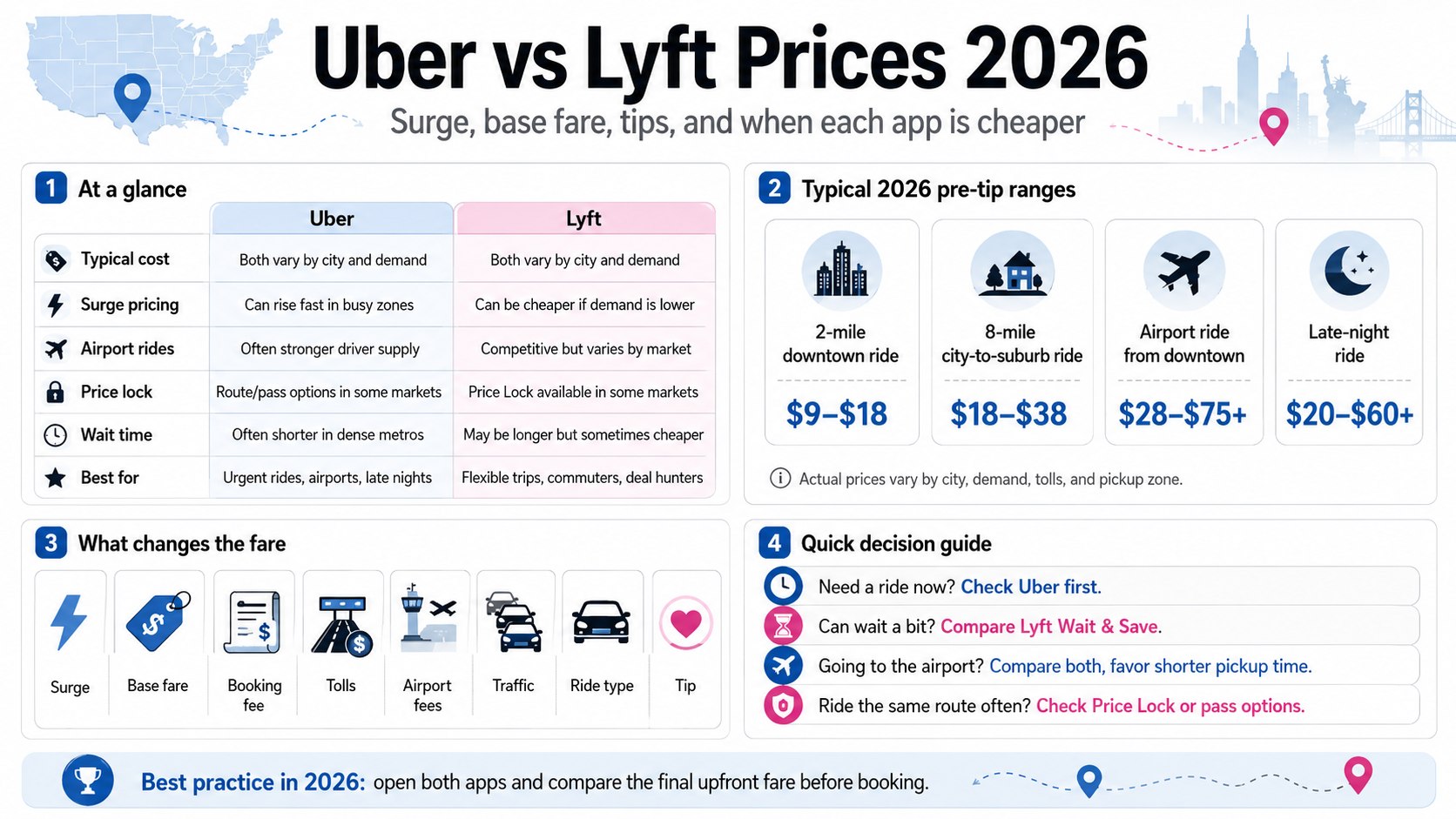
| Factor | Uber in 2026 | Lyft in 2026 | Best pick |
|---|---|---|---|
| Typical cost | Often close to Lyft, but can rise faster in high-demand zones | Often competitive on short city trips and flexible pickup times | Compare both |
| Base and upfront fare | Uses upfront pricing in the US based on estimated time, distance, traffic, demand, fees, and route factors | Uses upfront pricing based on ride type, route, driver availability, demand, traffic, and other charges | Tie |
| Surge or demand pricing | Strong coverage, but real-time surge can move quickly by neighborhood | Can be cheaper when Wait & Save is available or local demand is lighter | Depends on timing |
| Tip | Tip is separate from the quoted fare unless added after or during checkout | Tip is separate from the quoted fare unless added after or during checkout | Tie |
| Airport rides | Usually strong supply at major airports such as LAX, JFK, ORD, ATL, and DFW | Competitive at many airports, but pickup availability can vary more by market | Uber for reliability |
| Scheduled rides | Uber Reserve offers upfront pricing and may include reservation fees | Lyft scheduled rides can lock pickup time and price in many markets | Compare route by route |
| Price lock | Uber offers route-based price lock or pass features where available | Lyft Price Lock is a clear option for regular routes at $2.99/month where available | Lyft for commuters |
| Fare disputes | Fare adjustments go through Uber support | Fare adjustments go through Lyft support | Tie |
Uber vs Lyft prices 2026 by surge, base, and tip
Riders searching for Uber vs Lyft cost comparison usually want the same answer: which button costs less right now. The answer is not locked to one brand because both Uber and Lyft use dynamic pricing that changes with demand, driver availability, traffic, tolls, ride type, and pickup location.
Uber says US riders are offered an upfront price on every trip, and that price is based on estimated trip length and duration, with real-world factors such as traffic affecting the estimate. Uber also notes that post-trip prices may include a base rate, booking fee, surcharges, tolls, and demand-related factors in some cities.
Lyft says its upfront price is based on ride type, route, driver availability, demand, traffic, and other charges. That means the fare shown before booking is more useful than old-style per-mile or per-minute estimates.
The real comparison is not Uber’s brand price against Lyft’s brand price. It is Uber’s live quote against Lyft’s live quote for the same route, pickup point, ride type, and booking time.
For a short urban ride in cities such as New York, Chicago, Los Angeles, Miami, Dallas, Phoenix, Seattle, Denver, Atlanta, or Baltimore, the lower fare can flip within minutes. A $14 Lyft ride can become a $22 Lyft ride if a concert lets out, while Uber may stay at $18 if more drivers are nearby.
Tips should be compared separately. A $20 Uber ride plus a 20% tip is $24. A $22 Lyft ride plus a 15% tip is $25.30. Riders who only compare the pre-tip quote may underestimate the final card charge.
Uber prices in 2026
Uber is the better default when the ride has a high penalty for failure: airport departures, medical appointments, work shifts, school pickup, or late-night trips. Its larger national footprint often means more driver options in dense US markets, though that does not guarantee the lowest fare.
Uber pros
- Strong availability in many US cities, suburbs, airports, downtowns, and entertainment districts.
- Broad ride-type menu, including economy, comfort, XL, premium, pet, and scheduled options where available.
- Upfront pricing helps riders see the total before booking, including expected route and demand factors.
- Uber Reserve can help with planned rides, though reservation fees and higher quotes may apply.
Uber cons
- Surge can be sharp during airport rushes, storms, stadium exits, bar closing, and commuter peaks.
- The cheapest Uber option may disappear when driver supply tightens.
- Upfront fares can change if the route, stops, destination, wait time, tolls, or trip duration changes materially.
Uber is ideal for riders who care more about pickup confidence than saving the last $2. It is also a strong first check for airport rides, late-night rides, and trips in unfamiliar cities.
For Baltimore-area airport trips, the fare comparison should include pickup rules, terminal access, and transit alternatives. Baltimore Chronicle’s guide to BWI to downtown Baltimore by train, bus, rideshare, and taxi is a useful companion for riders deciding whether an app ride is worth the premium.
Lyft prices in 2026
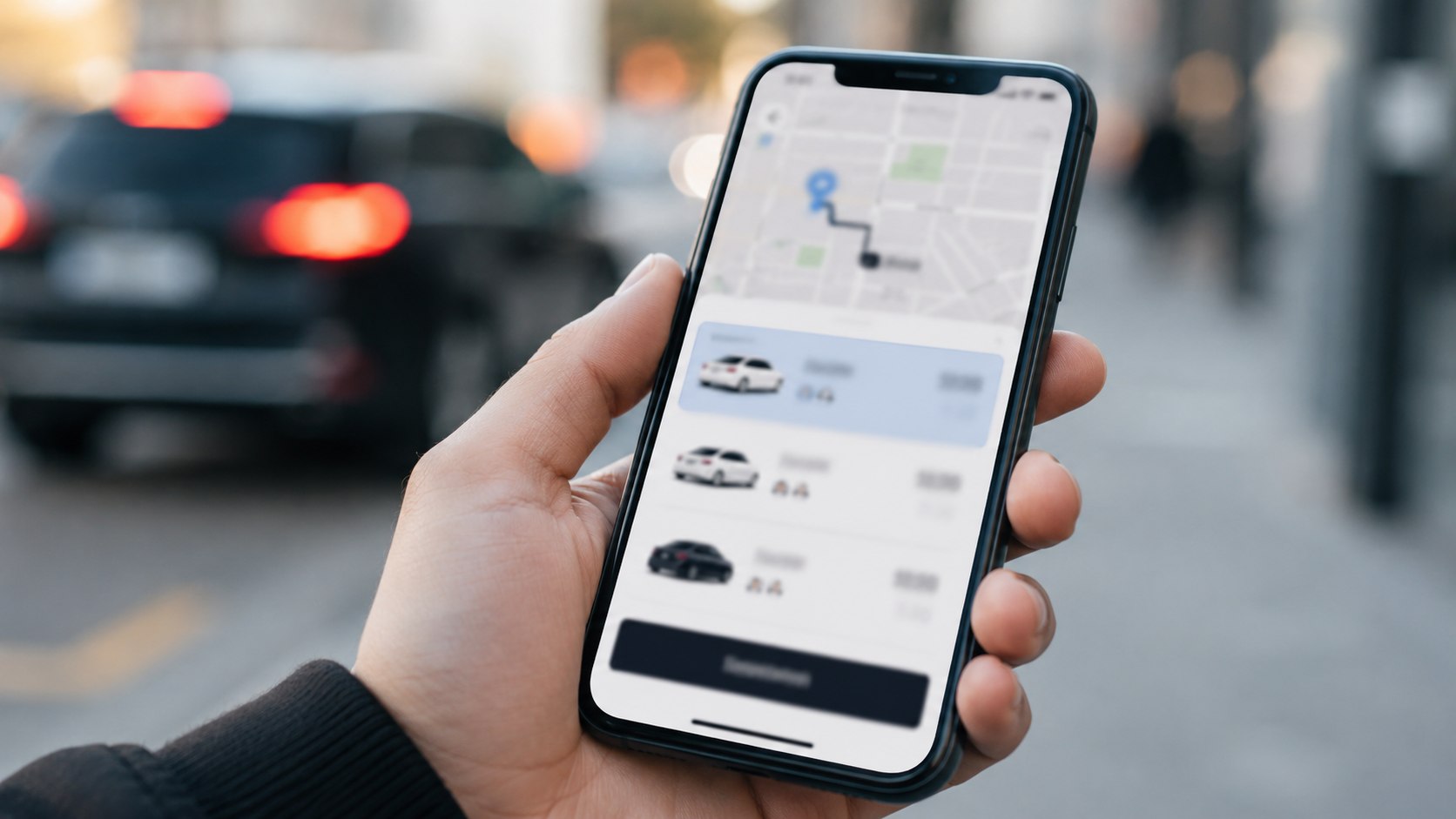
Lyft is often the better value play when the rider has flexibility. If arrival time is not critical, Lyft’s lower quote, Wait & Save option, scheduled ride pricing, or Price Lock feature may reduce the total.
Lyft pros
- Strong price competition on short and mid-length city rides in many US markets.
- Wait & Save may lower the fare when the rider can accept a longer pickup window.
- Lyft Price Lock can cap regular-route pricing for commuters where the feature is available.
- Lyft Pink may reduce eligible ride costs for frequent riders, depending on the active membership terms.
Lyft cons
- Driver availability can be thinner than Uber in some suburbs, smaller cities, and late-night markets.
- Lower fares may come with longer wait times, especially during demand spikes.
- Airport pickup reliability varies by airport, city rules, terminal layout, and driver supply.
Lyft is ideal for renters, freelancers, parents, students, and commuters who can compare fares before booking. It is also a smart second check when Uber shows a surge warning or unusually high airport quote.
For renters and workers who use rideshare as part of a monthly budget, transportation should be compared with rent, utilities, groceries, and public transit. The broader cost of living in Baltimore in 2026 guide puts those recurring expenses in one place.
Real price examples for US riders in 2026
Exact fares should be verified inside the Uber and Lyft apps because pricing changes by minute and location. The ranges below reflect realistic 2026 consumer scenarios, not fixed company rates.
| Scenario | Typical pre-tip range in 2026 | What changes the price | Likely cheaper choice |
|---|---|---|---|
| 2-mile downtown ride | $9–$18 | Minimum fare, demand, wait time, traffic | Lyft if Wait & Save appears |
| 8-mile city-to-suburb ride | $18–$38 | Route time, driver supply, tolls, ride type | Compare both |
| Airport ride from downtown | $28–$75+ | Airport fees, terminal demand, luggage time, tolls | Uber for supply, Lyft if quote is lower |
| Late-night bar district ride | $20–$60+ | Surge, driver scarcity, pickup congestion | Whichever has lower surge |
| Weekly commute route | Varies by route | Peak-hour demand, price lock, subscription perks | Lyft or Uber pass if available |
A parent leaving a school event in California, a freelancer heading to a client in Texas, and a renter in Maryland going to the airport may see three different outcomes on the same day. The best app is the one with better local driver supply at the exact pickup time.
How surge pricing changes the winner
Rideshare surge pricing is the main reason the cheaper app changes. Uber says surge pricing is specific to different areas of a city and can change quickly as demand updates in real time. Lyft’s upfront price also responds to demand and driver availability.
Surge is usually most visible during predictable pressure points: weekday commute peaks, rain, snow, major concerts, sports events, airport rushes, holiday nights, and last-call hours. It can also appear in small zones, such as one side of a stadium or one terminal pickup lot.
The fastest way to reduce surge is not complicated:
- Move the pickup pin 1–3 blocks away from the crowded exit, hotel, terminal, or venue entrance.
- Wait 5–10 minutes if the trip is not urgent and refresh both apps.
- Compare UberX against Lyft Standard, not premium or XL products.
- Check shared, wait, or scheduled options only if they fit the trip.
- Avoid adding stops unless needed because stops can affect the final fare.
For airport rides, walking to a designated pickup zone is usually required. At airports such as LAX, JFK, ORD, ATL, DFW, SFO, MIA, SEA, and LAS, terminal rules and pickup congestion can matter as much as the brand.
Base fare, fees, and the tip problem
Uber base fare vs Lyft base fare is less useful than it used to be because upfront pricing bundles several factors into one quote. Base rate, time, distance, booking fee, tolls, airport fees, local surcharges, demand, and route predictions can all affect the number shown before booking.
The tip is the cleanest part of the bill because the rider controls it. Many US riders use 15% to 20% for good service, more for difficult pickups, heavy luggage, bad weather, extra assistance, or late-night trips.
That creates a simple math rule. If Uber is $24 and Lyft is $22, Lyft is cheaper before tip. With a 20% tip, Uber becomes $28.80 and Lyft becomes $26.40. The $2 quote gap becomes $2.40 after tip.
Cancellation fees, wait-time fees, toll adjustments, cleaning fees, and airport surcharges can make the final charge higher than expected. Uber states that upfront prices may change when riders add stops, update destinations, spend extra time at stops, pass through unpriced tolls, or experience significant route or duration changes.
Which should you buy in 2026
Rideshare is not a one-time purchase, but the same decision-tree logic applies. Pick the app that best fits the trip in front of you, not the app that was cheaper last month.
- If the ride is urgent, then open Uber first and book if the price is reasonable.
- If the ride is flexible, then compare Lyft Wait & Save against UberX before booking.
- If the route repeats weekly, then test Lyft Price Lock and Uber route pass options where available.
- If the trip is to an airport, then compare both apps but favor the one with a shorter pickup time and clearer terminal instructions.
- If the quote looks unusually high, then wait a few minutes, move the pickup point, or check public transit for part of the route.
The best 2026 habit is to keep both apps installed, save the same payment method, and compare the same route before committing. Riders who only use one app usually pay more during at least some surge windows.
How to compare Uber and Lyft before booking
Lyft vs Uber fare estimate checks should be done at the same minute, from the same pickup point, to the same destination. A quote from two blocks away is not the same ride.
Use this checklist before booking:
- Enter the exact pickup and destination in Uber.
- Enter the same pickup and destination in Lyft.
- Compare equivalent ride types, such as UberX and Lyft Standard.
- Check pickup time, not just fare.
- Add a realistic tip to both totals.
- Look for tolls, airport fees, reservation fees, and wait-time warnings.
- For repeat routes, check Price Lock, Uber passes, Lyft Pink, or Uber One ride credits where available.
- Book the lower total only if the pickup time still works.
For local trips, a rideshare quote should also be compared against bus, Metro, Light Rail, and app-based transit planning. Baltimore Chronicle’s Baltimore public transit guide gives riders a baseline before paying surge fares for short city routes.
Official support pages are the safest place to verify how each platform describes pricing mechanics: Uber explains US upfront rider pricing on its marketplace pricing page, while Lyft explains upfront ride charges in its ride pricing and charges help page.
FAQ
Is Uber cheaper than Lyft in 2026?
Uber is not always cheaper than Lyft in 2026. Uber may be the better value when it has more nearby drivers, while Lyft may be cheaper when Wait & Save, Price Lock, or lower local demand applies.
Why does Lyft cost less than Uber sometimes?
Lyft can cost less when its driver supply is better near the pickup point, its demand level is lower, or the rider chooses a slower pickup option. Promotions, credits, and subscriptions can also change the final price.
Why does Uber cost less than Lyft sometimes?
Uber can cost less when it has more drivers nearby, shorter pickup times, or lower demand in that specific zone. It may also be more reliable for airports, late-night rides, and high-traffic US downtowns.
Do Uber and Lyft prices include tips?
Standard upfront ride quotes generally do not include the driver tip unless the rider adds one during checkout or after the ride. For a fair comparison, add the same tip percentage to both quotes.
Does surge pricing affect both Uber and Lyft?
Yes. Both platforms adjust prices when demand, traffic, route conditions, or driver availability changes. The effect can differ by app, city, neighborhood, airport, and time of day.
What is the best way to save on rideshare in 2026?
The best method is to compare both apps before every ride, avoid peak surge windows when possible, move away from crowded pickup zones, use flexible pickup options, and check route-based price locks for regular trips.
Earlier we wrote about How to File a Tax Extension 2026 Online With Form 4868 and IRS Payment Rules