

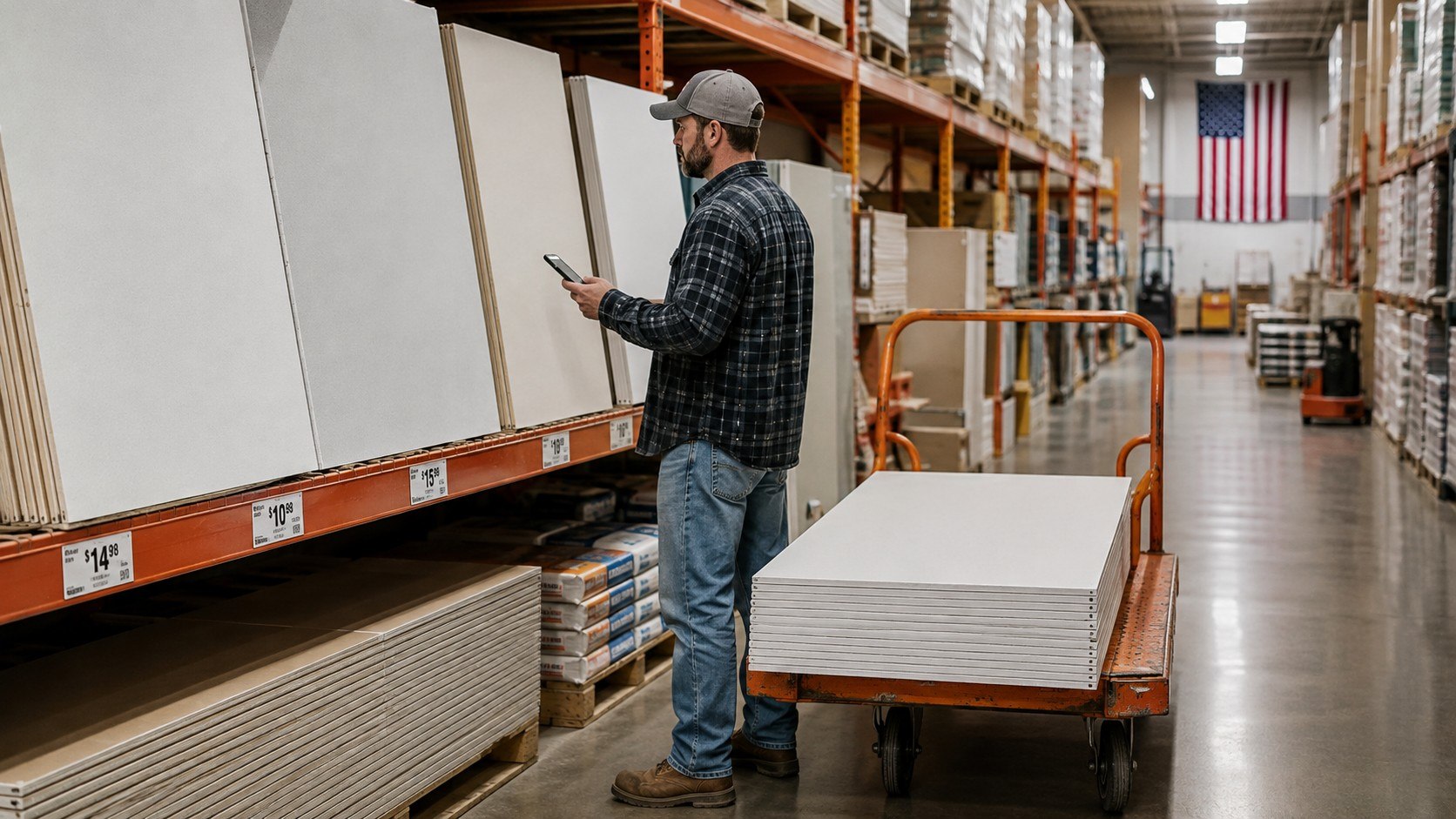
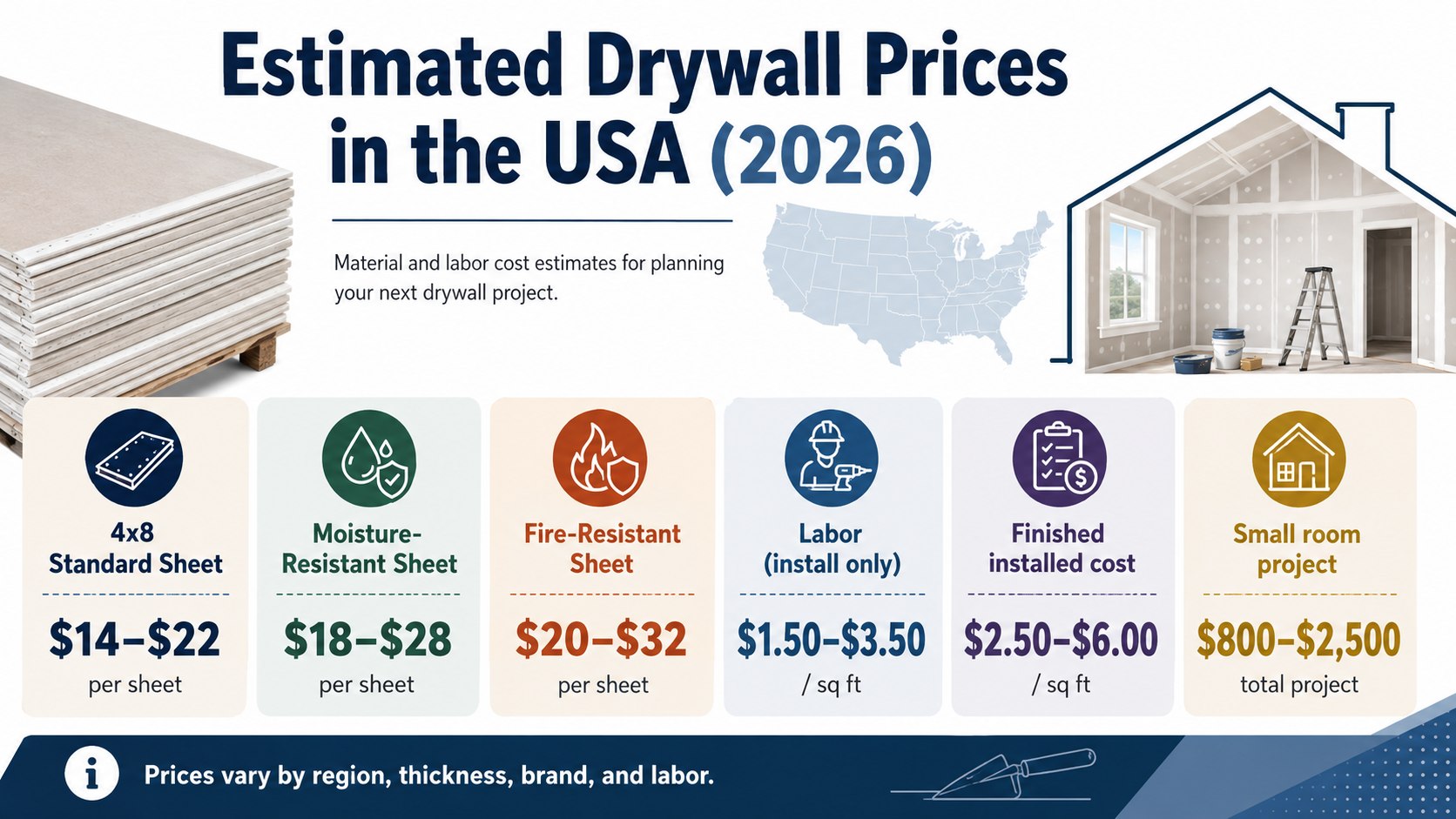
Drywall prices USA 2026 typically range from $14 to $24 for a standard 1/2-inch, 4-by-8-foot sheet. Specialty panels can cost $20 to $70 each. With professional hanging, finishing, and cleanup, most projects reach $1.50 to $3.00 per sq ft, or roughly $60 to $90 per installed sheet, according to Baltimore Chronicle.
For a straightforward 12-by-12-foot room, homeowners should generally budget $1,000 to $2,500. That range covers walls, a ceiling, joint compound, fasteners, labor, and a basic smooth finish. Small repairs cost more per sq ft because travel, setup, dust control, and return visits remain necessary.
Key takeaways
- Standard drywall commonly costs $14–$24 per 4-by-8-foot sheet before tax, delivery, fasteners, and finishing supplies.
- Professional installation usually costs $1.50–$3.00 per sq ft, but difficult ceilings and premium finishes cost more.
- Accurate estimates must include waste, corner bead, joint compound, sanding, disposal, delivery, and wall preparation.
These figures are national planning ranges rather than guaranteed store quotes. Panel pricing varies by ZIP code, product availability, order volume, and local taxes. Labor in New York City, Los Angeles, Seattle, and Washington, D.C., often exceeds pricing in smaller Midwestern and Southern markets.
Drywall prices USA 2026 per sheet and installed square foot
A basic 4-by-8-foot panel covers 32 sq ft before cutting losses. However, dividing the panel price by 32 does not reveal the finished wall cost. A complete job also requires screws, tape, joint compound, corner protection, sanding materials, primer, delivery, and labor.
Common brands include USG Sheetrock, Gold Bond from National Gypsum, CertainTeed, and Georgia-Pacific ToughRock. Product labels matter because “drywall” can describe several panels with different fire, moisture, weight, and sound-control characteristics.
| Line item | Typical 2026 cost |
|---|---|
| Standard 1/2-inch, 4-by-8-foot sheet | $14–$24 per sheet |
| Lightweight 1/2-inch panel | $16–$27 per sheet |
| 5/8-inch Type X fire-rated panel | $18–$30 per sheet |
| Moisture- or mold-resistant panel | $20–$35 per sheet |
| Sound-control or specialty panel | $35–$70+ per sheet |
| Basic hanging and finishing | $1.50–$3.00 per sq ft |
| Complex or premium installation | $3.00–$5.00+ per sq ft |
| Small drywall repair | $150–$800, depending on damage |
Those ranges include different purchasing conditions. A contractor ordering 50 matching panels may receive volume pricing unavailable to a homeowner buying 4 sheets. Conversely, contractor quotes may include handling, business overhead, insurance, supervision, and warranty obligations.
Current listings from major retailers show why buyers must compare exact dimensions. A 4-by-10-foot or 4-by-12-foot sheet costs more than a 4-by-8-foot panel. Yet longer panels can reduce seams, taping time, and visible joints.
Do not compare products solely by sheet price. Calculate cost per covered sq ft, delivery charges, expected waste, and the labor needed to finish each seam.
The Baltimore Chronicle guide to reading a construction estimate explains how allowances, exclusions, labor, and material quantities affect the final quote.
What drives the price
Panel type and thickness
Standard 1/2-inch drywall is the usual choice for interior residential walls. Ceilings, garages, mechanical areas, and required fire assemblies may need 5/8-inch panels or Type X products. Bathrooms and laundry rooms may require moisture-resistant materials, depending on local code and wall location.
Specialty panels contain additional materials or engineered cores. These products can resist mold, improve impact performance, reduce sound transmission, or support tested fire assemblies. Their higher price may also increase cutting and handling costs.
Project size
Larger jobs usually have a lower installed price per sq ft. Crews can spread delivery, protection, setup, and cleanup costs across more panels. A whole-house installation also creates a predictable workflow for hanging, taping, coating, and sanding.
Small jobs behave differently. Replacing one damaged section may require several visits because joint compound must dry between coats. The contractor still needs tools, floor protection, dust control, and matching texture.
Finish level
Drywall finishes are commonly described from Level 0 through Level 5. An unfinished utility area may require only basic hanging or limited treatment. Painted living areas usually need a more complete finish, while strong lighting or glossy paint can expose minor surface defects.
A Level 5 finish adds a skim coat over the panel surface. It can improve appearance under critical lighting, but it increases material, labor, drying, and sanding requirements.
Room geometry
Flat walls in an empty rectangular room are faster than stairwells, vaulted ceilings, arches, soffits, closets, and occupied interiors. Every inside corner, outside corner, opening, and irregular cut adds handling and finishing time.
Ceiling work also costs more because panels must be lifted and supported overhead. Contractors may need a panel lift, scaffolding, or a larger crew.
Location and labor market
Drywall installation cost varies across states and metropolitan areas. Wages, insurance, licensing requirements, parking, travel, disposal fees, and demand all influence contractor pricing.
California, New York, Massachusetts, Washington, and the District of Columbia often produce higher labor quotes. Parts of Texas, Ohio, Indiana, Missouri, and North Carolina may be less expensive, although fast-growing cities can exceed statewide averages.
Access, delivery, and disposal
A retailer may offer an attractive panel price while charging separately for delivery. Costs rise when crews must carry sheets upstairs, cross long driveways, reserve elevators, or work inside occupied apartments.
Demolition creates another expense. Old drywall is heavy, bulky, and difficult to transport. Quotes should state whether debris removal, disposal fees, and final cleaning are included.
Price breakdown for a typical room
Consider a 12-by-12-foot bedroom with 8-foot ceilings, one door, and two windows. Its gross wall area is about 384 sq ft. Adding a 144 sq ft ceiling produces 528 sq ft before subtracting openings.
A contractor may calculate panel quantities from the actual layout rather than simple floor area. The estimate should include approximately 10% waste for cuts, breakage, and unusable offcuts. Complicated layouts may require a larger allowance.
| Budget component | Typical 2026 range |
|---|---|
| 17–19 standard panels | $240–$455 |
| Screws, tape, compound, and corner bead | $90–$220 |
| Delivery or vehicle rental | $0–$180 |
| Professional hanging and finishing | $790–$1,585 |
| Protection, cleanup, and disposal | $100–$350 |
| Estimated project total | $1,220–$2,790 |
The lower figure assumes standard panels, easy access, and minimal demolition. The upper figure allows for higher labor rates, delivery, waste removal, and more detailed finishing. Texture matching, insulation replacement, painting, and hidden repairs can increase the total.
Some bids quote the area of drywall installed. Others quote floor area, panel count, or the complete room. Ask the contractor to identify the measurement method before comparing offers.
A quote of $2.25 per sq ft may look cheaper than a $75-per-sheet quote. The apparent difference can disappear when both are converted to the same coverage and finish level.
A reliable drywall budget separates visible wallboard costs from the less obvious work required to produce a paint-ready surface.
Homeowners planning broader work can compare these figures with the Baltimore Chronicle guide to bathroom remodeling costs in 2026.
How to estimate how many drywall sheets you need
Measure each wall’s length and height, then calculate its area. Add the ceiling when it will receive drywall. Divide the total area by 32 for 4-by-8-foot panels, 40 for 4-by-10-foot panels, or 48 for 4-by-12-foot panels.
- Measure every wall and ceiling section in feet.
- Multiply width by height for each rectangular surface.
- Add the separate areas into one project total.
- Subtract only large openings when useful.
- Divide by the selected panel’s coverage.
- Add 10% waste for a simple room.
- Add 12%–15% for complex cuts or inexperienced DIY work.
- Round upward to complete sheets.
For example, 500 sq ft divided by 32 equals 15.625 standard panels. Adding 10% produces 17.19, so the practical order is 18 sheets.
Panel orientation can change the required quantity. Horizontal installation often reduces seams on standard 8-foot walls. Vertical installation may suit certain commercial layouts or tested assemblies.
Longer sheets can create fewer butt joints, but they are harder to transport and maneuver. A 12-foot panel may not fit through a stairwell or around a tight hallway corner.
Order matching products together when appearance or performance matters. Minor differences in edge profile, thickness, or panel composition can complicate installation.
Ways to save in 2026
The cheapest panel is not always the cheapest completed wall. Savings should reduce waste and labor without creating cracks, visible seams, moisture damage, or code problems.
- Request itemized bids. Separate hanging, finishing, demolition, materials, delivery, disposal, texture, and painting.
- Compare equal finish levels rather than accepting vague terms like “finished” or “ready.”
- Schedule drywall after plumbing, electrical, framing, and inspections are complete.
- Clear furniture and personal items before the crew arrives.
- Buy complete project quantities together to reduce mismatched panels and repeated delivery fees.
- Use standard drywall where specialty performance is unnecessary.
- Ask whether bulk pricing applies to full-unit or multiroom orders.
- Keep several labeled offcuts for future repairs and texture testing.
DIY demolition can reduce labor charges, but it carries risks. Walls may contain electrical wiring, plumbing, insulation, lead-painted surfaces, or materials requiring special handling.
Homeowners can also handle painting after the drywall contractor completes a paint-ready finish. However, the scope must define who applies drywall primer and who corrects defects revealed after priming.
Buying materials yourself may provide price transparency. It can also shift responsibility for incorrect quantities, damaged panels, delayed delivery, and unavailable replacement sheets.
Check whether the contractor receives trade pricing. Their material markup may still cost less than homeowner retail pricing plus delivery and breakage.
The guide to professional-quality cabinet painting at home offers related advice on surface preparation, dust control, primers, and finish planning.
When paying more makes sense
Fire-rated construction
Garages, shared walls, utility spaces, and multifamily buildings may require a tested fire-resistance assembly. The correct result depends on the complete assembly, not merely a Type X label. Studs, fasteners, spacing, joints, and penetrations must follow the approved design.
Moisture-prone rooms
Moisture-resistant drywall can be useful in bathrooms, laundry rooms, and selected basement locations. It is not a substitute for approved tile backer or waterproofing inside showers and other direct-wet areas.
Ceilings and difficult access
Lightweight panels may justify a modest premium when installers work overhead. Easier handling can reduce fatigue, edge damage, and lifting difficulty. USG publishes product specifications for its lightweight drywall panels.
High-visibility finishes
Large windows, long walls, wall-washing lights, and glossy paint reveal surface irregularities. Paying for additional finishing may prevent visible joints, ridges, and fastener depressions.
Premium drywall work makes financial sense when the upgraded material or finish solves a defined fire, moisture, sound, access, or appearance problem.
Questions to ask before signing a drywall contract
A clear scope protects both parties. It also makes bids easier to compare because every contractor is pricing the same work.
- Which brand, thickness, dimensions, and panel type are included?
- How many sq ft or panels does the estimate cover?
- Which finish level will be delivered?
- Are ceilings, closets, soffits, and window returns included?
- Who provides delivery, floor protection, and waste removal?
- Does the price include texture matching and drywall primer?
- How will change orders and hidden damage be priced?
- What workmanship warranty applies after completion?
Obtain at least 3 comparable estimates for a substantial project. Verify licensing and insurance where state or local rules require them. Avoid large unexplained deposits and pressure to sign immediately.
Confirm whether painting is included. “Ready for paint” usually describes the drywall surface, not the application of primer and finish coats.
Photograph framing, wiring, pipes, and blocking before panels cover the walls. These images can help with later repairs, mounting, and remodeling.
FAQ about drywall costs in 2026
How much does one sheet of drywall cost in 2026?
A standard 1/2-inch, 4-by-8-foot sheet commonly costs $14–$24. Moisture-resistant, fire-rated, impact-resistant, and sound-control panels cost more.
How much does drywall installation cost per sq ft?
Typical professional hanging and finishing costs $1.50–$3.00 per sq ft. Complex ceilings, difficult access, premium finishes, and high-cost cities can exceed $3.00.
How much drywall is needed for a 2,000 sq ft house?
Floor area alone cannot provide an exact quantity. Wall height, layout, ceilings, openings, garages, and interior partitions matter. Many 2,000 sq ft homes require several hundred panels, but plans must be measured directly.
Is it cheaper to hang drywall yourself?
DIY work can eliminate part of the labor charge. However, panel transport, overhead lifting, joint finishing, dust control, tool rental, and mistakes can reduce the savings.
Does drywall price include painting?
Usually not. Most drywall bids cover hanging, taping, coating, and sanding. Primer, texture, and finish paint should appear as separate items unless the contract states otherwise.
Should drywall be repaired or replaced?
Small holes, dents, and localized cracks are often repairable. Replacement makes more sense for widespread water damage, severe mold contamination, crumbling panels, or major structural access.
Earlier we wrote about How Much Rent Can I Afford on a $50K Salary? 2026 Budget