


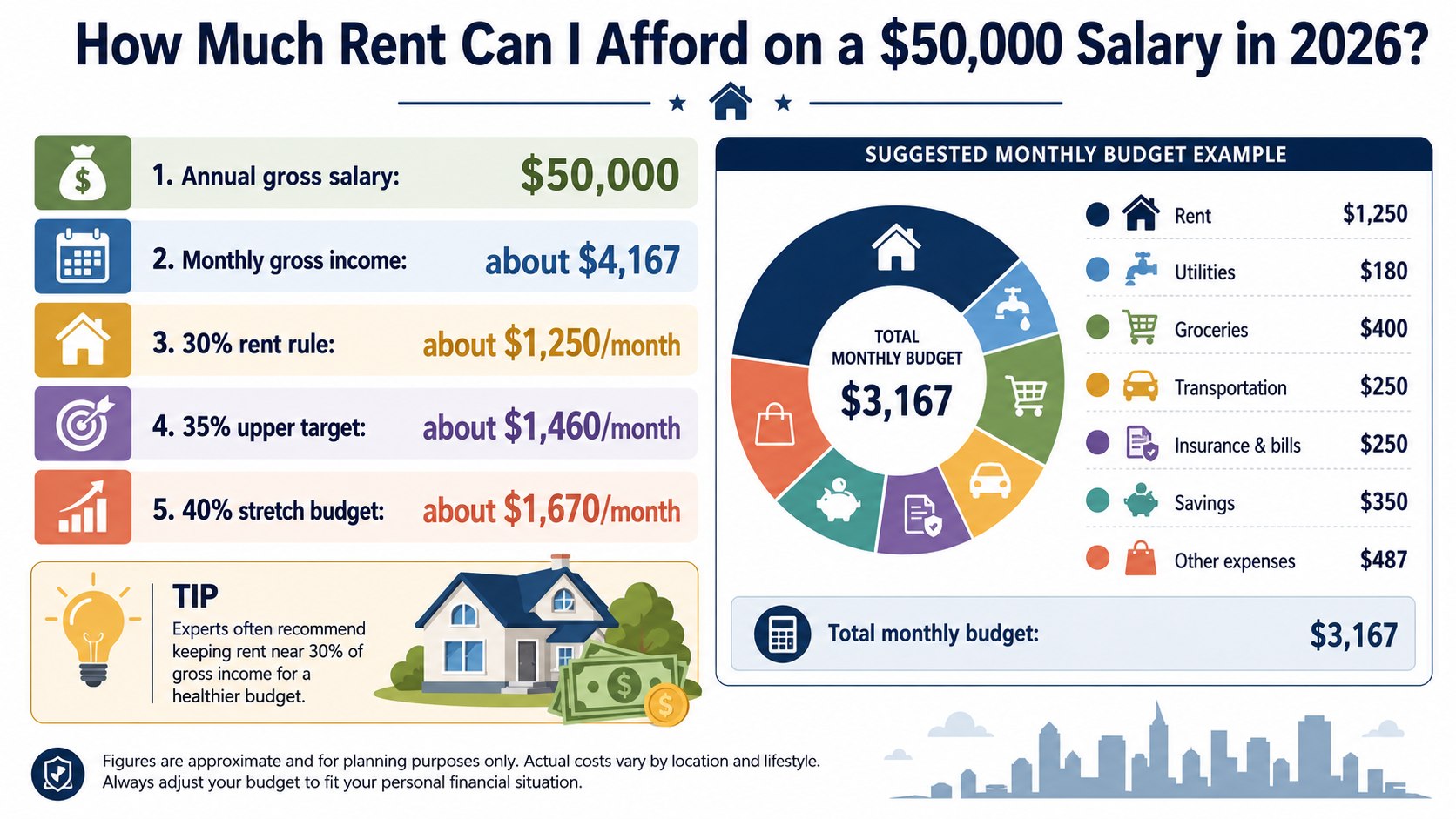
How much rent can I afford on 50k salary? In 2026, a practical range is $1,000 to $1,250 monthly. About $1,250 is the traditional 30% ceiling, while $1,000 leaves more room for utilities, debt, savings, and emergencies. A rent near $1,500 is possible, but it consumes 36% of gross income before utilities, as noted by Baltimore Chronicle.
A $50,000 annual salary equals $4,166.67 in gross monthly income. Applying the 30% rule produces a maximum housing budget of $1,250. However, after federal payroll taxes, income tax, health insurance, and possible state taxes, monthly take-home pay may fall near $3,200 to $3,550. That makes a rent target of roughly $950 to $1,150 more resilient for many single renters.
Key takeaways
- The 30% rule sets rent near $1,250, but it uses gross income rather than take-home pay.
- A safer target is usually $1,000 to $1,150 when utilities and renter expenses remain separate.
- Debt, childcare, commuting, health insurance, and local taxes can reduce the affordable amount sharply.
The correct answer depends less on a landlord’s approval formula than on the money remaining after every recurring bill. A household can qualify for an apartment and still struggle to pay for groceries, car repairs, medical costs, or retirement contributions.
How Much Rent Can I Afford on 50k Salary Using the 30% Rule?
The standard calculation is simple: multiply $50,000 by 30%, then divide the result by 12. That produces an annual housing allowance of $15,000 and a monthly limit of $1,250 in rent. HUD commonly treats households spending more than 30% of income on housing costs as cost-burdened.
That benchmark should include more than the amount printed on the lease. Electricity, gas, water, trash charges, mandatory internet packages, parking, and renter insurance can add $150 to $400 monthly. If those costs are not included, the base rent may need to remain closer to $950 or $1,050.
The 30% rule is a screening tool, not proof that a particular apartment fits your cash flow.
Someone living without a car in a low-tax state may manage $1,250 comfortably. A parent paying for childcare or a driver with a $600 auto payment may need to stay below $1,000. Baltimore renters can compare local housing and utility costs in this 2026 Baltimore living expenses guide.
After-Tax Math on a $50,000 Salary
A realistic rental budget starts with net pay. For a single taxpayer using the 2026 standard deduction, federal income tax and employee payroll taxes reduce the amount deposited into the bank. State income tax, local tax, health coverage, retirement contributions, and other payroll deductions reduce it further.
The IRS lists a $16,100 standard deduction for single filers in tax year 2026. Federal tax brackets begin at 10%, then rise to 12% for the next portion of taxable income. Exact withholding depends on Form W-4 settings and eligibility for credits, so pay stubs provide a better figure than a generic calculator.
For a single worker earning $50,000, a simplified estimate may look like this:
| Income or expense | Typical 2026 monthly amount |
|---|---|
| Gross salary | $4,167 |
| Estimated federal income tax | About $318 |
| Social Security and Medicare | About $319 |
| State and local income taxes | $0–$220 |
| Health insurance or workplace deductions | $100–$350 |
| Estimated take-home pay | About $2,960–$3,430 |
| Practical rent target | About $900–$1,150 |
These figures are planning estimates rather than individual tax advice. A resident of Texas, Florida, Nevada, or Tennessee may avoid state tax on wage income. Workers in California, New York, Oregon, Maryland, or another income-tax state may take home less.
Employer benefits also matter. A worker paying $250 monthly for medical coverage and contributing 5% to a 401(k) receives less cash than someone without those deductions. The retirement contribution still builds wealth, but it cannot pay the current month’s rent.
Review several paychecks before signing a lease. Use ordinary months rather than checks containing bonuses, overtime, reimbursements, or an extra pay period. Baltimore Chronicle’s guide to filing federal taxes for free in 2026 also explains options for checking federal tax information without paying a commercial preparer.
What Drives the Price
Location and Local Taxes
Rent varies widely between cities and neighborhoods. A $1,100 budget may secure a one-bedroom in parts of Ohio, Oklahoma, or Indiana. The same amount may cover only a room or shared apartment in San Francisco, Boston, New York City, or coastal Southern California.
Utilities Included in the Lease
A $1,200 apartment with heat and water included may cost less overall than a $1,050 unit with separate electric heating. Ask the landlord for average utility costs from comparable units. Older buildings, poor insulation, and inefficient HVAC systems can make winter and summer bills unpredictable.
Transportation
Cheaper rent far from work can produce a larger transportation bill. Fuel, tolls, parking, maintenance, insurance, and car payments may erase the savings. A higher-priced apartment near reliable transit can sometimes reduce total monthly spending.
Debt Obligations
Credit cards, student loans, personal loans, and auto financing compete directly with rent. Someone paying $700 monthly toward debt should not use the same rental ceiling as a debt-free worker. A lower rent creates room to reduce principal rather than repeatedly carrying balances.
Household Needs
Parents may require another bedroom, safer access, laundry facilities, or proximity to childcare. Freelancers may need workspace and stable internet. Pet owners can face monthly pet rent, deposits, cleaning charges, and breed restrictions.
Lease Structure
Month-to-month contracts often cost more than 12-month leases. Furnished apartments may also carry a premium. Concessions such as 1 free month can lower the first-year average, but the renewal may be based on the full advertised rent.
Price Breakdown
Base rent is only one part of the housing bill. Before applying, request a written list of mandatory charges. Include every recurring fee when calculating the percentage of income spent on housing.
| Line item | Typical 2026 cost |
|---|---|
| Base rent | $900–$1,250 monthly |
| Electricity and gas | $80–$220 monthly |
| Water, sewer, and trash | $30–$100 monthly |
| Internet | $40–$90 monthly |
| Renter insurance | $12–$30 monthly |
| Parking | $0–$250 monthly |
| Pet rent | $20–$75 monthly |
| Application and screening charges | $25–$100 per applicant |
| Security deposit | Often $500 to 1 month’s rent |
| Moving and setup costs | About $300–$1,500 |
A unit advertised at $1,100 can approach $1,400 after utilities, parking, insurance, and required service packages. That difference can consume most of the monthly savings planned for emergencies.
Move-in costs deserve separate attention. First month’s rent, a deposit, application charges, utility deposits, moving supplies, and basic furniture may require several thousand dollars. Paying those expenses by credit card makes the apartment more expensive through interest.
Ask whether the property uses variable billing for water or shared utilities. Request the full lease before paying nonrefundable charges. Read the sections covering renewal increases, late fees, early termination, maintenance duties, and deposit deductions.
Renters choosing a smaller unit can use Baltimore Chronicle’s guide on making a small apartment feel larger. Better furniture scale and storage can make a lower-cost studio more functional.
Ways to Save in 2026
The strongest savings usually come from changing the housing arrangement, not trimming small household purchases. Use the following steps before settling for an apartment that strains the budget:
- Set an all-in housing ceiling. Combine rent, utilities, parking, insurance, pet charges, and mandatory building fees.
- Search 2 or 3 neighborhoods beyond the most popular district. Compare commute costs before deciding.
- Consider a roommate who can reduce both rent and utility expenses.
- Ask for actual utility history or estimates from the provider before signing.
- Compare 12-month, 15-month, and 18-month lease pricing where available.
- Negotiate parking, storage, pet fees, or move-in dates when base rent is fixed.
- Avoid paying for amenities that replace services you rarely use.
- Keep move-in funds in cash rather than financing deposits and furniture.
A roommate can change the calculation more than any discount. Splitting a $1,800 two-bedroom may reduce each renter’s base cost to $900. Shared internet and utilities can produce additional savings, though both tenants should understand the lease and payment responsibilities.
Timing can also influence available concessions. Large apartment communities may discount units that have remained vacant. Independently owned properties may offer more flexibility on move-in dates, deposits, or minor improvements.
Do not focus only on introductory offers. A unit promoted as “1 month free” may still carry a higher contractual rent. Calculate the total paid during the full term, then examine the likely renewal amount.
The best deal is the home that remains affordable after the promotion ends, the electric bill arrives, and an unexpected expense appears.
Preserve at least a small monthly margin. Even $150 to $250 can cover prescription costs, vehicle repairs, travel, or a rising utility bill. A budget with no margin is already overextended.

When Paying More Makes Sense
Paying above the conservative range can be reasonable when the higher rent reduces another major expense. A unit near work may remove the need for a car, paid parking, or a lengthy commute. Compare complete monthly costs rather than rent alone.
Higher rent may also be justified when utilities are included. A well-insulated apartment at $1,250 could outperform an older $1,050 unit with electric heat and high summer cooling costs.
Parents may pay more for a shorter childcare trip, safer building access, or another bedroom. Freelancers might justify dedicated workspace when it prevents renting an office elsewhere.
A premium can also make sense for a stable, professionally managed property with responsive maintenance. It does not make sense when the extra cost only buys cosmetic finishes, a rarely used pool, or a package of mandatory amenities.
FAQ
Can I Afford $1,500 Rent on a $50,000 Salary?
You may qualify, but $1,500 equals 36% of gross income. After utilities, housing could consume 40% or more. It is most workable for someone with limited debt, low transportation costs, and reliable monthly income.
Is $1,250 the Maximum Rent for a $50K Salary?
It is the amount produced by the 30% rule, not a legal maximum. Your practical ceiling may be lower after taxes, insurance, debt payments, childcare, and utilities.
How Much Income Do Landlords Require for $1,200 Rent?
Many landlords require gross monthly income equal to 2.5 or 3 times rent. At 3 times rent, a $1,200 apartment requires $3,600 monthly or $43,200 annually. Screening policies vary by property and jurisdiction.
Should Rent Be Based on Gross or Net Income?
Landlords usually screen applicants using gross income. Personal budgeting works better with net income because that is the money available after payroll deductions.
Can I Afford Rent and a Car Payment on $50,000?
Possibly, but the combined burden matters. A $1,250 rent payment and a $600 car payment use $1,850 before utilities, insurance, fuel, or maintenance. Lower rent may be necessary when vehicle costs are high.
How Much Should I Save Before Renting an Apartment?
A strong target covers the deposit, first month’s rent, moving costs, utility setup, and an emergency reserve. For a $1,100 apartment, that may require roughly $3,000 to $6,000, depending on local rules and existing savings.
Earlier we wrote that BTS in Baltimore: ARMY meetups, parties and ticket prices for the August concerts