

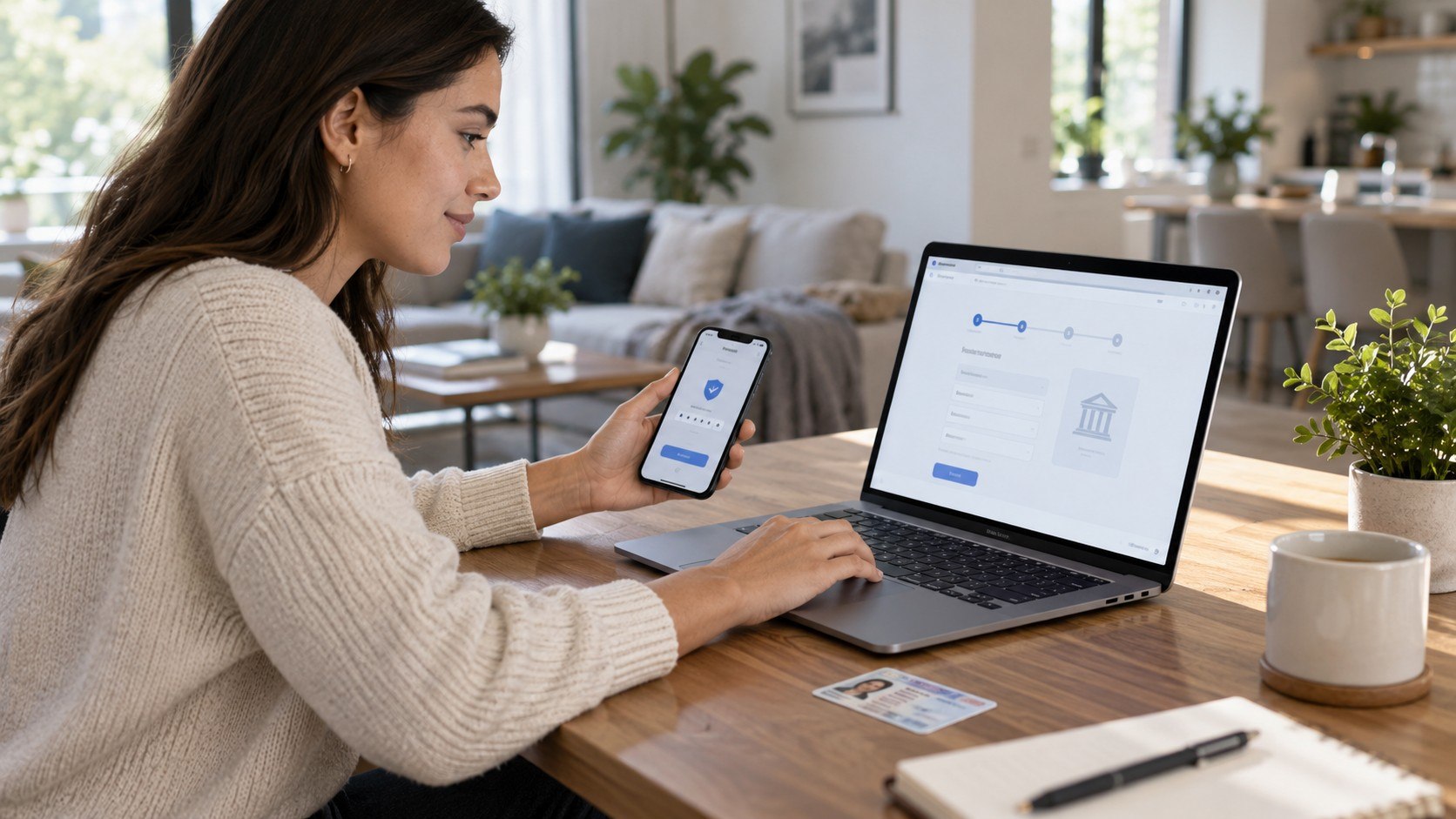
How to open a checking account online 2026 comes down to 3 things: valid identification, a verifiable address, and an accepted taxpayer number. Most applicants can finish an online form within 10 to 20 minutes. People without an SSN may need an ITIN or an in-person identity check, as noted by Baltimore Chronicle.
A successful application does not require excellent credit or a long banking history. The harder cases involve recent immigrants, people who recently moved, applicants with frozen consumer reports, or customers lacking an SSN. This guide explains which documents usually work and when an online application may turn into a branch visit.
Key takeaways
- Most online banks request an SSN or ITIN, current U.S. address, photo ID, phone number, and opening deposit.
- No SSN does not automatically prevent account opening, although fully online options become more limited.
- Compare monthly fees, minimum-balance rules, ATM access, overdraft terms, and FDIC or NCUA insurance before applying.
A bank must establish a reasonable belief that it knows a customer’s identity. That rule affects citizens, permanent residents, visa holders, and other applicants. Requirements differ because every institution builds its own risk-based verification process.
Online verification is usually easiest when names and addresses match government and financial records. A recent move can trigger manual review even when every document is legitimate. Applicants planning to build savings afterward can compare current options in Baltimore Chronicle’s guide to high-yield savings accounts in 2026.
What you need before opening a checking account
Gather the documents before starting the application. A missing address document or mismatched name can turn a short application into several days of verification.
- A current driver’s license, state ID, passport, or another accepted government-issued identification document.
- Your SSN or ITIN when the financial institution requires one for online applications.
- A physical U.S. residential address and, when requested, separate proof of that address.
- A working mobile number and email address that you control.
- Money for the opening deposit, if the account requires one.
- An existing debit card or bank account if funding will happen electronically.
- About 10 to 20 minutes for the application, plus extra time if manual verification is required.
The FDIC says some accounts can be opened with an initial deposit as low as $25. Some banks also offer accounts with no minimum opening deposit. The actual requirement belongs to the specific product, not banking rules generally.
Keep the name format consistent across every document. Do not shorten a legal first name on one screen and use the full version elsewhere. Apartment numbers and recently changed addresses also deserve careful checking.
The fastest application is usually the one that gives the bank exactly the same identity information its verification systems already expect to find.
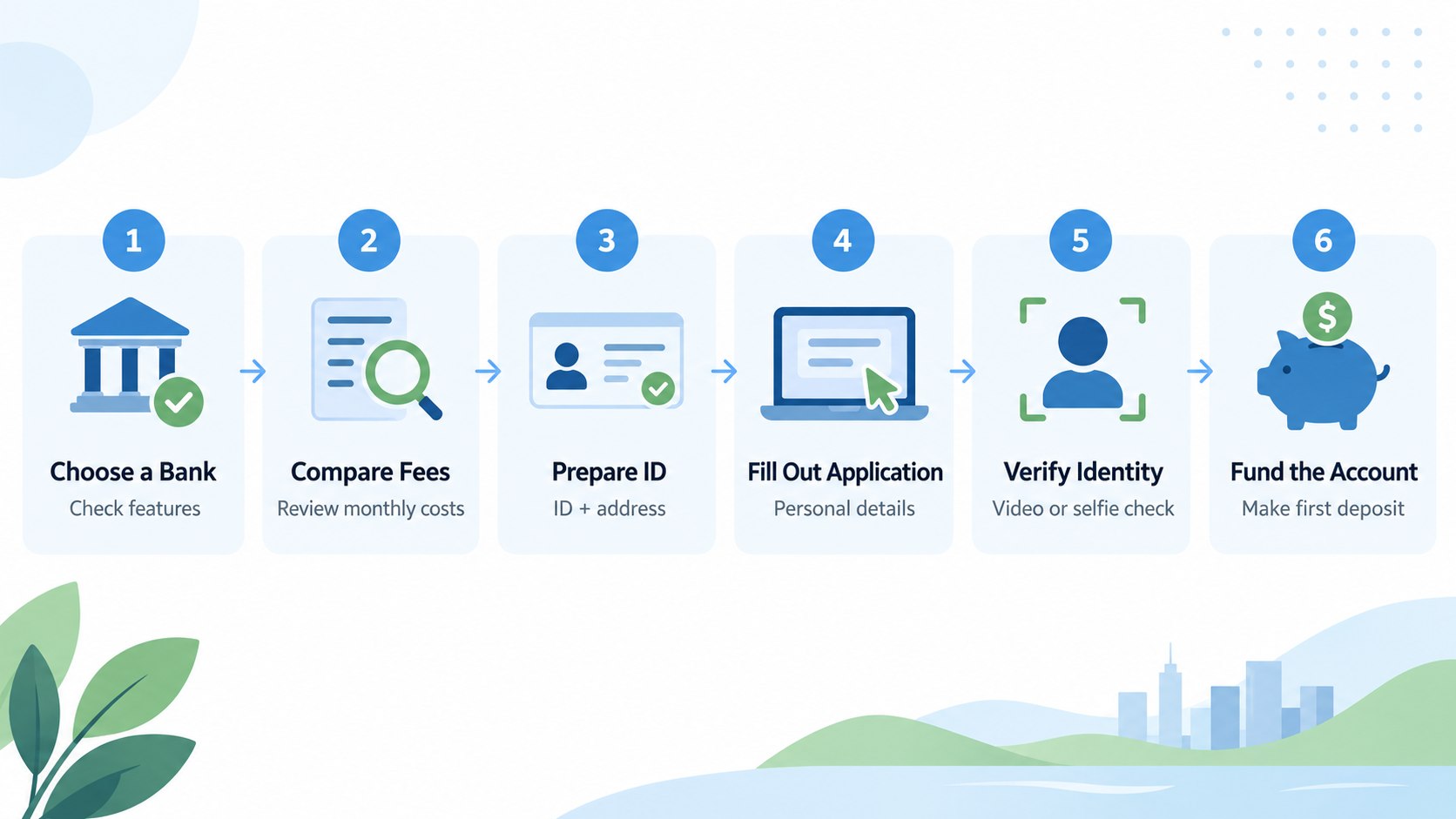
How to open a checking account online 2026 step by step
Step 1: Choose the right checking account
Start with the account’s fee schedule rather than its advertising page. Look for monthly maintenance fees, minimum balances, overdraft policies, ATM charges, and direct-deposit requirements.
This matters because a “free” account may become expensive when its fee waiver depends on monthly activity. A common mistake is choosing an account for a signup offer without reading the ongoing conditions.
People building an emergency fund should also consider whether checking and savings can be linked easily. Baltimore Chronicle’s explanation of how high-yield savings accounts work covers the differences between spending cash and interest-bearing reserves.
Step 2: Confirm the bank accepts your identification
Check the application requirements before submitting personal information. Common options include a driver’s license, state ID, U.S. passport, foreign passport, permanent resident card, or employment authorization card.
The exact list varies by institution. This matters most for immigrants and non-U.S. citizens because some identification is accepted only at physical branches.
A common mistake is assuming a foreign passport guarantees online approval. The document may satisfy identification rules while the bank’s automated system still requires an SSN or ITIN.
Step 3: Enter your SSN or ITIN when required
Most mainstream online applications request a taxpayer identification number. An SSN is standard for eligible U.S. applicants, while an ITIN can serve some people who are not eligible for an SSN.
The IRS explains the ITIN application process and requires Form W-7 plus supporting documentation. The IRS generally issues ITINs for federal tax purposes, not merely because someone wants a bank account.
This distinction matters because an ITIN is not a substitute immigration document. A common mistake is paying a third party that promises an instant ITIN solely for banking access.
“An ITIN is a 9-digit number issued by the U.S. Internal Revenue Service.”
Internal Revenue Service, Form W-7 guidance, describing taxpayer identification for people who cannot obtain an SSN.
Step 4: Prove your residential address
Enter the physical address where you actually live. Banks may request a lease, utility bill, pay stub, mortgage statement, vehicle registration, or another recent document.
This matters because automated systems compare the application against available records. Applicants who recently moved from California to Texas, for example, may encounter extra verification.
A common mistake is using a P.O. Box as the residential address. A mailing address may be added separately when the institution permits it.
Step 5: Complete identity verification
The bank may ask knowledge-based questions, request document images, verify a phone number, or compare information through third-party databases. Some institutions may also require a selfie or video verification.
Federal Customer Identification Program rules require banks to collect and verify identifying information. The FDIC’s GetBanked guidance lists SSNs, ITINs, passports, and other identification used during account opening.
This step matters because approval is not based only on the form being complete. A common mistake is repeatedly submitting applications after a verification failure, which can create additional identity conflicts.
Step 6: Fund the new account
Choose the funding method offered by the bank. Typical choices include ACH transfer, debit card funding, mobile deposit, cash at a branch, or another approved transfer.
| Funding method | Typical convenience | What to check |
|---|---|---|
| ACH transfer | Good for existing bank customers | Transfer limits and availability holds |
| Debit card | Fast when supported | Card funding limits |
| Cash at a branch | Useful without another account | Branch availability |
| Mobile check deposit | Convenient after enrollment | Deposit eligibility and hold periods |
The opening deposit can be $0 at some institutions, while others require $25 or more. Verify the current disclosure before starting. Do not confuse an opening deposit with a minimum balance required to avoid monthly fees.
Transferred money may also face an availability hold. That delay can matter when rent or utilities are due soon. Avoid closing the old account before every pending payment has cleared.
A new checking account should create more control over cash flow, not force essential bills through an account that has not been fully activated.
Step 7: Activate the account and secure it
Once approved, enroll in online banking and activate the debit card when it arrives. Set transaction alerts, low-balance alerts, and multifactor authentication where available.
This matters because unauthorized activity is easier to detect quickly when alerts are enabled. A common mistake is leaving the account untouched until the first direct deposit arrives.
Test a small transfer before moving an entire paycheck. Customers working on a broader financial profile can also review how to build credit from nothing in 2026. A checking account itself does not normally create a credit score.
Can you open a bank account without an SSN?
Yes, in some circumstances, but opening a bank account without an SSN is not the same as avoiding identity verification. Federal rules still require banks to identify customers. A non-U.S. person may be able to use an ITIN, passport number, alien identification number, or another qualifying government identifier.
The practical problem is the application channel. A bank may accept alternative identification at a branch while requiring an SSN or ITIN for its automated online form. Some national banks state that online checking applications require an SSN or ITIN and a physical U.S. address.
Someone without either number should contact the institution before applying. Ask specifically whether a branch can process a non-U.S. citizen using a foreign passport or consular identification.
No single national list guarantees approval because bank procedures vary. Eligibility can also differ between account types at the same institution.
SSN, ITIN and foreign ID options compared
The following categories explain why one applicant can finish online while another must appear in person.
| Identification route | Online availability | Typical additional requirement | Best fit |
|---|---|---|---|
| SSN | Widely supported | Government ID and U.S. address | Eligible U.S. applicants |
| checking account with ITIN | Supported by some banks | Photo ID and physical address | Applicants with valid ITINs |
| Foreign passport without SSN | More limited online | Branch visit may be required | Some non-U.S. customers |
| Consular or immigration ID | Institution-specific | Additional identification | Customers whose bank accepts that document |
An ITIN can improve access to online applications, but it does not guarantee approval. A passport can establish identity yet still fail an automated eligibility screen. Banks also consider fraud controls and their ability to verify the address.
Requirements can differ between Maryland, Florida, New York, Arizona, and other states because institutions serve different footprints. National banks often have broader branch networks, but their digital systems may use standardized criteria. Local credit unions can have different membership requirements.
Do not submit false identification information to fit an online form. An in-person application is safer than creating inconsistent records. Keep copies of documents presented and record the account terms accepted during enrollment.
Fees and account rules to check before clicking submit
A successful application can still produce a poor account choice. The most important online checking account requirements include both identity rules and the costs attached after approval.
- Check the monthly maintenance fee and every available waiver.
- Review overdraft and insufficient-funds policies before enabling optional coverage.
- Confirm access to fee-free ATMs near home and work.
- Check whether direct deposit is necessary for fee waivers or account benefits.
- Read incoming and outgoing transfer limits.
- Confirm FDIC insurance for a bank or NCUA insurance for a federal credit union.
- Review minimum opening deposits and ongoing balance requirements separately.
A $10 monthly fee costs $120 over 12 months. That is significant for an account used mainly for rent and household bills. Direct-deposit waivers can help workers with regular payroll.
Freelancers should check whether transfers from payment platforms count toward qualifying deposits. Parents opening joint accounts should also review ownership and access rules. Couples should decide whether each person needs an individual account alongside shared checking.
The cheapest account is not always the most useful. Reliable ATM access, bill payment, mobile deposits, and responsive fraud support can justify choosing one bank over another.
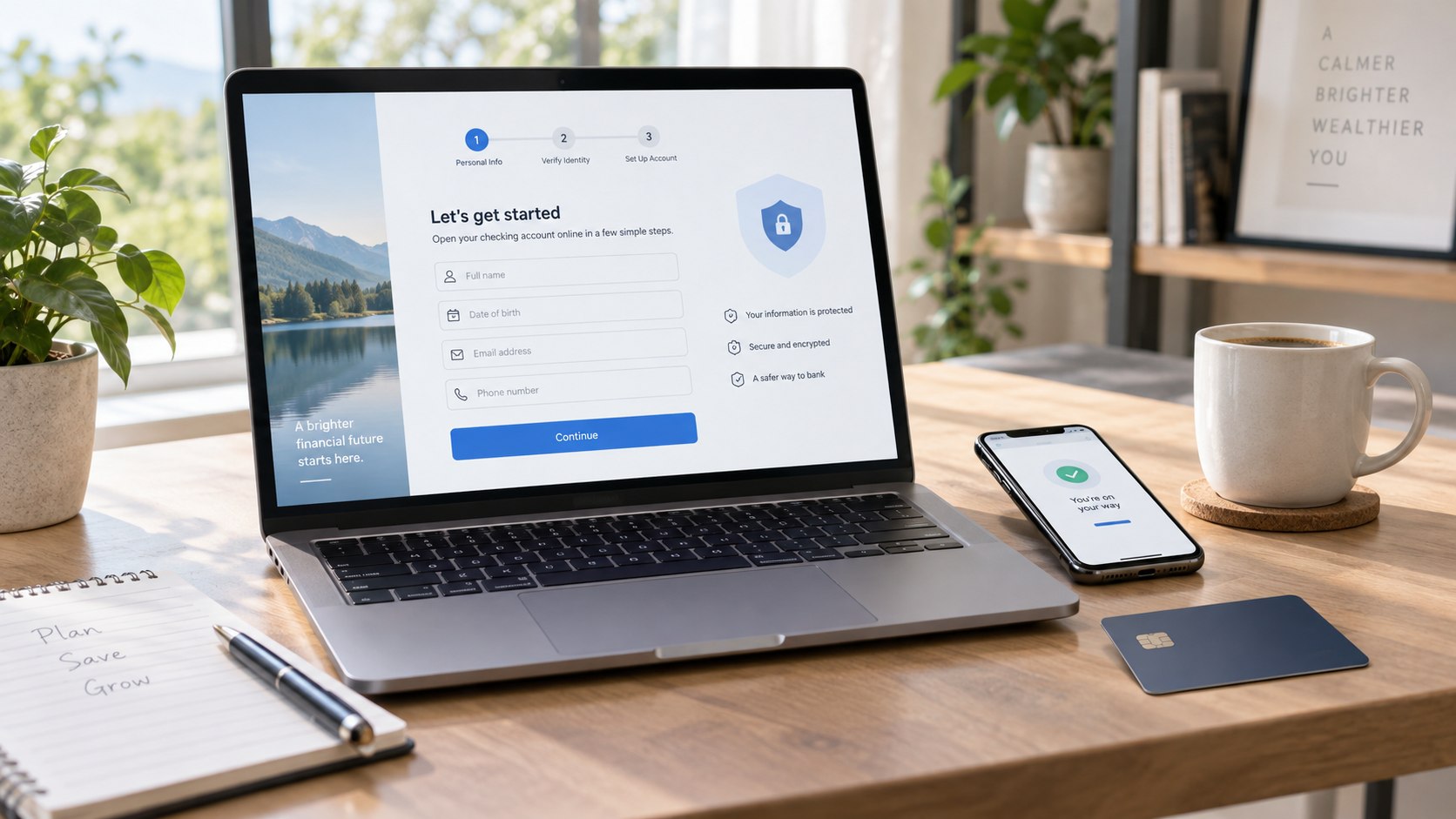
Troubleshooting an online checking account application
Automated approval systems fail for ordinary reasons. A rejection or verification message does not always mean the customer is ineligible.
- Address cannot be verified: use the exact address shown on current official documents or request branch review.
- No SSN: ask whether an ITIN works online or whether alternative identification is accepted in person.
- Recently moved: prepare a lease, utility bill, pay stub, or other current proof of address.
- Name mismatch: correct differences between passports, tax records, licenses, and the application before resubmitting.
- Application stalls after identity questions: contact the bank rather than repeatedly starting new applications.
Some applicants can solve the problem during a single branch appointment. Bring original documents rather than screenshots when the institution requires originals. A foreign passport may need to be current and undamaged.
Ask what specific category failed if the bank can disclose it. Do not send identity documents through ordinary email unless the bank provides an approved process. Fraudsters frequently imitate account-opening notices.
A legitimate bank will not ask for an online banking password from another institution. Funding another account should happen through a secure transfer process. Those precautions matter especially when searching for banks that accept ITIN 2026 through search engines.
FAQ
Can I open a checking account online in 2026 without visiting a branch?
Yes. Many U.S. banks and credit unions support fully online applications for eligible adults. Applicants usually need verifiable identification, an SSN or ITIN, a physical address, and contact information.
Can I open a checking account online without an SSN?
Sometimes. Some institutions accept an ITIN online, while customers without an SSN or ITIN may need a branch appointment. A foreign passport or other government identification may be accepted under the bank’s procedures.
Do banks check your credit when opening checking accounts?
Checking accounts usually do not rely on a traditional credit score for approval. Banks may use identity, fraud, and deposit-account screening systems instead. Policies vary by institution.
How much money do I need to open a checking account?
Some accounts have a $0 opening requirement. Others require $25, $50, or another amount. Check the bank’s 2026 disclosure because minimum deposits can change.
How long does opening a checking account online take?
A straightforward digital application often takes about 10 to 20 minutes. Manual identity or address verification can extend the process. Debit card delivery usually occurs after approval under the bank’s stated schedule.
Is an ITIN enough to open a checking account?
Not by itself. The bank usually needs identity and address information as well. An ITIN checking account application remains subject to the institution’s verification and eligibility rules.
Earlier we wrote about Apple Watch Without iPhone in 2026: Cellular Models, Family Setup and US Carrier Rules Explained