


Turo insurance options 2026 are protection choices that determine a guest’s financial responsibility when a booked vehicle is damaged. In the United States, Premier can reduce eligible physical-damage responsibility to $0, Standard caps it at $500, and Minimum caps it at $3,000. The important catch is that these limits do not cover every type of loss, according to the Baltimore Chronicle editorial team.
The practical decision is simpler than the insurance language suggests. Drivers should compare their existing auto coverage with the maximum amount they could comfortably pay after an accident. Turo protection is also different from a traditional rental-car damage waiver, so credit-card benefits should never be assumed to apply.
Key takeaways
- Premier limits eligible physical-damage responsibility to $0, while Standard uses $500 and Minimum uses $3,000.
- Turo prices protection at checkout, so there is no reliable single national 2026 price for each plan.
- Mechanical damage, interior damage, policy violations, and other excluded costs can remain the guest’s responsibility.
The dollar limits describe potential responsibility for eligible vehicle damage, not the price charged for the protection plan. Turo displays that price separately during checkout and can change its pricing. A cheaper protection choice can therefore create substantially greater exposure after an accident. A personal auto insurer may also become involved before Turo’s contractual limit applies. Drivers should compare the complete checkout price rather than the advertised daily vehicle rate.
Travelers Excess and Surplus Lines Company provides third-party liability insurance for US Turo trips under Turo’s current arrangement. Liability treatment can depend on state law and other applicable coverage.
In plain English
Think of a Turo protection plan as choosing how much financial risk remains on your side of the counter. A higher-cost plan can reduce exposure after eligible exterior damage. A lower-cost option leaves more money at risk if something goes wrong.
It is not identical to buying an ordinary auto insurance policy. Turo describes the physical-damage protection as a contractual limitation on what a guest owes. Third-party liability insurance operates separately.
“Don’t assume that your personal auto insurance policy or credit card coverage applies.”
Turo, US guest protection guidance, referring to peer-to-peer car-sharing bookings.
A driver who already has comprehensive and collision coverage may discover that the personal policy applies to a Turo vehicle. Another insurer may exclude peer-to-peer car sharing entirely. The policy wording matters more than whether someone casually calls Turo a “rental car.”
The $500 Standard limit sounds simple, but it should never be interpreted as a universal $500 deductible for every possible Turo claim.
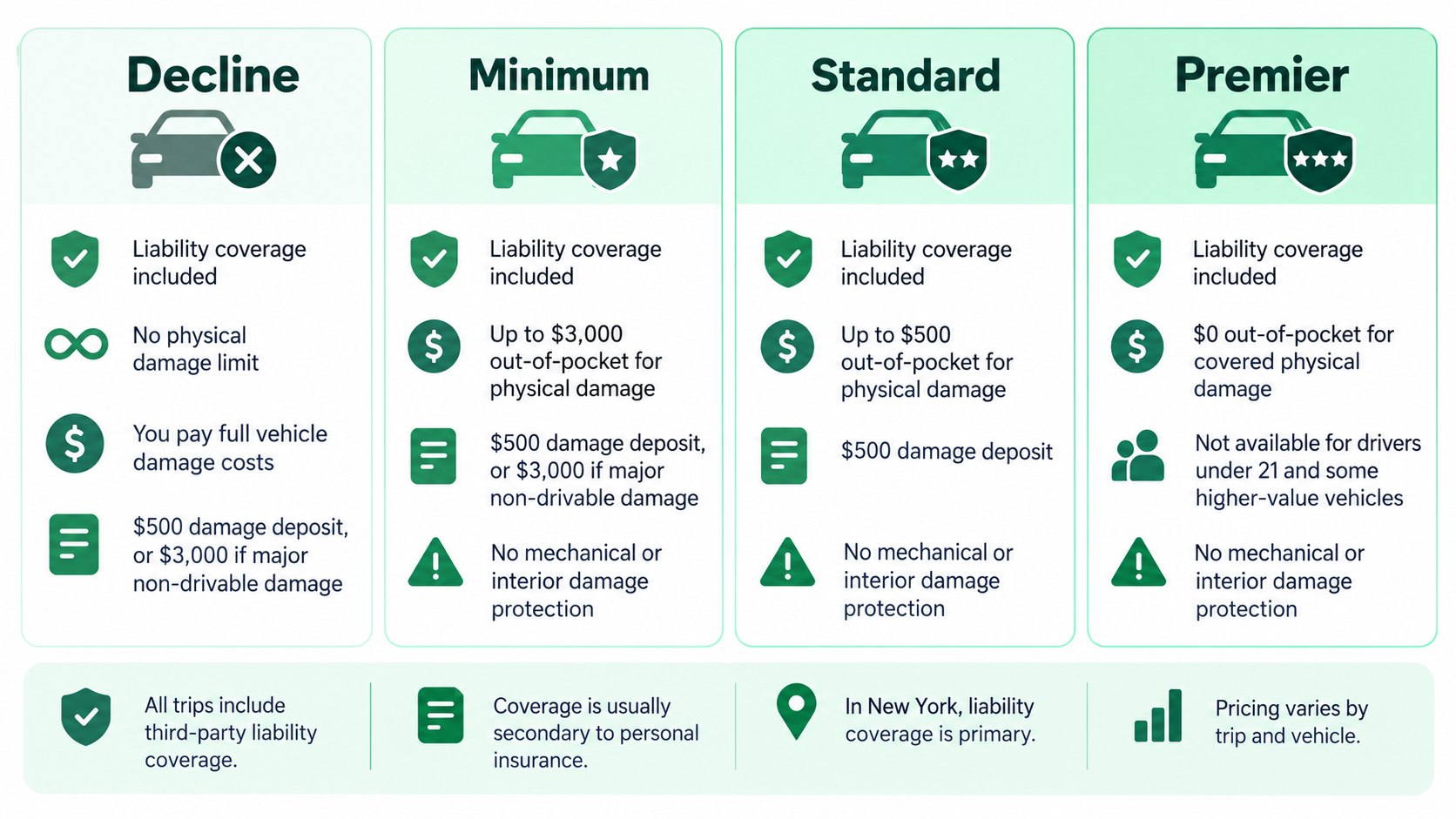
Turo insurance options 2026 compared
The three main paid choices differ most clearly in their treatment of eligible physical damage. Turo can also allow a guest to decline physical-damage protection on certain bookings.
| 2026 option | Eligible physical-damage responsibility | Important limitation |
|---|---|---|
| Premier | $0 contractual limit | Availability depends on driver, vehicle, and trip |
| Standard | $500 contractual limit | Mechanical and interior damage are excluded |
| Minimum | $3,000 contractual limit | Mechanical and interior damage are excluded |
| Decline, when available | No contractual physical-damage limit | Guest can remain responsible for eligible damage costs |
Premier provides the lowest eligible physical-damage exposure, but not every guest can select it. Turo states that drivers under 21 cannot choose Premier. Availability can also depend on vehicle value and trip details. Standard creates a much smaller maximum exposure than Minimum. Minimum can make sense only when the driver understands the possible $3,000 obligation.
Declining protection deserves greater caution. The guest can become responsible for vehicle damage, related costs, and claims expenses. That choice is more defensible when an insurer has confirmed applicable peer-to-peer coverage in writing.
For a broader booking overview, the Baltimore Chronicle guide on how to rent a car on Turo in 2026 explains age rules, fees, pickup, and protection together. Travelers comparing platforms can also review the Turo versus traditional rental comparison.
How it actually works
A guest first chooses a car, trip dates, and pickup arrangement. Turo then presents the protection choices available for that specific booking. The price appears as a separate checkout item rather than one permanent nationwide rate.
After an eligible accident, applicable personal insurance can become important. Turo’s US protection guidance describes its physical-damage contract as secondary to available personal insurance. Liability insurance is generally secondary as well, although state rules can change that order.
New York is a notable example. Turo states that trips there include $1.25 million in liability insurance with Premier, Standard, or Minimum. Maryland can also have different primary-coverage treatment because state law affects peer-to-peer car sharing.
Damage documentation can determine how smoothly a claim proceeds. Guests should photograph wheels, bumpers, glass, body panels, seats, and existing scratches before departure. Those images should be uploaded through Turo’s Trip Photos feature.
After the trip, another set of photos can establish the vehicle’s return condition. A few minutes of documentation can resolve a dispute that would otherwise depend on competing recollections.
What to check before paying
A driver should answer these questions before choosing Turo protection plans at checkout:
- Ask the personal auto insurer whether coverage extends to peer-to-peer car sharing.
- Check whether comprehensive and collision coverage follow the driver into a Turo vehicle.
- Verify whether the credit card excludes car-sharing platforms.
- Compare the plan price with the $0, $500, or $3,000 physical-damage exposure.
- Read exclusions for interior damage, mechanical damage, prohibited use, and unauthorized drivers.
Insurance representatives should be given the platform name rather than being asked only about “rental cars.” That wording matters because some policies distinguish traditional rentals from peer-to-peer sharing. A credit-card benefits administrator should receive the same specific question. Written confirmation is preferable when available. The final decision should use the actual checkout amount for that trip.
What the plans do not cover
The most expensive choice does not turn every incident into a $0 event. Turo says Premier, Standard, and Minimum do not contractually limit responsibility for qualifying mechanical or interior damage.
That distinction matters when a guest damages upholstery, causes mechanical harm through misuse, or violates platform rules. Parking tickets, tolls, fuel charges, and excess mileage are separate from physical-damage protection.
Turo guest insurance can also lose much of its value when the terms of service are violated. Turo states that prohibited use or reckless misuse can void the contractual limitation. A guest could then face liability extending to the vehicle’s actual cash value and related costs.
“We reserve the right to change protection plan pricing at any time.”
Turo, US guest protection summary, explaining why checkout pricing should be verified for each reservation.
This pricing approach also explains why old percentage charts found online can mislead. The amount shown for one Tesla Model 3 booking may not match another trip. Location, vehicle, dates, and trip characteristics can affect available choices.
The safest comparison uses the actual 2026 checkout price and the amount the household could absorb without borrowing money.
Who it matters to in 2026
Drivers who already own a car
Owners with full personal auto coverage should call their insurer before buying additional protection. Some policies can extend collision or comprehensive coverage to temporary vehicles. Others contain language that treats car-sharing differently.
The relevant question is not simply whether the policy covers rentals. The insurer should confirm whether it covers a vehicle booked through Turo specifically.
Renters and drivers without personal auto insurance
Someone without a personal auto policy has fewer layers to absorb physical-damage costs. That makes the difference between $500 and $3,000 more consequential.
A driver without personal collision coverage may therefore place greater value on Standard or Premier. The decision still depends on the plan price displayed for the booking.
Parents and younger drivers
Premier is unavailable to primary guests younger than 21 under current US rules. Younger guests may therefore face Standard or Minimum choices instead. Age-related booking charges can also change the total trip price.
Parents paying for a young adult’s trip should confirm who is the primary guest. Only approved drivers should operate the vehicle. An unauthorized driver can create serious protection problems after a crash.
Common myths
Several assumptions about Turo car rental insurance survive because traditional rental terminology gets applied to a different business model.
- Turo insurance coverage means every loss is covered. Correction: interior, mechanical, and excluded damage can remain outside the contractual limit.
- A credit card automatically covers Turo. Correction: many benefits distinguish peer-to-peer sharing from conventional rentals.
- Standard means the most anyone can ever owe is $500. Correction: the limit applies only to eligible physical damage under its terms.
- Premier is available on every vehicle. Correction: age, vehicle value, trip details, and other factors can restrict availability.
- Declining protection removes all Turo-related insurance. Correction: third-party liability arrangements still apply under applicable terms and state law.
The language used at checkout deserves more attention than the plan name. “Premier” describes a protection tier, not unlimited insurance against every expense. “Minimum” does not mean minimum state liability coverage alone. It also establishes a $3,000 contractual physical-damage limit for eligible losses. The official Turo US guest protection summary should be checked before paying.
Which Turo protection option makes sense?
Standard offers the clearest middle ground for many risk-sensitive travelers. Its $500 eligible physical-damage limit is far below Minimum’s $3,000 exposure. The correct choice still depends on price and existing coverage.
Premier is easier to justify when a driver wants minimal eligible physical-damage exposure. It can also suit households that would struggle with an unexpected repair bill. Availability remains a significant constraint.
Minimum is more reasonable when $3,000 would be manageable and the price difference is meaningful. Declining protection requires the strongest understanding of existing insurance. It should not be selected merely because the checkout total becomes cheaper.
Hosts face a different protection structure from guests. Owners considering the other side of the marketplace can read Baltimore Chronicle’s guide on how to list a car on Turo in 2026.
Editorial checklist before booking
Before confirming a reservation, save the insurance answer, inspect the checkout page, and document the vehicle. These steps reduce uncertainty without adding much time.
- Confirm peer-to-peer coverage with the personal auto insurer.
- Check the credit card’s written car-rental exclusions.
- Compare Premier, Standard, and Minimum using the actual checkout price.
- Photograph every exterior side, wheel, glass surface, and major interior area.
- Add every person who may drive as an approved additional driver.
- Save receipts for fuel, charging, tolls, parking, and trip-related payments.
A driver should also read the host’s pickup and return instructions before departure. Photograph the fuel level or battery percentage during both handoffs. Report new damage through the platform rather than relying on private messages alone. Keep screenshots of the selected protection plan and final checkout amount. Those records can become useful when a claim involves several parties.
FAQ about Turo insurance options in 2026
Does Turo include insurance in 2026?
US Turo trips include third-party automobile liability insurance under the platform’s applicable arrangement. Physical-damage responsibility depends on the guest protection option selected.
What is the Turo Standard protection limit?
Standard limits a primary guest’s eligible physical-damage responsibility to $500 under current US terms. Mechanical and interior damage do not receive that same contractual limit.
How much can a guest owe with Turo Minimum?
Minimum carries a $3,000 contractual limit for eligible physical damage. Other excluded costs can remain outside that amount.
Does Turo Premier have a deductible?
Premier provides a $0 contractual out-of-pocket limit for eligible physical damage. It does not eliminate responsibility for every possible charge or excluded loss.
Does personal auto insurance cover a Turo rental?
It depends on the insurer and policy. Drivers should specifically ask whether their coverage extends to peer-to-peer car sharing through Turo.
Does credit-card rental insurance cover Turo?
Not automatically. Some card benefits exclude peer-to-peer vehicle sharing even when they cover cars rented from traditional companies.
Earlier we wrote about Home Addition Cost 2026: What 300, 400 and 500 Sq Ft Projects Can Cost