


Turo vs traditional car rental 2026 comes down to 3 things: final checkout cost, insurance exposure, and pickup hassle. Most travelers should choose a traditional rental for predictable airport travel and easier replacement support. Turo is better when vehicle choice, neighborhood pickup, or a longer stay matters more, as noted by the Baltimore Chronicle editorial team.
The cheapest option cannot be identified from the advertised daily rate alone. Turo can add a trip fee, protection, delivery, airport charges, or deposits. Enterprise, Hertz, Avis, and similar agencies can add taxes, airport fees, protection products, fuel charges, and driver fees. A $45 headline rate can therefore lose to a higher-priced offer at checkout.
Key takeaways
The practical choice becomes easier when the reservation is judged by its final price and risk, rather than its promotional rate.
- Turo often offers more vehicle choice, but fees and protection can materially change the final checkout price.
- Traditional agencies usually provide easier vehicle replacement when a car breaks down or develops a problem.
- Drivers should check personal insurance and credit-card benefits before paying for any optional protection product.
Search both options for the same dates and pickup area. Compare the amount due before booking, not the first daily price shown. Check mileage limits, fuel rules, cancellation terms, and additional-driver costs. Airport travelers should also compare rideshare and transit costs to the rental itself. Baltimore Chronicle’s Uber vs. Lyft price comparison for 2026 provides another benchmark for short trips.
At a glance
The differences are clearest when both models are compared around the problems that create unexpected bills.
| Factor | Turo | Traditional rental |
|---|---|---|
| Price structure | Host price plus platform costs, protection, delivery, and possible airport charges | Base rate plus taxes, facility fees, protection, fuel, and optional extras |
| Vehicle choice | Specific models may be bookable | Usually a vehicle class, not a guaranteed model |
| Pickup | Host location, delivery, remote handoff, or permitted airport location | Rental counter, garage, shuttle facility, or neighborhood branch |
| Insurance | Turo protection plans are contractual protection products | Agency waivers and protection products vary by company and location |
| Breakdown replacement | Depends on host, availability, and platform process | Large fleets can make replacement easier |
| Mileage | Host listing can impose a distance allowance | Unlimited mileage is common on many bookings, but not universal |
| Additional drivers | Must follow Turo’s approved-driver rules | Agency rules and daily charges can apply |
| Drivers under 25 | A young-driver fee can apply | Young-renter surcharges are common |
| Damage process | Photos and trip documentation are especially important | Handled through the rental company and applicable protection |
No column wins every trip. A 2-day airport rental has different economics from a 3-week suburban booking. Location also matters because airport charges can distort both prices. Vehicle availability changes the result again during holidays and major events. The correct comparison is always the final reservation for the same dates, vehicle size, mileage needs, and protection level.
For cost comparisons, treat the checkout total as the starting price and every unresolved insurance question as potential additional cost.
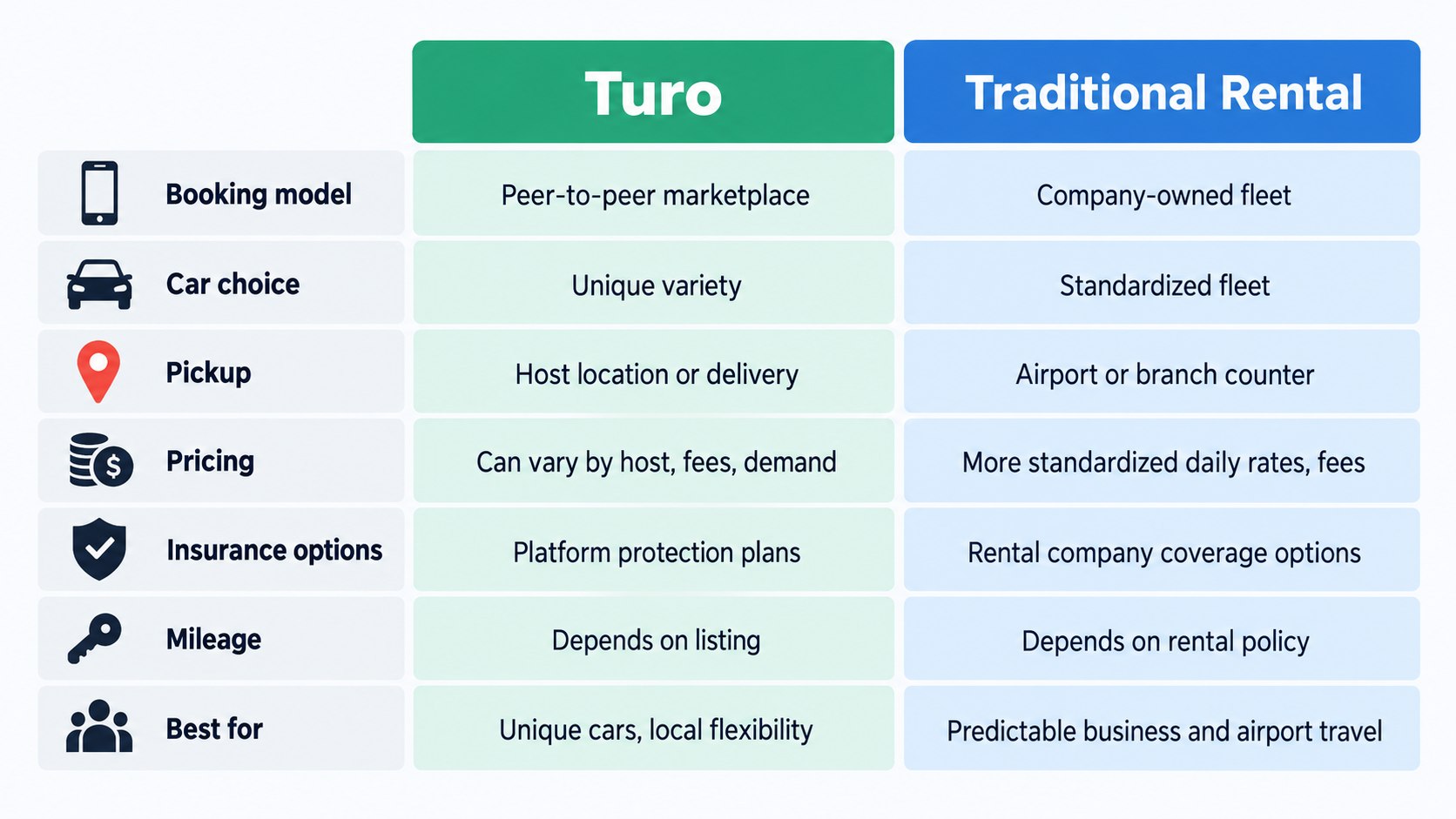
Turo vs traditional car rental 2026: what actually costs less
Turo rental costs in 2026 begin with the host’s vehicle price, but that number is only one component. The platform can also show trip fees, protection costs, delivery charges, airport-related costs, taxes, and applicable deposits. Turo says trip fees can vary, while young-driver fees apply to US guests under 25. Details are available in Turo’s official trip-cost guidance.
A traditional reservation has its own layers. The displayed rate can be followed by state taxes, airport concession charges, optional Damage Waiver, roadside products, child seats, fuel plans, or additional-driver charges. Enterprise currently lists a daily additional-driver charge in most US situations, with several exceptions. Current conditions should be checked on the company’s official site before booking.
That makes nationwide claims such as “Turo is always cheaper” unreliable. Prices in Miami, Phoenix, Los Angeles, New York, Dallas, and Baltimore react to very different supply conditions. A Toyota Corolla from a local host may beat an airport counter. A corporate weekly rate from Enterprise or Hertz may reverse the comparison.
Airport location is particularly important. A rental counter can carry facility charges, while Turo airport delivery can involve permitted pickup areas and airport-specific fees. Travelers using BWI can compare those costs with the Baltimore Chronicle guide to BWI transportation to Downtown Baltimore.
Turo works best when vehicle choice matters
The biggest advantage of Turo vs rental car companies is that shoppers can often select an actual listed vehicle. Someone needing a Tesla Model 3, Ford Bronco, Toyota Sienna, or pickup can search those listings directly. Traditional agencies generally sell classes such as midsize SUV or full-size sedan.
Pros, cons, and ideal user
The strongest Turo use case is a planned trip with flexible pickup arrangements. It also suits renters who care about a particular model. Neighborhood inventory can eliminate the journey to a distant rental counter.
The weaknesses appear when plans change. Pickup quality depends partly on the individual host and handoff method. A late flight can be more awkward when the reservation requires coordination with one vehicle owner. Replacement inventory also lacks the simplicity of walking back to a large fleet desk.
“These plans are not insurance.”
Turo uses that wording for its US guest protection plans. The company describes them as contracts limiting a guest’s financial responsibility for eligible physical damage. Its current US guest protection information lists Premier, Standard, Minimum, and a decline option. Standard currently limits qualifying out-of-pocket physical-damage responsibility to $500 after applicable insurance. Minimum carries a $3,000 contractual limit under stated conditions.
The ideal Turo customer reads those conditions before booking. That matters more than finding a vehicle priced $8 lower per day.
Traditional rental wins on standardization and backup
Traditional car rental in 2026 remains easier for many business trips, airport arrivals, family vacations, and disrupted itineraries. Enterprise, Avis, Hertz, Budget, National, and Alamo operate around standardized rental agreements and fleet-based operations.
The main benefit is operational redundancy. When one vehicle develops a mechanical problem, a staffed company may have another vehicle available. A traveler arriving after a canceled flight can also find a counter easier to manage than a time-sensitive private handoff.
Traditional rental has its own friction. Counter lines can be long. Debit-card policies may be restrictive. The reserved class may be available without the model pictured online. Optional products can also make the final bill much higher than the original search result.
“Damage Waiver is not insurance.”
Enterprise uses that exact language when explaining its optional Damage Waiver. The company states that DW can contractually waive responsibility for some damage, loss, or theft. It also advises customers to check personal auto insurance and credit-card protection first.
A familiar rental-company logo does not remove financial risk; the signed agreement still controls what happens after damage.
Insurance is where the cheaper booking can become expensive
The most important part of any Turo insurance comparison is determining what existing coverage follows the driver. A personal auto policy may treat a rental-company vehicle differently from a peer-to-peer car-sharing vehicle. Credit-card rental benefits can also contain exclusions for car-sharing platforms.
Turo’s Standard guest plan currently sets a $500 contractual out-of-pocket limit for eligible physical damage after applicable insurance. Its Minimum plan uses a $3,000 limit. Interior and mechanical damage have separate treatment under the policy terms. Turo also says primary guests remain responsible for eligible damage during their booked trip.
Traditional agencies also sell optional products instead of one universal “rental insurance” package. Enterprise offers Damage Waiver, Supplemental Liability Protection, Personal Effects Coverage, and roadside protection. Prices depend on the vehicle and location.
Before paying, drivers should complete a short insurance check.
- Ask the personal insurer whether coverage extends to Turo or other peer-to-peer car sharing.
- Ask whether collision and comprehensive coverage follow a traditional rental vehicle.
- Check the credit card’s benefits guide for car-sharing exclusions and vehicle restrictions.
- Record deductibles and maximum benefits before comparing optional protection costs.
- Photograph every side, wheel, windshield, and interior before driving away.
Do not rely on a customer-service assumption when several thousand dollars may be involved. Get the policy answer from the insurer or card benefit administrator. Save screenshots of the reservation terms. Keep pre-trip and post-trip photos until the transaction closes. After an accident, report it through the required channels promptly.

Which should you buy in 2026
The choice between Turo or rental car should follow the trip, rather than loyalty to either platform.
- If airport reliability matters most, then start with Enterprise, National, Hertz, Avis, or another staffed fleet operator.
- If a specific model matters most, then check Turo because the listing can identify the actual vehicle.
- If the booking lasts several weeks, then compare both complete checkout totals before choosing.
- If personal insurance excludes peer-to-peer sharing, then price Turo with suitable protection included.
- If plans may change repeatedly, then favor the option with simpler cancellation and replacement terms.
Families should also price additional drivers and child seats before paying. Younger renters need to check surcharges on both sides. Long-distance travelers should examine mileage allowances before choosing a cheaper daily rate. Remote arrivals require a close look at pickup instructions and return timing. A difference of $30 can become irrelevant when one option creates an extra hour of transportation or coordination.
Traditional rental is the safer default for a traveler who values standardized procedures. Turo becomes stronger when vehicle choice and pickup geography solve a specific problem. Neither platform deserves the booking until taxes, fees, mileage, protection, and delivery are visible. That final screen is the meaningful car rental price comparison 2026.
FAQ
Is Turo cheaper than Enterprise in 2026?
Sometimes, but not consistently. Compare Turo’s complete checkout price with Enterprise’s final estimated total for identical dates and vehicle sizes. Airport location, trip fees, protection, taxes, and extras can change the result.
Does personal car insurance cover Turo?
Coverage depends on the insurer and policy. Some policies may cover peer-to-peer car sharing differently from conventional rentals. Confirm the answer directly with the insurance company before booking.
Is Turo protection the same as rental car insurance?
No. Turo describes its guest protection plans as contractual limits on financial responsibility, not insurance products themselves. Third-party liability arrangements and personal insurance can interact separately.
Which option is easier after a breakdown?
A traditional rental company usually has an operational advantage because it manages a fleet. Turo assistance depends on platform procedures, the individual reservation, and replacement availability.
Is Turo better for long-term rentals?
It can be competitive for longer bookings, particularly where hosts apply longer-trip pricing. Traditional agencies also offer weekly and monthly rates. Compare final totals, mileage, insurance, and cancellation conditions.
What should be checked before booking either option?
Check the final price, mileage allowance, fuel rules, insurance exposure, deposit, additional drivers, cancellation terms, and return instructions. These items matter more than the advertised daily rate.
Earlier we wrote about How to Grow Instagram Followers 2026: Real Tactics Using Reels, Insights and Profile Conversion