

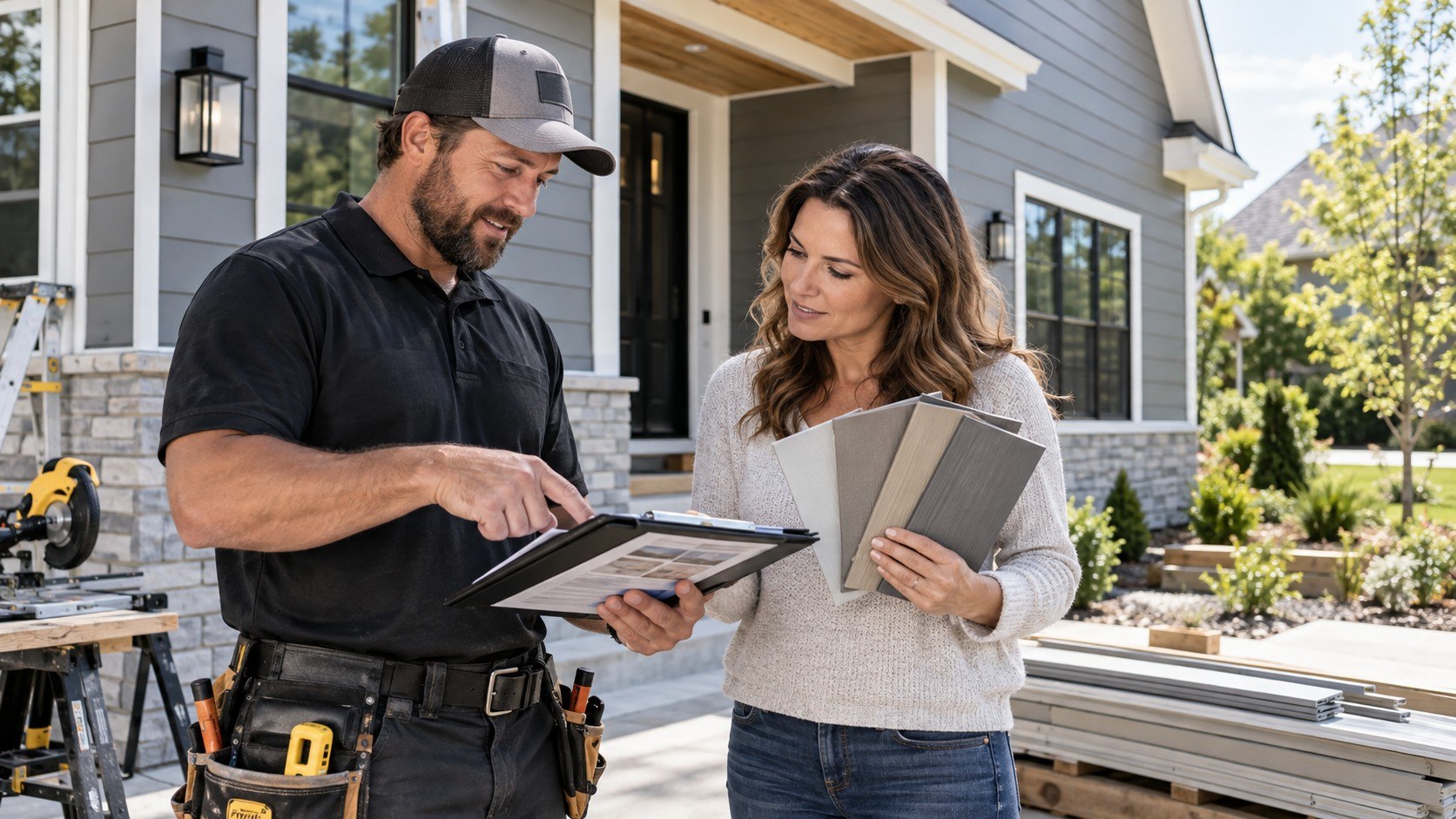
Siding replacement cost USA 2026 typically falls between $8,500 and $20,000 for a full-house project. Smaller, straightforward jobs can approach $5,500, while complex homes using premium materials can exceed $30,000. Vinyl usually sits at the affordable end. Fiber cement and natural wood require larger budgets. The practical number depends on exterior wall area, removal work, labor, trim, and hidden damage, as noted by Baltimore Chronicle.
For a homeowner comparing bids, the biggest mistake is pricing siding only by the visible square footage. Corners, windows, doors, soffits, damaged sheathing, disposal, and scaffolding can materially change the contract. A $12,000 proposal and a $17,000 proposal may cover very different scopes.
Key takeaways
- A practical 2026 planning range is about $8,500 to $20,000, although large or complicated projects can exceed $30,000.
- Vinyl usually costs less than fiber cement or wood, but preparation and labor can narrow that price difference.
- Compare removal, sheathing repairs, trim, permits, cleanup, and warranties before treating the lowest estimate as the cheapest option.
Those figures are budgeting ranges rather than nationwide fixed prices. Regional labor conditions can produce major differences between California, Texas, Maryland, Florida, and Ohio. Coastal exposure, wildfire concerns, wind requirements, and winter weather can also affect product selection. House design matters just as much as state location. A simple ranch is usually cheaper to side than a 2-story house with dormers and multiple roof intersections.
Before signing anything, compare the scope line by line. Baltimore Chronicle’s guide on how to read a construction estimate explains how exclusions, allowances, and change orders can alter the final bill. Homeowners should also separate cosmetic siding problems from moisture or structural defects.
The useful question is not simply, “What does siding cost per square foot?” It is, “What work is actually included in that square-foot price?”
Siding replacement cost USA 2026 by material
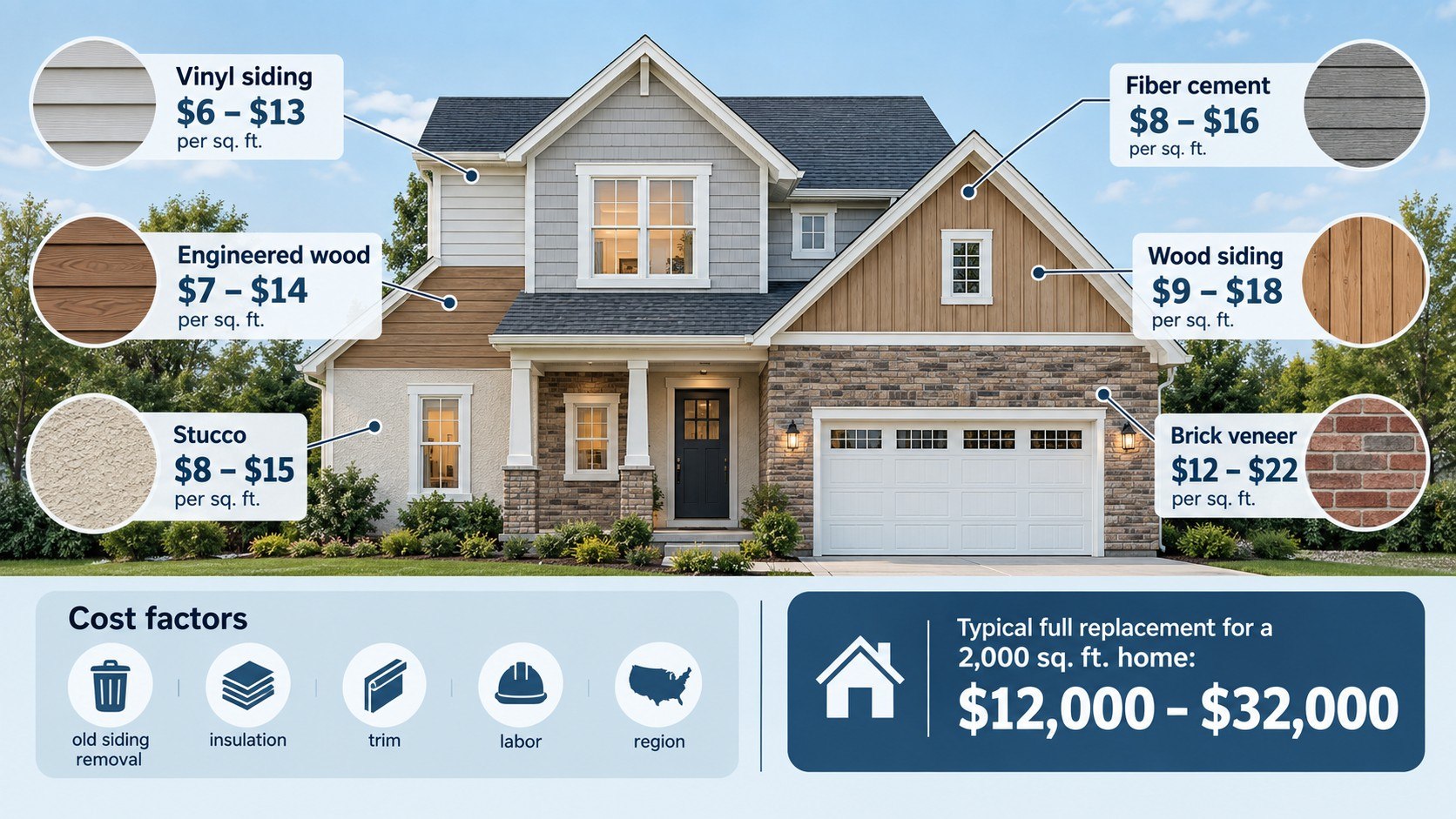
The material decision creates the first major price split. Current 2026 national estimates place installed siding across a wide range, depending on product and project complexity. Vinyl remains among the lower-cost choices, while wood and fiber cement commonly move higher.
| Material | Typical 2026 installed range | Main budget issue |
|---|---|---|
| Vinyl siding | About $4–$12 per sq ft | Profile, thickness, insulation, trim, and wall preparation |
| Fiber cement | About $6–$14 per sq ft | Heavier material and more demanding installation |
| Wood siding | About $5–$15 per sq ft | Species, finish, labor, and long-term maintenance |
These ranges work better as comparison tools than as quote calculators. A contractor may price removal separately, while another includes demolition in the installed rate. One proposal may include housewrap and flashing but exclude rotten sheathing. Another may include standard trim yet charge separately for decorative details.
Vinyl siding replacement cost often appeals to homeowners controlling upfront expenses. Products from manufacturers such as CertainTeed, Mastic, and Ply Gem appear widely in US markets. Insulated vinyl and premium profiles can move the project beyond basic vinyl pricing.
Fiber cement brings different economics. James Hardie states that its Hardie Plank products carry a 30-year non-prorated limited transferable substrate warranty. Product availability, finishes, installation requirements, and warranties should be verified through James Hardie’s official product information.
“Proper installation is imperative for all cladding materials.”
James Hardie installation guidance, referring to correct product performance and appearance.
Wood remains attractive when authentic material is part of the home’s architecture. Cedar and other natural products can require staining, painting, or sealing during ownership. That maintenance cost belongs in the decision, even when the initial quote looks competitive.
What drives the price
Exterior wall area
Contractors price the surface being covered, not the home’s interior floor area. A 2,000 sq ft single-story house and a 2,000 sq ft 2-story house can have different siding quantities. Wall height, attached garages, gables, additions, and architectural projections all change measurements.
Removal of existing siding
Tear-off creates labor and disposal costs before new material reaches the wall. Multiple existing layers increase the workload. Disposal charges also vary by municipality, landfill, and container requirements.
The removal stage can expose problems that were invisible during estimating. Soft sheathing, missing flashing, insect damage, or chronic moisture intrusion can create change orders. A pre-project exterior review helps, but siding itself can conceal wall conditions.
Material and product line
Fiber cement siding cost is influenced by product style, finish, trim package, and installation requirements. Vinyl pricing also changes substantially between builder-grade panels and insulated premium products. Natural wood varies by species, grade, profile, and finish.
Brand alone does not establish the installed price. CertainTeed, James Hardie, LP Building Solutions, Mastic, and regional suppliers all sell multiple product families. The contractor’s labor system and supplier relationship also matter.
House complexity
A long uninterrupted wall is fast to cover. Bay windows, dormers, steep grade changes, chimneys, decks, utility penetrations, and decorative bands slow production. Second-story work can require additional access equipment and safety procedures.
Wall repairs and weather protection
New siding should not become a decorative cover for an unresolved leak. Homeowners who see stains or soft wall sections may benefit from a broader home inspection checklist before committing the renovation budget.
Water-resistive barriers, flashing details, window transitions, and penetrations matter because siding is one part of an exterior wall assembly. Fixing hidden damage now costs more than simply hanging panels. Ignoring it can be much more expensive later.
Price breakdown
A complete siding proposal contains more than panels or planks. The following ranges show where money can appear inside a 2026 estimate. Exact costs remain dependent on local labor and site conditions.
| Line item | Typical 2026 planning cost |
|---|---|
| Vinyl siding installation | About $4–$12 per sq ft |
| Fiber cement installation | About $6–$14 per sq ft |
| Wood siding installation | About $5–$15 per sq ft |
| Existing siding removal | Often about $0.50–$2 per sq ft |
| Permits and local fees | Often $150–$1,500, depending on jurisdiction |
| Sheathing or structural repairs | Project-specific after damaged areas are exposed |
Published 2026 cost estimates vary noticeably between providers. That gap illustrates why one national average cannot describe every house.
A quote should identify who handles demolition, debris, housewrap, flashing, trim, caulk, painting, and permits. Ask whether window and door trim is included. Confirm treatment around hose bibs, vents, electrical boxes, and exterior lights.
Also check what happens if rotten OSB or plywood appears after demolition. The contract should state a unit price or clear approval process. That protects both parties from an undefined repair bill.
A lower contract price can become the expensive bid when demolition, repairs, trim, cleanup, and permits appear later as additions.
Ways to save in 2026
Reducing the budget does not require choosing the cheapest panel available. Better savings come from controlling scope, timing, specifications, and contractor comparisons.
- Get at least 3 written bids using the same material specification and project scope.
- Ask each bidder to separate tear-off, installation, trim, repairs, permits, and disposal.
- Keep the existing siding profile when changing the design would create expensive trim modifications.
- Choose standard manufacturer colors before paying premiums for uncommon finishes or custom painting.
- Bundle soffit or fascia work when crews already have access equipment at the property.
- Resolve gutter, roof, and flashing problems before new siding covers the affected transitions.
- Ask whether off-season scheduling changes labor availability in your local market.
The savings begin with comparable bids. The Federal Trade Commission advises consumers to obtain multiple estimates and review written contracts carefully. It also recommends checking licenses and insurance where applicable. Its home improvement contractor guidance warns against pressure for immediate decisions or full payment upfront.
“Get multiple estimates.”
Federal Trade Commission, Consumer Advice guidance for home improvement projects.
Do not remove useful scope merely to reach an arbitrary target price. Flashing and moisture protection are poor places to economize. The same applies to correcting deteriorated sheathing discovered during demolition.
Homeowners coordinating siding with roof work should review signs that a roof needs replacement. Shared access and flashing details can make project sequencing important. Replacing siding first and disturbing it later for roof-related wall work creates avoidable labor.
Material substitutions deserve careful review. Moving from premium fiber cement to basic vinyl can reduce cost significantly. Dropping from one vinyl product line to another may save far less once labor remains unchanged.
When paying more makes sense
Higher spending can be rational when the premium solves a specific problem. It should buy measurable scope, better preparation, suitable material, or stronger installation support.
- Pay more for wall repairs when removal exposes wet, rotten, or structurally compromised sheathing.
- Consider higher-grade products when severe weather exposure makes durability a larger ownership concern.
- Spend on skilled detailing when the house has many windows, roof intersections, corners, or architectural features.
- Consider factory-finished products when they reduce immediate field painting and fit the maintenance plan.
The expensive material is not automatically the best material. A modest house with uncomplicated walls may perform well with properly installed vinyl. A coastal or high-exposure property may justify a different specification.
Installation quality also affects value. Fiber cement is heavier and requires product-specific cutting, clearances, fastening, and flashing practices. Vinyl must accommodate expansion and contraction rather than being fastened rigidly.
Cost to replace siding on a house should therefore be evaluated over the planned ownership period. A household expecting to move soon may value lower initial expenditure. A long-term owner may place greater weight on maintenance and material durability.
Resale value should remain secondary to the condition of the wall. New cladding has limited value when moisture damage remains underneath it.
Vinyl vs. fiber cement vs. wood
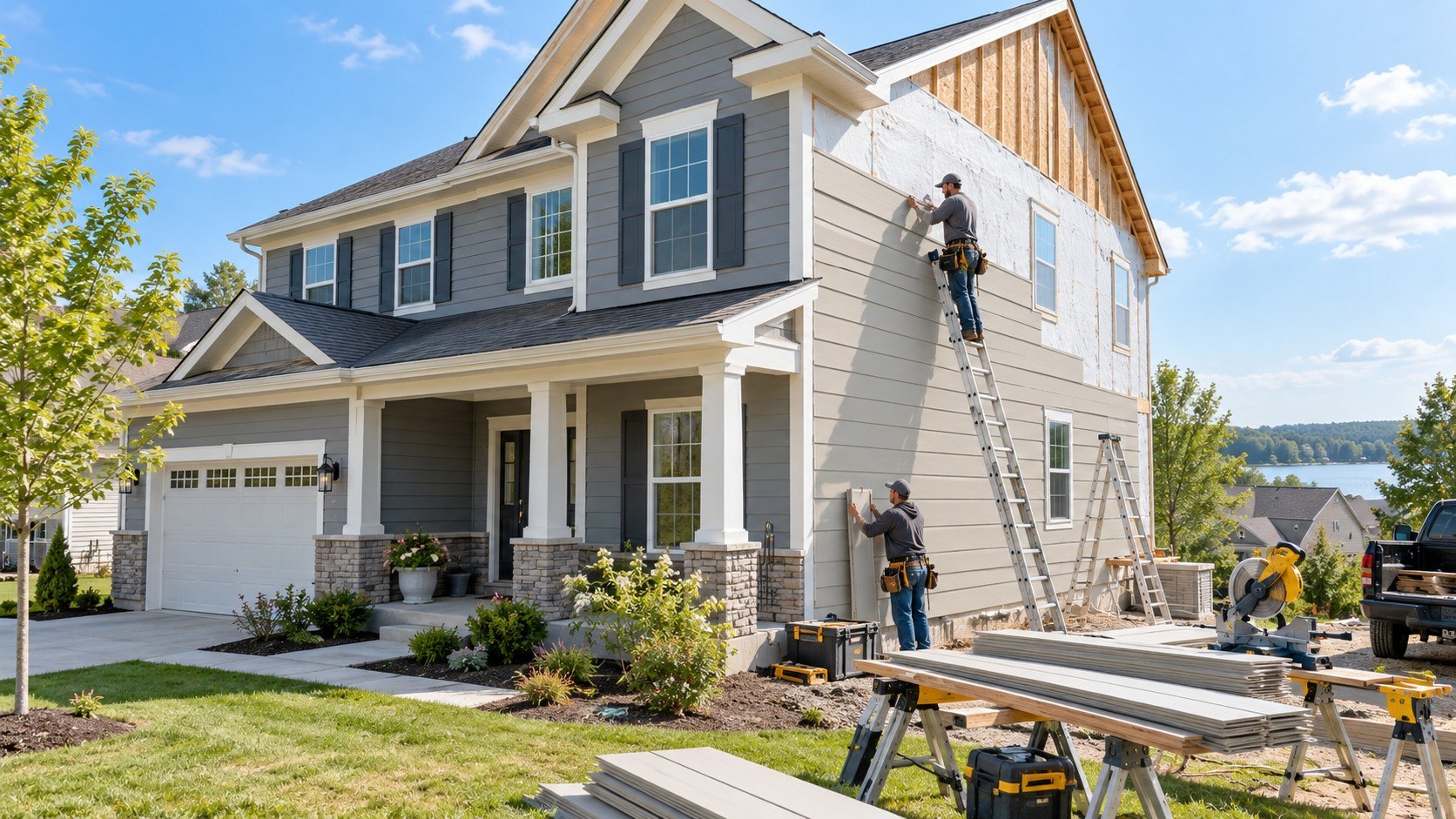
For many homeowners, the final choice comes down to these 3 materials. Their visual character, installation requirements, maintenance, and initial costs differ enough to affect the entire project strategy.
| Factor | Vinyl | Fiber cement | Wood |
|---|---|---|---|
| Initial cost | Usually lower | Usually mid-to-high | Mid-to-high |
| Painting | Usually unnecessary | Depends on finish | Common over service life |
| Weight | Light | Heavy | Moderate |
| Maintenance | Relatively low | Relatively low | Usually higher |
| Appearance | Many profiles and colors | Plank, panel, shingle styles | Natural grain and traditional character |
Wood siding replacement cost becomes easier to justify when preserving architectural character matters. Cedar can look appropriate on Craftsman homes, cabins, and traditional houses. That appearance comes with maintenance obligations.
Vinyl works differently. It is lightweight, widely available, and usually needs little finish maintenance. Premium insulated products cost more and should not be compared with basic panels solely by brand.
Fiber cement occupies a middle ground between manufactured consistency and a wood-like appearance. Products such as Hardie Plank are designed for exterior cladding and offered in several textures and finishes. Installation details remain important to warranty and performance.
The best bid identifies the exact manufacturer, product line, profile, exposure, color, trim system, and warranty. “Premium siding” is not a useful specification.
FAQ
How much does siding replacement cost in the USA in 2026?
Many full replacement projects fall around $8,500 to $20,000. Smaller projects can approach $5,500, while premium or complicated work can exceed $30,000.
How much is vinyl siding per square foot in 2026?
A practical national planning range is roughly $4 to $12 per sq ft installed. Premium profiles, insulation, difficult access, and repair work can raise the total.
Is fiber cement more expensive than vinyl?
Usually, yes. Fiber cement commonly requires more expensive material and more demanding labor. The gap varies by contractor, finish, house design, and local market.
Should old siding always be removed first?
Not in every assembly. However, removal allows contractors to inspect the wall beneath the existing cladding. Local codes and manufacturer instructions should guide the decision.
How many siding estimates should a homeowner get?
Three written estimates provide a useful comparison for many projects. Give every contractor the same requested specifications and compare exclusions before comparing totals.
What should a siding estimate include?
It should define materials, quantities, removal, disposal, trim, weather barrier work, repairs, permits, cleanup, warranty terms, and payment milestones. Any allowance should state what it covers.
Earlier we wrote about What Is a HELOC and How Does It Work in 2026? The Draw Period, Variable Rates and Repayment Explained