


What is the new NAR commission rule 2026: it is the post-settlement real estate rule that requires many buyers to sign a written agreement before touring a home and removes buyer-agent compensation offers from MLS listings, as noted by Baltimore Chronicle.
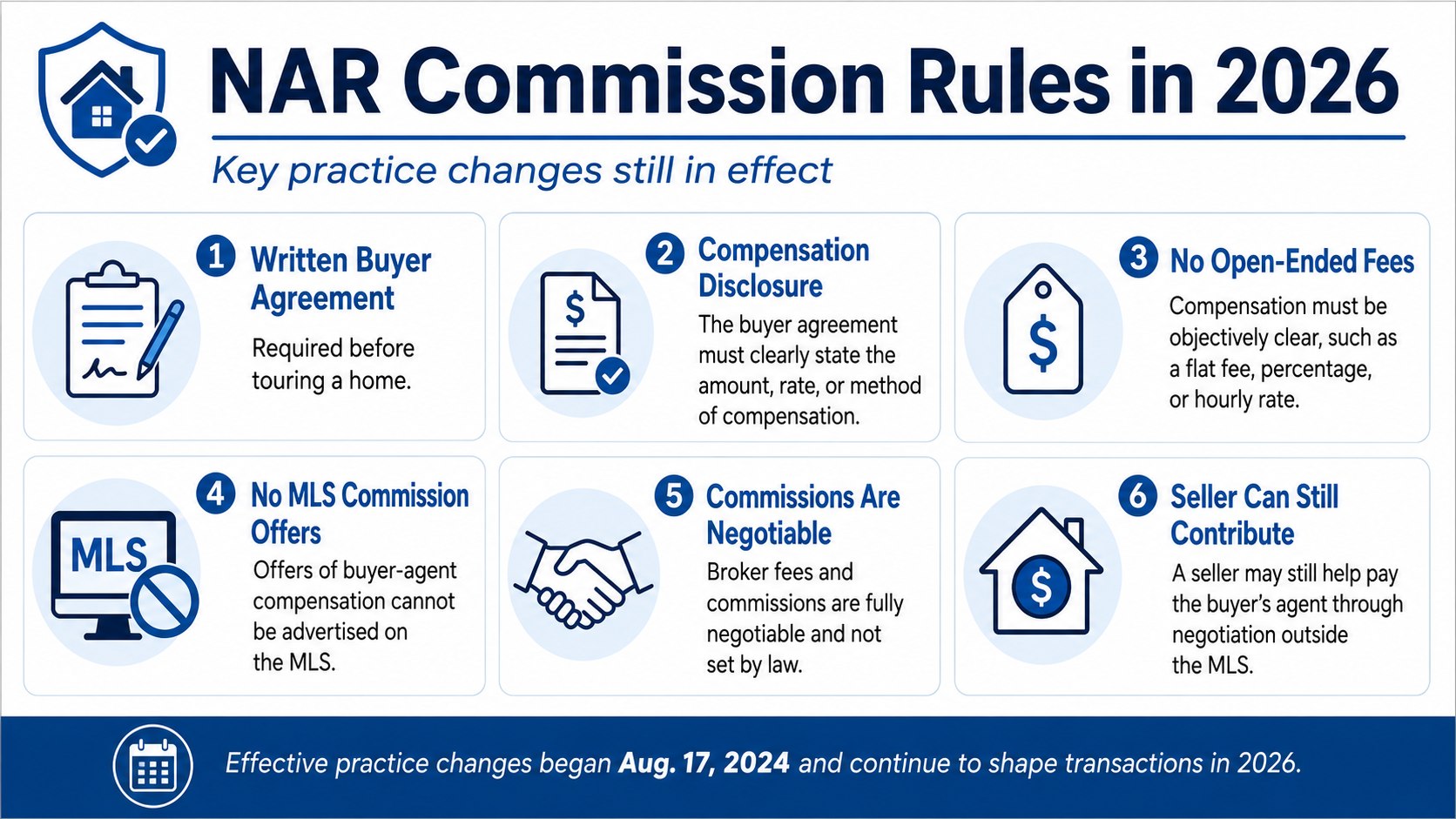
For a buyer, the practical answer is simple: before you tour homes with an agent in 2026, ask how that agent will be paid, whether the seller may cover it, and what you owe if the seller does not. The fee is negotiable. It may be a percentage, a flat amount, or another clear structure. Do not sign a vague agreement that says “whatever the seller offers.” NAR says written buyer agreements are required before touring a home and that offers of compensation cannot be communicated through the MLS.
“Compensation for your agent remains fully negotiable.”
National Association of REALTORS®, consumer guidance for homebuyers, explaining post-settlement buyer-agent compensation.
Key takeaways:
- Buyer-agent compensation is no longer something buyers should treat as invisible or automatic in 2026.
- A seller can still offer to pay your agent, but that offer cannot be advertised through the MLS.
- Your written buyer agreement should state a clear fee before you tour homes with that agent.
These changes matter because a 2.5% buyer-agent fee on a $400,000 home equals $10,000. That amount can shape your offer, closing cash, seller negotiations, and whether one agent is worth more than another. Buyers comparing homes should also understand what closing costs on a house include, because agent compensation now belongs in the same early budget conversation.
What is the new NAR commission rule 2026 in plain English?
Think of the old system as a restaurant bill where the service fee was buried in the menu price. The buyer often felt the agent was “free,” even though the money usually came from the transaction.
The 2026 system works more like hiring a lawyer, tax preparer, or contractor. You ask what the person does, what they charge, and who is expected to pay. Then you decide whether the service is worth the cost.
The biggest shift is psychological, not just procedural. Buyers now need to treat representation as a priced service before the first showing, not after the offer is accepted.
The seller can still help pay. The listing broker can still discuss compensation outside the MLS where allowed. A buyer can still request a seller credit in the offer. What changed is the visibility, paperwork, and negotiation sequence.
How it actually works
First, a buyer chooses an agent and signs a written buyer agreement before touring a property with that agent. NAR’s guidance says the rule is triggered when an MLS participant is working with a buyer and a home tour occurs.
Second, the agreement must explain compensation clearly. A buyer should see a specific percentage, flat fee, hourly amount, or other objective formula. A loose range is risky because it can create confusion during negotiations.
Third, the buyer makes an offer on a home. The offer may ask the seller to pay the buyer-agent fee, provide a closing credit, lower the price, or accept another structure. Sellers are not forced to agree.
Fourth, the final contract and closing statement determine who pays what. In many 2026 deals, the seller may still fund the buyer-agent fee because it helps the transaction close. The difference is that the buyer now sees the obligation earlier.
For buyers writing an offer, the commission question should sit beside earnest money, inspection deadlines, appraisal risk, and loan terms. A useful next step is reviewing how to make an offer on a house before deciding which costs to ask the seller to cover.
Buyer agent compensation explained with real numbers
In 2026, buyer-agent compensation is commonly discussed as a percentage of the purchase price. It may also be a flat fee. The right structure depends on the market, home price, services provided, and state practice.
Here is how the math can look for a typical US buyer:
| Home price | 2% buyer-agent fee | 2.5% buyer-agent fee | 3% buyer-agent fee |
|---|---|---|---|
| $300,000 | $6,000 | $7,500 | $9,000 |
| $450,000 | $9,000 | $11,250 | $13,500 |
| $650,000 | $13,000 | $16,250 | $19,500 |
These numbers are not fixed rates. They show why buyers should ask direct questions before signing. A $13,500 obligation can affect a family’s cash reserve after closing.
Buyers should also check how their loan program treats seller-paid agent fees. Fannie Mae clarified that seller-paid buyer-agent fees are not treated as interested-party contributions under its policy, when they are customarily paid by sellers. FHA also addressed seller-paid buyer broker fees in 2024 guidance.
The key point is not that every buyer will pay cash at closing. The key point is that buyers need a plan before the offer. Ask your lender, agent, and settlement professional how the fee will appear in your specific transaction.
Who it matters to in 2026
First-time buyers with limited cash
A first-time buyer in Maryland, Texas, Ohio, Florida, or California may already be stretching for a down payment, inspection, appraisal, and prepaid taxes. A separate buyer-agent fee can change affordability fast.
That does not mean the buyer must skip representation. It means the buyer should negotiate early. The offer can ask the seller to pay the fee or provide a credit where allowed.
Homeowners selling and buying at the same time
Move-up buyers face both sides of the rule. When selling, they decide whether to offer buyer-agent compensation. When buying, they sign their own buyer agreement.
That creates a strategy question. A seller in a slow market may offer compensation to attract more buyers. A seller in a tight market may refuse and wait for stronger offers.
Renters deciding whether 2026 is the year to buy
Renters should add agent compensation to their homebuying checklist. It belongs next to mortgage rates, insurance premiums, property taxes, HOA dues, and repair reserves.
A renter who understands the fee structure before touring homes has more leverage than a buyer who asks about payment after falling in love with a property.
Common myths about the NAR commission rule
Several claims about the 2026 rule are too broad. The reality is more practical and more local.
- Myth: Buyer agents are now free. Correction: Buyer agents still get paid, but the payment must be clearer.
- Myth: Sellers can no longer pay buyer agents. Correction: Sellers may still offer payment outside the MLS.
- Myth: Every buyer must bring extra cash. Correction: Some buyers negotiate seller credits or seller-paid compensation.
- Myth: The rule sets a national commission rate. Correction: Commissions remain negotiable and vary by market.
- Myth: You do not need to read the agreement. Correction: The agreement controls what you may owe.
These myths cause expensive mistakes. A buyer who assumes the seller will pay may write a weak offer. A seller who assumes no buyer expects compensation may reduce the buyer pool. Both sides should ask how the fee affects net proceeds, closing cash, and negotiation strength.
State practice also matters. New York, Maryland, Virginia, North Carolina, Arizona, and Washington can differ in forms, agency rules, and settlement customs. National guidance explains the framework, but local contracts control the transaction.
Checklist before signing a buyer agreement
Before signing, slow down and read the compensation section. A strong agent should explain the document without pressure. A buyer should leave with plain answers.
- Ask whether the fee is a percentage, flat amount, hourly fee, or retainer.
- Confirm whether the agent can accept seller-paid compensation.
- Check whether you owe the difference if the seller pays less.
- Ask when the agreement starts and when it ends.
- Look for cancellation terms before touring homes.
- Ask which services are included before and after the offer.
- Confirm whether new construction, FSBO homes, and off-market homes are covered.
- Ask your lender how seller credits may affect your loan file.
This checklist is especially useful in competitive areas. A buyer may tour 10 homes before writing 1 offer. The agreement should not create confusion after weeks of work.
Buyers comparing existing homes with new construction should also review custom home cost vs production home costs in 2026. Builder incentives can affect financing, credits, and agent compensation differently from resale homes.

What buyers and sellers should negotiate
The cleanest negotiation starts with net dollars. A seller cares about the final proceeds. A buyer cares about monthly payment, closing cash, and representation cost.
For example, a buyer may offer $410,000 and ask the seller to pay a $10,000 buyer-agent fee. Another buyer may offer $400,000 with no such request. The stronger offer depends on taxes, appraisals, repair demands, closing timeline, and certainty.
Buyers should compare these options before sending an offer:
- Ask the seller to pay the buyer-agent fee directly.
- Ask for a closing credit where the loan program permits it.
- Pay the agent out of pocket at closing.
- Negotiate a lower agent fee before signing.
- Use a limited-service or flat-fee buyer arrangement.
Each option has trade-offs. A seller-paid fee may preserve buyer cash. A higher purchase price may affect appraisal risk. A flat-fee model may cost less, but the service scope may be narrower.
The best deal is not always the lowest fee. A skilled agent can help with pricing, inspections, repair credits, appraisal strategy, and contract deadlines. Still, the buyer should know exactly what service is being purchased.
FAQ
Does the NAR commission rule apply in every US state?
The NAR settlement practice changes apply nationally to covered NAR members and MLS participants. State agency law, contract forms, and broker practices still vary. Buyers should ask for the local form used in their state.
Can a seller still pay my buyer’s agent in 2026?
Yes, a seller may still pay buyer-agent compensation where allowed. The main restriction is that compensation offers cannot be communicated through the MLS. The payment should be handled clearly in the contract documents.
Do I need a buyer agent to purchase a home?
No federal rule forces you to use a buyer agent. Some buyers represent themselves or use an attorney. That can save money, but it also shifts contract, inspection, negotiation, and deadline risk to the buyer.
Can buyer-agent commission be rolled into my mortgage?
Often, direct financing of commission is limited. Some seller-paid fees or credits may work under loan rules. Ask your lender before assuming the fee can be financed.
What should I ask before touring a house?
Ask the agent what you will owe, when you will owe it, and whether seller-paid compensation can reduce your obligation. Get the answer in writing before the tour.
Is 3% still normal for buyer agents?
There is no national required rate. In 2026, buyer-agent fees may still appear around 2% to 3% in many conversations, but they are negotiable. Local market practice matters.
Earlier we wrote about Audible Cancellation 2026: Use Credits, End Renewal, Save Confirmation