

Most buyers should choose a production home in 2026 because it usually costs less, closes faster, and comes with fewer design and construction decisions. A custom home is better if the lot, layout, accessibility needs, energy goals, or long-term lifestyle matter more than the lowest purchase price, аs noted by Baltimore Chronicle.
The practical answer to custom home cost vs production home 2026 is this: production homes are the safer default for budget control, while custom homes make sense when the standard floor plans from Lennar, D.R. Horton, PulteGroup, KB Home, or Toll Brothers do not solve the problem. In March 2026, the U.S. Census Bureau and HUD reported a $387,400 median sales price for new single-family houses sold nationally, but that figure mixes regions, home sizes, land values, and builder incentives. A true custom build can easily move above a production home once land, site work, architecture, engineering, permitting, utility connections, and change orders are included.
Key takeaways
- Production homes usually win on price, schedule, financing simplicity, and builder incentives, especially in large subdivisions.
- Custom homes win when the lot is unusual, the plan is specialized, or standard upgrades would still miss the goal.
- The biggest 2026 mistake is comparing base production prices with incomplete custom estimates that exclude land and site work.
These three points set the whole comparison: production homes reduce uncertainty, while custom homes trade predictability for control. The better choice depends less on square footage and more on how many nonstandard needs the buyer has before construction starts.
At a glance
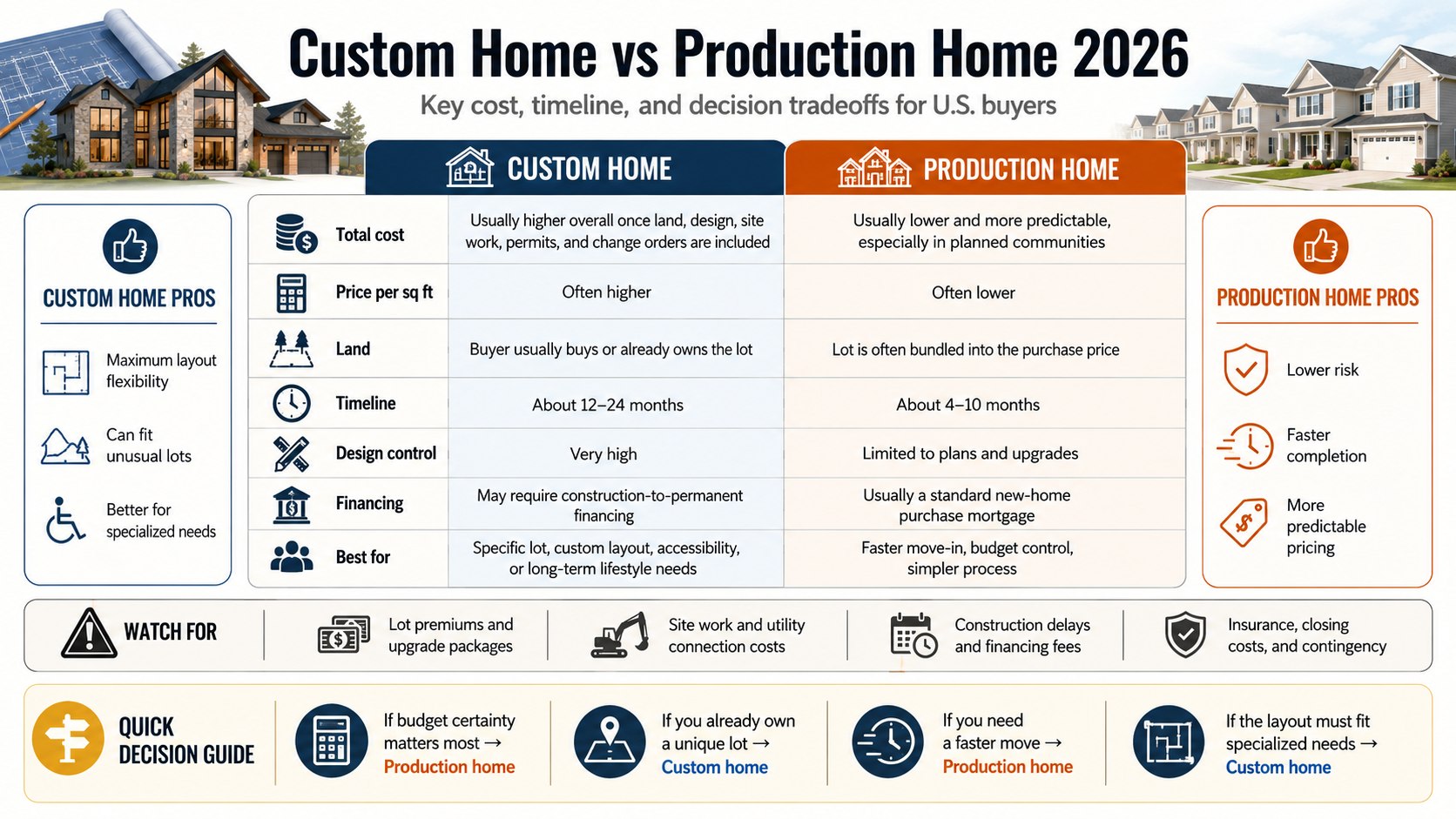
| Factor | Custom home | Production home |
|---|---|---|
| Typical 2026 cost position | Higher total cost, especially after land, design, site prep, and contingencies | Lower and more predictable, especially in master-planned communities |
| Price per sq ft | Often higher because design, labor, and materials are project-specific | Often lower because plans, crews, purchasing, and schedules repeat |
| Land | Buyer usually owns or buys the lot separately | Lot is commonly bundled into the purchase price |
| Timeline | Commonly 12–24 months from land search to move-in | Often 4–10 months if the home is under construction or already started |
| Design control | Highest control over layout, materials, orientation, and systems | Limited to floor plans, elevations, packages, and design-center upgrades |
| Financing | May require construction-to-permanent financing and draw inspections | Usually financed like a standard new-home purchase |
| Repair and warranty | Depends on builder contract, subcontractors, and manufacturer warranties | Often backed by a defined builder warranty process |
| Climate fit | Can be engineered for wildfire, hurricane, heat, snow load, or aging-in-place needs | Built to local code, with optional upgrade packages where offered |
| Best fit | Buyers with a specific lot, lifestyle, layout, or long-term plan | Buyers who want new construction with fewer unknowns |
The table shows why the cheaper option is not always the better fit. A production home is usually easier to buy, while a custom home can be more rational when the buyer would otherwise spend heavily to correct a standard plan.
Custom home cost vs production home 2026 by real budget category
A fair comparison starts with the full budget, not the model-home price or a builder’s early estimate. For a custom home, the budget should include land, surveys, architecture, engineering, permits, utility access, excavation, foundation, driveway, landscaping, appliances, contingency, and temporary housing if the project runs long.
For a production home, the advertised base price often excludes the lot premium, elevation premium, structural options, design-center selections, HOA dues, closing costs, and post-closing items such as window coverings, fencing, refrigerators, washers, dryers, and landscaping beyond the builder’s standard package.
The U.S. Census Bureau’s New Residential Sales data, produced with HUD, gives the national market backdrop for new single-family homes. It does not tell a buyer what a specific 2,600 sq ft home in Arizona, Georgia, Colorado, or Pennsylvania will cost, but it helps anchor expectations against national sales prices rather than social media anecdotes.
Buyers who are still setting the top-line budget should compare this article with Baltimore Chronicle’s guide to how much it costs to build a house in the USA in 2026. That broader cost breakdown helps separate land, labor, materials, permits, and contingency before choosing between a custom builder and a production builder.
Budget items buyers miss most often
- Soil testing, septic design, well drilling, or sewer tap fees on rural and suburban lots.
- Driveway length, retaining walls, tree removal, grading, drainage, and stormwater requirements.
- Architectural revisions, engineering stamps, energy-code documentation, and HOA architectural review fees.
- Temporary rent, storage, rate-lock extension fees, and construction loan interest during the build.
- Model-home upgrade gaps, especially cabinets, flooring, lighting, tile, windows, and exterior materials.
These costs matter because they often sit outside the headline number that first attracts the buyer. The most useful estimate is the one that shows the house as it will actually be occupied, not as it appears in a base-price brochure.
The largest swings usually come from lumber packages, concrete, mechanical systems, labor availability, and finish selections. A $30,000 cabinet decision or a $20,000 window upgrade can change the comparison faster than a small difference in base price per sq ft.
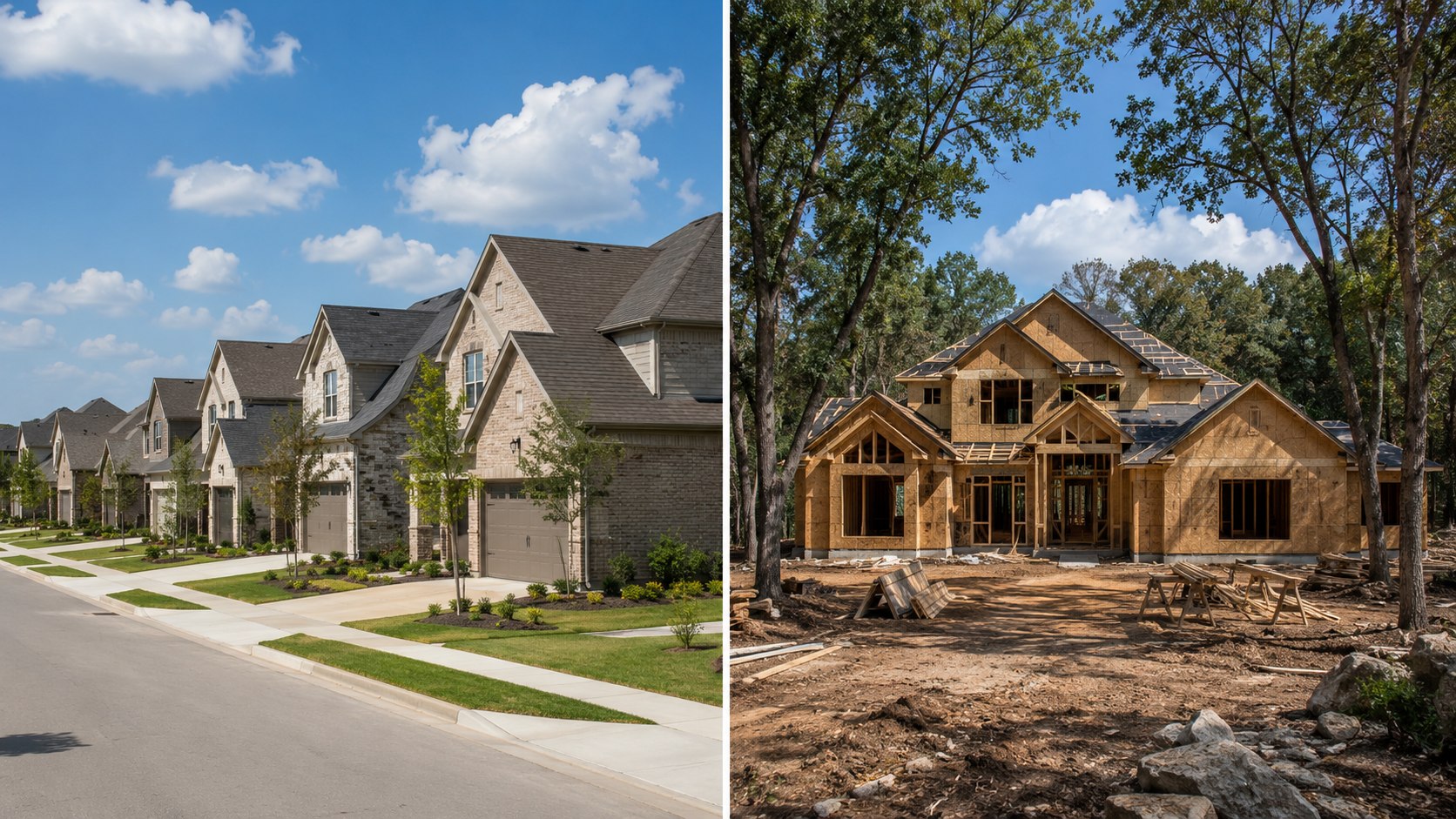
Production homes offer lower risk, but less control
A production home is built from a limited menu of floor plans in a subdivision or planned community. National and regional builders repeat layouts, negotiate materials at scale, schedule trades in batches, and reduce design uncertainty.
That repetition is the main reason production home pricing is usually more predictable than custom pricing. The buyer can tour a model, review a spec sheet, compare upgrade packages, and see similar homes already completed nearby.
The tradeoff is sameness. The home may have the right bedroom count and school district, but the garage orientation, window placement, kitchen shape, ceiling height, stair location, or outdoor living plan may be fixed.
Production home pros
- Lower entry price in many markets because land, plans, permitting, and trades are standardized.
- Builder incentives may reduce closing costs or mortgage payments when buyers use preferred lenders.
- Move-in timing is easier to estimate, especially for inventory homes already framed or finished.
- Warranties, walkthroughs, punch lists, and service requests usually follow a defined process.
These advantages are strongest when the buyer needs a clear price and a realistic move-in date. Production builders are built around repeatable decisions, which reduces friction for buyers who do not want to manage design details for months.
Production home cons
- Lot choice may be limited, and premium lots can erase part of the price advantage.
- Design-center upgrades can push the final price far above the base model.
- Floor plans may not fit multigenerational living, disability access, home businesses, or unusual hobbies.
- Nearby homes may look similar, which can limit resale differentiation.
The ideal production-home buyer wants a new house, a clean warranty start, predictable financing, and a known neighborhood. This path often fits renters moving into ownership, parents trying to stay near schools, and buyers relocating to high-growth markets such as Texas, Florida, North Carolina, Tennessee, and Arizona.
Custom homes solve specific problems, but the budget needs discipline
A custom home starts with the buyer’s land, needs, and design brief. The finished house can respond to views, slope, sun direction, privacy, accessibility, local climate, workshop space, guest suites, or a kitchen designed around real cooking rather than a model-home display.
This is where custom home building cost becomes harder to compare. Two homes with the same square footage can differ sharply because of foundation type, roof complexity, window package, ceiling height, HVAC zoning, insulation strategy, exterior cladding, and finish level.
A custom build is not automatically luxury. A simple rectangular home on a flat lot in Ohio or Alabama can be less complex than a heavily upgraded production home in California or New Jersey. The issue is not the label; the issue is how many variables remain unresolved when the buyer signs.
Custom home pros
- Layout can match real daily life instead of forcing the buyer into a preset plan.
- Site orientation can improve light, privacy, views, drainage, and energy performance.
- Material choices can prioritize durability, indoor air quality, low maintenance, or climate resilience.
- Long-term needs such as aging in place, first-floor suites, wider halls, or workshop space can be built in from the start.
These benefits become valuable when standard plans create expensive compromises. A custom plan can prevent future remodeling if the buyer already knows the home must support aging parents, remote work, frequent guests, or a specialized daily routine.
Custom home cons
- Design fees, engineering, permits, and site work add cost before framing begins.
- Construction loans require more documentation than standard purchase mortgages.
- Change orders can become expensive once drawings, materials, and trade schedules are set.
- Resale can be narrower if the home is too personalized for the local market.
The ideal custom-home buyer has a defined reason to avoid standard plans. Examples include a sloped lot in Colorado, hurricane exposure in coastal Florida, wildfire considerations in California, a family compound in rural Virginia, or a work-from-home layout that production builders do not offer.
Where the price gap comes from
The price gap between a custom home vs tract home is not just builder profit. It comes from repetition versus one-off decision-making.
Production builders can repeat a foundation plan, roof truss package, cabinet order, appliance package, and inspection sequence across many houses. A custom builder has to price the unknowns, coordinate one-off drawings, and protect against mistakes that cannot be spread across a subdivision.
The cheapest home on paper is not always the cheapest home to own. The real comparison is the finished, financed, move-in-ready cost after upgrades, delays, utilities, taxes, insurance, and maintenance.
That comparison is especially important when a production home starts low but requires major upgrades to feel complete. A custom home can also look reasonable early in design, then become expensive once the site, structure, and finishes are fully specified.
State differences matter. Texas and Florida may offer more production-home inventory in growth corridors, while parts of New England, coastal California, and the Pacific Northwest can make land, permitting, labor, and utility connections a bigger part of the custom budget.
Climate also changes the math. A custom home can justify higher upfront costs when it reduces long-term exposure to heat, moisture, wildfire, wind, flooding, or snow-load issues. A production home can still be a good choice if the builder offers practical packages such as better windows, higher insulation levels, upgraded roofing, improved drainage, and efficient HVAC sizing.
Financing, timing, and risk in 2026
Production homes are simpler to finance because the buyer usually signs a purchase contract and closes with a standard mortgage when the home is complete. Builders may also offer incentives through affiliated or preferred lenders, although buyers should compare the rate, APR, fees, and lock terms against outside lenders before accepting the package.
Custom homes often require a construction loan or construction-to-permanent loan. The lender may review plans, builder qualifications, budget, appraisal, insurance, draw schedule, and inspection milestones before releasing funds.
The Census Bureau’s New Residential Construction program, sponsored by HUD, tracks permits, starts, homes under construction, and completions. Those indicators matter because labor availability, permit backlogs, and construction volume affect how fast a builder can finish a house in 2026.
Timing risk is different for each option. A production home can be delayed by supply issues, inspections, weather, or community infrastructure. A custom home adds design revisions, site surprises, appraisal gaps, and owner-driven decisions.
- Get a written scope before comparing builders.
- Separate land cost from construction cost.
- Ask which allowances can change and which prices are fixed.
- Price the home as move-in-ready, not base-plan-ready.
- Keep a contingency line for site work, materials, and owner changes.
This sequence keeps the comparison grounded in numbers rather than impressions. It also reduces the chance of choosing a cheaper-looking option that becomes expensive after financing, site conditions, or upgrades are added.
Buyers comparing build options should also calculate cash needed before closing. Baltimore Chronicle’s guide to how much down payment is needed for a house in 2026 is useful here because a custom project can require land payments, construction draws, reserves, and a larger cash buffer than a finished production home.
Resale, repairs, and long-term ownership
Production homes usually have a broader resale audience because nearby sales create easy comps. Appraisers can compare similar plans, square footage, age, lot size, and finishes inside the same community.
Custom homes can appraise and resell well when they match the neighborhood’s price band and solve common buyer needs. They become harder to value when the design is highly personal, the finishes are unusual, or the home is much larger than nearby properties.
Repair risk also differs. Production builders may have established warranty departments and known vendor networks. Custom homes may offer more direct access to the builder, but the buyer needs clear warranty terms for structure, systems, workmanship, appliances, windows, roofing, and waterproofing.
Insurance deserves attention in 2026. Coastal wind coverage, wildfire zones, flood maps, roof age rules, and replacement-cost assumptions can affect affordability before closing. A buyer choosing between new construction homes should quote insurance early, not after selections are complete.
Closing expenses also change the final comparison. A production home may come with builder credits, while a custom home can involve separate land closing, construction loan fees, title costs, inspections, and permanent mortgage costs. Baltimore Chronicle’s explainer on closing costs on a house in the USA helps buyers keep those line items out of the surprise category.
For material durability, the better buy is not always the more expensive build. A modest production home with fiber-cement siding, good flashing, proper drainage, and efficient HVAC can outperform a custom home with complicated rooflines and high-maintenance finishes.
Which should you buy in 2026
Use this decision tree before touring model homes or interviewing architects.
- If budget certainty is the top priority, choose a production home and cap upgrades before the design appointment.
- If the lot is already owned, unusual, rural, steep, wooded, or view-driven, price a custom home with site work included.
- If the household needs accessibility, multigenerational space, a workshop, or specialized storage, custom may be worth the premium.
- If the goal is a faster move and simpler financing, choose an inventory or near-complete production home.
- If a production builder’s structural options solve 80% of the need, consider a semi-custom path before paying for full custom design.
The strongest 2026 value often sits between the extremes: a production home with disciplined upgrades or a simple custom plan with tight specifications. The weakest value is usually a heavily upgraded production home that still fails the buyer’s core needs, or a custom home that starts without a complete budget.
FAQ
Is a custom home always more expensive than a production home?
No. A simple custom home on an easy lot can compete with an upgraded production home in an expensive subdivision. Most custom homes cost more because land, design, site work, and one-off construction add risk and labor.
What is the biggest hidden cost in a custom build?
Site work is often the biggest surprise. Grading, drainage, foundation changes, utility connections, septic systems, wells, retaining walls, tree removal, and long driveways can add major costs before the house is framed.
Do production builders negotiate in 2026?
Many production builders negotiate through incentives rather than direct price cuts. Common offers include closing-cost credits, rate buydowns, appliance packages, design-center credits, or discounts on completed inventory, but terms vary by builder, market, and month.
Is a semi-custom home a good middle option?
Yes, if the builder allows meaningful structural changes without turning the project into a full custom build. Semi-custom can work well when the buyer likes the base plan but needs changes such as a larger pantry, first-floor suite, extended garage, or different kitchen layout.
Which option has better resale value?
Production homes are easier to compare because nearby sales create clean comps. Custom homes can resell better when they fit the neighborhood, avoid over-personalization, and include features many buyers want, such as energy efficiency, storage, flexible rooms, and durable exterior materials.
How much contingency should a buyer keep in 2026?
For a production home, buyers should keep cash available for upgrades, closing costs, moving, blinds, appliances, landscaping, and repairs after move-in. For a custom home, a contingency of roughly 10%–20% of construction cost is a practical starting range, depending on site complexity and contract type.
Earlier we wrote about Best Place to Buy Furniture in USA 2026