


Most readers comparing ikea vs ashley vs wayfair quality 2026 should pick IKEA for budget control and predictable parts, Ashley for heavier sofas and recliners, and Wayfair only when selection or delivery speed matters more than uniform build quality, as noted by Baltimore Chronicle.
If the decision is sitting in a cart today, use this rule: choose IKEA for apartments, kids’ rooms, storage, and DIY assembly; choose Ashley for living room seating you want delivered as a finished piece; choose Wayfair when you need a specific size, style, or color that IKEA and Ashley do not carry.
Key takeaways
- IKEA usually wins on price transparency, replaceable parts, and small-space furniture, but assembly quality depends on the buyer.
- Ashley is often stronger for sofas, sectionals, recliners, and mattresses, with warranties tied to product categories and parts.
- Wayfair is a marketplace, so quality varies by brand; read dimensions, materials, return terms, and warranty details before ordering.
The first filter is not brand loyalty. It is the job the furniture needs to do: temporary setup, everyday seating, storage, or a hard-to-fit room.
The broader furniture-store choice matters before comparing individual sofas or dressers. Baltimore Chronicle’s guide to the best furniture stores in the USA for 2026 gives a wider market view for shoppers comparing national retailers.
At a glance
| Category | IKEA | Ashley | Wayfair |
|---|---|---|---|
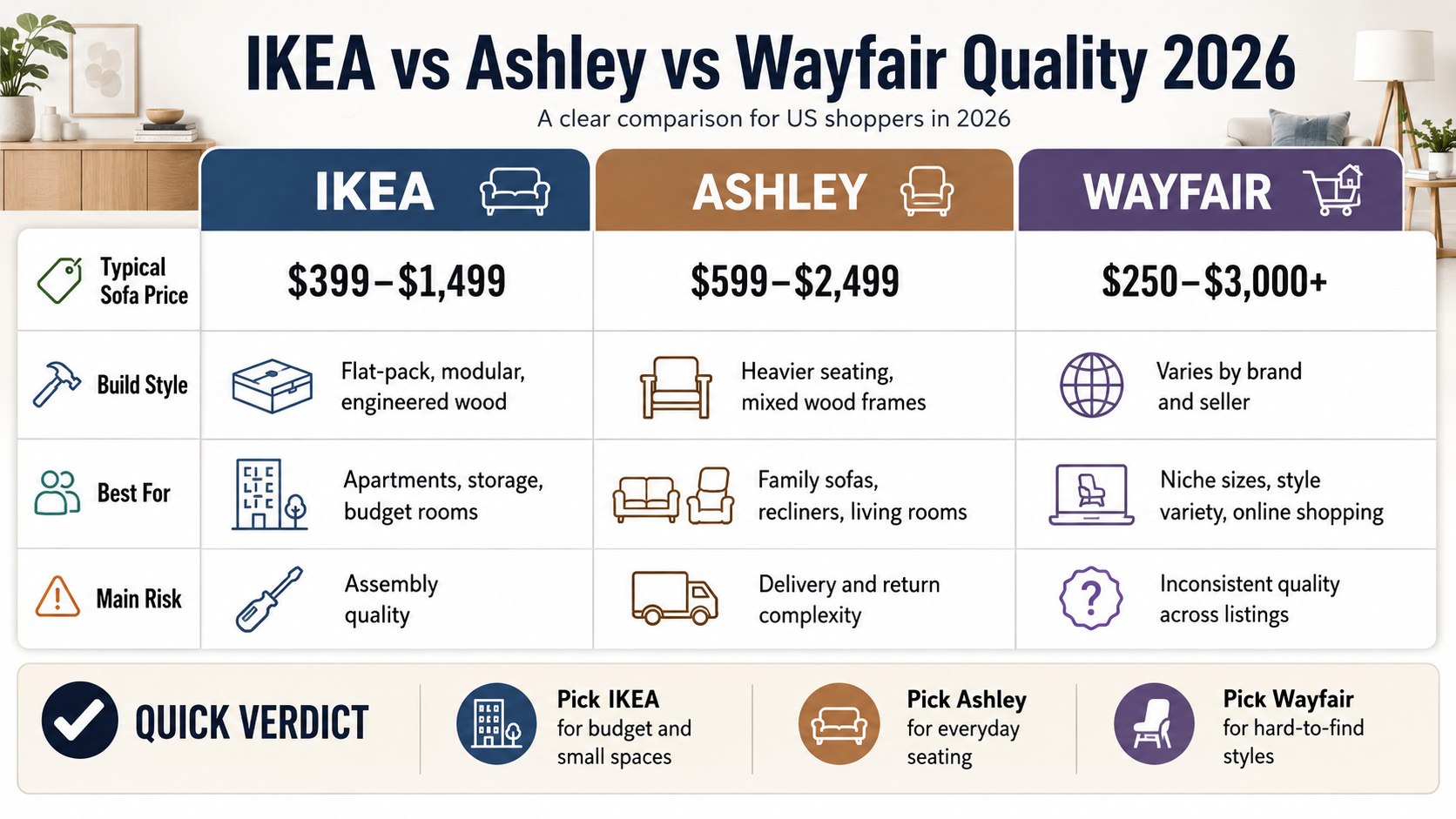
| Typical 2026 sofa price | About $399–$1,499 for many fabric sofas and sectionals | About $599–$2,499 for many sofas, sectionals, and recliners | About $250–$3,000+, depending on brand and sale pricing |
| Build style | Flat-pack, modular, often particleboard or engineered wood | Factory-assembled seating, mixed wood frames, metal recliner mechanisms | Mixed: flat-pack, assembled, private-label, and third-party brands |
| Installation | Mostly self-assembly; paid services may be available by market | Often delivered assembled or partly assembled | Varies by item; many pieces require assembly |
| Expected lifespan | Best for 3–8 years on budget items; longer for higher-end lines | Often 5–10 years for midrange seating with normal use | Ranges from short-term rental furniture to long-term solid wood pieces |
| Climate concerns | Humidity can affect particleboard in Florida, Texas, and coastal states | Fabric, leather, and cushion wear depend on sun, humidity, pets, and cleaning | Material varies; check wood type, veneer, foam density, and outdoor ratings |
| Repair | Good for spare hardware and modular replacements | Better for frame, spring, cushion, and mechanism claims through warranty channels | Depends on seller, manufacturer warranty, and whether parts are available |
| Return risk | Lower when buying in-store because dimensions and firmness are visible | Lower for shoppers who test seating locally before delivery | Higher for large furniture ordered from photos only |
| Best buyer | Renters, first homes, college apartments, small spaces | Homeowners, families, recliner buyers, living room upgrades | Style-specific shoppers, odd room dimensions, fast online comparison |
The table shows why a single “best brand” answer usually fails. IKEA, Ashley, and Wayfair solve different buying problems, so the strongest option changes by room, budget, and tolerance for assembly.
IKEA quality in 2026
IKEA is strongest when the buyer needs a clear price, a known footprint, and furniture that can be moved through narrow halls, walk-up apartments, and older homes in cities such as Baltimore, Boston, Chicago, and New York.
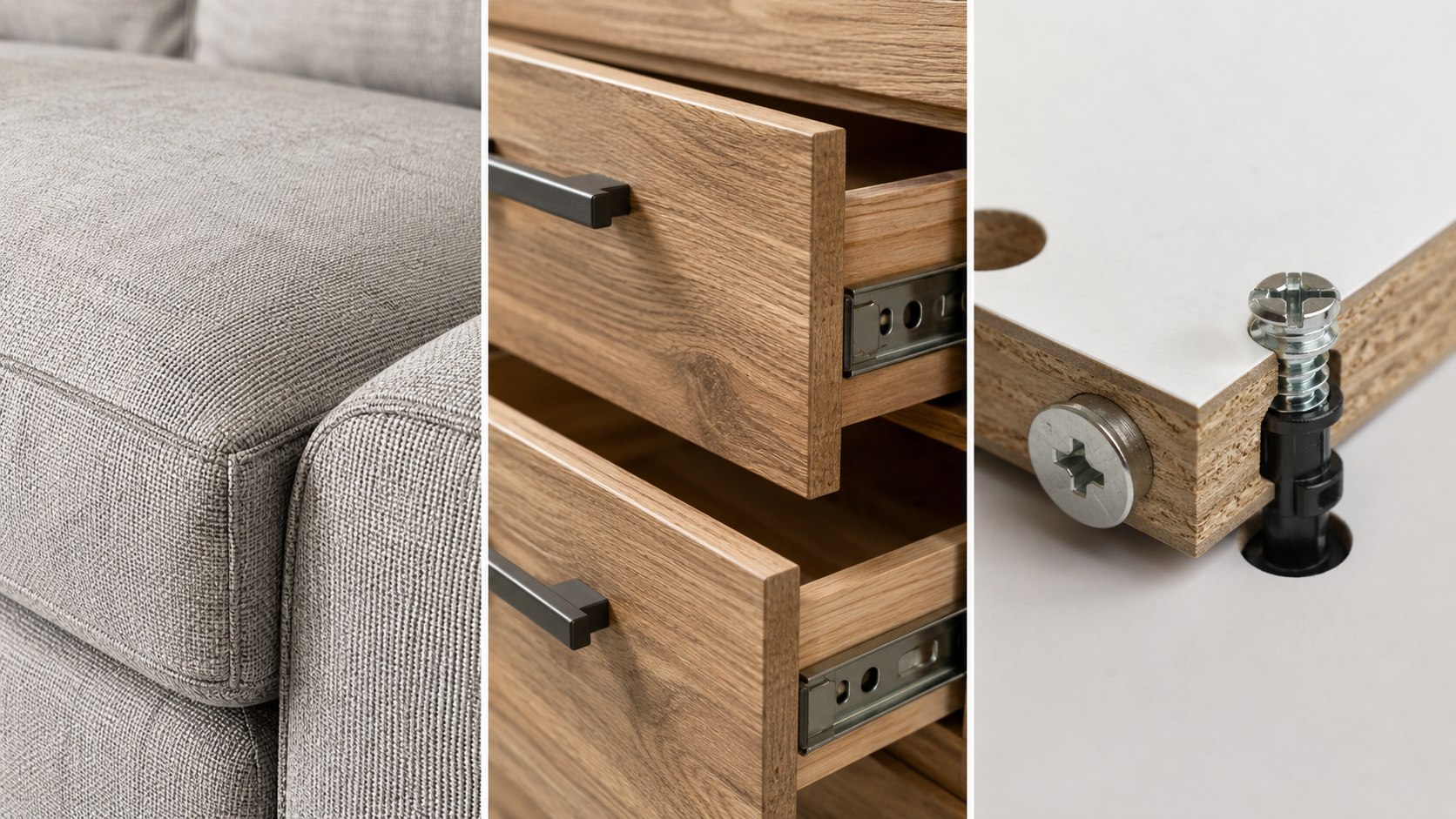
The quality gap inside IKEA is wide. A low-cost bookcase or dresser is not built like a higher-priced sofa, kitchen cabinet system, or solid wood table.
Pros
- Prices are easy to compare because IKEA sells under its own product names.
- Flat-pack furniture is easier to move in compact cars, elevators, and rental vans.
- Many systems are modular, so shelves, doors, covers, and small parts may be replaceable.
- IKEA publishes product measurements clearly, which reduces layout mistakes in small rooms.
These strengths matter most when a buyer needs predictable dimensions and a lower upfront price more than a heavy, fully assembled piece.
Cons
- Assembly quality changes the final result, especially on drawers, hinges, beds, and wardrobes.
- Budget particleboard pieces can suffer from water, repeated moves, and overtightened hardware.
- Some popular items go in and out of stock by metro area.
The weak points are manageable for low-stress furniture, but they become more serious for wardrobes, beds, and drawers that carry weight every day.
IKEA’s official US warranty page says limited warranties start on the purchase date and require the original receipt as proof of purchase. The company also lists many category-specific warranties on its product warranties page.
The practical verdict: IKEA is the safest low-to-mid-budget pick when the buyer can assemble carefully, measure twice, and avoid dragging the same particleboard dresser through three moves.
Ashley quality in 2026
Ashley is the most traditional furniture-store option of the three. It is usually the better match for a buyer who wants a sofa, recliner, sectional, dining set, or mattress delivered as a substantial finished product rather than a weekend assembly project.
In a furniture quality comparison, Ashley’s advantage is seating. Frames, cushions, springs, recliner hardware, and upholstery matter more on a family sofa than on a simple shelf.
Pros
- Broad living room range, including reclining sofas, power sectionals, sleepers, and loveseats.
- More in-person testing through Ashley stores and authorized retailers across the USA.
- Warranty language is more specific for frames, springs, cushions, sleeper mattresses, and mechanisms.
- Better fit for families that want a heavier sofa and do not want to assemble large furniture.
These advantages make Ashley easier to justify for high-use living rooms where comfort, frame strength, and delivery handling matter more than the lowest sticker price.
Cons
- Delivery, protection plans, and retailer policies can differ by store or region.
- Large pieces are harder to return once delivered and unpacked.
- Sale pricing can make it difficult to know the true everyday price.
The main risk is not that Ashley lacks selection. The risk is buying during a promotion without checking delivery charges, return limits, and what the written warranty actually covers.
Ashley’s official warranty page says its limited warranties apply to the original retail purchaser and are non-transferable. Warranty periods begin on the delivery date, and claims generally require the original bill of sale and product serial number through the retailer or Ashley process.
A warranty should not be treated as a promise that furniture will survive every pet, spill, move, or cleaning product. It is mainly protection against covered manufacturing defects.
The practical verdict: Ashley is a strong 2026 choice for homeowners in states such as Pennsylvania, Georgia, Ohio, Arizona, and Texas who want living room seating that feels heavier than most flat-pack alternatives.
Wayfair quality in 2026
Wayfair is not one furniture maker. It is a large online marketplace with house brands, partner brands, imported flat-pack furniture, higher-end lines, outdoor furniture, lighting, rugs, and decor.
That makes Wayfair furniture reviews useful but incomplete. A five-star review on one Wayfair sofa says little about a different sofa from another manufacturer.
Pros
- Huge selection of sizes, colors, styles, and price points.
- Useful for unusual room dimensions, narrow console tables, corner desks, and accent chairs.
- Frequent sales can produce good value when the brand and materials are solid.
- Customer photos often reveal scale, color accuracy, and assembly difficulty.
Wayfair’s biggest advantage is search depth. It is often the easiest place to find a 72-inch sofa, a 10-inch-deep console, or a specific wood tone that local stores do not stock.
Cons
- Quality varies sharply from item to item because Wayfair sells many brands.
- Return shipping on large furniture can be expensive depending on the item and reason.
- Product names can change, making long-term replacement parts harder to find.
The drawback is the same marketplace structure that creates the selection. Each listing needs to be judged on its own materials, seller terms, weight, dimensions, and recent buyer photos.
Wayfair’s official return policy says most items can be returned within 30 days of delivery if they are in original, undamaged condition, with exclusions by category and product type. Wayfair’s protection plan page says many items include a manufacturer warranty, commonly 90 days to one year, while optional plans may extend coverage for eligible products through plan terms.
The practical verdict: Wayfair is best when the buyer is comfortable reading specifications and accepting more variance. It is not the simplest answer for a high-use family sofa unless the exact brand, frame, fabric, and return terms are clear.
IKEA vs Ashley vs Wayfair quality 2026 by build, warranty, and price
The main difference is control. IKEA controls the product line, Ashley controls much of the branded furniture experience, and Wayfair controls the marketplace experience rather than every item’s construction.
For IKEA vs Ashley furniture, the decision often comes down to assembly versus finished seating. IKEA gives more flexibility for small spaces and lower budgets. Ashley gives more confidence for recliners, sectionals, and larger living room sets.
For Ashley vs Wayfair furniture, the decision comes down to predictability. Ashley is easier to inspect in person. Wayfair offers more choice but demands more homework.
For IKEA vs Wayfair furniture, the decision comes down to consistency. IKEA’s materials are not always premium, but the buyer usually knows what system, measurements, and parts are involved. Wayfair may offer better-looking options at the same price, but the build can range from flimsy to excellent.
| Use case | Best first choice | Why |
|---|---|---|
| First apartment under 800 sq ft | IKEA | Lower entry prices, compact sizing, easier moving |
| Family room sofa | Ashley | Better focus on seating, recliners, frames, cushions |
| Odd-size entry table or accent cabinet | Wayfair | More sizes, finishes, and niche styles |
| Furniture for a short lease | IKEA or Wayfair budget line | Lower cost matters more than long-term durability |
| Main bedroom set | Ashley or higher-end IKEA | Stability, drawers, and finish quality matter over time |
The pattern is simple: IKEA wins when replacement cost matters, Ashley wins when daily seating comfort matters, and Wayfair wins when the room demands a narrow or uncommon specification.
Furniture spending also depends on whether the buyer rents, owns, or is preparing to move. For buyers furnishing a new property, Baltimore Chronicle’s guide on how to buy a house in the USA in 2026 helps connect furniture decisions with closing costs, moving costs, and first-year home expenses.
How warranty and return rules change the real cost
The cheapest cart is not always the cheapest ownership cost. A $499 sofa that costs $150 to return, cannot fit through the doorway, or loses cushion shape quickly is not a better deal than a $799 sofa that fits and lasts longer.
The Federal Trade Commission explains that implied warranties may apply even without a written warranty unless properly disclaimed, and that rules can vary by state. California, Massachusetts, New York, and other states may handle consumer warranty disputes differently, so large purchases deserve saved receipts and screenshots of product pages.
For more background on consumer protection, the FTC’s consumer guide to warranties explains how written warranties, implied warranties, and service contracts differ.
- Save the receipt, order confirmation, delivery photos, and product page screenshots.
- Inspect furniture before signing final delivery paperwork when possible.
- Photograph damage, missing parts, stains, or broken mechanisms the same day.
- Read whether the warranty covers parts only, labor, shipping, cushions, fabric, or frames.
- Check whether the return clock starts on order date, ship date, or delivery date.
These steps are basic, but they prevent the most expensive furniture disputes: missed return windows, undocumented delivery damage, and confusion between a product warranty and an optional protection plan.
Which should you buy in 2026
If the budget is tight and the furniture may move again within two years, then buy IKEA for beds, shelves, desks, dressers, and storage that can be replaced without wrecking the household budget.
If the purchase is a main sofa, sectional, recliner, or sleeper used every day by kids, pets, guests, or remote workers, then start with Ashley and compare the exact warranty terms before adding protection plans.
If the room needs a very specific width, fabric color, farmhouse cabinet, coastal console, or narrow office desk, then search Wayfair but filter by solid materials, customer photos, dimensions, and return terms.
If the buyer cannot tolerate assembly mistakes, then avoid complex IKEA wardrobes and low-cost Wayfair flat-pack cabinets unless paid assembly is available and still keeps the total price competitive.
If the purchase is for a furnished rental, Airbnb-style unit, guest room, or temporary setup, then compare IKEA and Wayfair on replacement cost rather than treating the furniture as a 10-year investment.
Students and renters face a different calculation because furniture may need to fit dorms, shared apartments, and short leases. Baltimore Chronicle’s University of Maryland Baltimore housing guide gives useful context for furnished and unfurnished housing choices near campus.
FAQ
Is IKEA better quality than Ashley in 2026?
IKEA is better for modular storage, low-cost furniture, small apartments, and buyers who can assemble carefully. Ashley is usually better for sofas, recliners, sectionals, and large seating that needs to feel substantial from day one.
Is Wayfair furniture good quality?
Wayfair furniture can be good, but quality depends on the specific brand, materials, price tier, and item category. The safest approach is to read recent reviews, inspect customer photos, verify dimensions, and avoid judging the whole marketplace by one listing.
Which brand has the best warranty?
IKEA has strong published warranties on select categories and requires proof of purchase. Ashley has detailed limited warranties by furniture part and product category. Wayfair often relies on manufacturer warranties and optional protection plans, so terms vary by item.
Which is cheapest for a full apartment?
IKEA is usually the easiest place to furnish a full apartment on a predictable budget in 2026. Wayfair may beat IKEA on individual sale items, but the quality and return risk vary more across listings.
What should parents and pet owners buy?
Parents and pet owners should prioritize washable covers, darker performance fabrics, sturdy frames, rounded corners, and replaceable parts. IKEA works well for kids’ rooms and storage, while Ashley is often stronger for the main family sofa.
What is the safest pick for most US shoppers?
The safest pick is IKEA for budget and small-space furniture, Ashley for everyday seating, and Wayfair for hard-to-find styles or dimensions. The best value comes from matching the brand to the job, not from treating one retailer as best for every room.
Earlier we wrote about How Much Down Payment Do You Need to Buy a House in the USA in 2026?