

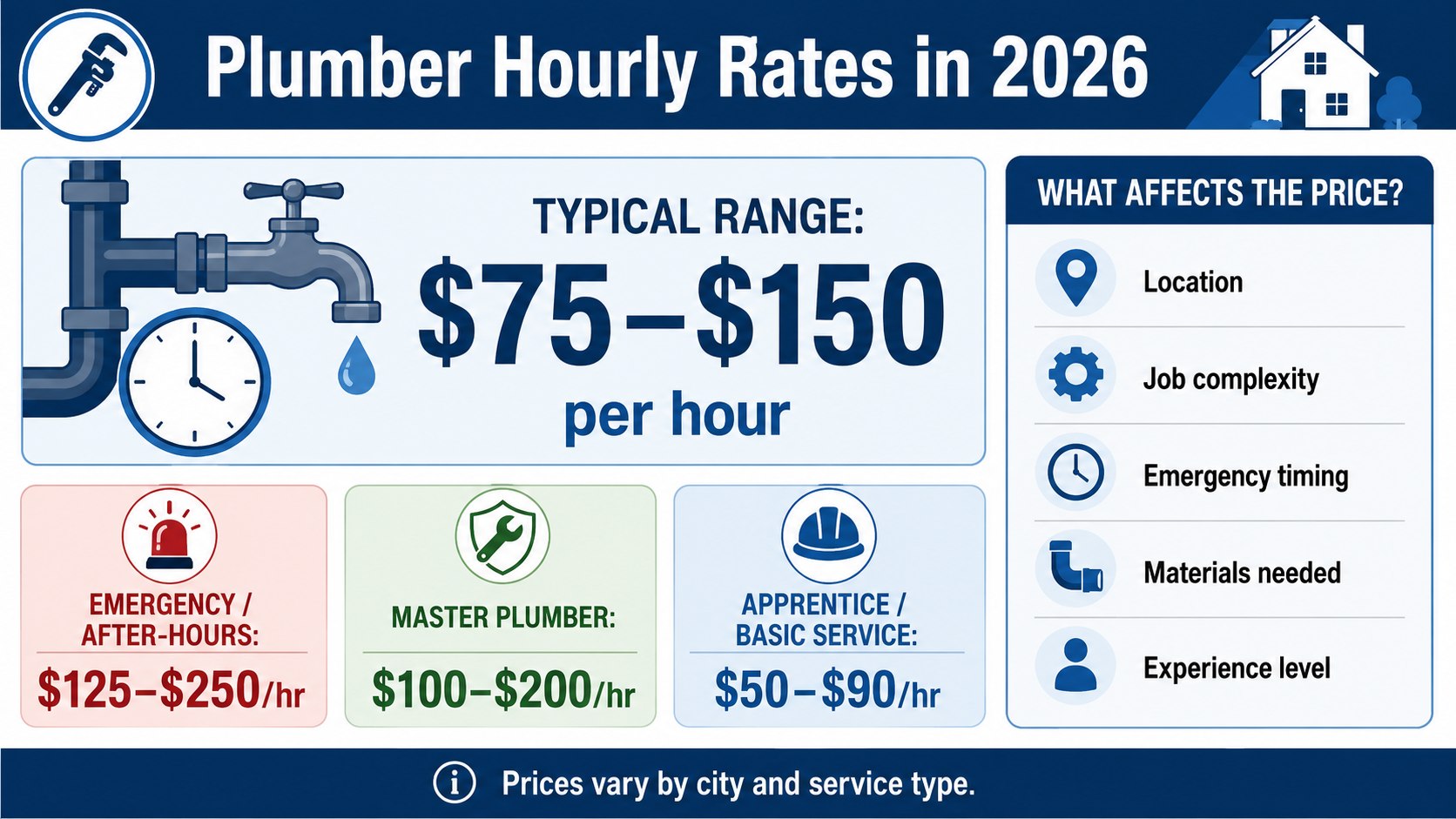
How much does a plumber charge per hour 2026? In the USA, expect about $75–$150 per hour for many standard plumbing jobs, $100–$200 for master plumbers, and $150–$400 for urgent or after-hours calls. A small repair may finish near $180–$500 total, while emergency work can climb fast once trip fees, parts, and minimum labor are added, as noted by Baltimore Chronicle.
The practical answer is simple: if water is leaking, shut off the nearest valve first, then ask the plumber for the hourly rate, service-call fee, minimum charge, emergency surcharge, and parts markup before approving work. For a non-urgent faucet, toilet, garbage disposal, or drain issue, schedule regular business hours and compare 2–3 written estimates. That one step can save more than negotiating the hourly rate alone.
Key takeaways
- Most homeowners should budget $75–$150 per hour for routine plumbing labor in 2026.
- Large cities, emergencies, permits, and hard-to-access pipes can double the final bill.
- Ask for the total job price, not only the hourly rate, before work starts.
A plumber charging $130 per hour is not automatically expensive. A slower plumber at $85 per hour can cost more if the job takes twice as long.
How much does a plumber charge per hour 2026 by city?
Plumber hourly rate 2026 pricing depends heavily on local wages, licensing rules, insurance costs, parking, traffic, and the age of the housing stock. In lower-cost metro areas, a basic service plumber may quote around $75–$115 per hour. In expensive coastal cities, $125–$225 per hour is common for licensed professionals.
City pricing also changes by job type. A clogged bathroom sink in Phoenix is not priced like a sewer-line camera inspection in Brooklyn. Older homes in Baltimore, Boston, Philadelphia, and Chicago can take longer because shutoff valves, galvanized pipes, cast iron drains, and tight basements add labor risk.
Before approving a repair, compare the estimate with broader home-project budgets. Homeowners planning bathroom work can review bathroom remodel costs in the USA in 2026, because plumbing labor often becomes one of the most expensive line items.
| City or metro area | Typical 2026 hourly range | Why it may cost more |
|---|---|---|
| New York City, NY | $140–$250 | High labor costs, permits, parking, old buildings |
| Los Angeles, CA | $125–$225 | Licensing, traffic, high overhead, seismic code concerns |
| Chicago, IL | $100–$190 | Older pipe systems, multi-unit buildings, winter emergencies |
| Houston, TX | $85–$160 | Slab leaks, storm damage, large service areas |
| Phoenix, AZ | $85–$155 | Water heaters, hard water, heat-related scheduling pressure |
| Baltimore, MD | $95–$180 | Row homes, aging drains, tight access, permit work |
| Atlanta, GA | $85–$165 | Suburban travel time, sewer roots, mixed housing age |
| Seattle, WA | $120–$220 | High wages, permit costs, older urban housing |
These city ranges are realistic 2026 planning numbers, not guaranteed quotes. A local plumber may price a simple job as a flat fee instead of an hourly charge. That can help homeowners because the risk of slower labor stays with the contractor. Still, ask what happens if hidden damage changes the scope.
For remodels, the written estimate matters more than the headline hourly rate. Baltimore Chronicle’s guide on how to read a construction estimate explains why allowances, exclusions, and change orders can shift the real price.
What drives the price
Licensing level and skill
A journeyman plumber usually costs less than a master plumber. Master plumbers often handle complex diagnostics, gas lines, water heater systems, sewer work, and permit-heavy projects. Paying more can make sense when the mistake would damage walls, flooring, cabinets, or a finished basement.
Emergency timing
Emergency plumber cost is higher because the company pays for night coverage, dispatch, fuel, and overtime. A Sunday sewer backup or burst pipe after midnight can move from a normal hourly rate into a premium range. Some firms also add a separate trip fee.
Access and diagnosis
A visible P-trap repair under a sink is usually quick. A leak behind tile, under a slab, inside a ceiling, or behind a built-in cabinet is different. The plumber may need cameras, moisture meters, pipe locators, wall cuts, or extra protection for finished rooms.
Parts, fixtures, and brands
Common brands such as Moen, Delta, Kohler, American Standard, Rheem, Bradford White, AO Smith, and Toto affect parts cost. A standard faucet cartridge may be cheap and available locally. A specialty shower valve or imported fixture can take longer and cost more to source.
Permits and code work
Permits can matter for water heaters, gas lines, sewer replacements, repiping, and major bathroom changes. Local building departments set requirements, and state licensing boards regulate who may perform certain work. Skipping required permits can become expensive during resale, insurance claims, or inspections.
Location and travel time
Rural customers may see lower labor rates but higher travel minimums. Urban customers may pay more for parking, congestion, and building access. Condo buildings can add elevator scheduling, insurance paperwork, water shutoff windows, and management approval.
Price breakdown for common plumbing work
Hourly labor is only one part of the bill. Many companies use a service-call fee to cover dispatch and diagnosis. Others apply a 1-hour or 2-hour minimum. Ask whether the fee is credited toward the repair if you approve the job.
| Line item | Typical 2026 cost |
|---|---|
| Standard plumber labor | $75–$150 per hour |
| Master plumber labor | $100–$200 per hour |
| Emergency or after-hours labor | $150–$400 per hour |
| Service call or diagnostic visit | $75–$250 |
| Minor faucet or toilet repair | $150–$450 total |
| Drain clearing | $150–$500 total |
| Water heater repair | $200–$900 total |
| Toilet replacement labor and basic parts | $250–$750 total |
| Sewer camera inspection | $250–$700 total |
| Whole-home repiping | $4,000–$18,000+ |
A low hourly quote can hide expensive minimums. For example, a company charging $80 per hour with a 2-hour minimum and $175 dispatch fee starts at $335 before parts. Another plumber charging $125 per hour with no separate trip fee may be cheaper for a 45-minute repair.
Flat-rate pricing is common in plumbing because homeowners prefer a known total. It can be fair when the scope is clear, such as replacing a toilet, installing a disposal, or clearing a standard drain. The risk appears when the quote excludes access, drywall repair, permits, or upgraded parts.
The best estimate describes the problem, the repair method, the parts, the warranty, and what is not included. A single total with no scope is not enough.
Ways to save in 2026
The best savings come from preparation, timing, and scope control. Buying the cheapest fixture is rarely the smartest move. A failed bargain faucet can leak inside a cabinet and create a larger repair.
- Use regular business hours unless water is actively damaging the home.
- Send clear photos of the fixture, pipe, shutoff valve, and leak location.
- Ask whether the company charges a service fee, minimum labor, or travel fee.
- Bundle small tasks, such as a running toilet and dripping faucet, into 1 visit.
- Clear access under sinks, around water heaters, and near cleanouts before arrival.
- Buy repairable brands with common parts, including Delta, Moen, Kohler, and American Standard.
- Get 2–3 written estimates for non-emergency work above $500.
- Keep records of previous repairs, fixture models, warranties, and shutoff locations.
These tactics work because plumbers bill for time, uncertainty, and risk. If the plumber can see the issue before arrival, the truck is more likely to carry the right parts. If the work area is clean, labor starts faster. If several small repairs are grouped, the service-call fee is spread across more useful work.
For fraud prevention, the Federal Trade Commission advises homeowners to consider licensed and insured contractors, check complaints, and avoid pressure tactics in home-improvement work. The same logic applies to plumbing, especially after storms, freezes, floods, or sewer backups. The FTC’s home-improvement guidance is available at consumer.ftc.gov.
The FTC warns consumers to be cautious with contractors who pressure for immediate decisions, demand large upfront payments, or appear after emergencies. Source: Federal Trade Commission, home improvement scam guidance.
When paying more makes sense
Paying more makes sense when the plumber reduces a serious risk. A licensed professional with insurance, permits, and a clear warranty may cost more upfront. That premium can protect the home from water damage, gas hazards, mold, and failed inspections.
- Water is entering finished space. A ceiling leak, slab leak, or burst pipe needs fast professional response.
- The repair involves gas. Gas water heaters, gas lines, and combustion venting require licensed skill.
- The job needs permits. Water heaters, repiping, sewer lines, and remodel plumbing may trigger inspections.
- The fixture is inside tile or cabinetry. A hidden valve mistake can destroy expensive finishes.
There is also a resale angle. A clean invoice from a licensed plumber can help during inspection negotiations. It shows the repair was handled professionally, not patched for showings. That matters in older houses and renovated bathrooms.
Bathroom upgrades often overlap with plumbing labor. If the project includes a shower conversion, compare fixture choices with walk-in shower vs bathtub resale value in 2026 before approving expensive plumbing changes.
How to read a plumber’s quote before signing
A useful quote should separate labor, parts, permits, access work, cleanup, warranty, and exclusions. It should also state whether pricing is hourly or flat-rate. If the plumber refuses to write down the scope, choose another contractor for non-emergency work.
- Confirm the company name, license status, insurance, and service address.
- Ask whether the price includes diagnosis, labor, parts, and return visits.
- Check whether drywall, tile, flooring, paint, or cabinet repair is excluded.
- Ask who pulls permits when permits are required.
- Confirm the warranty length for labor and installed parts.
- Request model numbers for major fixtures, valves, pumps, or water heaters.
- Keep the invoice, photos, and payment record after the repair.
One strong question is enough to expose weak estimates: “What could make this price increase?” A reliable plumber should explain hidden damage, unavailable parts, code upgrades, and access problems. That answer is often more useful than a discount.
FAQ
What is the average plumber hourly rate in 2026?
The average plumber hourly rate in 2026 is usually $75–$150 for standard work in the USA. Master plumbers, complex repairs, and high-cost cities often run $100–$200 per hour or more.
Why do plumbers charge a service-call fee?
A service-call fee covers dispatch, travel, diagnosis, vehicle costs, insurance, and time. Some companies credit it toward the repair. Others charge it separately even if you decline the work.
Is flat-rate plumbing better than hourly pricing?
Flat-rate pricing is better when the scope is clear and the written quote is complete. Hourly pricing can be better for uncertain diagnostic work, but it needs a clear cap or approval point.
How much does an emergency plumber cost in 2026?
An emergency plumber often costs $150–$400 per hour in 2026, plus possible trip fees. Nights, weekends, holidays, frozen pipes, sewer backups, and active leaks usually raise the price.
Should I hire a plumber or a handyman?
Use a licensed plumber for water heaters, gas lines, sewer work, repiping, hidden leaks, and permit jobs. A handyman may be suitable for simple fixture tasks where local rules allow it.
How can I avoid overpaying for plumbing work?
Get written estimates, ask about minimums, verify licensing, avoid panic approvals, and schedule non-urgent work during business hours. Send photos before arrival and group small repairs into 1 visit.
Earlier we wrote about New NAR Commission Rule 2026 Explained: What Homebuyers Must Know Before Touring