


For sale by owner pros and cons 2026 come down to one practical tradeoff: most sellers should use a capable listing agent, but FSBO can work when the owner already has a qualified buyer. Selling without an agent may preserve thousands of dollars, yet pricing errors, weak exposure, disclosure failures, and difficult negotiations can erase those savings, as the Baltimore Chronicle editorial team notes.
The safest middle ground is often a hybrid sale. The owner manages showings and negotiations but pays separately for MLS access, professional photography, legal review, and closing services. That approach offers more control without treating a six-figure transaction like a weekend marketplace listing.
Key takeaways
- FSBO works best when the buyer is already known and the property has few legal or condition complications.
- Commission savings are not guaranteed because buyers may request compensation, concessions, repairs, or a lower purchase price.
- A flat-fee MLS service and real estate attorney can reduce risk without requiring a full traditional listing package.
At a glance
The comparison below separates the 3 main selling models available to US homeowners in 2026. Actual fees depend on the state, property value, brokerage agreement, MLS provider, and complexity of the transaction.
| Factor | Full-service agent | For sale by owner | Hybrid or flat-fee MLS |
|---|---|---|---|
| Seller-side fee | Negotiated percentage or fixed fee | No listing commission | Flat fee plus optional services |
| Buyer-agent payment | Negotiated separately | May still be requested | May still be requested |
| MLS exposure | Usually included | Usually unavailable directly | Usually included at a basic level |
| Pricing support | Agent market analysis | Owner research or appraisal | Varies by package |
| Photography | Often included | Owner arranges it | Usually optional |
| Showings | Agent coordinates | Owner coordinates | Usually owner-managed |
| Negotiation | Agent handles or advises | Owner handles directly | Limited help may be available |
| Legal risk | Moderate, with professional support | Higher without legal review | Depends on included services |
| Best fit | Complex or competitive sale | Known buyer and simple property | Experienced, organized seller |
The traditional model costs more because the seller is buying labor, distribution, negotiation support, and transaction management. FSBO removes that package, not the work itself. The owner becomes the listing coordinator, marketer, showing agent, document manager, and first-line negotiator.
The hybrid model can be more efficient for sellers who understand their local market. However, a low advertised MLS fee may exclude photography, lockbox access, contract assistance, listing changes, or offer review. Sellers should compare the complete service list rather than the headline price.
Agent compensation also remains negotiable. Following the National Association of Realtors practice changes, offers of buyer-agent compensation cannot be displayed on participating MLS platforms. Sellers may still negotiate compensation outside the MLS or offer buyer concessions, subject to lender and contract rules.
That distinction matters. A home advertised as “no commission” can still produce requests for buyer-agent payment during negotiations. The seller must judge those requests alongside price, financing strength, inspection terms, and closing date.
Before choosing any model, estimate net proceeds rather than comparing percentages alone. The highest offer does not always produce the highest check after credits, repairs, taxes, title charges, legal fees, and mortgage payoff.
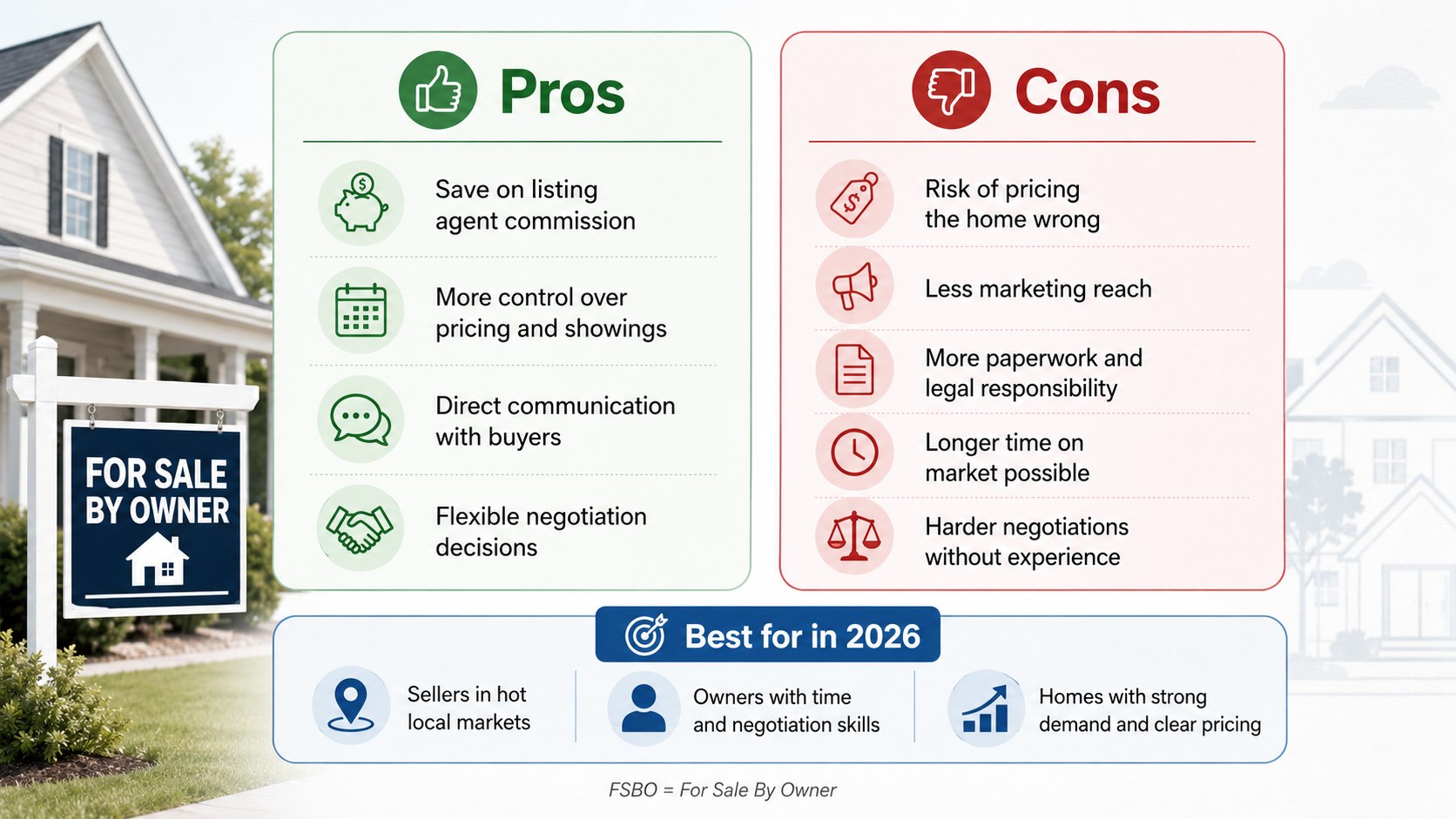
For sale by owner pros and cons 2026
The main FSBO advantage is control. Owners choose the asking price, showing schedule, marketing language, response strategy, and negotiation pace. They also speak directly with buyers, which can reduce delays when both parties communicate clearly.
The financial appeal is equally direct. Removing the listing side of a conventional commission may preserve a meaningful amount, particularly on an expensive property. Yet the seller should not assume the entire traditional commission becomes savings.
FSBO advantages
- Direct control over pricing, marketing, showings, and offer discussions.
- No automatic obligation to pay a full-service listing commission.
- Immediate knowledge of the home’s repairs, upgrades, utilities, and neighborhood.
- Flexible showing times without repeated communication through an intermediary.
- Potentially efficient sale when a relative, tenant, neighbor, or colleague is buying.
- Freedom to purchase photography, legal review, and MLS exposure separately.
These advantages are strongest when the property is easy to value. A conventional suburban house with recent comparable sales is usually simpler than an unusual rural property. Condominiums with pending assessments or homes with additions may require more investigation.
An owner may also understand the property better than an outside agent. That knowledge helps answer questions about roof work, utility bills, renovations, parking, drainage, or neighborhood routines. Buyers still expect documentation, not only verbal assurances.
Direct communication can improve efficiency, but it can also weaken negotiation. Sellers often reveal urgency, financial pressure, or their minimum acceptable price without realizing it. A buyer’s agent may use those details when structuring the next offer.
FSBO also works better when demand is already established. A tenant buying the rental or a neighbor purchasing for family use may require less marketing. Even then, the parties need a written contract, title work, inspections, and a controlled closing process.
The strongest FSBO seller is not merely confident. That seller is organized, responsive, financially prepared, and willing to pay for specialized help where mistakes become expensive.
FSBO disadvantages
- Incorrect pricing can create a stale listing or leave money unclaimed.
- Limited MLS access can reduce visibility among represented buyers.
- Owners must screen inquiries and protect personal security during showings.
- State disclosure forms and federal requirements still apply.
- Emotional attachment may interfere with repair and price negotiations.
- Contract deadlines can be missed without disciplined transaction management.
- Buyers may expect a discount because no listing agent is involved.
NAR’s 2025 national seller research reported that FSBO transactions represented 5% of sales. It also found that many FSBO sellers already knew their buyer. Those findings do not prove that every agent-assisted sale produces a better result, but they show how uncommon a fully independent open-market sale has become.
Exposure is one reason. Buyers often search through Zillow, Realtor.com, Redfin, brokerage websites, and MLS-fed applications. A yard sign and social media post may reach local prospects, yet they rarely reproduce the distribution of a properly syndicated listing.
Pricing presents a second problem. Automated estimates can differ because algorithms cannot fully evaluate interior condition, street position, deferred maintenance, permitted additions, or competing inventory. A licensed appraisal costs money, but it can be useful when comparable sales are weak.
An owner who saves $12,000 in fees but accepts $20,000 less has not completed a cheaper transaction. The correct measure is net proceeds after every cost and concession.
What a full-service real estate agent provides
A full-service agent should provide more than a listing form and yard sign. The service normally includes pricing analysis, listing preparation, MLS entry, showing coordination, feedback, offer comparison, negotiation, inspection management, appraisal support, and deadline tracking.
Agent quality varies sharply between brokerages and individual professionals. Brand names such as RE/MAX, Coldwell Banker, Compass, Keller Williams, and Berkshire Hathaway HomeServices do not guarantee identical service. The individual agreement controls what the seller receives.
Homeowners comparing agents should ask for a written marketing plan and recent local results. The Baltimore Chronicle guide on how to find a real estate agent in the USA explains how to evaluate experience, fees, communication, and local knowledge before signing.
Questions to ask before signing
- Which services are included in the proposed fee?
- Who will photograph, measure, and write the listing?
- How will the price be supported with comparable sales?
- Who attends inspections and handles repair negotiations?
- Can the agreement be canceled, and what fees survive cancellation?
- Does the contract include an administrative or transaction charge?
- How will requests for buyer-agent compensation be handled?
- Who communicates when the primary agent is unavailable?
The answers should be specific. “Full marketing” means little without defined deliverables, distribution channels, and timelines. Sellers should also confirm whether staging, drone photography, floor plans, open houses, or paid advertising cost extra.
Contract duration matters. A long exclusive listing can become restrictive if communication deteriorates or the pricing strategy fails. The cancellation clause should explain notice periods, protection periods, and any continuing payment obligation.
Commission discussions should focus on services and expected net proceeds. A lower fee may be sensible for an easy sale, while a difficult property may require more marketing. No percentage should be treated as mandatory.
Sellers should also determine who handles offers during evenings and weekends. Real estate deadlines often move quickly. Slow communication can weaken an otherwise strong position.
A competent agent does not eliminate risk. The agent organizes the process and helps the seller make informed decisions, while attorneys, title professionals, inspectors, appraisers, and lenders handle separate functions.
Legal and disclosure risks in an owner-managed sale
FSBO does not remove disclosure duties. State law may require written information about known defects, water intrusion, structural problems, septic systems, boundaries, homeowners associations, insurance claims, or environmental conditions. Requirements differ across Maryland, California, Texas, Florida, New York, and other states.
Federal law creates another layer. For most residential properties built before 1978, sellers must provide known lead-paint information and the required federal disclosure materials before contract completion. The Environmental Protection Agency’s lead disclosure guidance explains the applicable documents and buyer rights.
“Compensation remains fully negotiable.”
National Association of Realtors, consumer guidance on post-settlement practice changes affecting buyers and sellers.
A disclosure form is not permission to conceal defects. Owners should answer carefully and avoid making promises that exceed their knowledge. Statements such as “the basement never leaks” can create problems when records or prior repairs indicate otherwise.
Legal review is especially valuable for estates, divorces, trusts, inherited homes, leased properties, boundary disputes, solar leases, unpermitted work, or multiple owners. These cases may involve authority, payoff, title, tax, or possession questions beyond a standard form.
A real estate attorney is not a substitute for marketing, and an agent is not a substitute for legal advice. FSBO sellers may need both services on a limited basis.
How much can an FSBO seller actually save?
There is no universal answer because US real estate fees are negotiable. A useful calculation starts with the expected sale price, then subtracts every seller expense under each model. This prevents a misleading comparison based only on the listing commission.
| Possible seller cost | FSBO treatment | Traditional listing treatment |
|---|---|---|
| Listing-side representation | Avoided or purchased separately | Negotiated in listing agreement |
| Buyer-agent compensation | May be negotiated | May be negotiated |
| MLS entry | Flat-fee provider may charge | Usually included |
| Photography and floor plan | Paid directly | Included or separately charged |
| Attorney review | Strongly advisable | May still be advisable or required |
| Title and settlement charges | Still apply | Still apply |
| Repairs and buyer credits | Negotiated by owner | Negotiated with agent support |
| Transfer or recording charges | Depends on state and contract | Depends on state and contract |
Assume a hypothetical home sells for $500,000. A seller should request written estimates for a full-service listing, a flat-fee MLS package, photography, attorney review, and settlement charges. The seller can then compare expected net proceeds under several realistic sale prices.
Do not assume an FSBO property will sell for the same amount as an agent-listed property. It may sell for more, less, or the same. Condition, pricing, competition, photography, access, and negotiation all influence the result.
Closing costs also extend beyond commissions. Sellers may face prorated property taxes, mortgage payoff charges, lien releases, title-related costs, transfer taxes, HOA documents, repair credits, and moving expenses. The Baltimore Chronicle overview of closing costs on a house in 2026 separates common buyer and seller expenses.
Buyer financing can change the calculation again. A strong offer with fewer contingencies may produce a better risk-adjusted result than a higher offer dependent on major concessions. Owners should compare price, financing, deposit, inspection, appraisal, and closing date together.
The final number should be verified through a local settlement company, attorney, tax adviser, or title professional. State and county practices can materially alter seller expenses.
Which should you buy in 2026
The real choice is which selling service to buy. Homeowners can use the following decision tree before committing to a model.
- If you already have a qualified buyer, consider FSBO with attorney and title support.
- If the home is unusual or difficult to price, use an experienced local listing agent.
- If you understand contracts and can manage showings, consider a flat-fee MLS package.
- If you must sell by a fixed date, prioritize distribution and transaction management over maximum fee savings.
- If the title, ownership, or condition is complicated, obtain legal advice before advertising the property.
This framework is not based on the seller’s confidence alone. It measures the transaction’s complexity, the owner’s available time, and the cost of a mistake. A motivated owner can learn marketing, but title defects or missed deadlines may require professional intervention.
Time pressure should receive extra weight. Sellers relocating for work, buying another home, handling an estate, or facing a rate-lock deadline may not have room for experimentation. A failed contract can cost more than the fee initially avoided.
Local market conditions matter as well. In a seller’s market, a well-priced FSBO may attract attention quickly. In a slower market, professional presentation, buyer-agent access, and consistent follow-up become more valuable.
The hybrid option fits sellers who want control but recognize operational limits. They can purchase MLS exposure, photography, lockbox service, contract review, or negotiation assistance separately. Every package should be reviewed for exclusions.
The final decision should be based on estimated net proceeds, not ideology. Paying for a useful service is rational. Paying for a service that adds no measurable value is not.

FSBO seller checklist
A homeowner proceeding without a listing agent should complete these steps before accepting showings or offers:
- Confirm every legal owner and resolve title questions.
- Collect the deed, survey, permits, warranties, tax records, and HOA documents.
- Review federal, state, county, and municipal disclosure requirements.
- Compare recent closed sales, active listings, and withdrawn properties.
- Order professional photographs and prepare an accurate property description.
- Choose a secure showing process and verify visitor identities.
- Decide whether to purchase flat-fee MLS access.
- Prepare a method for comparing price, financing, contingencies, and concessions.
- Arrange attorney, title, escrow, or settlement support before contract acceptance.
- Verify all wire instructions by calling a trusted number independently.
Documents should be gathered before the listing goes live. Missing permits, association resale packages, or payoff information can slow the transaction after an offer arrives. Early preparation also makes the seller appear more credible.
Security deserves deliberate planning. Owners should remove medication, financial papers, jewelry, keys, firearms, and identifying documents before showings. Personal contact details should not be exposed more widely than necessary.
Wire fraud is another risk. Criminals may impersonate title companies, attorneys, lenders, or agents and send altered payment instructions. Any last-minute change should be verified through a known telephone number, not the contact information contained in the suspicious message.
Offer comparison should be systematic. A spreadsheet can track purchase price, deposit, loan type, inspection period, appraisal language, requested credits, possession date, and financing deadline. This reduces the influence of an attractive headline price.
Finally, the seller needs a response schedule. Buyer agents expect timely access, answers, and counteroffers. An owner who cannot monitor the transaction daily may need professional support.
FAQ
Is FSBO legal in every US state?
Homeowners may generally sell their own property, but state-specific forms, disclosures, closing practices, and attorney requirements vary. Sellers should verify rules with the state real estate regulator or a licensed local attorney.
Can an FSBO property appear on the MLS?
Owners usually cannot enter a listing directly into a broker-operated MLS. A flat-fee brokerage may place the property on the MLS while leaving photography, showings, negotiations, and paperwork to the seller.
Does an FSBO seller have to pay the buyer’s agent?
No universal rule requires a particular payment. Compensation is negotiable, and the buyer may have a written agreement with their agent. A seller can evaluate any compensation request as part of the complete offer.
Should an FSBO seller hire a real estate attorney?
Legal review is prudent and may be customary or required in some jurisdictions. It becomes especially important with trusts, estates, tenants, liens, title defects, unpermitted work, or unusual contract terms.
Do FSBO homes always sell for less?
No. Sale results depend on the property, buyer relationship, exposure, pricing, condition, and negotiation. National survey comparisons should not be treated as a prediction for a specific home.
What is the best alternative to a full FSBO sale?
A flat-fee MLS or limited-service brokerage can provide market exposure while the owner handles other work. Sellers can also purchase photography, appraisal, legal review, showing support, and negotiation assistance separately.
Earlier we wrote about iPhone Battery Health 80 Percent Meaning 2026: Should You Replace It Now