

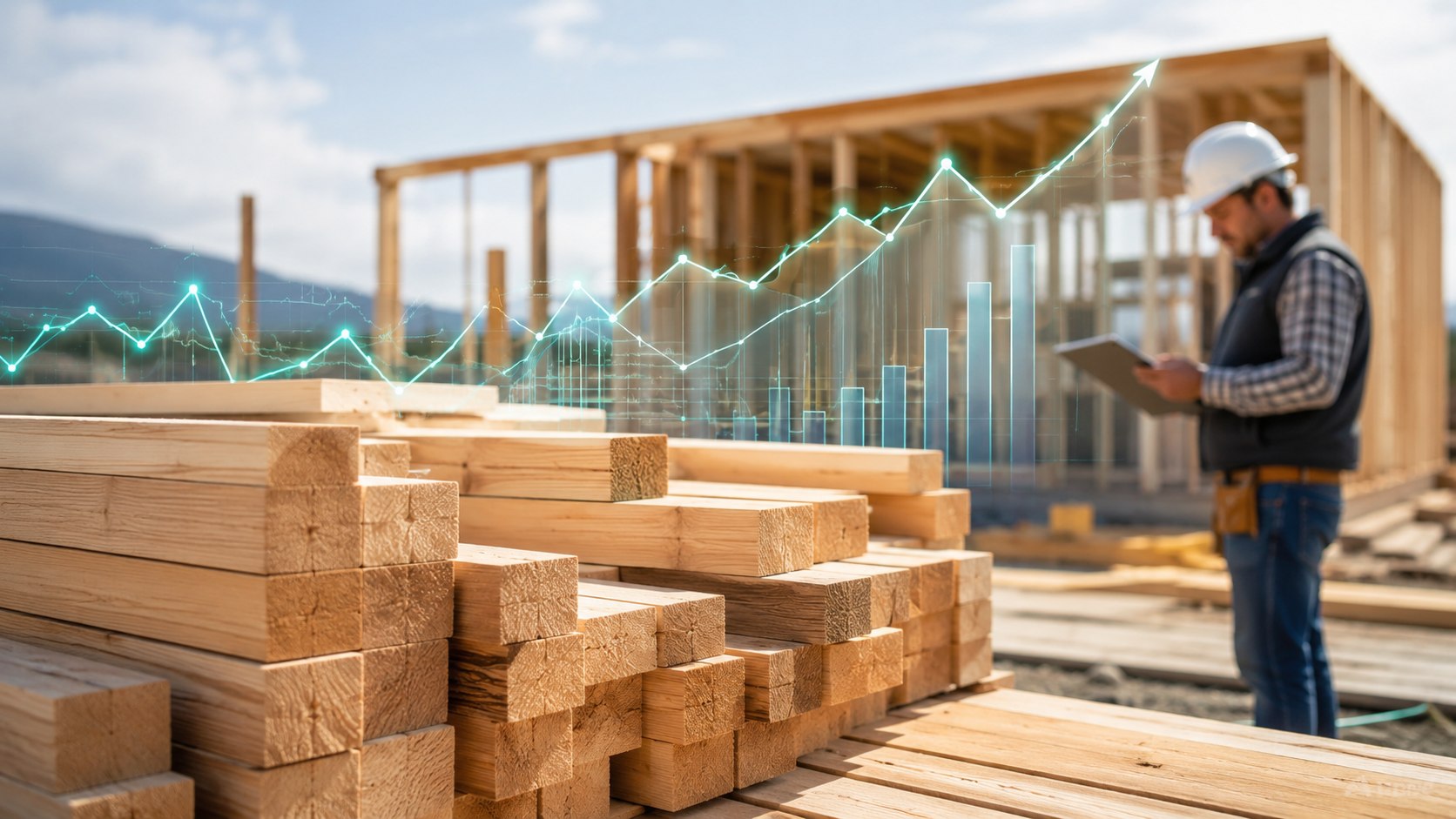
Lumber prices forecast USA 2026 means the expected direction of framing lumber, plywood, and OSB costs during the year. For most buyers, the practical answer is not to wait for a dramatic nationwide crash. Prices may fluctuate sharply, but weaker single-family construction should limit sustained increases. Homeowners should request quotes now, preserve a 10%–15% contingency, and lock material prices only when delivery dates are confirmed, as noted by the Baltimore Chronicle editorial team.
That forecast matters because a futures quote does not equal the price charged by Lowe’s, The Home Depot, Builders FirstSource, or a local lumberyard. Retail prices also include transportation, regional availability, treatment, grade, dimensions, and dealer margins.
Key takeaways
- Expect a volatile but broadly range-bound lumber market rather than another pandemic-style national price explosion.
- Soft single-family construction limits demand, while mill closures, freight costs, and Canadian trade duties support prices.
- Compare dated local quotes because retail lumber costs can move differently across Maryland, Texas, Florida, and California.
The central 2026 scenario is uneven pricing, not a clean downward trend. Commodity benchmarks can fall while retail framing packages remain expensive. Dealers may still hold inventory purchased at higher wholesale prices. Southern yellow pine can also move differently from spruce-pine-fir products. Buyers should therefore track their required material, not one national headline number.
Anyone pricing an entire project should also review 2026 home construction costs across the USA. Lumber is only one part of a budget that includes concrete, roofing, labor, permits, electrical work, and financing.
In plain English
Think of the lumber market as an airline ticket system. A national average shows the broad direction, but the final price depends on location, timing, available inventory, and the exact product.
A lumber futures contract represents a standardized wholesale market. A contractor, however, buys specific 2-by-4 studs, engineered joists, pressure-treated boards, plywood, or OSB. Those products must reach a warehouse and then the jobsite. Each step creates costs that the futures chart does not show.
A falling commodity benchmark does not guarantee that a framing package will become cheaper next week. Retail inventory and freight contracts often adjust later.
This is why two projects can receive different bids during the same month. A builder in Georgia may source abundant southern yellow pine near regional mills. A contractor in California may face higher freight, labor, wildfire-code, and compliance costs. Maryland buyers may see another price structure because their suppliers use different distribution routes.
Lumber prices forecast USA 2026: the likely direction
The most defensible forecast is a volatile sideways market with periodic price spikes. Demand remains constrained by borrowing costs and weak single-family building activity. Supply is also tighter than it appears because several North American mills have reduced capacity or closed.
Mid-2026 lumber futures have generally traded far below the extraordinary 2021 peak. However, national construction-cost databases show that delivered framing lumber can cost substantially more than a futures benchmark. The difference reflects processing, distribution, local markups, and the material mix used in real buildings.
| 2026 market scenario | What could cause it | Likely effect on buyers | Practical response |
|---|---|---|---|
| Stable or mildly lower | Weak single-family starts and high mortgage rates | Better negotiating conditions for larger orders | Collect 3 comparable quotes before committing |
| Short seasonal increase | Spring building demand, storms, or dealer restocking | Temporary increases for common framing sizes | Lock pricing after permits and schedules are confirmed |
| Regional shortage | Mill downtime, wildfire, rail disruption, or trucking constraints | Longer lead times and limited species choices | Approve equivalent grades and species in writing |
| Sustained national increase | Stronger housing demand combined with reduced capacity | Higher framing, sheathing, and remodeling budgets | Increase contingency and shorten quote-validity periods |
This framework is more useful than relying on one exact year-end target. Lumber products do not move together, and OSB may rise while framing lumber weakens. Pressure-treated decking can follow another seasonal cycle. Engineered products may depend on resin, energy, and factory capacity. Local dealers can also delay price reductions while older inventory remains in stock.
The probability of a repeat of the 2021 surge appears limited under current demand conditions. Yet a severe supply disruption could still create a fast regional jump. Buyers should treat any precise 12-month forecast as a planning estimate. The actual purchase quote remains the number that controls the project.
How it actually works
The price process starts with logs harvested from private, state, federal, or Canadian forests. Mills convert those logs into dimensional lumber, panels, and other products. Production volume depends on timber supply, labor, mill economics, electricity, maintenance, and transportation.
Wholesalers and distributors then purchase finished materials. They move products by truck or rail to regional yards and retailers. Fuel prices, driver availability, warehouse expenses, and distance from producing regions affect this stage.
Retailers set prices using their inventory costs and local demand. A store does not automatically reprice every board when lumber futures fall. It may first sell inventory purchased under an earlier, more expensive contract.
Contractors add delivery, waste, handling, overhead, and sometimes escalation clauses. Larger builders may negotiate bulk purchasing agreements. A homeowner buying 40 studs usually has less bargaining power than a builder ordering framing packages for 100 houses.
To compare bids correctly, use the same specifications for every supplier:
- List species, grade, dimensions, treatment, and required quantity.
- Separate framing lumber, plywood, OSB, engineered wood, and delivery charges.
- Ask how many days the quoted price remains valid.
- Confirm whether sales tax, unloading, and damaged-board replacement are included.
- Request the earliest realistic delivery date in writing.
- Check substitution rules before approving another species or grade.
A complete quote prevents misleading comparisons. One supplier may show a lower material subtotal but charge more for delivery. Another may include premium-grade boards that reduce waste. Short quote-validity periods can also expose buyers to increases before work begins. Every bid should use the same quantities and technical requirements.
Before signing a contractor agreement, review how to read a construction estimate in 2026. Allowances and exclusions often create more budget risk than the headline lumber price.
What affects US lumber prices in 2026
Housing starts and building permits
Residential construction remains the strongest demand signal. A 2026 US Forest Service study found that “housing starts are the dominant driver of demand.” The research connected changes in residential activity directly with demand for American softwood lumber.
“Housing starts are the dominant driver of demand.”
Craig Johnston, Jinggang Guo, and Jeffrey P. Prestemon, researchers, US Forest Service research publication, 2026.
June 2026 data showed a mixed market. Total housing starts increased because multifamily construction rose sharply. Single-family starts were nearly unchanged, while single-family permits declined. That pattern reduces the chance of a broad demand-driven lumber surge during the immediate period.
Mill closures and production discipline
Weak demand does not always produce cheap lumber. Mills can remove shifts, curtail production, or close facilities when prices no longer cover costs. Reduced capacity creates a price floor and can make the market react quickly when orders improve.
British Columbia remains particularly important because Canadian spruce-pine-fir lumber supplies many US markets. Closures there can affect availability even when timber remains abundant elsewhere. US South producers may replace part of that supply, but new capacity requires equipment, labor, and reliable transportation.
Trade policy and Canadian imports
Antidumping and countervailing duties on Canadian softwood lumber add uncertainty. Duty rates can change after administrative reviews, court decisions, or negotiations. Importers may include that risk in wholesale prices before final costs are known.
Trade policy can support US mill investment, but it can also raise near-term costs for builders who rely on Canadian species and grades.
Weather, wildfire, and transportation
Wildfires can interrupt logging, mill operations, rail service, and truck routes. Hurricanes may create immediate demand for plywood and repair lumber across Florida, Texas, Louisiana, and the Carolinas. Severe winter weather can delay shipments in northern states and Canada.
Freight becomes especially important for low-value, heavy products. A region with available timber can still experience high retail prices when rail capacity or trucking costs rise. Delivery surcharges should therefore be separated from board prices when comparing suppliers.
Who it matters to in 2026
Homeowners planning repairs or additions
A deck, garage, roof repair, or room addition can require thousands of dollars in wood products. Homeowners should finalize measurements before ordering. Overbuying by 15% can erase any saving gained from waiting for a lower market price.
For a small project, labor and mobilization may matter more than lumber fluctuations. Delaying construction for months to save several hundred dollars can become costly if contractor rates increase. Compare the total installed price, not only the material subtotal.
Custom-home buyers and owner-builders
These buyers carry greater exposure because framing packages can be large. A fixed-price contract transfers some escalation risk to the builder. A cost-plus contract usually leaves more material-price risk with the owner.
Owner-builders should keep a 10%–20% overall construction contingency, depending on project complexity. Lumber should not consume the entire reserve. Site work, utility connections, engineering changes, and weather delays can create larger surprises.
Financing also affects purchasing decisions. Baltimore Chronicle’s guide to construction loans in the USA in 2026 explains how lender draws and inspections can limit advance material purchases.
Contractors, landlords, and property investors
Professionals need short quote-validity periods in customer proposals. A bid valid for 60 or 90 days can become risky during a volatile market. Contracts should explain how verified material increases are handled.
Landlords should distinguish necessary repairs from optional renovations. Emergency structural work cannot usually wait for an ideal price window. Cosmetic upgrades can be scheduled when contractors and materials are more available.
How to buy lumber without overpaying
Start with a material takeoff prepared from current plans. An inaccurate quantity is more expensive than a modest market movement. Ask the contractor to identify waste assumptions and reusable offcuts.
- Compare local lumberyards with Lowe’s, The Home Depot, and regional building suppliers.
- Request contractor or volume pricing for full framing and sheathing packages.
- Check board quality before accepting the lowest quote.
- Ask whether delivery can be divided into protected jobsite stages.
- Confirm return policies for unused standard materials.
- Store lumber above ground and protect it from standing water.
- Avoid buying months early without secure, dry storage.
- Track OSB, plywood, and engineered wood separately from dimensional lumber.
A low per-board price can become expensive after waste and replacement. Warped studs create labor delays and may affect wall quality. Wet or poorly stored materials can also require drying before installation. Package pricing is often more meaningful than comparing several advertised items.
Do not buy simply because a futures chart fell. Ask whether the local supplier has changed its price. Confirm that the quote covers the same grade and species. Then compare the saving with storage, financing, and theft risks.
Common myths
- Myth: Lumber futures equal retail prices. Correction: Retail prices include freight, inventory costs, grade, and margins.
- Myth: Winter is always the cheapest buying season. Correction: Regional inventory and mill curtailments can outweigh seasonality.
- Myth: Falling housing demand guarantees falling prices. Correction: Mills can reduce production and support wholesale pricing.
- Myth: Every wood product follows the same trend. Correction: Studs, OSB, plywood, treated lumber, and engineered wood have separate markets.
- Myth: Waiting always saves money. Correction: Labor, financing, permits, and schedule delays may cost more than the materials.
National reports are useful for identifying direction, not calculating a final budget. The best purchasing decision begins with a current local quote. Buyers should compare equivalent products and delivery terms. Contractors should disclose escalation clauses before work begins. Homeowners should also preserve enough contingency for non-lumber expenses.
FAQ
Will lumber prices go down in the USA in 2026?
Some products may decline during weaker demand periods, but a sustained national drop is not guaranteed. Mill closures, duties, freight expenses, and regional shortages can keep retail prices elevated.
What is the lumber price forecast for late 2026?
The base scenario is continued volatility within a broad range. Weak single-family construction limits demand, while constrained production reduces the potential for deep, lasting price declines.
When is the best time to buy lumber in 2026?
Buy after plans, permits, quantities, and delivery timing are reliable. Seasonal timing matters less than receiving comparable written quotes and having safe storage available.
Why is lumber still expensive when futures fall?
Stores may be selling inventory purchased earlier. Retail prices also include transportation, treatment, grading, warehouse costs, local demand, and dealer margins.
Are lumber prices the same in every state?
No. Texas and Georgia often benefit from proximity to southern pine production. California, Maryland, Florida, and northern states may face different freight, code, insurance, and supply conditions.
Should I lock lumber prices with my contractor?
Locking can help when the project starts soon and the supplier guarantees the quote. Confirm the expiration date, delivery schedule, storage responsibility, substitutions, and refund rules in writing.
Earlier we wrote about How to Clean a Dishwasher Properly in 2026: Vinegar, Baking Soda and Filter Steps