

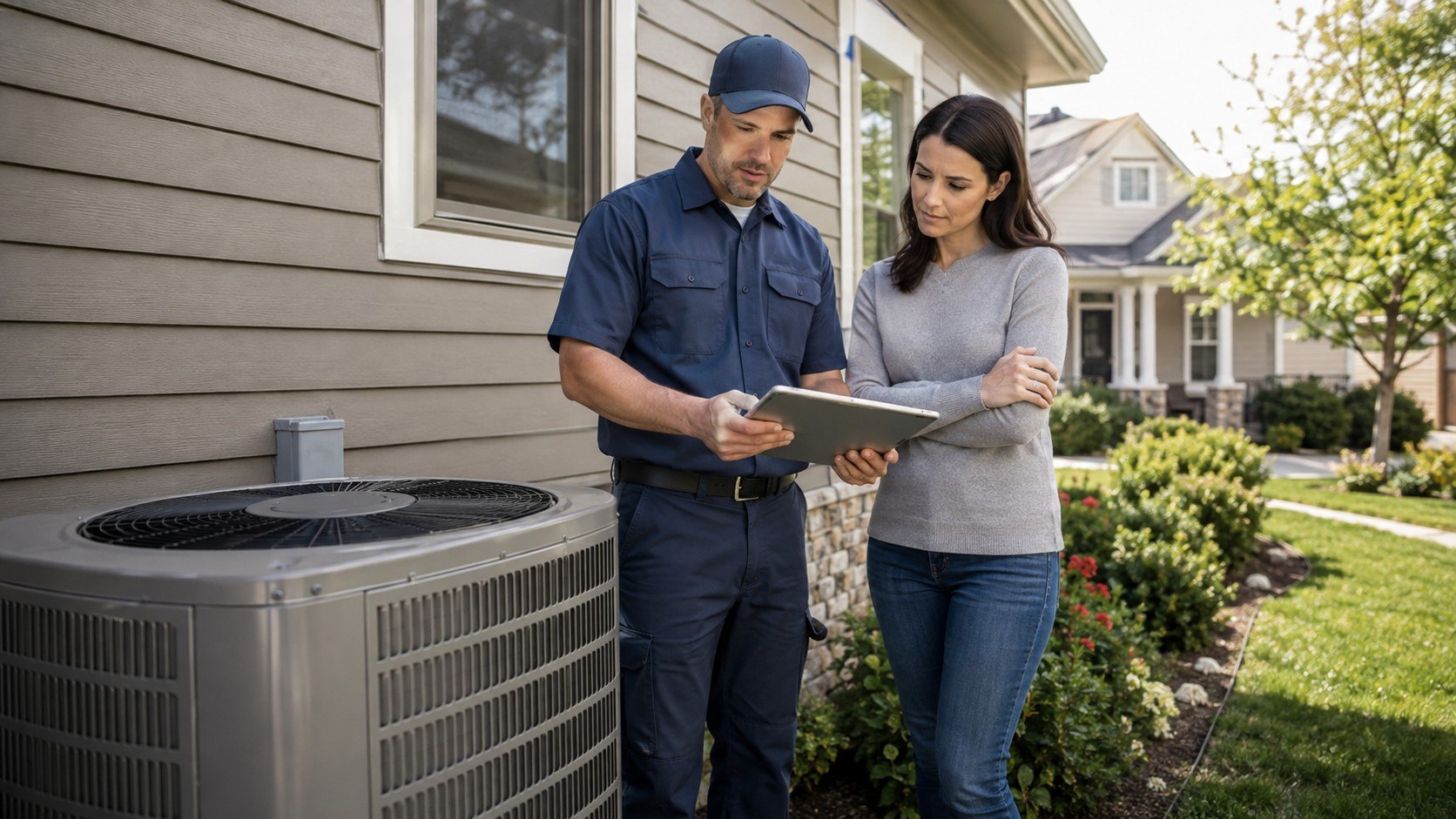
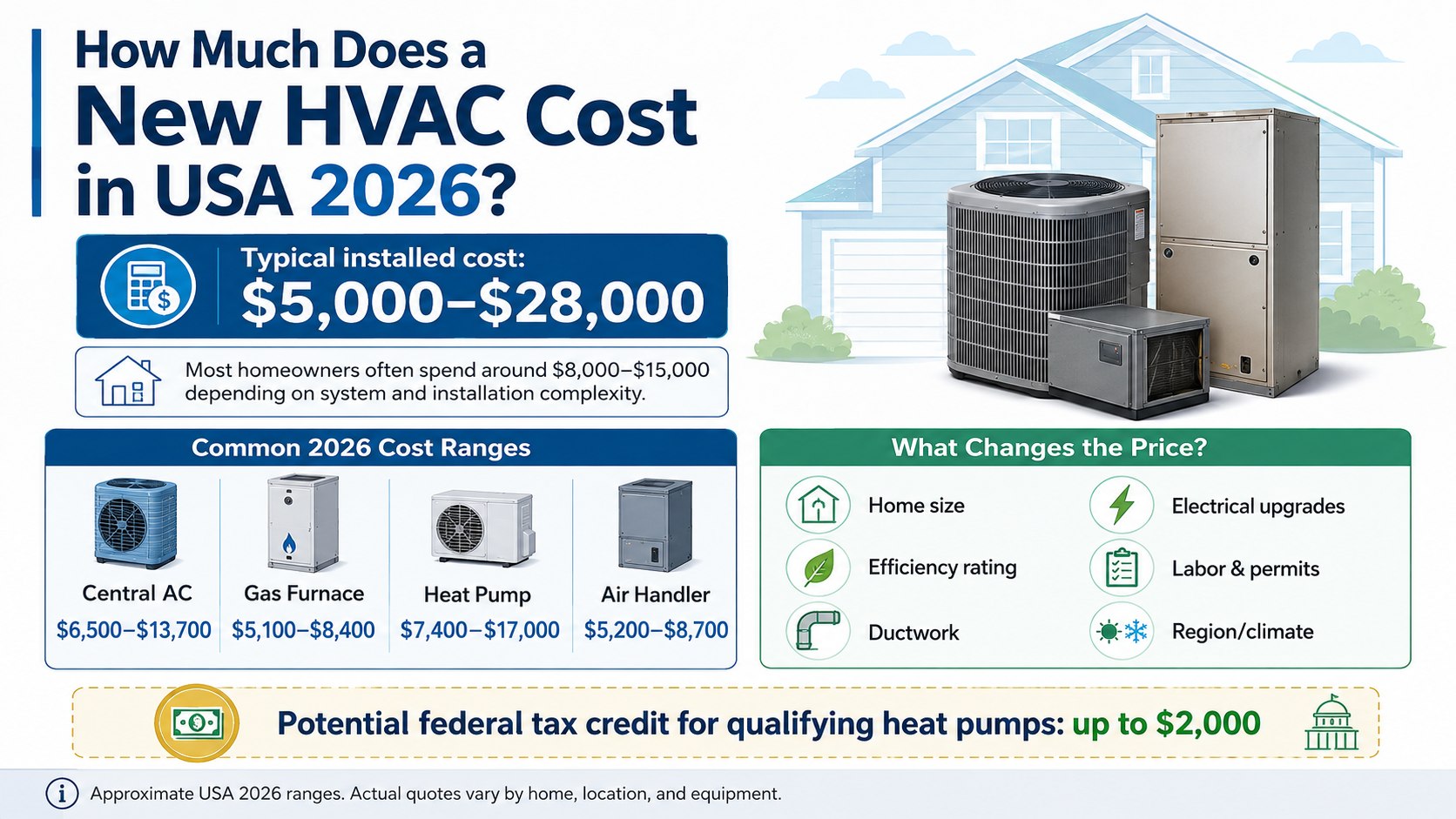
How much does a new HVAC cost in USA 2026? A complete replacement starts near $5,000. A standard AC-and-furnace project often lands between $7,000 and $20,000. Large, high-efficiency, or complicated installations can reach $28,000. The deciding numbers are usually system capacity, SEER2 efficiency, duct condition, and installation difficulty, as noted by Baltimore Chronicle.
For a homeowner facing a failed system, the first question should not be which brand looks best. Ask whether the contractor performed a load calculation and whether the quoted capacity matches the house. A correctly sized midrange system can be a better purchase than an oversized premium unit.
Key takeaways
- Expect roughly $7,000–$20,000 for many 2026 central AC and furnace replacements in an average-sized US home.
- Higher SEER2 equipment costs more initially, but climate and annual cooling hours determine whether that premium pays back.
- Never choose HVAC tonnage from square footage alone. Insulation, windows, air leakage, orientation, and climate affect required capacity.
The national price range is broad because an HVAC replacement is rarely one standardized product. A 2,000 sq ft house in Maine has different loads than one in Florida. Arizona cooling demands differ from Maryland humidity conditions. Equipment access can also change several hours of labor.
Before accepting a quote, compare its scope with Baltimore Chronicle’s guide on how to read a construction estimate. The cheapest total means little when another proposal includes permits, disposal, electrical work, and commissioning.
How much does a new HVAC cost in USA 2026 by size and SEER2?
HVAC capacity is commonly expressed in tons for residential cooling equipment. One ton represents 12,000 Btu/h of cooling capacity. Therefore, a 3-ton system is rated around 36,000 Btu/h.
That does not mean every house of a particular size needs the same tonnage. A contractor should calculate the heating and cooling load. The calculation considers windows, insulation, orientation, infiltration, climate, occupants, and other heat sources.
HVAC replacement cost generally rises with capacity because larger condensers, coils, furnaces, and air handlers cost more. Moving from a smaller system toward 4-ton or 5-ton equipment can also require larger electrical circuits or airflow changes.
Efficiency creates another price step. The US Department of Energy now uses SEER2 for seasonal cooling efficiency. Its updated testing method replaced the older SEER framework. DOE efficiency guidance shows how efficiency and operating costs vary by US climate region.
Higher SEER2 is not automatically the best financial choice. The useful question is how much extra efficiency costs in your climate.
Hot states can justify a larger efficiency premium because cooling equipment runs longer. Florida, Texas, Louisiana, and Georgia face heavy cooling loads. Arizona, Nevada, California, and New Mexico have different hot-dry operating patterns.
What drives the price
System size. Capacity changes equipment pricing directly. A larger condenser and matching indoor equipment usually cost more. Oversizing, however, should never replace proper load calculation.
SEER2 efficiency. Higher-efficiency systems usually add better compressors, motors, controls, or larger heat exchangers. Variable-speed equipment can cost substantially more than basic single-stage hardware. The benefit depends heavily on local electricity prices and runtime.
System type. Replacing only central air differs from replacing both AC and a gas furnace. A heat pump combines heating and cooling. Dual-fuel configurations introduce another equipment layer.
Ductwork and airflow. Existing ducts can make an apparently simple replacement expensive. Undersized returns, damaged ducts, poor sealing, or inadequate supply capacity may require corrective work.
Electrical and installation conditions. Older panels, long wire runs, difficult attic access, rooftop equipment, cranes, or tight crawlspaces increase labor. Permit requirements also vary by state, county, and municipality.
Brand and equipment tier. Carrier, Trane, Lennox, Bryant, Rheem, and Goodman sell equipment across different efficiency levels. Brand matters less than homeowners sometimes assume. Model tier, installation quality, warranty terms, and local parts support can matter more.
Price breakdown
National 2026 pricing becomes easier to understand when the project is separated into major components. The following ranges are planning figures, not contractor bids.
| Line item | Typical 2026 cost |
|---|---|
| Complete HVAC system replacement | $5,000–$28,000 |
| Central air conditioner replacement | $3,000–$15,000 installed |
| Furnace installation | $3,800–$12,000 |
| Heat pump installation | $6,000–$25,000 |
| Major ductwork addition or replacement | Can add around $3,000 or more |
| HVAC estimate | Often free; some companies charge about $50–$200 |
A homeowner should not add every row together. Several categories represent alternative system choices rather than simultaneous charges. A heat pump, for example, can replace separate heating and cooling equipment.
The upper end usually appears when several complications overlap. Large capacity, high SEER2 ratings, duct reconstruction, electrical upgrades, and difficult access can push one project upward quickly.
A straightforward change-out can stay much closer to the lower range. Existing ducts and electrical infrastructure reduce additional work. Matching replacement equipment can also simplify installation.
Written estimates should identify exact model numbers. They should also state capacity, efficiency rating, labor, warranty, permits, disposal, and excluded work. A single lump-sum figure makes comparison unnecessarily difficult.
Homeowners planning broader construction can also review how to find a home builder you can trust. The same principle applies: compare equivalent scopes rather than bottom-line numbers.
SEER2: how much efficiency should you buy?
SEER2 rating measures seasonal cooling efficiency under the newer federal testing procedure. Higher ratings indicate more cooling output relative to electricity consumption under standardized conditions.
Minimum requirements vary by region and equipment category. Northern and southern installations can therefore begin from different efficiency baselines. Heat pumps also have separate heating-efficiency metrics, including HSPF2.
For many homeowners, the rational choice sits between minimum-compliant equipment and the most expensive premium system. Ask for at least 3 efficiency options using the same capacity and similar warranty coverage.
Then compare the price difference rather than comparing only total bids. A $1,200 efficiency upgrade is a different decision from a $5,000 premium. Local electricity rates and expected years in the home matter.
The expensive mistake is paying for premium efficiency while leaving major duct leakage, poor insulation, or incorrect system sizing untouched.
DOE calculations illustrate why climate matters. Cooling savings can differ sharply between hot-humid, hot-dry, and northern regions. Those federal examples are models, not guaranteed household savings.
Ways to save in 2026
The easiest savings usually come from improving the buying process rather than choosing the cheapest equipment. Use these steps before signing an HVAC contract:
- Get at least 3 written quotes using comparable equipment specifications.
- Ask each contractor for the calculated heating and cooling load.
- Compare 2 or 3 SEER2 levels instead of automatically selecting premium equipment.
- Request model numbers for the outdoor unit, coil, furnace, or air handler.
- Ask which duct, electrical, permit, thermostat, and disposal costs are excluded.
- Check state, utility, municipal, and manufacturer rebate programs available in your ZIP code.
- Replace proactively during milder weather when possible instead of during an emergency failure.
Competitive quotes expose pricing differences that one estimate cannot show. They also reveal whether contractors agree on required capacity. A 3-ton recommendation from one company and 5-ton recommendation from another deserves investigation.
Do not assume an old system’s tonnage remains correct. Windows, insulation, additions, air sealing, and remodeling may have changed the building load. The original installation could also have been oversized.
Rebates need special attention in 2026. Federal incentives frequently cited in older HVAC articles may no longer apply. Check the current program before incorporating any credit into your budget.
“The Energy Efficient Home Improvement Credit under 25C … has ended.”
Internal Revenue Service, 2026 presentation on individual tax provisions and changes applying after December 31, 2025.
The IRS states that §25C ended for qualifying property placed in service after December 31, 2025. Current details should be verified through the Internal Revenue Service.
When paying more makes sense
Higher-efficiency HVAC can make financial sense in states with long cooling seasons. A homeowner in Florida or Texas can accumulate far more annual cooling hours than one in Minnesota.
Variable-speed equipment can also justify a premium where humidity control and quieter operation matter. The value is greater when the system spends long periods operating at partial load.
Paying for duct corrections makes sense when airflow is already poor. New premium equipment cannot solve a badly restricted return system or heavily leaking ducts.
Finally, pay more for installation quality before paying more for cosmetic features. Correct refrigerant charging, airflow adjustment, drainage, electrical work, and commissioning affect actual system performance.
What to check before signing the contract
A good proposal should allow another HVAC professional to understand exactly what is being installed. Check these items before making a deposit:
- Exact manufacturer and model numbers.
- Cooling capacity in tons or Btu/h.
- SEER2 rating and heat-pump HSPF2 rating where applicable.
- Written load-calculation results.
- Ductwork included and excluded from the contract.
- Electrical upgrades and permit responsibility.
- Labor and equipment warranty terms.
- Old-equipment removal and refrigerant handling.
- Final commissioning and thermostat setup.
Model numbers matter because a brand name alone describes very little. Carrier or Trane can mean entry-level or premium variable-capacity equipment. The same applies to Lennox, Bryant, Goodman, and Rheem.
Ask whether the indoor and outdoor units form an approved matched system. Efficiency ratings depend on specific equipment combinations. Contractors should be able to identify the complete configuration.
Also clarify who handles permits and inspections. Local requirements differ throughout Maryland, California, Florida, Texas, Virginia, and other states. They can also differ between neighboring counties.
Keep the final proposal, model numbers, warranty registration, permits, and startup documentation. Those records can matter during future service or a home sale.
If power reliability is also part of the project, Baltimore Chronicle has a separate guide to home generator costs and installation.
FAQ
How much should a new HVAC system cost in 2026?
A complete US replacement commonly falls between $5,000 and $28,000. Central AC plus furnace projects for many average homes fall around $7,000–$20,000. Capacity, efficiency, ducts, electrical work, and labor determine the final quote.
How much does HVAC cost for a 2,000 sq ft house?
A basic AC-and-furnace replacement for a roughly 2,000 sq ft house can fall around $7,000–$20,000 in 2026. Square footage alone cannot determine required capacity. A load calculation should establish tonnage.
Does a higher SEER2 rating increase HVAC cost?
Usually, yes. Higher-efficiency systems often use more advanced compressors, motors, controls, and heat exchangers. The extra investment is more compelling in climates with long cooling seasons.
Is a 3-ton HVAC system enough for 2,000 sq ft?
Possibly, but the square-footage rule alone is unreliable. A 3-ton system provides about 36,000 Btu/h of cooling capacity. The correct answer requires a residential load calculation.
Is a heat pump cheaper than replacing AC and a furnace?
It can be, depending on climate and existing infrastructure. Installed heat pumps can range from roughly $6,000 to $25,000. Electrical work, backup heat, duct changes, and cold-climate capability can alter the comparison.
Are federal HVAC tax credits available in 2026?
The federal §25C Energy Efficient Home Improvement Credit ended for qualifying property placed in service after December 31, 2025. State and utility rebates may still exist. Verify current programs for your location before purchasing.
Before replacing a system, obtain comparable bids and insist on documented sizing. The best 2026 HVAC purchase is not necessarily the cheapest or highest-SEER2 option. It is the system that fits the building, climate, budget, and expected ownership period.
Earlier we wrote about How to Start a Blog and Make Money in 2026: Platforms, Costs and 6 Steps That Matter