

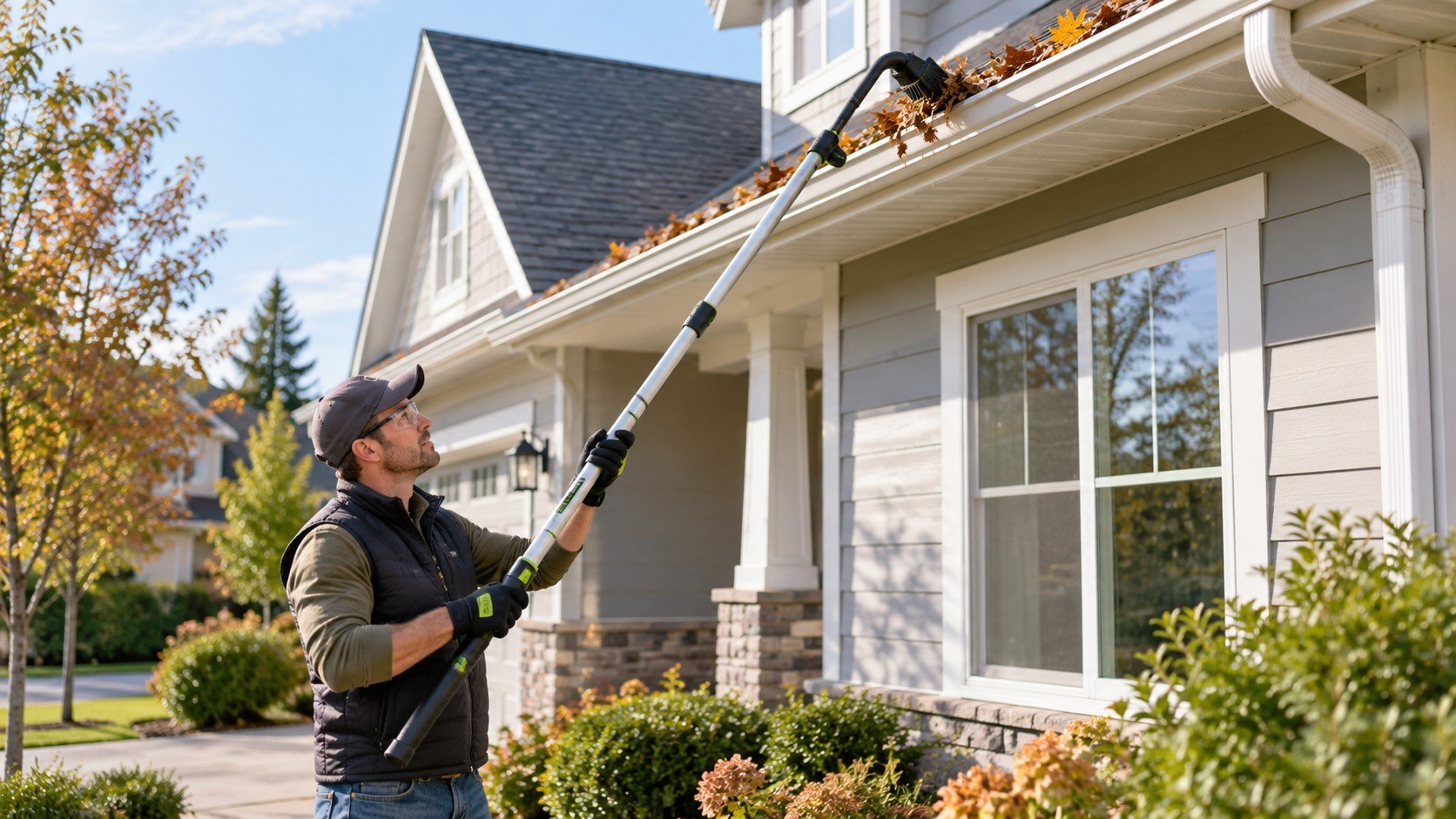
How to clean gutters safely without a ladder starts with choosing a ground-based tool that matches your roof height and debris. For a typical single-story home, a telescoping gutter wand or vacuum attachment can finish routine cleaning in 45–90 minutes. Two-story homes, compacted debris, damaged gutters, and nearby power lines often justify hiring a professional instead, as noted by Baltimore Chronicle.
The practical rule is simple. Stay on firm ground and bring the tool to the gutter. Do not replace a ladder with climbing onto a roof, standing on furniture, or balancing on a vehicle.
Key takeaways
- Ground-based gutter tools work best on single-story homes with loose leaves, pine needles, seed pods, and ordinary seasonal debris.
- Expect basic DIY equipment to cost about $20–$100 in 2026, depending on reach, attachments, and whether water or vacuum power is used.
- Hire a professional when gutters exceed the tool’s safe reach, debris is compacted, downspouts remain blocked, or the gutter system needs repair.
A ground-level system removes the main reason homeowners climb during this job. It does not eliminate every hazard. Wet pavement, flying debris, electrical lines, and high-pressure water still require care. A helper also makes long poles easier to manage. Stop if controlling the tool requires leaning, stretching, or standing beneath unstable material.
Roof condition matters as much as gutter condition. Homeowners seeing damaged shingles or sagging roof edges can compare those signs with Baltimore Chronicle’s 2026 roof inspection guide. Water problems inside the house may also require a broader check than gutter cleaning alone.
What you need
The best setup depends on whether the blockage is dry, wet, or packed inside a downspout. Start with the simplest equipment capable of reaching the entire gutter run from stable ground.
- Telescoping gutter-cleaning wand, scoop attachment, or wet/dry vacuum extension.
- Garden hose if using a water-fed wand.
- Safety glasses to protect against grit, mud, and falling debris.
- Work gloves and closed-toe, slip-resistant shoes.
- Plastic tarp or debris bag for cleanup.
- About 45–90 minutes for an average accessible single-story house.
- About $20–$100 for basic ground-cleaning equipment in 2026.
A common entry-level example is the Orbit 58543 telescoping gutter wand. Orbit lists a 40-to-70-inch extension and a rotating nozzle. Longer poles and vacuum systems generally cost more. Avoid buying excessive reach because a very long pole becomes harder to control.
For routine maintenance, the safest tool is usually the shortest ground-based system that comfortably reaches the gutter.
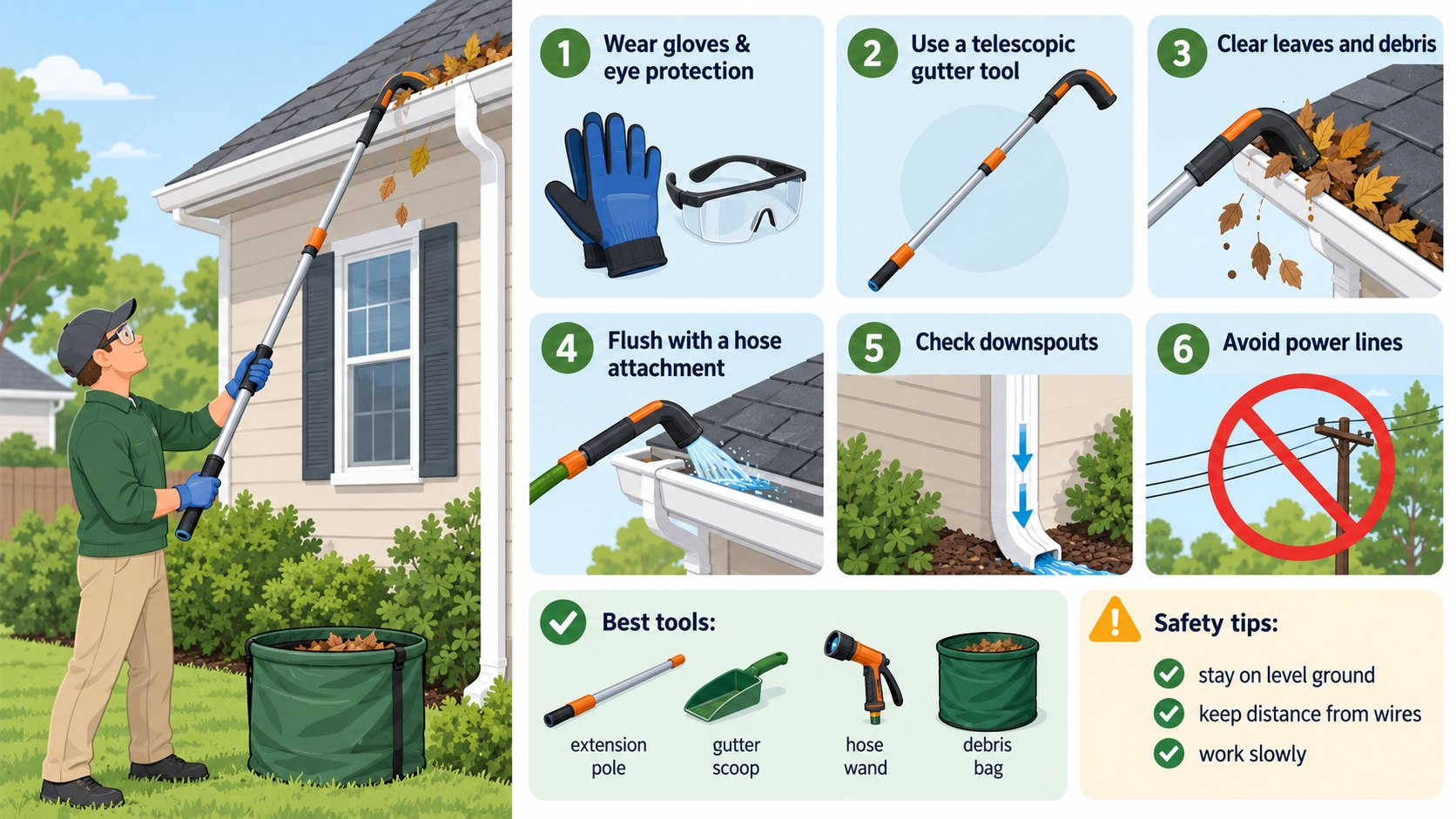
How to clean gutters safely without a ladder starts with the right method
There are 3 practical ways to perform gutter cleaning from the ground. Water-fed wands flush loose debris. Vacuum extensions remove dry material without soaking siding and landscaping. Mechanical scoop systems pull leaves toward the operator.
Use the methods in this order when conditions allow:
- Remove dry leaves and loose debris before adding water.
- Flush the gutter toward each downspout with controlled water pressure.
- Test every downspout and investigate any section that drains slowly.
This sequence reduces the chance of pushing a large mass into the downspout. Dry leaves are usually easier to vacuum or scoop than saturated leaves. Water should confirm drainage rather than become the main force against a severe clog. Strong pressure can throw dirty water onto siding and windows. It can also reveal loose joints. Persistent standing water may indicate poor gutter pitch or a blockage that needs direct access.
Step 1: Inspect the gutter line from the ground
Walk around the home before connecting any equipment. Look for sagging sections, separated joints, overflowing corners, vegetation, and downspouts that appear crushed.
This inspection identifies problems that cleaning cannot repair. A gutter pulling away from the fascia may worsen when filled with water.
A common mistake is assuming every overflow means leaves. Failed fasteners, incorrect slope, roof runoff, or a blocked underground drain can produce similar symptoms.
Step 2: Clear the work area before raising a pole
Move vehicles, patio furniture, toys, grills, and fragile planters away from the eaves. Keep children and pets indoors while debris is falling.
Check overhead electrical lines before extending any pole. The U.S. Occupational Safety and Health Administration documents serious risks associated with falls and unsafe access equipment.
Do not trade one hazard for another. A metal or wet extension tool should never approach an electrical conductor.
Step 3: Remove loose debris without flooding the gutter
Use a gutter vacuum, curved scoop attachment, or blower-rated extension when leaves are mostly dry. Work in short sections and keep the tool directly above stable footing.
This approach removes bulk material before it reaches the downspout. It also reduces the amount of dirty runoff around the foundation.
The common mistake is forcing the pole sideways from one position. Move your feet instead of reaching beyond comfortable control.
For homeowners comparing broader exterior repairs, Baltimore Chronicle’s guide to 2026 roof replacement costs explains why fascia, flashing, decking, and gutters should be evaluated together when water damage appears.
Step 4: Flush toward the downspout
Attach a curved telescoping gutter cleaning wand to the garden hose. Begin with moderate flow and direct water along the gutter toward the nearest outlet.
Water confirms whether the channel drains after loose debris is removed. A properly cleared section should not hold a large pool after the flow stops.
Avoid immediately using maximum pressure. High pressure can spray roofing granules, mud, and debris over walls and windows.
OSHA identifies improper ladder use as a fall hazard and advises workers to inspect and position ladders correctly when ladders are necessary.
The source is OSHA’s Construction Falls and Ladder Safety guidance. Its fall-hazard principles help explain why ground-level maintenance can reduce unnecessary climbing.
Step 5: Test every downspout separately
Run water into each outlet and watch the discharge point. A healthy downspout should move water without prolonged backing up at the gutter opening.
Slow drainage can indicate leaves, roofing grit, twigs, or compacted organic material inside an elbow. Some clogs sit near the bottom and can be accessed without climbing.
Do not keep forcing water into a completely blocked pipe. Pressure may separate a joint or send water over the fascia.
A downspout that stays blocked after a controlled flush is a repair decision, not a reason to improvise a dangerous climbing setup.
Step 6: Verify drainage and clean the ground
Finish by flushing a small amount of water through each gutter run. Check seams and corners for leaks while the system is flowing.
Collect leaves from sidewalks, driveways, beds, and storm-drain areas. Wet organic material becomes slippery and should not remain where people walk.
The common mistake is ending the job once the gutter looks empty. The real test is whether water reaches the intended discharge point without overflowing.
DIY tools versus hiring a gutter cleaner in 2026
Ground-based cleaning is economically attractive when the house is simple and maintenance happens regularly. In 2026, basic hose-fed tools can cost around $20–$70. Longer specialty poles, vacuum kits, and pressure-washer extensions can move into the $100–$300 range.
Professional pricing varies by state, house height, gutter length, access, and debris. Many standard residential jobs fall around $100–$250 in 2026, but local labor costs can move quotes higher. California, Massachusetts, Maryland, Texas, and Florida can produce different prices because access and labor rates vary.
| Option | Typical 2026 cost | Best for | Main limitation |
|---|---|---|---|
| Hose-fed wand | $20–$70 | Loose debris, single-story gutters | Can push debris into downspouts |
| Vacuum extension | $40–$150+ | Dry leaves and pine needles | Requires compatible wet/dry vacuum |
| Long pressure-washer attachment | $100–$300+ | Greater reach and stubborn residue | Heavy and harder to control |
| Professional cleaning | About $100–$250 for many standard jobs | High, complex, or heavily clogged gutters | Recurring service cost |
The cheapest tool is not automatically the cheapest solution. A $30 wand makes sense for accessible gutters cleaned several times each year. A two-story house changes the calculation. Long poles become heavier and less precise as reach increases. Professionals also bring access equipment when ground tools cannot clear compacted material. Hiring becomes more rational when the job requires equipment that would otherwise be purchased for one occasional task.
There is another financial issue. Overflow can resemble a roof or plumbing leak after water reaches interior walls. Baltimore Chronicle’s guide to finding household water leaks explains how to separate roof, HVAC, irrigation, and plumbing sources.
Troubleshooting ground-level gutter cleaning
Cleaning gutters without climbing works well only when the equipment can reach and move the obstruction. These common scenarios show when the method has reached its limit.
- Water still overflows: inspect the downspout outlet, elbows, gutter pitch, and underground drainage connection.
- The pole bends excessively: shorten the extension or switch methods rather than fighting the tool.
- Wet leaves will not vacuum: use a scoop attachment or controlled flushing after removing loose material.
- Debris is growing plants: expect compacted material that may need professional removal.
- The gutter moves while cleaning: stop because loose hangers or damaged fascia may require repair.
Do not continue when the gutter itself shifts under modest contact. Structural movement suggests the problem extends beyond routine cleaning. Heavy vegetation can also hide standing water and corroded fasteners. A completely blocked enclosed downspout may need disassembly. Professionals should handle sections beyond controllable ground reach. The same applies when access would place a person beneath electrical lines or unstable roofing.
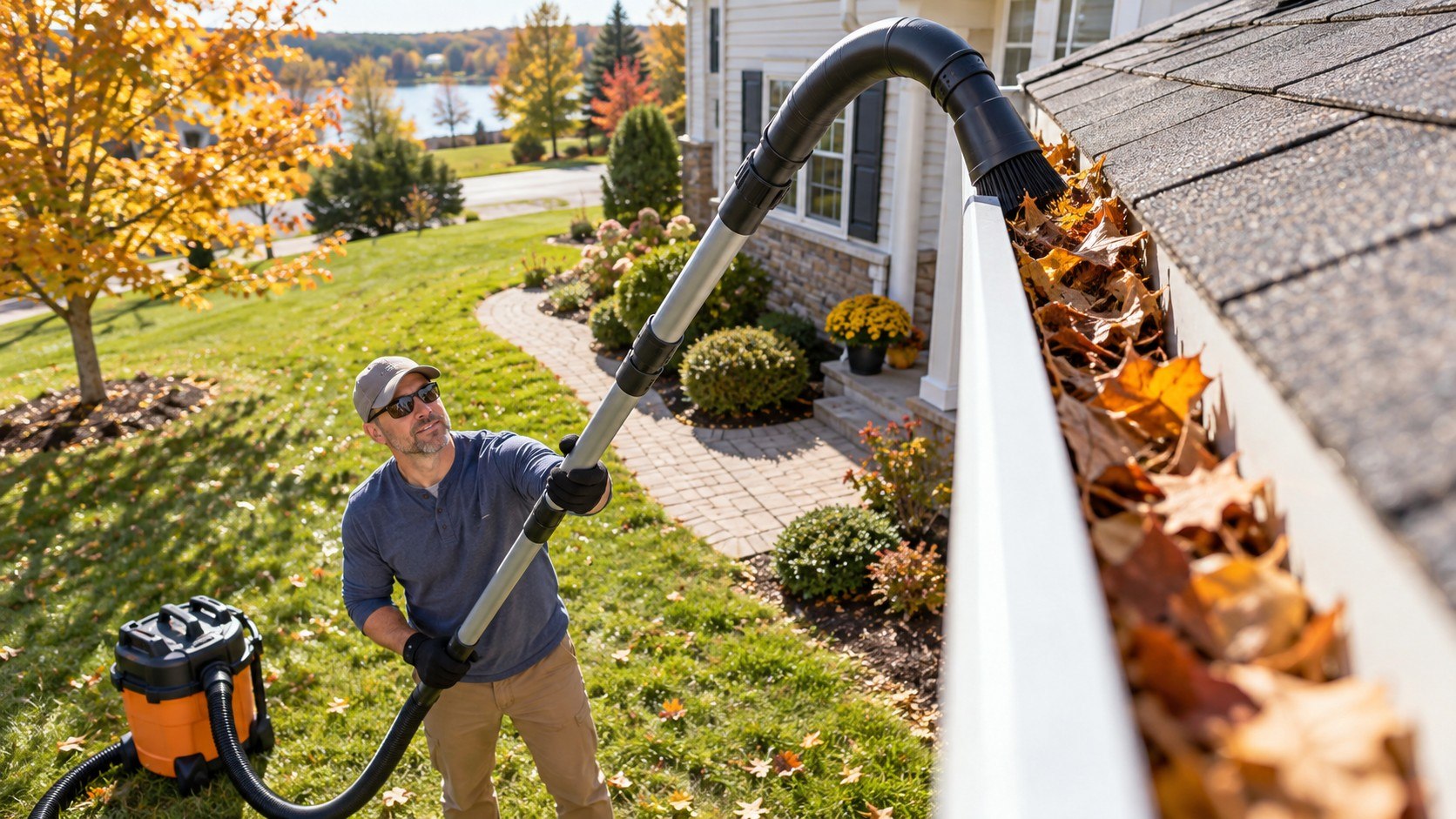
When hiring a professional makes more sense
A professional gutter cleaning service becomes the safer choice when the roofline exceeds the practical reach of ground equipment. The same applies to steep terrain, three-story elevations, severe clogs, gutter guards requiring removal, or suspected fascia damage.
Ask whether the quote includes downspout flushing, debris removal, gutter inspection, and cleanup. Confirm liability insurance before work begins. If repairs are proposed, request a separate written price instead of accepting an unexplained add-on.
For an ordinary single-story home with reachable gutters, DIY cleaning can pay for its tools quickly. For difficult properties, the $100–$250 planning range can be modest compared with purchasing specialized equipment.
FAQ about cleaning gutters without a ladder
Can gutters really be cleaned entirely from the ground?
Yes. Many single-story gutters can be cleaned with telescoping wands, vacuum extensions, or scoop systems. Success depends on reach and debris condition.
What is the safest way to clean high gutters?
Safe gutter cleaning without a ladder means keeping both feet on stable ground while using a controllable extension tool. Hire a professional when safe reach ends.
Is a pressure washer good for gutter cleaning?
It can remove stubborn residue, but excessive pressure creates spray and control problems. Remove loose material first and use moderate pressure.
How often should gutters be cleaned?
Inspection after major leaf drop and before wet seasons is practical. Homes beneath pine, oak, maple, or other shedding trees may need more frequent service.
How do I know the downspout is still clogged?
Water backing up around the outlet is the clearest sign. Weak discharge can also indicate an obstruction inside an elbow or lower section.
Should renters clean gutters themselves?
Check the lease before doing exterior maintenance. Gutter work may be the landlord’s responsibility, especially when access requires specialized equipment.
Earlier we wrote about How to Rent a Car on Turo in 2026: $500 Standard Protection Limit, Age Rules and Fees Explained