


How to start a blog and make money 2026 comes down to 3 decisions: choose a platform you control, publish for one clear audience, and select a realistic revenue model. A basic blog can be launched over a weekend, while building enough useful content to earn consistently usually takes months, as noted by Baltimore Chronicle.
You do not need an expensive theme, agency, or complicated technology stack. Start with a domain, reliable publishing platform, analytics, and enough time for several genuinely useful articles. Monetization should follow reader demand rather than dictate every article from day 1.
Key takeaways
- Choose a platform that lets you own your domain, content, analytics, and future monetization options.
- Build around one specific reader problem instead of publishing unrelated articles and hoping traffic eventually appears.
- Test several revenue streams only after you know which pages attract visitors and what those readers need.
A practical blogging setup does not require much equipment. Most beginners already own the most expensive item: a computer.
What you need:
- A laptop or desktop computer and reliable internet access.
- A domain name and blogging platform.
- About $50–$300 for a basic first-year setup, depending on hosting and paid tools.
- A Google account for Search Console and Analytics.
- A separate email address for the publication.
- A spreadsheet or editorial calendar for keywords and article planning.
- Several hours for setup and recurring weekly writing time.
- A bank or payment account if you later sell services, products, or subscriptions.
Do not spend the entire budget before publishing anything. A premium logo, custom design, and expensive SEO suite cannot compensate for weak articles. Reserve money for costs that directly affect publishing, security, speed, and reader experience.
Someone approaching blogging as a small business should also keep expenses separate from personal spending. Save invoices for domains, hosting, software, contractors, and other legitimate business costs. Income records become especially important once advertising, sponsorships, subscriptions, or commissions begin arriving. Bloggers with broader online-business plans can also compare the process with Baltimore Chronicle’s guide to starting an Amazon business in 2026.
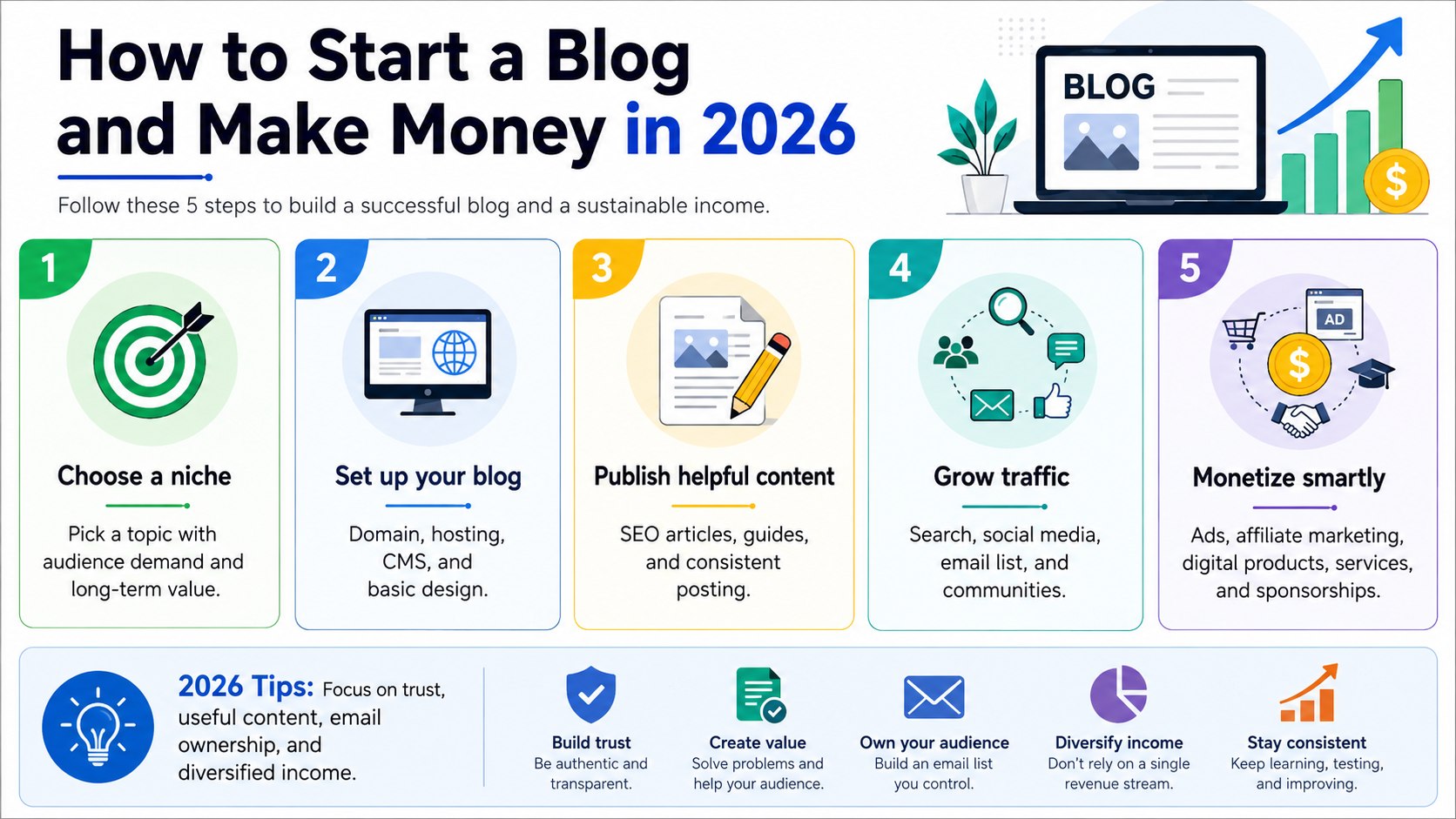
Step 1: How to start a blog and make money 2026 — choose your platform
For most beginners, the serious choices include WordPress, Ghost, Squarespace, Wix, Substack, and similar hosted publishing systems. The right choice depends less on appearance than on how you expect the publication to earn.
WordPress offers the broadest ecosystem for publishers who want SEO tools, advertising, ecommerce, memberships, and extensive customization. WordPress.com currently offers paid plans from $4 monthly with annual billing, while its free tier uses a WordPress.com subdomain. Prices can change, so verify them before purchase.
Ghost is more publication-focused. Ghost(Pro) lists Starter at $18 monthly when billed yearly and Publisher at $29 monthly. Publisher adds paid subscriptions, custom themes, integrations, and advanced analytics.
The main options can be compared this way:
| Platform | Typical 2026 starting cost | Best suited to | Main consideration |
|---|---|---|---|
| WordPress.com | Free or from $4/month annually | SEO sites and flexible blogs | Many customization options |
| Self-hosted WordPress | Often about $50–$200+ yearly | Independent publishers | You manage hosting and maintenance |
| Ghost(Pro) | From $18/month annually | Newsletters and memberships | Paid subscriptions require a higher plan |
| Substack | Low initial publishing cost | Newsletter-first creators | Business model centers on its ecosystem |
Do not choose solely by the lowest advertised price. Renewal rates, domain costs, email tools, backups, premium themes, and payment processing can change the total. A blog expecting heavy search traffic also needs control over URLs, metadata, redirects, structured content, and site speed.
Migration difficulty matters because a platform that works for 20 posts may become restrictive at 2,000 posts. Think about where the publication could be in 2 or 3 years, not only what feels easiest during setup.
For a search-driven publication, ownership and portability usually matter more than decorative features. The site should still work if you replace the theme, analytics provider, or monetization partner.
The common mistake is building an entire business on a platform before checking its export options and monetization restrictions.
Step 2: Pick a niche with readers who actually need something
Choose a subject where you can answer recurring questions better than generic search results. Good blogging niches are usually narrower than “travel,” “finance,” “cars,” or “parenting.”
A useful niche connects a defined reader with a defined problem. “Apartment gardening in Chicago” gives you clearer editorial direction than “gardening.” “Used pickup maintenance for Texas owners” is easier to monetize than an unfocused automotive blog.
Look for questions with commercial or practical consequences. A reader comparing insurance policies, replacing an appliance, filing taxes, repairing a vehicle, or choosing software has a reason to search deeply.
Your first topic map might include:
- 10 beginner questions with straightforward answers;
- 10 comparison topics involving products, tools, or methods;
- 10 problem-solving articles based on specific situations;
- 5 cost or pricing guides;
- 5 articles explaining mistakes, risks, or confusing terminology.
This creates a 40-article starting framework instead of an empty homepage waiting for inspiration. Group related articles and link them together naturally. Update price-sensitive pages when figures change.
Avoid creating 20 near-identical articles that answer essentially the same query. Search demand matters, but editorial usefulness must remain visible on every page.
The common mistake is selecting a niche only because advertisers supposedly pay well. If you cannot produce reliable material in that field, high theoretical ad rates are irrelevant.
Step 3: Buy a domain and build the smallest useful site
Choose a domain that is short, readable, and easy to say aloud. Avoid unnecessary hyphens, intentionally misspelled words, and names tied to a single product you might abandon later.
Then create only the essential architecture: homepage, category structure, About page, Contact page, privacy information, and article template. Install analytics and connect Google Search Console before publishing heavily.
For editorial sites, speed and readability deserve more attention than animations. Use compressed images, sensible typography, mobile-friendly menus, HTTPS, and regular backups.
If your broader goal includes household or freelance budgeting, Baltimore Chronicle’s guide on filing taxes for free in the USA in 2026 provides useful context for organizing income documents.
The common mistake is spending several weeks redesigning the homepage while the website contains only 3 articles. Readers normally arrive through individual pages, not because they admire your header.
Step 4: Publish content built around search intent
Before writing, determine what the searcher needs after typing the query. Someone searching “best checking account” expects comparison. Someone searching “how to unclog a kitchen sink” needs an ordered procedure.
Search Google manually and inspect the results. Note recurring subtopics, but do not rewrite competitors. Look for questions they answer poorly, outdated prices, missing examples, unclear instructions, and opportunities to provide better context.
A strong article usually needs a direct answer near the beginning, meaningful headings, original explanation, and enough detail to complete the task. Add photographs, calculations, examples, or firsthand testing when they genuinely improve the page.
Blog SEO in 2026 is therefore less about repeating a phrase and more about matching the purpose behind that phrase. Internal links should connect readers to the next useful question rather than merely pass authority between pages.
The common mistake is publishing hundreds of shallow articles because content volume looks like progress. A smaller site with coherent topic coverage can be far easier to maintain and improve.
Step 5: Build traffic before forcing monetization
Search traffic can take time, so distribution should not depend on Google alone. Build an email list, participate in relevant communities, and repurpose useful material for platforms where your intended readers already spend time.
Track pages rather than obsessing over the site’s total visitor count. Search Console can show which queries receive impressions, which pages gain clicks, and where rankings suggest an article deserves improvement.
A page receiving 300 highly relevant visits can be commercially stronger than a viral article receiving 30,000 visits from people who will never need the site’s products or services.
Update articles when facts change. Improve titles when impressions grow without clicks. Expand sections when readers repeatedly ask the same follow-up question.
The common mistake is buying low-quality traffic or backlinks simply to make analytics numbers rise. Traffic that has no relationship to the site’s audience rarely creates a durable business.
Step 6: Monetize the blog without turning every page into an advertisement
A blog can earn through display advertising, affiliate commissions, sponsorships, subscriptions, digital products, consulting, freelance services, or ecommerce. You do not need all of them at once.
Display advertising works best when a site reaches enough pageviews to make small per-visit earnings meaningful. Affiliate marketing works differently because the reader usually needs purchase intent. Services can generate revenue with a much smaller audience when the publisher has valuable expertise.
Consider the economics before choosing a model:
| Revenue model | Traffic requirement | Typical strength | Main risk |
|---|---|---|---|
| Display ads | Usually higher | Scales across many articles | Weak revenue with low traffic |
| Affiliate links | Moderate | Strong on buying-intent pages | Commissions and programs can change |
| Services | Can be low | High value per customer | Limited by your available time |
| Digital products | Moderate | High control over margins | Requires product-market fit |
| Paid membership | Loyal audience needed | Recurring revenue | Continuous value required |
No revenue model guarantees earnings. Advertising rates fluctuate, affiliate programs change terms, and digital products can fail. Treat the first revenue experiments as tests rather than proof that a particular model will scale.
Measure revenue by page and traffic source whenever possible. That reveals whether your business actually depends on 3 commercial articles rather than 300 informational posts.
Affiliate relationships also require clear disclosure. The Federal Trade Commission says compensation relationships should be disclosed clearly and conspicuously near endorsements or affiliate links.
“I get commissions for purchases made through links in this post.”
Federal Trade Commission, Endorsement Guides guidance for affiliate marketers.
You can review the FTC Endorsement Guides guidance before publishing sponsored recommendations or commission-based links.
The common mistake is adding affiliate links to every product name regardless of reader intent. That makes articles feel transactional and can reduce trust.

Troubleshooting: Why your new blog is not making money
Most unsuccessful launches do not have one dramatic technical problem. They usually combine weak positioning, insufficient content, and unrealistic expectations.
- You have traffic but no revenue: check whether visitors reach pages with purchase, subscription, or service intent.
- You have impressions but few clicks: rewrite titles and descriptions around the actual query rather than vague branding.
- You publish regularly but rankings stay weak: compare your pages with stronger results and identify missing depth or credibility.
- Affiliate clicks produce no sales: check whether the recommendation fits the reader’s problem and whether links still work.
- Your site is becoming expensive: cancel tools that do not measurably improve publishing, traffic, security, or revenue.
Also check technical basics before assuming the niche is dead. Pages should be indexable, mobile-friendly, internally linked, and reachable without broken navigation.
Search Console can reveal indexing problems that ordinary analytics cannot. A sitemap, canonical tags, redirects, and crawl access should be checked before expanding content production.
Revenue itself creates another responsibility. The IRS generally treats profit-seeking independent activity as a business, and self-employment income can create federal tax obligations. Individuals generally may need estimated payments when they expect to owe $1,000 or more when filing.
State obligations differ in places such as California, Maryland, New York, Texas, and Florida. Keep records from the first payment rather than reconstructing them months later.
Baltimore Chronicle also explains how a federal tax extension works in 2026 when a return cannot be completed on time.
FAQ about starting a profitable blog in 2026
How much does it cost to start a blog in 2026?
A simple independent blog can often begin for roughly $50–$300 during its first year. The final amount depends on hosting, domain pricing, themes, email software, and optional tools.
Managed publishing platforms can cost more each month but reduce maintenance work.
Can you still make money blogging in 2026?
Yes, but publishing articles alone does not create a business. Revenue requires useful traffic and a suitable model, such as advertising, services, subscriptions, affiliate commissions, sponsorships, or products.
Is WordPress still good for blogging?
WordPress remains practical when flexibility, SEO control, plugins, and long-term ownership matter. WordPress.com manages infrastructure, while self-hosted WordPress gives publishers greater responsibility for hosting and maintenance.
How long does it take a new blog to make money?
There is no reliable universal timeline. A consultant may find a client from a small audience quickly, while an advertising-based publication may require substantial search traffic before revenue becomes meaningful.
How many blog posts should I publish before monetizing?
There is no mandatory number. Build enough content to establish a useful publication first, then introduce monetization where reader intent supports it.
Twenty strong connected articles can be more valuable than 100 unrelated posts.
Do bloggers have to pay taxes in the United States?
Blog revenue can be taxable business income. The IRS states that net self-employment earnings of $400 or more can trigger self-employment tax filing requirements.
Estimated payments may also apply, while state and local rules depend on where you live and operate.
Start with one focused niche, one publishing platform, and a manageable editorial calendar. Publish material that solves concrete problems, study which pages attract useful traffic, then match monetization to what those readers are already trying to accomplish.
Earlier we wrote about Best Divorce Lawyers in Baltimore 2026: Attorneys for Custody, Property and High-Conflict Cases