

This guide explains how to find a home builder you can trust 2026 before you pay a deposit, approve a design package, or sign a construction contract. The first screening pass takes 2–3 hours; the serious reference and contract check usually takes about one week, аs noted by Baltimore Chronicle.
The practical answer is simple: get three written bids, call recent references, verify license and insurance, compare real 2026 pricing, and reject any contract that does not define payment milestones, change orders, warranties, permits, and lien waivers. Everything else supports that decision.
Key takeaways
- A trustworthy builder welcomes reference calls, license checks, permit questions, and written contract edits before taking a large deposit.
- Realistic 2026 pricing should separate scope, materials, allowances, labor, site work, builder fee, and change-order rules.
- The contract matters as much as the sales pitch because it controls delays, substitutions, defects, payment timing, and warranty claims.
What you need before you contact builders
Start with a clear project file. A vague request such as “build a 2,400 sq ft house” invites vague bids, padded allowances, and disputes after framing begins.
You need a basic project description: new build, custom home, production home, teardown, modular build, addition, or major renovation. You also need the target size in sq ft, number of bedrooms, garage size, basement plan, preferred exterior style, and desired finish level.
Prepare the lot address, survey, zoning notes, HOA rules, soil information, flood map notes, or land listing if available.
Set a budget range in USD, including a contingency of 10%–20% for unknowns. Site work, utility connections, drainage, rock removal, driveway length, and septic systems can change the budget before the first wall is framed.
Clarify your financing status. Cash, construction loan, FHA, VA, and conventional loan paths can create different draw schedules and inspection requirements. List preferred material brands where they matter, such as Andersen or Pella windows, GAF roofing, James Hardie siding, Trane or Carrier HVAC, CertainTeed insulation, Moen plumbing fixtures, and Sherwin-Williams paint. A homeowner comparing bids for a 2,000–2,800 sq ft house in Maryland, Texas, Florida, California, or Ohio should expect large price differences. Labor, code requirements, insurance, hurricane standards, wildfire rules, frost depth, and utility access vary by state and county.
For broader budget planning, Baltimore Chronicle’s guide to how much it costs to build a house in the USA in 2026 explains how square footage, land conditions, finish level, and hidden costs affect the final number.
How to find a home builder you can trust 2026
A trustworthy builder is not just the cheapest contractor with polished photos. The better test is whether the builder can prove recent work, explain pricing, show insurance, document permits, and accept contract language that protects both sides.
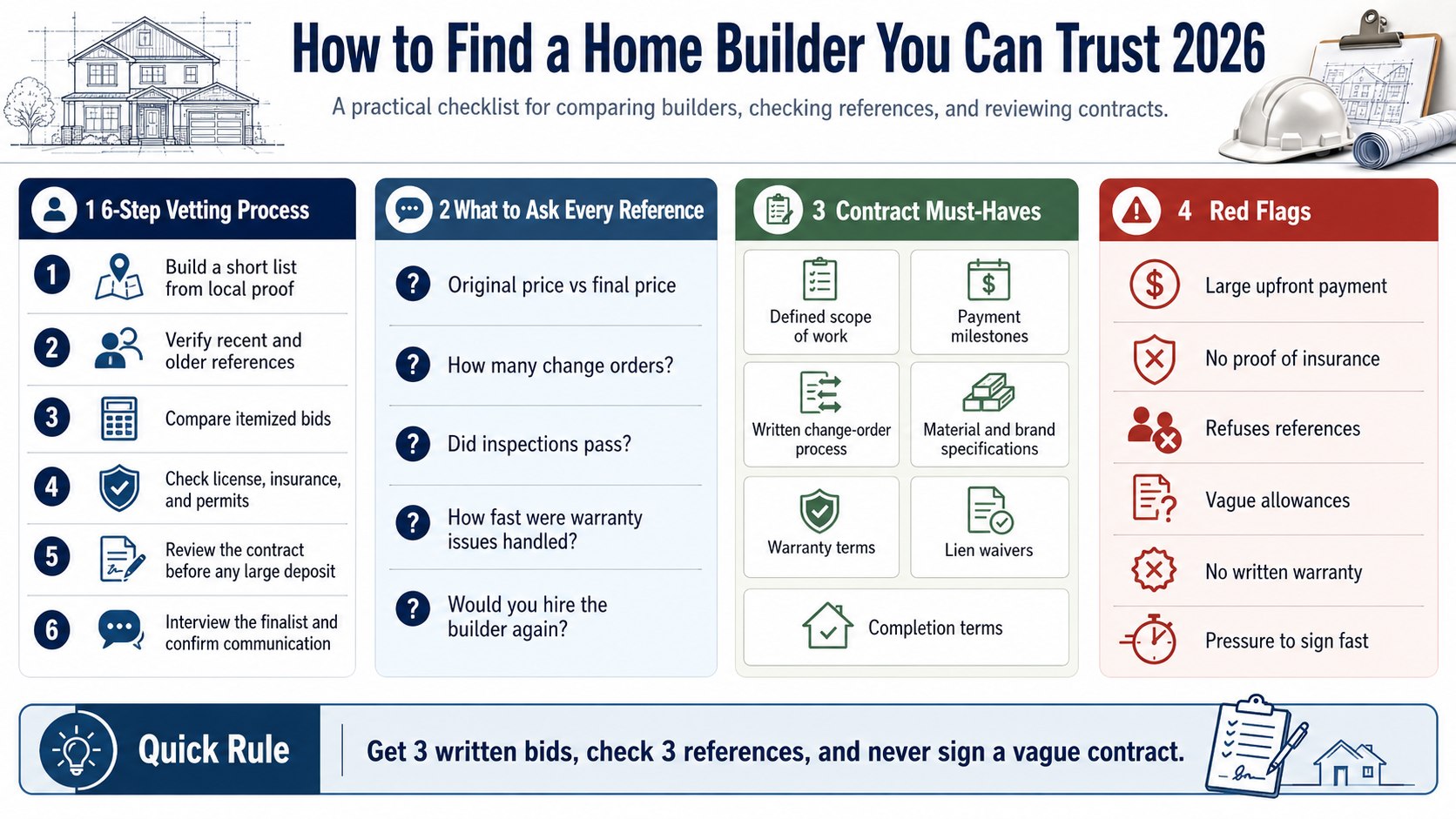
Use this first-pass filter before any meeting:
- Search the builder’s legal business name, owner name, and trade name.
- Check state licensing through the state contractor board or local licensing office.
- Ask for a certificate of general liability insurance and workers’ compensation coverage.
- Request three recent references and one older reference from 2–5 years ago.
- Compare the payment schedule to completed work, not calendar dates alone.
- Ask who pulls permits and who pays reinspection fees if work fails inspection.
- Review the full contract before paying more than a small design or application deposit.
A serious trusted custom home builder should be comfortable with these checks. Marketing can show finished kitchens; references and contracts show how the builder behaves when the weather turns, a supplier misses a delivery, or a framing mistake has to be corrected.
Homeowners still deciding between a one-off build and a subdivision model can compare the trade-offs in Baltimore Chronicle’s breakdown of custom home cost vs production home cost in 2026.
Step 1: Build a short list from local proof
Ask lenders, building inspectors, architects, structural engineers, real estate agents, neighbors, and recent buyers for builder names. Give more weight to people who completed a similar project in the same county within the last 24 months.
This matters because building is local. A builder who performs well on a flat suburban lot in Ohio may not be the right fit for coastal Florida wind loads, California wildfire zones, Maryland stormwater rules, or Texas expansive clay soil.
The common mistake is relying on social media photos or a sponsored listing alone. Photos do not show permit corrections, warranty response time, lien releases, or whether the final price matched the signed scope.
Where to look beyond Google
Check the local Home Builders Association, state contractor licensing pages, county permit records where available, and consumer protection offices.
The Federal Trade Commission’s contractor scam guidance recommends checking reputation, using written contracts, avoiding pressure tactics, and working with licensed and insured contractors.
Search the company name with terms such as “complaint,” “lawsuit,” “review,” “permit,” and “scam.” One angry review does not prove a bad builder, but repeated complaints about deposits, unfinished work, or ignored warranty claims are hard to dismiss.
Step 2: Verify references like a lender would
Ask each builder for at least three recent customers, one current job in progress, and one project completed more than two years ago. Call the references directly and ask about budget changes, schedule delays, communication, warranty work, and whether they would hire the same builder again.
This matters because references reveal patterns that online reviews miss. A homeowner may forgive a weather delay but remember a builder who ignored punch-list repairs for three months.
The common mistake is asking only, “Were you happy?” Better questions force specifics: original contract price, final price, number of change orders, inspection problems, and how the builder handled defects.
| Reference question | Why it matters | Warning sign |
|---|---|---|
| What was the original contract price and final price? | Shows whether the bid was realistic. | Large unexplained jumps after signing. |
| How many change orders did you approve? | Shows scope control and documentation. | Verbal changes billed later. |
| Did inspections pass on the first attempt? | Shows code discipline and trade quality. | Repeated failed inspections without explanation. |
| How fast did the builder respond after closing? | Shows warranty behavior. | No response after final payment. |
| Would you sign the same contract again? | Shows the full customer experience. | Qualified praise with major regrets. |
For a home builder reference check, ask to see work that is not freshly staged. A house that has gone through one winter, one summer, and one rainy season tells more than a spotless model home.
Step 3: Compare bids using real 2026 price ranges
Request a written bid that separates site work, foundation, framing, roofing, windows, mechanical systems, insulation, drywall, finishes, permits, builder fee, and allowances.
As of 2026, many US new-build quotes fall roughly in the $150–$400 per sq ft range for standard to higher-end construction. Complex custom homes can exceed that depending on land, design, labor market, code requirements, and finish level.
This matters because a low bid can hide missing work. Septic, driveway, utility trenching, stormwater controls, demolition, engineering, retaining walls, tree clearing, and permit fees can add tens of thousands of dollars if they are excluded.
The common mistake is comparing only the bottom-line number. A $620,000 bid with realistic allowances may be safer than a $545,000 bid that leaves windows, cabinets, HVAC, excavation, and utility connections unclear.
Allowance items that need a written number
- Cabinets and countertops.
- Windows and exterior doors.
- Flooring per sq ft.
- Plumbing fixtures.
- Appliances.
- Lighting fixtures.
- HVAC equipment and efficiency rating.
- Landscaping, driveway, and exterior drainage.
- Tile, shower glass, and bathroom hardware.
- Interior doors, trim, and closet systems.
Ask whether quoted brands are fixed or only examples. “Pella windows included” is not enough; the contract should identify product line, glazing, color, size assumptions, screens, hardware, and installation standard.
Step 4: Check licenses, insurance, permits, and complaints
Ask for the builder’s license number, legal business name, physical address, certificate of insurance, and workers’ compensation proof. Then verify the license through the state or county agency that regulates contractors in that location.
This matters because licensing rules differ by state. Maryland, Florida, California, Texas, Virginia, and Pennsylvania do not handle contractor regulation in the same way, so the correct verification source is the state board or local permitting office for the project address.
The common mistake is accepting a PDF certificate without confirming it is current. Insurance should be active for the project period, and the certificate should come from the insurance agent, not only from the builder’s sales packet.
HUD’s homebuying resources also reinforce the value of inspections and informed review before major housing decisions. A municipal inspection and a private inspection do not serve the same purpose.
A licensed insured home builder should be able to explain who pulls permits, who schedules inspections, who pays reinspection fees, and how failed inspections affect the schedule.
Step 5: Read the contract before the deposit
Ask for the full construction contract, not just a proposal. A sound home construction contract checklist covers scope, drawings, specifications, payment milestones, change orders, lien waivers, warranty terms, dispute process, insurance, permits, start conditions, and substantial completion.
This matters because the contract controls what happens when memory, text messages, and sales promises conflict. Courts, insurers, lenders, and inspectors will care more about signed documents than a friendly conversation in a model home.
The common mistake is paying a large deposit before reading the contract. A reputable builder should allow time for review by the homeowner, lender, attorney, or construction consultant.
| Contract clause | What it should say | What to avoid |
|---|---|---|
| Scope of work | Plans, specs, materials, exclusions, and finish levels. | Broad phrases like “builder grade” without definitions. |
| Payment schedule | Milestones tied to completed work and inspections. | Large payments due before visible progress. |
| Change orders | Written approval, price, schedule effect, and signature. | Verbal approvals or open-ended labor charges. |
| Substitutions | Equal-or-better materials with owner approval. | Builder-only discretion on product changes. |
| Warranty | Length, covered defects, response process, exclusions. | Vague “standard warranty” language. |
| Termination | Rights, notice period, payment for completed work. | No clear exit path after breach or abandonment. |
| Lien waivers | Proof that subcontractors and suppliers are paid. | Final payment without supplier documentation. |
For a builder contract review, pay close attention to lien waivers. Before each major payment, the builder should provide proof that subcontractors and suppliers are being paid, especially for framing, roofing, HVAC, electrical, plumbing, concrete, and lumber packages.
Change orders deserve the same discipline. Each change should state the price, schedule impact, product difference, and approval date before work begins.
Step 6: Interview the finalist before signing
Meet the finalist in person or by video and walk through the contract line by line. Ask who manages the job daily, how often updates are sent, which software is used, and how the builder documents photos, inspections, selections, and change orders.
This matters because construction stress usually comes from communication gaps. A builder using Buildertrend, CoConstruct, JobTread, or another project system may provide cleaner records than a builder relying only on scattered texts.
The common mistake is treating the interview like a personality test. A likable builder still needs disciplined paperwork, clear cost controls, and a repeatable process for fixing mistakes.
Timeline questions matter too. Baltimore Chronicle’s guide to how long it takes to build a house in the USA in 2026 explains where delays usually appear before move-in.
Questions to ask before the final yes
- Who is the daily point of contact after the contract is signed?
- How many homes will the superintendent manage at the same time?
- What work is performed by employees versus subcontractors?
- How are weather delays documented?
- What selections must be made before framing starts?
- What happens if a specified product is backordered?
- How are punch-list items tracked after substantial completion?
- When does warranty coverage start?
- How many days does the builder have to respond to warranty requests?
- What happens if the lender refuses a draw because work is incomplete?
Evasive answers before signing often become expensive delays after signing. Clear answers do not guarantee a perfect build, but they lower the risk of surprises.
Troubleshooting
- All bids are far above budget: reduce square footage, simplify rooflines, delay nonessential finishes, or ask an architect for value engineering before rebidding.
- The builder refuses to provide references: remove the builder from the list unless there is a clear privacy reason and another verifiable proof source.
- The contract has no change-order process: request written change-order terms before any deposit because verbal approvals create billing disputes.
- The builder wants the homeowner to pull permits: verify local rules first; this can shift legal responsibility and inspection problems onto the homeowner.
- The price is much lower than every other bid: check exclusions, allowances, site work, utility connections, permit fees, and whether the builder misunderstood the plans.
Red flags do not always prove fraud, but they raise the cost of trust. A serious builder can explain pricing, timing, documents, and risk in plain English.
FAQ
How many references should I call before hiring a home builder?
Call at least three recent references and one older reference from a project completed 2–5 years ago. Recent clients show current performance, while older clients reveal warranty behavior and long-term workmanship.
What deposit is normal for a home builder in 2026?
Deposit norms vary by state, contract type, lender rules, and project size. As of 2026, a small preconstruction or design deposit may be reasonable, but large upfront payments before permits, materials, or mobilization should be reviewed carefully against state law and the contract.
Should I hire the cheapest builder?
Not without comparing scope. The cheapest bid may exclude excavation, utility connections, permits, engineering, driveway work, landscaping, appliances, or realistic finish allowances.
Can I use my own contract instead of the builder’s contract?
Some builders will negotiate from an owner-provided contract, but many prefer their standard form. The practical move is to have an attorney or construction consultant review the builder’s form and request edits before paying a deposit.
What is the biggest warning sign when choosing a builder?
The biggest warning sign is resistance to verification. A builder who avoids license checks, refuses references, discourages contract review, or pressures for immediate payment is asking for trust without proof.
Do I need an independent inspector for a new build?
Yes. Many homeowners hire independent inspectors at foundation, pre-drywall, and final stages. Municipal inspections focus on code compliance, while a private inspector can document workmanship concerns before they are covered by drywall or final payment.
Earlier we wrote about How to Get a Passport in 2026 USA: Fees, Timeline, Forms, and Renewal Steps