

In 2026, building a house in the USA typically costs about $140 to $500 per sq ft before land, with most standard single-family homes landing around $170 to $260 per sq ft. A basic 2,000 sq ft build may start near $280,000, a typical custom home often runs $340,000 to $520,000, and a high-end coastal or mountain build can exceed $800,000, аs noted by Baltimore Chronicle.
The fastest way to answer how much does it cost to build a house in USA 2026 is to multiply the target square footage by a realistic state-level range, then add land, site work, permits, utility connections, design fees, financing costs, and a 10% to 15% contingency. The U.S. Census Bureau reported a $414,000 median sales price for new houses sold in December 2025, while its 2024 construction characteristics data showed a 2,210 sq ft median size for new single-family homes sold. Census new residential sales data and Census construction characteristics are useful baselines, but bids still depend heavily on ZIP code and lot conditions.
Key takeaways
- Most 2026 custom builds fall between $170 and $260 per sq ft before land, furniture, and major owner upgrades.
- California, Hawaii, Massachusetts, New York, and Washington usually price higher because labor, codes, land, and fees cost more.
- The cheapest bid is rarely the cheapest house if it excludes excavation, utilities, permits, appliances, or driveway work.
How much does it cost to build a house in USA 2026 by state?
State-level pricing is best treated as a planning range, not a guaranteed quote. A simple ranch on flat land in Oklahoma can price very differently from a hillside build outside Seattle, even if both homes are 2,000 sq ft.
The ranges below assume a livable single-family house with standard finishes, professional labor, code-compliant systems, and no land purchase. They do not include unusual foundation work, luxury architecture, major retaining walls, septic surprises, off-grid systems, or waterfront restrictions.
| State | Typical 2026 build cost per sq ft | 2,000 sq ft planning range |
|---|---|---|
| Alabama | $140–$220 | $280,000–$440,000 |
| Alaska | $240–$420 | $480,000–$840,000 |
| Arizona | $170–$280 | $340,000–$560,000 |
| Arkansas | $135–$215 | $270,000–$430,000 |
| California | $250–$500+ | $500,000–$1,000,000+ |
| Colorado | $200–$350 | $400,000–$700,000 |
| Florida | $160–$290 | $320,000–$580,000 |
| Georgia | $145–$240 | $290,000–$480,000 |
| Hawaii | $300–$600+ | $600,000–$1,200,000+ |
| Illinois | $170–$300 | $340,000–$600,000 |
| Massachusetts | $250–$475 | $500,000–$950,000 |
| Michigan | $155–$260 | $310,000–$520,000 |
| New York | $220–$450+ | $440,000–$900,000+ |
| North Carolina | $150–$250 | $300,000–$500,000 |
| Ohio | $145–$240 | $290,000–$480,000 |
| Oregon | $200–$340 | $400,000–$680,000 |
| Pennsylvania | $160–$280 | $320,000–$560,000 |
| Tennessee | $145–$240 | $290,000–$480,000 |
| Texas | $145–$260 | $290,000–$520,000 |
| Virginia | $170–$300 | $340,000–$600,000 |
| Washington | $220–$400 | $440,000–$800,000 |
For states not shown, use the nearest regional peer as a starting point: much of the Midwest and South often prices in the $140 to $250 per sq ft range, while the Northeast, West Coast, mountain resort markets, and island locations usually run higher. Buyers comparing construction with renovation should also look at practical ways to save money on renovation, because labor, materials, phasing, and contractor management affect both budgets.
What drives the price
Location and labor market
Labor is one of the biggest reasons the average cost to build a house changes by state. Framing crews, electricians, plumbers, HVAC contractors, roofers, and finish carpenters charge more where demand is high and skilled labor is tight.
Lot condition
A flat lot with street utilities is much cheaper to build on than a wooded, sloped, rocky, or remote parcel. Clearing, grading, soil correction, septic design, well drilling, stormwater control, and long utility runs can add tens of thousands of dollars before the slab or foundation is finished.
Home size and shape
A simple rectangle costs less than a house with multiple wings, rooflines, dormers, covered porches, and large glass openings. A two-story home can be cheaper per sq ft than a sprawling one-story plan because the roof and foundation cover less area.
Materials and specifications
Brands and product lines matter. Andersen or Marvin windows, James Hardie siding, standing-seam metal roofing, Kohler plumbing fixtures, Bosch appliances, quartz counters, and white oak flooring can push the budget well above builder-grade allowances.
Code, climate, and insurance requirements
Florida wind requirements, California wildfire rules, northern insulation needs, seismic engineering, coastal flood elevation, and local energy codes can change the budget. A house built for hurricanes, snow loads, or wildfire resistance costs more than the same floor plan in a lower-risk inland market.
Builder contract type
A fixed-price contract may cost more upfront but gives better budget control. A cost-plus contract can work for a complex custom home, but the owner carries more risk if labor, lumber, concrete, roofing, or mechanical costs rise during construction.
Price breakdown
A complete budget should separate hard construction costs from soft costs and owner costs. Many disappointing bids look cheap because they leave out design, permits, utility connections, appliances, landscaping, and financing expenses.
| Line item | Typical 2026 cost |
|---|---|
| Architecture, engineering, surveys | $8,000–$45,000+ |
| Permits, impact fees, inspections | $3,000–$30,000+ |
| Site clearing, grading, excavation | $10,000–$60,000+ |
| Foundation | $20,000–$80,000+ |
| Framing and structural shell | $60,000–$180,000+ |
| Roofing, windows, exterior doors | $35,000–$120,000+ |
| Plumbing, electrical, HVAC | $55,000–$160,000+ |
| Insulation, drywall, interior paint | $30,000–$90,000+ |
| Cabinets, counters, flooring, tile | $45,000–$180,000+ |
| Driveway, basic landscaping, exterior cleanup | $10,000–$70,000+ |
| Contingency | 10%–15% of project budget |
These numbers explain why new home construction cost per square foot can be misleading. A $210 per sq ft builder quote may not include the same scope as a $250 per sq ft quote from another contractor.
Do not compare builders by the headline price alone. Compare the allowances, exclusions, site-work assumptions, change-order rules, and payment schedule.
Ways to save in 2026
The best savings come from design choices made before permits, not from cutting quality after construction starts. Once trades are scheduled and materials are ordered, changes usually cost more than expected.
- Choose a simpler floor plan. A compact rectangle, stacked plumbing, fewer corners, and a clean roofline reduce labor and waste.
- Build only the square footage that will be used daily. A smaller house with better storage often beats a larger house with unused formal rooms.
- Use standard window and door sizes. Custom sizes slow procurement and increase both product and labor costs.
- Set realistic allowances before signing. Cabinets, tile, plumbing fixtures, lighting, and appliances should match actual showroom prices.
- Price site work early. Soil tests, septic feasibility, driveway length, tree removal, and utility access can decide whether a lot is affordable.
- Limit late changes. Moving a wall after framing or changing tile after ordering can trigger labor, materials, schedule, and restocking costs.
- Ask for alternates. Builders can price asphalt shingles versus metal roofing, vinyl windows versus fiberglass, or LVP flooring versus hardwood.
- Phase nonessential exterior work. A patio, detached garage, pool, fence, or outdoor kitchen can wait if the core home budget is tight.
For buyers funding the project with debt, the construction budget should be viewed alongside the broader mortgage market. A lower contract price can still feel expensive if monthly payments rise, which is why Baltimore Chronicle’s coverage of mortgage rates and homebuyer costs is useful before locking a lender or builder timeline.
When paying more makes sense
Better building envelope
Paying more for insulation, air sealing, quality windows, and a right-sized HVAC system can lower monthly utility costs and improve comfort. This is one of the few upgrades that affects the house every day.
Risk-resistant construction
Impact-rated windows in hurricane zones, ignition-resistant materials in wildfire areas, and drainage upgrades on wet lots can be worth the premium. Insurance, maintenance, and repair risk should be part of the decision.
Durable exterior materials
Fiber-cement siding, brick, stone veneer, metal roofing, and better flashing details can cost more at installation but reduce future maintenance. The math is strongest for owners planning to stay 10 years or longer.
Professional design for difficult lots
A good architect or residential designer can save money on a sloped, narrow, wooded, or view-driven lot by reducing structural guesswork. The design fee is painful only until a bad plan creates expensive field changes.
Financing, permits, and cash planning
Most buyers use a construction loan, a construction-to-permanent loan, cash, or a builder’s preferred lender. Construction loans usually release funds in draws as work is completed, so the payment schedule should match the builder contract.
FHA financing may be relevant for some buyers, but loan limits vary by county. HUD lists the 2026 FHA nationwide one-unit floor at $541,287 and ceiling at $1,249,125 for forward mortgages, with county-specific limits available through HUD resources.
A strong cash plan includes design deposits, permit fees, appraisal fees, builder deposits, utility connection charges, temporary housing, storage, moving costs, and post-closing items. The cost to build a custom home in 2026 should never be measured only by the construction contract.
Local ownership costs also matter after the house is finished. In higher-tax cities and counties, the annual tax bill can change the real affordability of a new build, so homeowners in Maryland can compare the construction budget with Baltimore property tax guide.
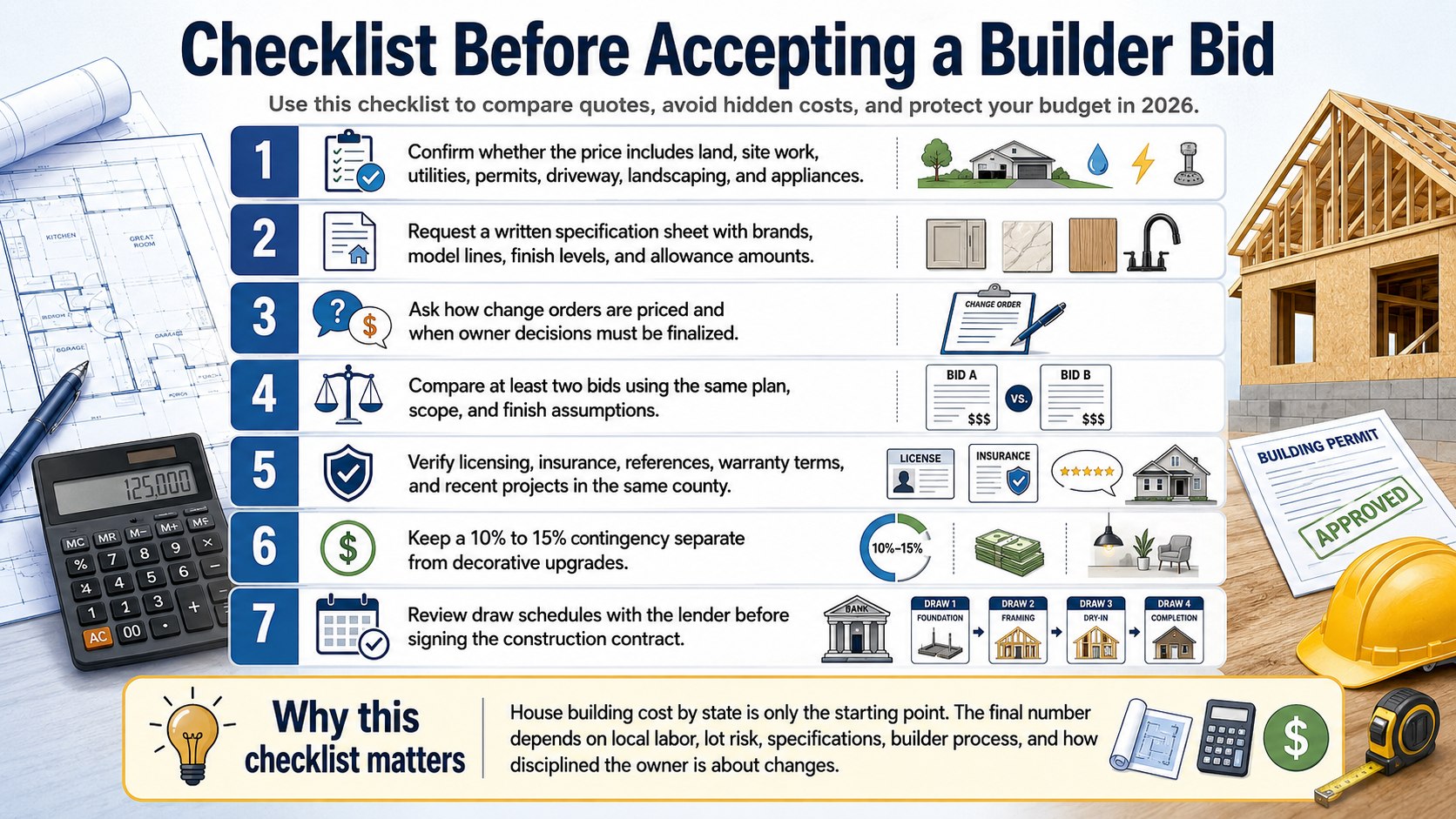
Checklist before accepting a builder bid
- Confirm whether the price includes land, site work, utilities, permits, driveway, landscaping, and appliances.
- Request a written specification sheet with brands, model lines, finish levels, and allowance amounts.
- Ask how change orders are priced and when owner decisions must be finalized.
- Compare at least two bids using the same plan, scope, and finish assumptions.
- Verify licensing, insurance, references, warranty terms, and recent projects in the same county.
- Keep a 10% to 15% contingency separate from decorative upgrades.
- Review draw schedules with the lender before signing the construction contract.
This checklist matters because house building cost by state is only the starting point. The final number comes from local labor, lot risk, specifications, builder process, and how disciplined the owner is about changes.
FAQ
How much does it cost to build a 2,000 sq ft house in 2026?
A 2,000 sq ft house commonly costs about $280,000 to $520,000 for standard construction before land, with high-cost states and custom finishes pushing the total above $700,000. Site work, utilities, permits, and design fees can change the number quickly.
Is it cheaper to build or buy a house in 2026?
Buying an existing home is often cheaper upfront, especially where land and labor are expensive. Building can make sense when available resale homes need major repairs, the buyer already owns land, or the owner wants a specific layout and energy profile.
Does price per sq ft include land?
Usually no. Builder price per sq ft normally refers to the house itself, and sometimes excludes site work, permits, utilities, landscaping, appliances, and design fees. Always ask for a written list of exclusions.
Which states are most expensive for building a house?
Hawaii, California, Massachusetts, New York, Washington, Colorado, and parts of Oregon often sit near the high end because of labor costs, land constraints, codes, permitting, and insurance-related requirements.
How much contingency should be added to a 2026 home build?
A practical contingency is 10% to 15% of the project budget. Difficult lots, custom architecture, remote locations, or owner-selected premium finishes may require more.
What is the biggest hidden cost when building?
Site work is often the biggest surprise. Clearing, grading, rock removal, drainage, septic, wells, utility extensions, and driveway construction can add major costs before framing begins.
Earlier we wrote about How to Track a USPS Package Without Tracking Number in 2026