


How to rent out your house in USA in 2026 starts with 3 decisions: confirm local rental rules, set written screening standards, and prepare for federal tax reporting. A homeowner can organize the basic documents in 1–3 days, although inspections, permits, repairs, or licensing may extend the process. The safest route is to check local requirements before advertising, rather than fixing compliance problems after a tenant moves in, as the Baltimore Chronicle editorial team notes.
This guide covers the practical landlord workflow from licensing through lease signing. It also explains screening under federal law, rental-income taxes, deposits, insurance, pricing, and the records worth keeping from day 1.
Key takeaways:
- There is no single nationwide landlord license; registration, inspections, and permits depend on state and local rules.
- Tenant screening should follow consistent standards, while consumer reports bring Fair Credit Reporting Act obligations.
- Rental income is generally taxable, but qualified expenses and depreciation can reduce taxable rental profit.
What you need before becoming a landlord
Prepare the property file before posting it on Zillow, Apartments.com, Realtor.com, or another listing service. Missing paperwork can delay a lease and create expensive disputes later.
- Deed, mortgage information, HOA documents, and current property-tax records
- Homeowners policy and a quote for landlord or dwelling-property insurance
- Local rental registration, permit, or inspection documents when required
- Written tenant qualification standards and a compliant application
- Lease template appropriate for the property’s state
- Bank account or bookkeeping system for rent and expenses
- Move-in condition report with dated photographs
- Cash reserve for repairs, vacancies, insurance deductibles, and turnover
A mortgage does not automatically prevent a home from becoming a rental. The loan documents still matter, particularly with owner-occupancy requirements or recently originated financing. Owners considering a future sale can review the Baltimore Chronicle guide to selling a house with an existing mortgage.
Insurance deserves the same attention. A standard owner-occupied homeowners policy may not fit a tenant-occupied property. Ask the carrier how loss of rent, landlord liability, dwelling damage, appliances, and vacant periods are treated.
Treat the property as a small business before the first rent payment arrives, not after the first problem appears.
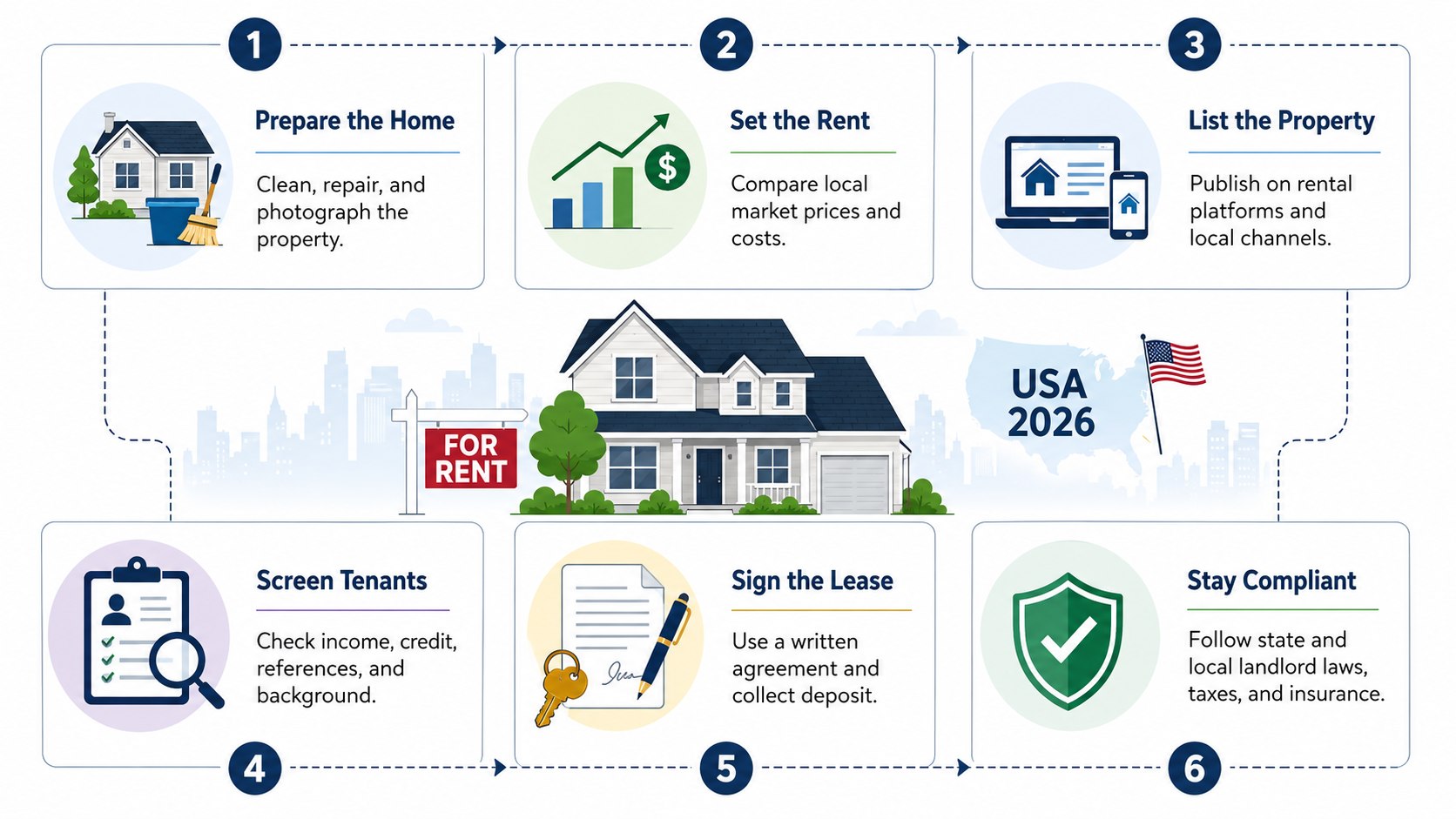
Step 1: Check licenses, registration, zoning, and insurance
The first requirement in renting out a house in the USA is determining which rules apply at the property address. The United States has no universal federal landlord license. States, counties, and cities can impose their own registrations, inspections, certificates, occupancy rules, and fees.
California, Texas, Florida, New York, and Maryland can produce very different compliance checklists. Even neighboring cities within one state may regulate rentals differently. Search the city or county government website for “rental license,” “rental registration,” “certificate of occupancy,” and “rental inspection.”
Do not assume a single-family house is exempt because it has never been rented before. HOA rules can also restrict leasing periods or require owner notifications.
Common mistake: advertising first and checking municipal requirements only after receiving applications.
Step 2: Calculate rent and the real monthly cost
Start with comparable rentals within the same school district or neighborhood. Compare houses with similar bedrooms, bathrooms, parking, condition, square footage, and pet policies. Zillow, Redfin, Realtor.com, and Apartments.com can reveal asking prices, but asking rent is not guaranteed market rent.
The useful number is net cash flow rather than gross rent. A $2,600 monthly lease can look profitable until property tax, insurance, maintenance, vacancy, HOA charges, and management are included.
| Expense | Planning approach for 2026 | What to verify |
|---|---|---|
| Mortgage | Actual monthly payment | Escrow and occupancy terms |
| Property tax | Current local bill | Assessment changes after conversion |
| Landlord insurance | Property-specific quote | Liability and loss-of-rent limits |
| Management | Often quoted as a percentage of rent | Leasing and renewal fees |
| Repairs | Maintain a separate reserve | Age of HVAC, roof, plumbing |
| Vacancy | Budget for periods without rent | Local leasing demand |
These categories matter more than a generic national percentage because housing costs vary sharply by location. A property-tax bill in Baltimore will not resemble one for an equivalent house in Austin or Tampa.
The same is true for insurance. Premiums can change because of weather exposure, claims history, construction type, deductibles, and ZIP code. Homeowners comparing housing expenses can see how taxes fit into ownership costs in the Baltimore Chronicle Baltimore property-tax guide.
Management deserves a separate quote if the owner lives far away. Ask whether the advertised percentage covers only monthly management or also tenant placement, renewals, inspections, and maintenance coordination.
Common mistake: setting rent equal to the mortgage payment and assuming the remaining costs will be minor.
Step 3: Build a legal tenant screening process
Tenant screening for landlords should begin with written criteria applied consistently to applicants. Typical factors include verifiable income, rental history, credit information, occupancy limits, and permitted background information.
Consumer reports require particular care. The Federal Trade Commission explains that landlords using credit, rental-history, or background reports must comply with the Fair Credit Reporting Act. A report may come from Experian, Equifax, TransUnion, or a specialized tenant-screening provider.
“You can only get a consumer report if you have a permissible purpose.”
Federal Trade Commission, Using Consumer Reports: What Landlords Need to Know.
If a consumer report influences a denial, higher deposit, co-signer requirement, or another unfavorable decision, an adverse-action notice may be required. The notice identifies the reporting company and explains the applicant’s dispute rights.
Federal fair-housing protections also make consistency essential. Avoid criteria that discriminate based on protected characteristics, and check state or city rules that impose additional screening restrictions.
- Write qualification criteria before accepting applications.
- Use the same standards for applicants seeking the same property.
- Verify identity, income, and rental references through reliable channels.
- Obtain consumer reports only for a legally permitted housing purpose.
- Document the reason for each approval or rejection.
- Send required adverse-action information when a consumer report affected the decision.
A fixed process also improves practical decision-making. An applicant with excellent income but unverifiable rental history presents a different risk from someone with a thinner credit file and 5 years of documented payments.
Do not rely on screenshots of bank balances alone. Verification should match the type of income, including payroll, self-employment, benefits, or other lawful sources.
Keep applications and sensitive information secure. Screening documents can contain Social Security numbers, dates of birth, addresses, and detailed financial information.
Common mistake: changing income, deposit, or credit standards after seeing who applied.
Step 4: Prepare the lease, deposit, and move-in record
A strong rental agreement for a house should state rent, due dates, lease term, occupants, utilities, maintenance duties, pet terms, entry procedures, renewal conditions, and late-payment rules. State law may control deposits, notices, lease clauses, and required disclosures.
Security deposits deserve state-specific checking before money changes hands. Some jurisdictions cap the amount, regulate the account holding the funds, require interest, or impose deadlines for itemized deductions after move-out.
Prepare the condition record at the same time as the lease. Photograph flooring, walls, appliances, windows, bathrooms, landscaping, garage areas, and existing damage. Store the original files with dates instead of relying only on compressed images sent through messaging apps.
A lease cannot repair a weak paper trail. Deposits become easier to defend when the move-in condition is documented room by room.
Ask whether renters insurance will be required. Baltimore Chronicle’s review of renter’s insurance costs in 2026 places many standard policies around $13–$27 monthly, although individual quotes vary by state and coverage.
Common mistake: using an old generic lease downloaded for another state without checking current local requirements.
Step 5: Set up taxes, records, and rent collection
Rental property taxes become part of the job from the first payment. The IRS generally treats amounts received for the use of real estate as rental income. Owners commonly report residential rental income and eligible expenses using Schedule E with Form 1040.
The IRS identifies deductible categories that can include mortgage interest, real estate taxes, maintenance, utilities, insurance, and depreciation. The treatment of a property used partly as a personal residence can differ.
“You generally must include in your gross income all amounts you receive as rent.”
Internal Revenue Service, Rental Income and Expenses.
A dedicated bank account simplifies bookkeeping even when the owner is not legally required to create a separate business entity. Record rent, security deposits, repairs, advertising, management fees, insurance, mileage when applicable, and contractor invoices according to tax rules.
Depreciation deserves professional attention because it is not simply another cash expense. IRS Publication 527 explains residential rental property depreciation and the rules that apply when a former residence becomes a rental.
Tax planning should begin when the home changes use, because the conversion date can affect records needed years later.
Common mistake: treating the tenant’s rent as tax-free cash because the mortgage consumes most of the payment.
Step 6: Market the house, sign the tenant, and manage the handoff
Good landlord requirements in 2026 do not end when an applicant qualifies. The listing should accurately describe bedrooms, bathrooms, square footage, parking, utilities, pet rules, accessibility features, lease length, and available move-in date.
Photographs should reflect the property being offered. Remove old photos showing furniture or amenities that will not remain. Avoid advertising language that implies preferences for a particular family type, religion, nationality, disability status, or other protected group.
Before handing over keys, complete the following sequence:
- Confirm all required signatures and disclosures.
- Collect permitted move-in funds using a traceable payment method.
- Complete the condition report and photographs.
- Record utility-transfer responsibilities.
- Provide maintenance and emergency contact instructions.
- Store the signed lease and payment records securely.
- Schedule any legally required or agreed inspection.
The first month establishes the administrative pattern for the tenancy. Send receipts where required and keep communications organized by property and tenant.
Repairs should have a defined reporting channel. A tenant should know whether to report a leaking pipe through an online portal, email address, phone number, or property manager.
Emergency planning also matters for owners living hundreds of miles away. Identify a licensed plumber, HVAC contractor, electrician, and locksmith before an urgent call arrives at 2 a.m.
If self-management becomes impractical, compare local property managers using written fee schedules. Ask who approves repairs, handles notices, performs inspections, and represents the owner during disputes.
Common mistake: handing over keys before the lease, payment, condition report, and required disclosures are complete.

Troubleshooting common rental problems
Even a carefully prepared how to become a landlord plan can stall at a few predictable points. These problems usually require documentation rather than improvisation.
- Applications are weak: reassess the asking rent, listing quality, qualification criteria, and local demand before lowering screening standards.
- An applicant disputes a screening report: follow FCRA procedures and avoid independently correcting data supplied by a reporting agency.
- The house fails inspection: obtain the written deficiency list, complete repairs, keep invoices, and follow the local reinspection process.
- Rent does not cover expenses: calculate total annual ownership costs before deciding whether to lease, sell, or retain the property vacant.
- A tenant reports urgent damage: document the report, respond according to applicable habitability rules, and use qualified contractors where required.
A slow leasing period does not automatically mean the first qualified applicant should be accepted. Price, condition, photography, season, and local supply can all affect response rates.
Screening standards should not become stricter or looser based on personal impressions. Written rules provide a more defensible record.
Inspection failures are often easier to solve when the government notice identifies exact code items. Keep proof of completed work in the property file.
Negative cash flow needs arithmetic rather than optimism. Include large expenses that occur irregularly, such as an HVAC replacement or roof repair.
Maintenance response also creates evidence. Preserve tenant notices, contractor communications, photographs, invoices, and completion dates.
FAQ about renting out a house in the USA
Do you need a license to rent out your house?
Sometimes. There is no universal US landlord license, but cities, counties, and states may require rental registration, inspections, permits, or occupancy certificates. Check the government website for the exact property address before advertising.
How much money should a landlord keep for repairs?
No federal rule sets a universal reserve. The appropriate amount depends on the house’s age, roof, HVAC system, plumbing, appliances, deductible, and local contractor prices. A separate emergency fund is safer than relying on the current month’s rent.
Can a landlord run a credit check on an applicant?
Yes, when there is a permissible housing purpose and the applicable FCRA requirements are followed. If the report influences an adverse decision, additional notice obligations may apply.
Do landlords pay tax on rent?
Rental income is generally reportable for federal tax purposes. Eligible expenses and depreciation can reduce taxable income, subject to IRS rules and limitations.
Should a homeowner use an LLC for one rental house?
An LLC is not automatically required. Liability protection, financing, insurance, state fees, taxes, and ownership structure should be evaluated together with legal and tax advisers.
Can you rent out a house that still has a mortgage?
Often yes, but the loan agreement controls. Review occupancy clauses, lender requirements, insurance changes, HOA restrictions, and any program-specific rules before converting the home.
Earlier we wrote about How to Negotiate Cable Bill at Comcast 2026: Retention Scripts That Can Lower Your Xfinity Cost