


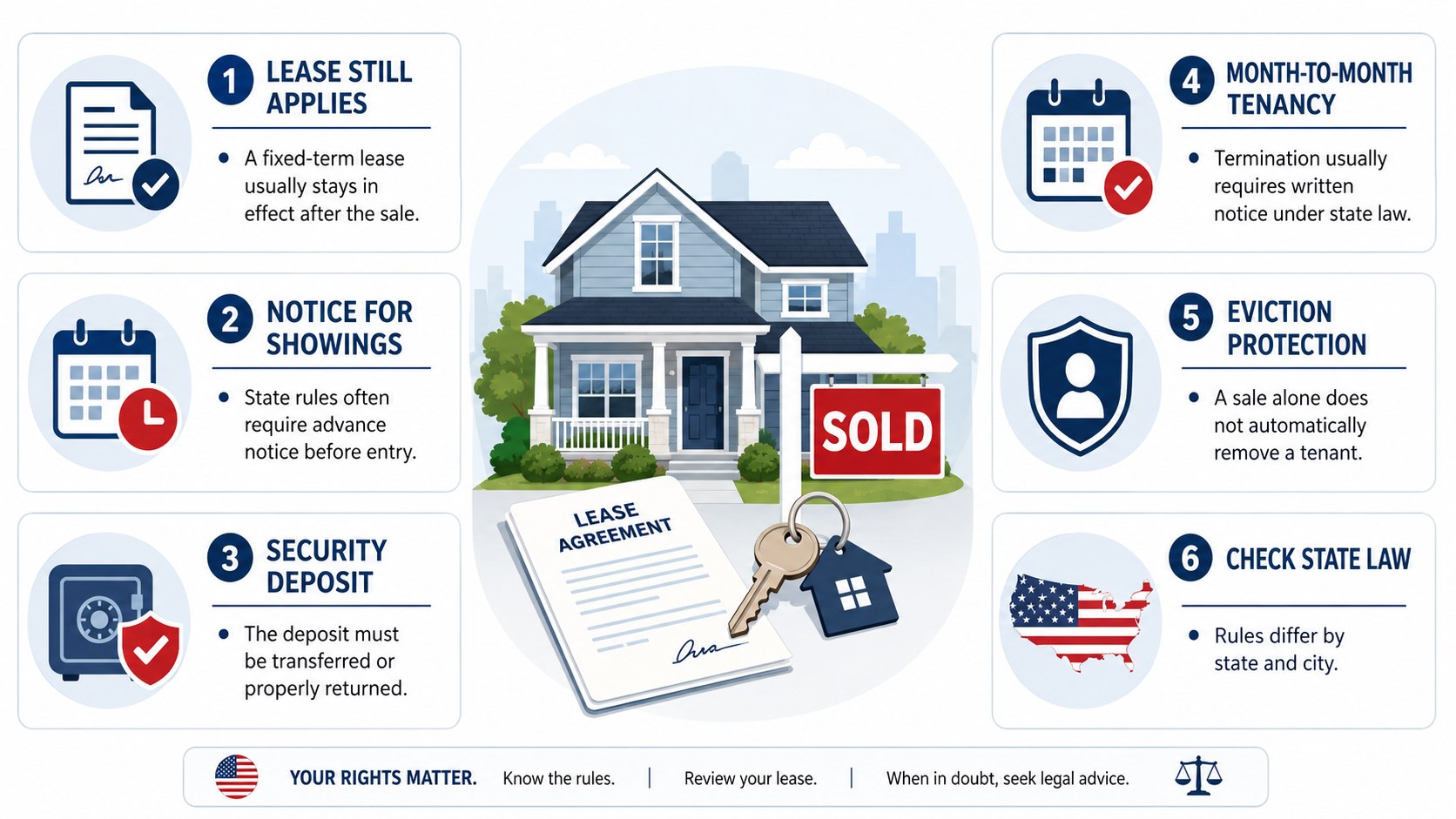
Tenant rights when landlord sells house in USA usually mean that a valid lease does not disappear simply because the property changes owners. A buyer generally acquires the rental together with existing lease obligations, although state law, lease wording, foreclosure status, and owner-occupancy plans can change the result, as noted by the editorial team at Baltimore Chronicle.
For a tenant facing a sale in 2026, the first question is not “Do I have 90 days?” It is “Is this an ordinary sale or a foreclosure?” The federal 90-day protection applies to qualifying tenants after foreclosure. It is not a nationwide 90-day rule for every landlord selling a rental home.
Key takeaways
- A fixed-term lease commonly continues after an ordinary sale, with the buyer becoming the new landlord.
- The federal 90-day notice rule mainly protects bona fide tenants when residential property is acquired through foreclosure.
- Month-to-month tenants must check state and local notice laws because no single nationwide period covers ordinary sales.
A sale also does not automatically erase security-deposit obligations, repair duties, or the tenant’s right to lawful possession. Renters should keep paying rent according to valid instructions while verifying any change in ownership or payment details.
In plain English
Think of a residential lease as a set of obligations attached to a rental relationship, not merely a personal promise from one landlord. When an occupied house is sold, the new owner often steps into the former owner’s position for the remaining lease term.
Suppose a tenant signs a 12-month lease from January through December. The landlord sells the property in June. Unless the lease or applicable law creates a valid exception, the closing date does not automatically turn June into move-out month.
The deed can change hands while the tenant’s contractual right to occupy the home remains in place.
That distinction matters in markets where occupied homes are routinely bought by investors. Companies ranging from small local LLCs to larger rental operators may purchase properties with tenants already living inside them. The identity of the owner changes, but existing legal duties may follow the property.
Renters comparing lease costs, deposits, and other housing obligations can also review Baltimore Chronicle’s guide to renting and lease expenses. Local rules remain important even when the basic lease principle looks straightforward.
Tenant rights when landlord sells house in USA and the 90-day rule
The biggest source of confusion is the phrase 90-day notice to vacate. Under the federal Protecting Tenants at Foreclosure Act, an immediate successor after foreclosure must generally provide a bona fide tenant at least 90 days’ notice before a qualifying termination.
The federal law also protects many tenants with fixed-term leases. They can generally remain until the lease expires. An exception can apply when the property is sold to a purchaser who will use the unit as a primary residence, subject to the required notice.
Federal foreclosure protections require at least 90 days’ notice to vacate for qualifying bona fide tenants and preserve many existing leases until their scheduled end.
Source: U.S. Department of Housing and Urban Development, Protecting Tenants at Foreclosure Act provisions, applicable in 2026.
The relevant federal text is published by the U.S. Department of Housing and Urban Development. It also states that stronger state or local protections remain effective.
The critical word is “foreclosure.” A private landlord listing a house with Zillow, Redfin, Realtor.com, or a local brokerage does not automatically trigger this federal 90-day protection.
| Situation | Typical 2026 starting point | What tenant should check |
|---|---|---|
| Ordinary sale with fixed lease | Lease often continues | Lease clauses and state law |
| Ordinary sale with month-to-month tenancy | State notice rules apply | Required notice period and local protections |
| Foreclosure with bona fide tenant | Federal protections may apply | 90-day rule and remaining lease term |
| Buyer plans primary residence after foreclosure | Lease may end earlier | Federal 90-day notice requirement |
| Subsidized housing | Additional rules may apply | Program, federal, state, and local requirements |
The categories above should be treated as starting points rather than interchangeable deadlines. A lease may contain a sale clause, but that clause must still operate within applicable law. Local ordinances can add notice requirements that federal law does not provide.
State protections can also exceed federal minimums. California, New York, Maryland, Oregon, Washington, and other states have their own landlord-tenant frameworks. Cities may add further protections through rental ordinances.
Tenants should distinguish a notice that the property is being listed from a legally effective termination notice. A real estate agent requesting photographs or showings does not itself end a tenancy. Neither does the appearance of a “For Sale” sign.
Payment instructions deserve the same scrutiny. A tenant should not redirect rent merely because someone claims to represent the buyer. Written ownership and management information provide a record if payment becomes disputed later.
Security deposits also remain part of the rental relationship. Selling the property is not a lawful reason for the landlord simply to keep the deposit as sale proceeds.
How it actually works
A typical occupied-property sale begins with listing activity. The tenant may receive notice of planned showings, inspections, an appraisal, photography, or access requested by potential buyers. Entry rules depend heavily on the lease and state law.
The home can then go under contract while the tenant remains in possession. Before closing, buyers often review the lease, payment history, deposit information, and other documents during due diligence.
At closing, ownership transfers. If the tenancy survives the sale, the purchaser becomes responsible for landlord duties connected to that tenancy.
A new owner cannot normally treat an occupied rental as an empty house simply because the purchase contract closed.
Tenants facing a pending sale can protect themselves with a short document trail. The process requires records rather than confrontation.
- Save the signed lease, renewals, addenda, and move-in inspection records.
- Keep receipts or bank records proving rent payments and the security deposit.
- Request written confirmation of the new owner’s or manager’s contact information.
- Check whether the transaction is a voluntary sale, foreclosure, or another transfer.
- Compare any termination notice with state law and the lease before moving.
- Document property condition before surrendering possession or negotiating an early exit.
A tenant should continue meeting lease obligations while the sale proceeds. Stopping rent because the landlord announced a sale can create a separate nonpayment issue.
Any proposed cash-for-keys agreement should be written. It should identify the payment, move-out date, deposit treatment, property condition, and when funds will be delivered. Oral promises are harder to prove after ownership changes.
A tenant who wants to remain can ask whether the buyer intends to keep the property as a rental. Investors often prefer an existing reliable tenant because vacancy, cleaning, marketing, and turnover can cost money. That economic incentive does not replace legal rights, but it can affect negotiations.
Renters considering a move instead can compare alternatives through Baltimore Chronicle’s review of lower-cost rental areas and commuting tradeoffs. A voluntary relocation only makes sense after calculating deposits, moving costs, rent differences, and timing.
Who it matters to in 2026
Fixed-term tenants
A renter with 7 months remaining on a written lease is usually in a stronger position than someone renting month to month. The central issue is whether the new owner takes the property subject to that lease and whether any lawful termination exception applies.
Maryland offers a clear illustration of how state law can reinforce continuity. Its Real Property provisions state that a transferee of leased property can become subject to remedies tied to agreements contained in the lease.
Month-to-month renters
Tenant rights after property sale can look different without a fixed expiration date. A periodic tenancy may generally be terminated through the notice procedure allowed by state or local law.
This is where online claims such as “every tenant gets 90 days” become dangerous. Ordinary-sale notice periods are not nationally uniform. The tenant’s city, state, occupancy length, housing type, and reason for termination may matter.
Tenants in foreclosed homes
Renter rights after foreclosure receive a separate federal layer. A bona fide tenancy generally requires an arm’s-length arrangement, a tenant who is not specified close family of the mortgagor, and qualifying rent conditions.
Most renters with qualifying fixed leases can remain through the lease term after foreclosure, subject to the owner-occupancy exception.
Official rule summarized from federal PTFA provisions and Maryland’s 2026 Real Property statute.
Maryland law provides a useful state example. It requires at least 90 days’ notice for qualifying tenants after foreclosure and recognizes continuing lease rights. The Maryland General Assembly statute also specifies required notice details.
Recent Maryland housing disputes show why procedural rules matter. Baltimore Chronicle has also covered changes to eviction notice procedures in Anne Arundel County, illustrating how local protections can supplement broader state rules.
What a landlord can and cannot do during the sale
A pending sale does not suspend the lease. The landlord generally remains responsible for ordinary obligations until ownership changes, including required repairs and lawful management of the property.
The owner may have rights to show the home to buyers or inspectors. Those rights are controlled by the lease and applicable entry laws. Sale preparations do not create unlimited access to a tenant’s home.
Several warning signs deserve immediate documentation:
- Locks are changed before the tenancy lawfully ends.
- Utilities are intentionally disconnected to pressure the tenant to leave.
- A tenant is told verbally to move without the notice required by law.
- The owner claims the lease vanished automatically on closing day.
- The security deposit is treated as money belonging to the seller.
- A new payment destination is demanded without credible ownership information.
Self-help eviction practices can violate state law even when an owner wants the property vacant for closing. A purchase contract between seller and buyer does not automatically override a tenant’s possession rights.
The tenant should preserve texts, emails, letters, photographs, payment confirmations, and notices. Dates matter because many disputes turn on when notice was served and when termination supposedly became effective.
If the seller promises the buyer a vacant house despite an existing protected lease, that is primarily a problem between the contracting parties. It does not automatically create a new termination right against the tenant.
Showing requests should also remain reasonable under applicable rules. A tenant cannot necessarily prevent all lawful access, but a sale does not convert a private residence into an unrestricted open house.
The sale contract binds the buyer and seller; it does not silently rewrite a tenant’s signed lease.
Common myths
Online discussions often combine ordinary sales, foreclosure sales, evictions, and month-to-month termination into one rule. Those are separate legal events.
- Myth: every home sale gives the tenant 90 days. Correction: the federal 90-day provision is primarily a foreclosure protection.
- Myth: the lease ends when the deed is recorded. Correction: many existing fixed leases continue under the new owner.
- Myth: a tenant never has to allow showings. Correction: lawful access can depend on lease terms and state rules.
- Myth: the buyer can immediately raise rent. Correction: an active fixed lease may restrict changes until legally permitted.
- Myth: the seller can keep the deposit after closing. Correction: deposit obligations remain subject to lease and state requirements.
The practical difference between a lease and a periodic tenancy is substantial. A fixed lease creates a defined contractual term, while month-to-month occupancy usually allows termination after legally sufficient notice.
A “sale clause” also deserves careful reading. Some leases contain provisions addressing transfers, early termination, or owner occupancy. The exact wording matters, and state law may limit what such a clause can accomplish.
Foreclosure should never be assumed merely because a landlord says the home “has to be sold.” Foreclosure involves enforcement of secured debt and transfer through a foreclosure process. An ordinary MLS listing is a different transaction.
Likewise, an eviction notice is not the same document as a notice announcing a sale. The legal effect depends on what the document says, who sent it, the reason asserted, and the governing jurisdiction.
When the amounts at stake include a security deposit, prepaid rent, and relocation expenses, keeping the entire record can prevent avoidable losses.

What tenants should check before agreeing to move
A landlord may offer money for an early departure because delivering a vacant property can make a sale easier. Such agreements are negotiations, not automatic obligations.
Lease rights when rental property is sold can have real financial value. A tenant paying $1,600 monthly under an existing lease may face a higher replacement rent elsewhere. Moving can also require a new deposit, application fees, movers, storage, or overlapping rent.
Before signing an early-termination agreement, confirm these points:
- The exact move-out deadline.
- The amount of any relocation payment.
- When and how that payment will be made.
- Whether the security deposit remains refundable separately.
- Whether unpaid rent or damage claims are being waived.
- How keys and possession will be transferred.
- Whether the agreement releases both sides from remaining lease obligations.
A payment offered only after the tenant vacates places more performance risk on the tenant. An agreement should state precise payment mechanics.
The security deposit should not be casually folded into a relocation offer. It may already be money held for a legally defined purpose. Combining separate amounts can make later accounting harder.
Tenants should also inspect replacement housing before surrendering their current home. Application approval is not the same as receiving possession. Closing dates can shift, and buyers can change plans before settlement.
If a notice appears defective or an owner threatens immediate lockout, a local tenant lawyer or legal-aid organization can evaluate state-specific rules. Federal protection is only one layer of the analysis.
FAQ
Does a tenant have to move when a landlord sells the house?
Not automatically. A valid fixed-term lease often continues after an ordinary sale. The buyer generally becomes the new landlord, subject to applicable law and lease terms.
Do tenants always get 90 days after a house is sold?
No. Landlord selling house tenant notice requirements differ by jurisdiction for ordinary sales. The federal 90-day rule specifically protects qualifying bona fide tenants in foreclosure situations.
Can the new owner raise the rent immediately?
A fixed lease usually controls rent during its stated term unless the agreement lawfully permits a change. Month-to-month rent increases depend on state and local notice requirements.
Can a landlord show the property while a tenant still lives there?
Usually some lawful access may be permitted, but entry requirements differ by state and lease. A sale does not automatically permit unannounced or unlimited access.
What happens to the security deposit after the sale?
The deposit does not simply become the seller’s money. Transfer, accounting, return deadlines, and liability depend on state law and the lease.
What should a tenant do after receiving a notice to vacate?
Compare the notice with the lease, identify whether the property was sold normally or foreclosed, and verify state requirements. Preserve the notice and related communications before agreeing to leave.
Earlier we wrote about Credit Card Debt Payoff 2026: Avalanche vs Snowball vs 0% Balance Transfer