

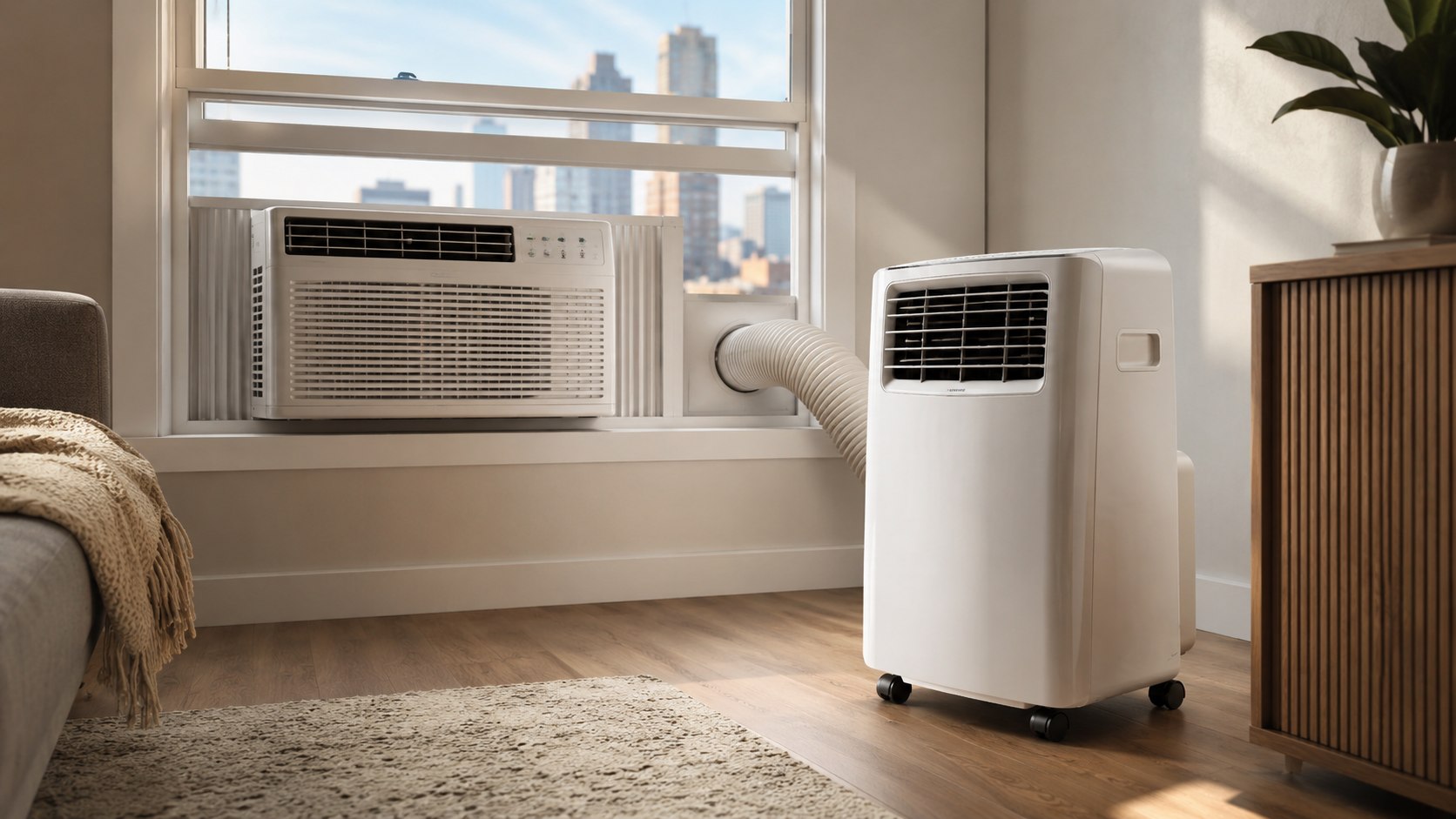
Window vs portable AC 2026 comes down to one practical choice: most households should buy a window unit for stronger cooling and better efficiency. A portable AC is better when window installation is prohibited, impractical, or needed only temporarily, as noted by Baltimore Chronicle.
For a bedroom, home office, or small apartment, a properly sized window AC usually costs less to operate. Portable units trade some efficiency for mobility and easier installation. Renters should first check lease rules, window type, outlet location, and whether the exhaust hose can reach outdoors.
Key takeaways
- Window ACs generally provide more useful cooling for each dollar spent on electricity and occupy no floor space.
- Portable ACs require an exhaust hose, but installation usually avoids lifting a heavy appliance into a window opening.
- In 2026, capacity labels, window dimensions, noise, drainage, and efficiency matter more than choosing a familiar brand.
Neither type is automatically suitable for every 8,000 or 10,000 Btu room. Sun exposure, ceiling height, insulation, room shape, cooking equipment, and local climate change the actual cooling load. A sunny apartment in Phoenix presents a different problem from a shaded bedroom in Maine.
At a glance
The biggest differences become clear when installation and energy use are compared together. Planning prices below represent common 2026 retail ranges rather than fixed national prices.
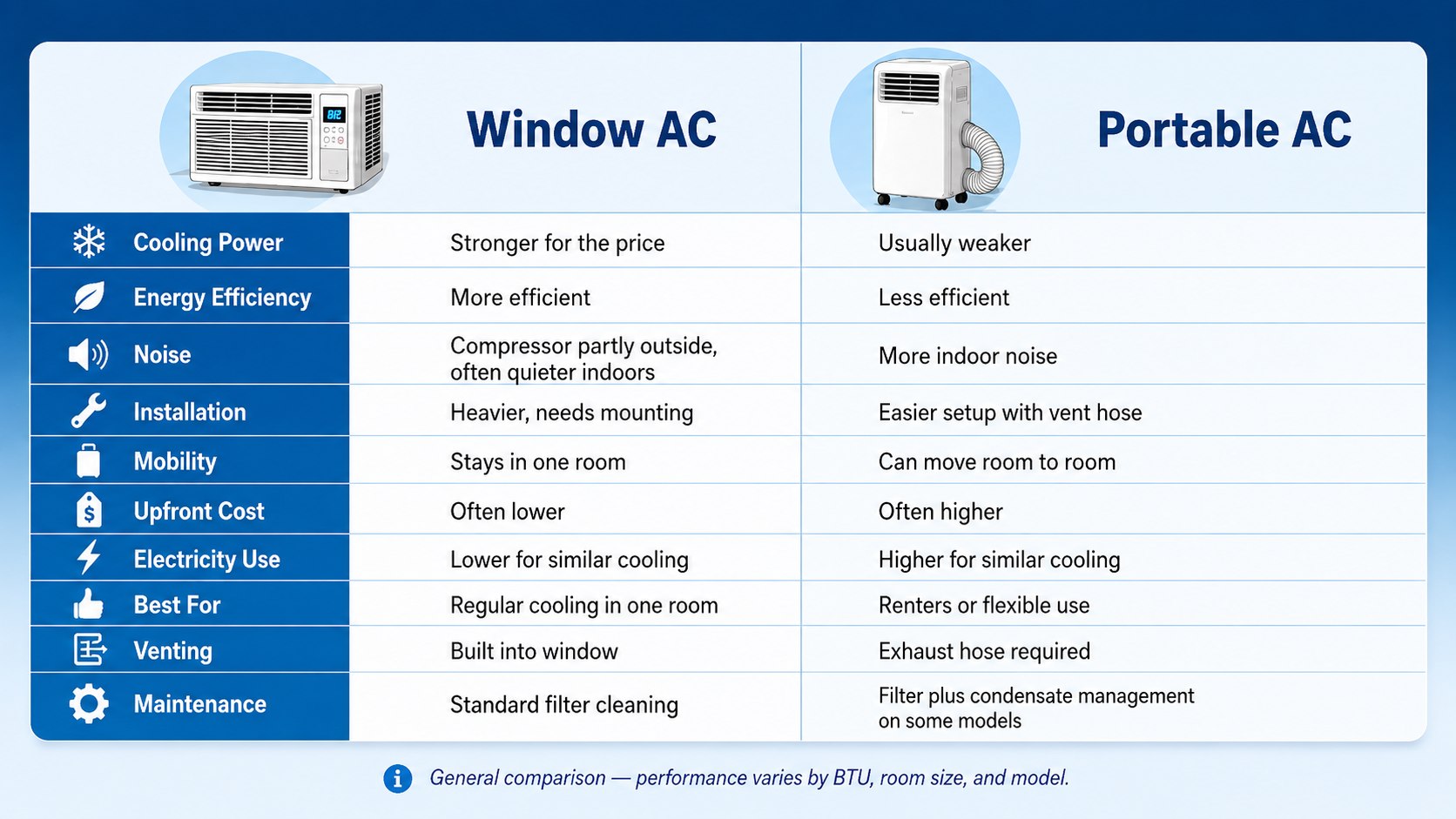
| Factor | Window AC | Portable AC |
|---|---|---|
| Typical 2026 purchase price | About $180–$650 | About $250–$750 |
| Installation | Moderate; window support and sealing required | Usually easier; hose kit goes in window |
| Cooling efficiency | Usually better | Usually lower |
| Floor space | None | About 2–4 sq ft plus hose clearance |
| Mobility | Low | High within practical hose limits |
| Noise location | Much of the system sits at the window | Compressor remains inside the room |
| Best climate fit | Frequent or sustained summer cooling | Temporary or occasional cooling |
| Maintenance | Filter, coils, drainage, seasonal sealing | Filter, hose, coils, condensate management |
| Typical lifespan | Often several seasons with proper care | Highly dependent on runtime and maintenance |
| Repair decision | Replacement often makes sense on low-cost units | Repair economics weaken as parts and labor rise |
The purchase price alone can mislead. A $300 portable appliance may cost more over several summers if it runs longer to maintain the same temperature. Window units reject condenser heat outdoors more directly, which gives them an important physical advantage.
Portable equipment also occupies conditioned space. Its compressor, condenser section, fan, and ducts operate inside the room. Single-hose designs can create pressure differences that pull warm outdoor air through gaps elsewhere in the building.
For frequent summer use, efficiency usually matters more than the convenience of rolling an appliance across the floor.
Owners considering larger whole-house upgrades can compare these room units with Baltimore Chronicle’s guide to new HVAC costs in 2026. Households focused on operating expenses can also review ways to lower an electric bill in 2026.
Window vs portable AC 2026 efficiency
The efficiency advantage generally belongs to the window air conditioner. A window unit places its hot condenser side outside the conditioned room. That arrangement limits how much rejected heat remains indoors.
Federal efficiency rules also give buyers standardized information. The US Department of Energy publishes requirements for room air conditioners and separate rules for portable units. Current DOE standards for portable air conditioners became mandatory for covered products beginning January 10, 2025, according to the agency’s portable air conditioner program.
“Compliance with the new standards … is required beginning on January 10, 2025.”
US Department of Energy, Building Technologies Office, federal portable air conditioner standards.
Window models can reach notably high efficiency levels. EPA ENERGY STAR listings in 2026 include Midea window models around 9,500 Btu/h with CEER ratings up to 17.6. Other listed Midea models around 10,000–12,000 Btu/h reach CEER 16.0.
Those figures should not be compared directly with every portable label because testing and rating terminology differ. For portable units, the DOE cooling capacity figure matters when comparing products. Retail marketing may also display larger legacy-style Btu figures prominently.
Window AC offers better cooling when installation works
A window AC vs portable AC comparison favors the window design when the room has a compatible opening. Brands such as Midea, GE, Frigidaire, LG, Friedrich, and Hisense sell models covering bedrooms through larger living areas.
Advantages of a window unit
Its main strengths are efficiency, space use, and direct heat rejection. Modern inverter models can also reduce compressor cycling and improve temperature control.
- Usually higher cooling efficiency for comparable room sizes.
- No appliance body occupying bedroom or office floor space.
- No long exhaust hose radiating heat back into the room.
- Strong selection of inverter models in common capacities.
- Often lower purchase prices than comparable portable systems.
Installation remains the decisive drawback. A 50-pound unit can be awkward or unsafe for one person to lift. The sash must close securely, and side gaps need proper sealing.
Some apartment buildings, homeowners associations, and landlords restrict visible window equipment. Casement and sliding windows can also require special hardware. Improvised supports should not replace the manufacturer’s mounting system.
Weather sealing deserves attention because a poorly installed unit allows hot humid air indoors. In Maryland, Florida, Louisiana, and other humid areas, infiltration can increase both cooling and moisture loads. In Arizona or Nevada, solar heat through an unshaded window can create a different penalty.
Before repairing an aging system, Baltimore Chronicle’s guide on when to repair or replace an AC can help frame the cost decision.
Portable AC solves installation problems at a cost
A portable air conditioner is not ventless. A true refrigerated portable AC must reject heat somewhere, which normally means an exhaust hose connected to a window kit.
That distinction matters because “portable” describes the cabinet, not unrestricted placement. The unit still needs a nearby window or another approved exhaust opening. It also needs electrical clearance and room around its air intake.
Where portable cooling makes sense
- Choose it when a lease prohibits conventional window-mounted equipment.
- Use it when the window shape cannot safely support a standard unit.
- Consider it for temporary cooling in a home office or guest room.
- Prefer dual-hose designs when efficiency and pressure balance justify the higher cost.
- Check condensate requirements before using it through a humid summer.
The advantage is flexibility. Many units roll on casters and can be stored after summer. Installation avoids suspending the entire machine above ground level.
The compromise appears once the compressor starts. The whole mechanical assembly remains indoors, so perceived noise can be greater. The exhaust hose also becomes hot and should remain short and straight.
Moving a unit between rooms is possible, but not instant. Each destination needs a compatible exhaust point and enough electrical capacity. A bedroom upstairs and office downstairs may require separate window kits.
Condensate management varies by model. Some units evaporate much of the collected moisture through the exhaust stream. Others may require periodic draining during humid conditions.
Portable does not mean hose-free, silent, or equally efficient; it means the refrigeration system can be moved without permanent installation.
Installation details that change the decision
Before buying either design, measure the window rather than estimating it. Record the opening width, opening height, sill depth, nearby wall clearance, and outlet distance.
Never plan around an extension cord unless the manufacturer explicitly permits one. Air conditioners draw substantial current, and many manuals require direct connection to a grounded wall receptacle. Large-capacity models can have different electrical requirements.
A practical pre-purchase check should include these items:
- Measure the exact window opening in inches.
- Confirm whether the window opens vertically or horizontally.
- Check the unit’s rated cooling capacity.
- Read landlord, HOA, and building rules before ordering.
- Confirm the outlet voltage and manufacturer electrical requirements.
- Leave the specified clearance around intake and exhaust areas.
- Plan safe seasonal storage before removing a window unit.
Capacity should match the room rather than simply maximizing Btu/h. An oversized conventional unit may cool quickly and cycle off before removing enough humidity. An undersized unit may run continuously during hot afternoons.
Rooms with west-facing glass need more cooling than shaded rooms of equal floor area. Kitchens add heat from cooking equipment. High ceilings increase conditioned volume beyond what square-footage estimates suggest.
Climate also changes priorities. Florida buyers may value moisture removal and continuous efficiency. California renters may care more about installation restrictions and seasonal heat waves.
Texas homeowners can face both long cooling seasons and high afternoon loads. In Minnesota, Wisconsin, or Maine, a less expensive room unit may see fewer operating hours each year.
Correct sizing therefore has financial value beyond comfort. Paying for capacity that the room cannot use does not automatically produce lower temperatures or lower bills.
What 2026 buyers should compare before paying
Brand recognition should come after measurable characteristics. Midea, LG, GE, Frigidaire, Friedrich, Hisense, Whynter, and Honeywell all compete in parts of the US room-cooling market.
For portable AC efficiency, read the federally standardized capacity and energy information instead of relying on the largest number printed on retail graphics. For window units, CEER provides a useful efficiency comparison within the same product category.
The EPA’s ENERGY STAR database includes certified room air conditioner configurations, including variable-speed models. Buyers comparing specific 2026 products should verify current certification and specifications in the official ENERGY STAR database before purchase.
Federal room-air-conditioner guidance uses standardized efficiency measures to compare cooling output with energy consumption.
US Department of Energy, federal room air conditioner efficiency guidance.
Prices deserve similar discipline. Basic window units can start below many inverter models, while premium U-shaped or saddle designs cost more. Portable equipment often begins higher because its cabinet includes the complete indoor refrigeration assembly.
A realistic 2026 shopping budget is roughly $180–$650 for many window models. Portable models commonly occupy a broader $250–$750 range. Exact prices vary by capacity, season, retailer, inverter technology, and promotions.
Which should you buy in 2026
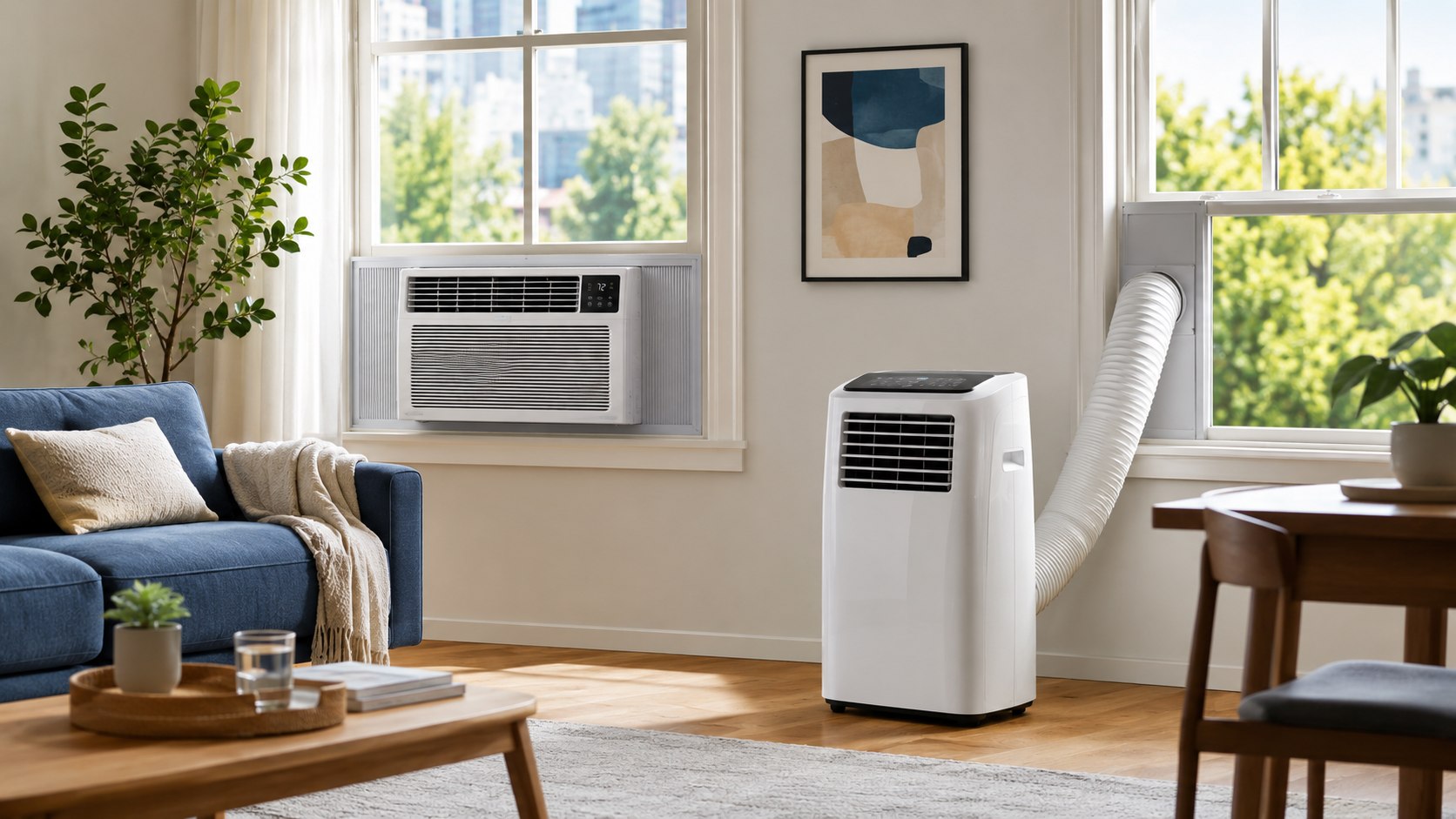
The best AC for apartment 2026 depends first on what the building allows. Efficiency becomes irrelevant if the selected unit cannot be installed safely or legally under a lease.
- If a standard window unit is permitted, then choose window AC for frequent summer cooling.
- If window mounting is prohibited, then choose a properly vented portable AC.
- If electricity cost is the priority, then favor an efficient inverter window model.
- If the unit moves between occasional-use rooms, then portable cooling may justify its compromises.
- If several rooms need daily cooling, then compare mini-split or central HVAC costs before buying multiple room units.
For a renter in Baltimore using one bedroom every night, the window option usually has the stronger economic case. A renter with casement windows and strict exterior rules may have little practical choice beyond portable equipment.
A homeowner cooling several occupied rooms should calculate the total equipment burden. Buying 3 separate room units can change the economics quickly. Installation convenience should not obscure annual electricity consumption.
Noise-sensitive sleepers should also examine manufacturer sound specifications. A portable unit keeps its compressor beside the bed, while a window design places part of the mechanical system outside.
The final purchase should follow the room, building, and climate. Product category comes before brand loyalty.
FAQ
Is a window AC cheaper to run than a portable AC?
Usually, yes. Window units generally reject heat more efficiently because the condenser sits outside the room. Actual cost depends on capacity, efficiency, electricity rate, runtime, insulation, and climate.
Why does a portable AC need a window?
The refrigeration system removes heat from indoor air but must release that heat elsewhere. The exhaust hose carries hot condenser air outdoors through a window kit or another approved opening.
What size AC do I need for a bedroom?
Room area is only the starting point. Ceiling height, sun exposure, insulation, occupancy, climate, and electronics affect the required capacity. Verify the manufacturer’s sizing guidance before purchasing.
Are portable AC units good for apartments?
They can be practical where landlords prohibit window-mounted units. Check the lease first because portable units still require exterior venting and may have window-kit restrictions.
Are inverter window air conditioners worth it in 2026?
They can make sense for rooms cooled many hours per day. Variable-speed operation can improve efficiency, temperature stability, and noise characteristics compared with basic fixed-speed designs.
How long should a room air conditioner last?
There is no guaranteed national lifespan. Runtime, cleaning, storage, climate, installation quality, and component availability all matter. Replacement often becomes more attractive when repair approaches the cost of a new room unit.
Earlier we wrote about Tenant Rights When Landlord Sells House in USA: What the 90-Day Rule Means in 2026