

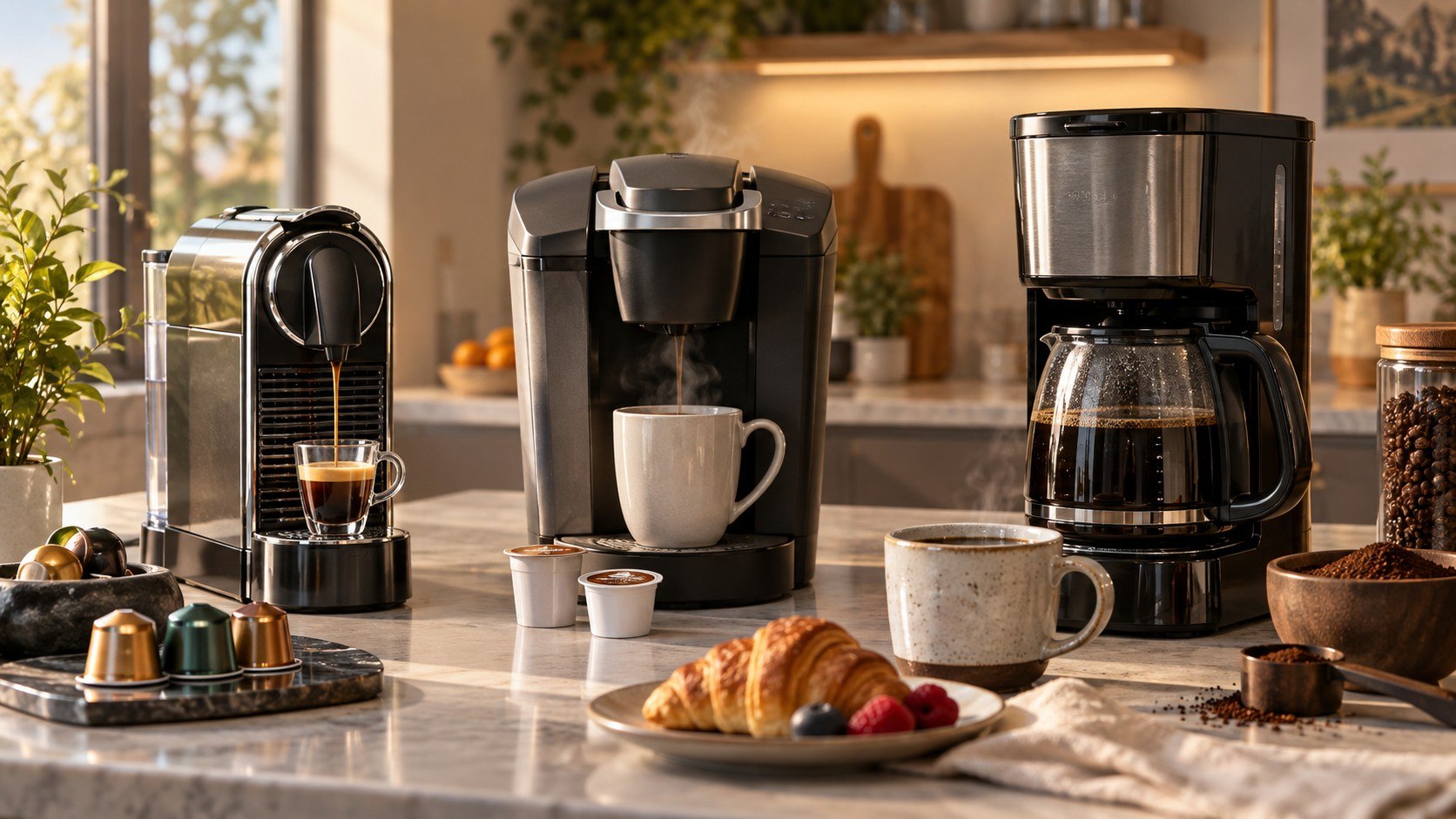
Nespresso vs Keurig vs Drip 2026 has a practical winner: most US households should choose drip for lower costs and better control. Nespresso suits espresso-style drinks, while Keurig wins on speed and variety, as noted by the Baltimore Chronicle editorial team.
The choice becomes clearer once recurring coffee costs enter the calculation. A Nespresso Vertuo cup can cost about $1.40 before milk. K-Cups commonly land around $0.45 to $0.80 each. Ground coffee can produce an 8-ounce serving for roughly $0.25 to $0.55, depending on beans and dosage.
Key takeaways
- Drip usually delivers the lowest coffee cost per cup, especially for households brewing several mugs every morning.
- Nespresso produces richer texture and stronger concentrated flavor without requiring a grinder, tamper, or espresso-making skills.
- Keurig offers the simplest single-cup routine, broad drink selection, and less waste when household members want different coffees.
Those differences become substantial at 2 cups daily. A $1.40 Nespresso habit reaches about $1,022 yearly before milk and taxes. Keurig can cost roughly $329 to $584 at the same frequency. Drip may fall near $183 to $402 using the ranges above. Machine price matters far less after several years of brewing.
Counter space also changes the answer. Renters may prefer compact pod machines with almost no preparation. Families often benefit from a 10- or 12-cup carafe. Buyers planning larger kitchen upgrades can also compare broader 2026 kitchen renovation costs before allocating money to countertop appliances.
At a glance
The three systems make coffee differently, so their headline prices reveal only part of the ownership cost. The comparison below uses typical US pricing and current manufacturer information available in 2026.
| Factor | Nespresso Vertuo | Keurig | Drip coffee maker |
|---|---|---|---|
| Typical machine cost | About $100–$250 | About $60–$170 | About $30–$150 |
| Estimated cost per cup | About $1.35–$1.55 | About $0.45–$0.80 | About $0.25–$0.55 |
| Taste profile | Concentrated, creamy, espresso-style | Light to medium filter-style coffee | Highly dependent on beans and technique |
| Preparation time | About 1 minute | Under 1 minute on many models | Usually 5–10 minutes per batch |
| Installation | Plug in and fill tank | Plug in and fill tank | Plug in and fill reservoir |
| Lifespan | No fixed manufacturer lifespan | No fixed manufacturer lifespan | Simple models may require fewer specialized parts |
| Climate and water sensitivity | Hard water increases descaling needs | Hard water increases descaling needs | Hard water affects flavor and scale |
| Repair economics | Replacement may beat major repair | Often inexpensive to replace | Basic models are usually simple appliances |
| Best household | Espresso and milk-drink fans | Busy single-cup households | Multi-cup coffee drinkers |
Nespresso commands the highest recurring cost in this comparison. Its advantage is drink texture rather than economy. Keurig sits between convenience and price, although pod discounts can change the calculation. Drip requires more preparation but gives owners control over coffee, grind, water, and strength. A programmable brewer can reduce the morning inconvenience considerably. None of the three requires permanent plumbing in a typical home kitchen.
“Our smallest, most colorful Vertuo ever.”
Nespresso, Vertuo Pop+ product page, describing its compact Vertuo machine for US buyers in 2026.
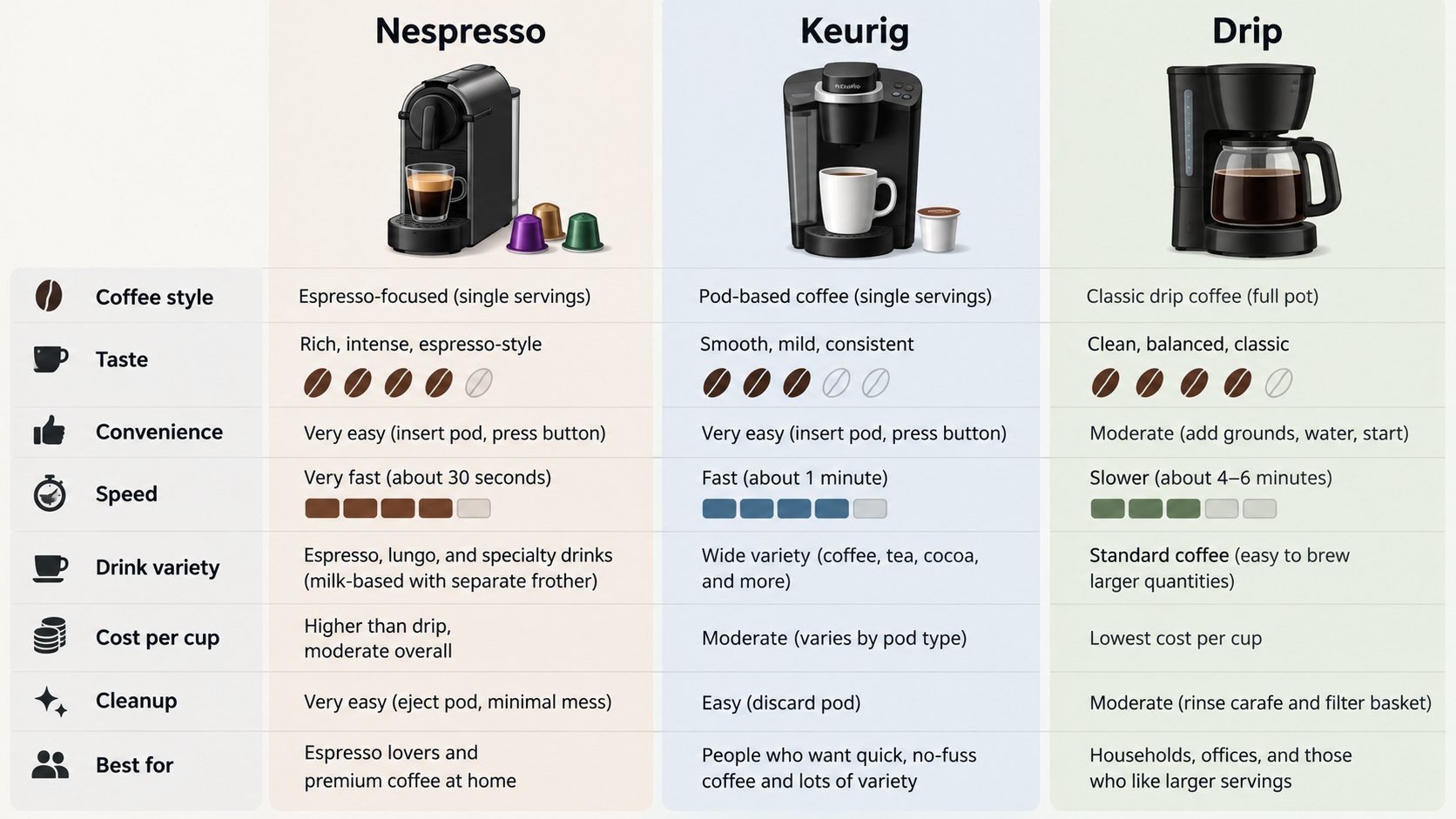
Nespresso vs Keurig vs Drip 2026: cost per cup and taste
Nespresso vs Keurig vs drip coffee is less about the brewer purchase than the consumable used every morning. That becomes obvious after calculating 730 cups, representing 2 coffees daily for 1 year.
Nespresso currently lists popular 7.77-ounce Vertuo capsules such as Melozio around $1.40 each. That creates an annual capsule bill near $1,022 at 2 cups daily. Specialty capsules can cost more, while subscription promotions may lower the effective price.
Keurig pricing varies much more because hundreds of K-Cup varieties compete across grocery stores and warehouse clubs. A realistic 2026 planning range is about $0.45 to $0.80 per pod. Reusable filters can reduce costs further because they accept ordinary ground coffee.
Drip coffee has the widest price range because shoppers choose the beans. A 12-ounce bag costing $8 to $14 can yield roughly 25–35 servings. The exact result depends on brew ratio and cup size.
For households drinking 4 or 5 cups each morning, consumable cost should outweigh a $50 difference between machines.
Taste changes the arithmetic. Freshly ground beans in a decent drip brewer can deliver greater aroma and clarity than prepacked pods. Nespresso offers more body and foam with almost no technique. Keurig prioritizes repeatable convenience over extraction control.
Nespresso: strongest taste without espresso work
Nespresso makes sense for people who want a concentrated drink but do not want a traditional espresso setup. Vertuo machines automatically identify capsules and adjust brewing parameters. Current models cover espresso, double espresso, 5-ounce, 8-ounce, and 12-ounce drinks.
The US Nespresso Vertuo Pop+ product page showed a $99.99 promotional price in October 2026. Its previous displayed price was $129.99. The machine measures about 8.6 inches wide and uses a 25.4-fluid-ounce water tank.
Pros, cons and ideal user
The largest advantage is consistency. Insert a capsule, press 1 button, and the machine handles dosing automatically. Milk-drink users can add a separate frother without learning espresso extraction.
The disadvantage is capsule economics and ecosystem dependence. Vertuo owners cannot simply buy any ground coffee from a supermarket. Long-term costs therefore remain closely tied to proprietary capsule pricing.
Best Nespresso for home use means something different from cheapest coffee maker. It suits 1 or 2 people who value texture, concentrated flavor, and minimal cleanup. Heavy black-coffee drinkers may find the capsule bill difficult to justify.
Regular descaling still matters, particularly in hard-water areas. Similar maintenance affects other kitchen appliances, including ovens and heating components. Baltimore Chronicle’s guide to self-cleaning oven safety illustrates why manufacturer maintenance instructions matter across appliance categories.
Keurig: convenience and variety remain the argument
Keurig occupies the practical middle ground. It makes 1 cup quickly and offers more brand choice than Nespresso Vertuo. Tea, cocoa, flavored coffee, decaf, and reusable filters also broaden its usefulness.
The official Keurig K-Classic page lists 6-, 8-, and 10-ounce brew sizes. Its removable reservoir holds 48 fluid ounces. Keurig also states that the machine can brew in under 1 minute.
“Always ready and brews in under a minute.”
Keurig, K-Classic product information, describing brewing speed for the current single-serve model.
Pros, cons and ideal user
Convenience is the strongest case for Keurig. Different people can choose different roasts without opening several bags. There is also no half-full carafe cooling on the counter.
The weakness appears in taste. Standard K-Cups contain a fixed dose, while larger water volumes can produce a thinner drink. Strong-brew modes help, but they cannot create the concentrated texture associated with Nespresso.
Keurig vs Nespresso taste therefore depends on the drink being compared. Someone wanting an 8-ounce breakfast coffee may prefer Keurig’s familiar profile. A latte drinker will probably notice Nespresso’s additional body.
Keurig works especially well for home offices, shared apartments, and households with conflicting preferences. It also reduces preparation compared with grinding beans before every cup. The compromise is paying a premium over ordinary ground coffee.
Drip coffee: lowest recurring cost with the most control
A conventional drip maker remains difficult to beat when several people drink coffee. One basket can produce 8 to 12 cups without loading individual capsules. Ground coffee is also available at nearly every grocery price point.
Drip’s flavor ceiling is higher than its modest reputation suggests. Good beans, filtered water, correct dosage, and a clean brewer can produce a balanced cup. Poor coffee or an overheated warming plate can ruin the same machine’s result.
Pros, cons and ideal user
The biggest advantage is flexibility. Owners can choose whole beans, preground coffee, roast level, dosage, and brew strength. Permanent filters can eliminate recurring paper-filter purchases.
There is more cleanup, however. Grounds must be removed, the basket needs rinsing, and carafes collect oils. Glass carafes can also leave coffee sitting on a hot plate for too long.
Drip coffee vs pods cost becomes decisive for families. At 4 cups daily, saving $0.50 per serving equals about $730 annually. That can exceed the purchase price of several good drip brewers.
A household brewing an entire morning carafe rarely receives enough convenience from capsules to offset their higher recurring expense.
Drip is ideal for parents, couples with similar preferences, remote workers, and anyone filling a travel mug daily. A thermal carafe is preferable when coffee must remain hot for hours. Single-person households may waste coffee unless they carefully match batch size to actual consumption.
Which should you buy in 2026
The right choice depends on how coffee is consumed, not which machine looks more advanced. Use this short decision path before comparing specific models.
- If lowest recurring cost matters most, choose drip and buy coffee by the bag.
- If espresso-style texture matters more than price, choose Nespresso Vertuo.
- If every household member wants something different, choose Keurig.
- If 4 or more cups are brewed together, choose drip with a thermal carafe.
- If counter space is extremely limited, compare compact Nespresso and Keurig models first.
Consider the monthly coffee bill before focusing on machine discounts. A $40 promotion disappears quickly when capsules cost another $30 monthly. Coffee quality also depends on drinking style. Milk and syrup can reduce subtle differences between premium roasts. Black-coffee drinkers tend to notice freshness and extraction more clearly. Renters should also consider storage for capsules, beans, filters, and accessories.
A practical single serve coffee maker comparison 2026 therefore produces no universal winner. Drip gives the strongest cost case. Nespresso makes the strongest convenience-to-texture case. Keurig provides the broadest middle ground for varied households.
FAQ
Is Nespresso cheaper than Keurig in 2026?
Usually not on a per-cup basis. Many Vertuo capsules cost around $1.35 to $1.55, while common K-Cups often cost less. Promotions can narrow the gap.
Is drip coffee cheaper than coffee pods?
Usually yes, especially when several cups are brewed daily. Ground coffee can cost roughly $0.25 to $0.55 per serving. Premium beans can push that higher.
Does Nespresso taste better than Keurig?
Nespresso generally produces a denser, more concentrated drink with foam. Keurig resembles ordinary filter coffee and offers more brand variety. Preference depends on drinking style.
Which system is best for 2 people?
Keurig works well when preferences differ. Nespresso suits couples favoring milk drinks or concentrated coffee. Drip is cheaper when both drink several similar cups.
Which coffee maker is easiest to clean?
Pod machines create less daily mess because grounds remain inside capsules. Both still need descaling. Drip brewers require regular basket, carafe, and filter cleaning.
Which coffee maker offers the best value in 2026?
Drip offers the strongest value for frequent coffee drinkers. Keurig balances convenience and cost. Nespresso earns its premium mainly through texture, speed, and espresso-style drinks.
Earlier we wrote about How to Switch Cellular Carriers Without Losing Your Number in 2026: Porting and eSIM Guide