


How to lower your electric bill in USA 2026 starts with 3 actions: read your rate plan, cut HVAC waste, and move flexible usage. Most households can identify their biggest problem in 30 minutes. The actual fixes can begin the same day, as noted by the Baltimore Chronicle editors.
The goal is not to sit in a dark house or stop using air conditioning. It is to pay for fewer wasted kilowatt-hours. It also means avoiding expensive electricity when your utility uses time-of-use pricing.
Key takeaways
- Compare kWh usage, not only dollars, because higher rates can raise a bill even when consumption falls.
- Heating and cooling deserve attention first because HVAC is one of the largest household energy loads.
- Check your utility’s rate options before buying equipment; changing when electricity is used can reduce costs without reducing comfort.
A $220 bill does not reveal whether the problem is consumption, price, fees, or all 3. Start with the usage line measured in kilowatt-hours. Then compare it with the same month last year.
Weather matters. A July bill in Texas cannot be judged like an April bill in Oregon. Household changes also matter, including remote work, an EV, a new freezer, or another family member.
Equipment replacement should come later. A dirty condenser, poor thermostat schedule, leaking duct, or wrong rate plan can create unnecessary spending. Baltimore Chronicle’s guide to cleaning an AC condenser safely explains one maintenance job that homeowners can handle themselves.
What you need
- Your last 12 months of electric bills or online utility account.
- Your current rate schedule, including any peak-hour pricing.
- A thermostat or HVAC control panel.
- Access to your breaker panel and major appliance labels.
- A phone calculator or spreadsheet for kWh comparisons.
- 30–60 minutes for the first household energy check.
Do not begin by unplugging random appliances. First establish where electricity is going. Bills often show monthly usage history, which provides a better baseline than memory.
Renters should document unusual consumption before contacting a landlord. Homeowners should separate maintenance problems from equipment replacement decisions. Large capital spending is rarely the first move.
A utility portal may also display hourly or daily consumption. Those graphs can expose overnight loads, air-conditioning spikes, and EV charging patterns. Download the data when the provider allows it.
If HVAC equipment is already near replacement age, compare operating costs before approving another major repair. The Baltimore Chronicle breakdown of new HVAC costs in 2026 provides useful context for that decision.
Keep one baseline number: total monthly kWh. Every change can then be measured against it.
Step 1: How to lower your electric bill in USA 2026 starts with the rate
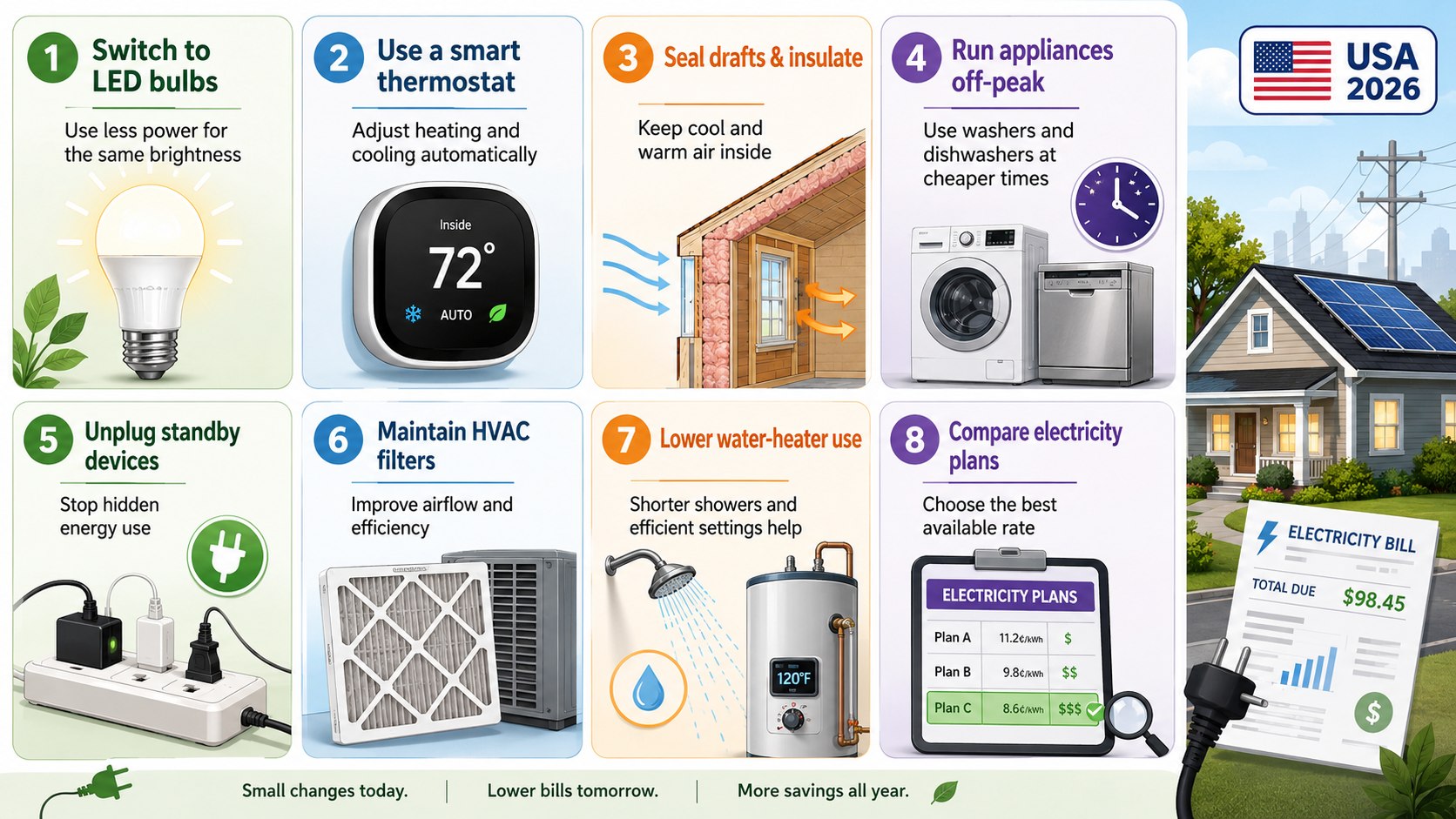
Find the electricity rate, delivery charges, fixed customer fee, and monthly kWh on your bill. Compare at least 3 months with the same period in 2025.
This matters because electricity became more expensive nationally. The U.S. Energy Information Administration reported a residential average of 18.44 cents per kWh for May 2026. May 2025 averaged 17.37 cents.
Higher electric bills do not automatically mean the household used more electricity.
The common mistake is comparing dollars alone. A household using 900 kWh can pay more than last year even after cutting consumption.
State differences are substantial. Preliminary EIA figures through May 2026 show why national averages provide only a reference point.
| Location | Residential price | What 1,000 kWh costs before fixed fees |
|---|---|---|
| United States | 18.16¢/kWh | $181.60 |
| Maryland | 21.27¢/kWh | $212.70 |
| Texas | 16.11¢/kWh | $161.10 |
| Florida | 15.36¢/kWh | $153.60 |
| California | 33.17¢/kWh | $331.70 |
| Hawaii | 45.95¢/kWh | $459.50 |
These figures are year-to-date residential averages through May 2026. Individual utility tariffs can differ sharply from state averages.
A California household therefore has a stronger financial incentive to eliminate 100 wasted kWh. At 33.17 cents per kWh, that amount represents about $33.17 before other bill adjustments.
In Texas, the same 100 kWh equals about $16.11 at the statewide average. Deregulated markets can also offer different supplier contracts.
Fixed charges cannot usually be reduced by conservation. Usage-based charges can.
Always use the price structure printed on the actual bill when estimating personal savings.
Step 2: Attack heating and cooling before small electronics
Inspect thermostat schedules, air filters, supply vents, return vents, doors, windows, and the outdoor condenser. Setbacks during sleeping or empty-house hours can reduce unnecessary HVAC runtime.
This matters because heating and cooling consume a large share of household energy. ENERGY STAR says nearly half of home energy use goes to heating and cooling.
“Nearly half of the energy used in your home goes to heating and cooling.”
ENERGY STAR, U.S. Environmental Protection Agency program, heating and cooling guidance.
The common mistake is setting an extreme thermostat temperature and expecting faster cooling. Residential air conditioners usually cool at their designed capacity, not according to thermostat impatience.
Check the filter monthly during heavy summer or winter use. Replace it when dirty and follow the equipment manufacturer’s specifications.
Central air systems also need unrestricted outdoor airflow. Leaves, grass clippings, cottonwood fibers, and dirt can obstruct condenser coils.
Step 3: Find appliances that quietly consume hundreds of kWh
Look beyond lights. Electric water heaters, pool pumps, resistance heaters, dehumidifiers, old refrigerators, freezers, and clothes dryers deserve closer inspection.
Calculate energy use with a simple formula: watts × operating hours ÷ 1,000 = kWh. A 1,500-watt space heater running 5 hours uses 7.5 kWh.
At 18.44 cents per kWh, that single day costs about $1.38 for electricity. Running it daily for 30 days approaches $41.50.
This matters because a device does not need to look large to become expensive. Runtime can matter more than its physical size.
The common mistake is obsessing over phone chargers while ignoring heating elements. Standby consumption exists, but high-wattage loads usually deserve attention first.
“A dirty filter will slow down air flow and make the system work harder.”
ENERGY STAR, heating and cooling efficiency guidance for US households.
Step 4: Move flexible electricity use away from expensive hours
Check whether your utility offers time-of-use, peak, off-peak, critical-peak, or demand-based pricing. Then identify loads that can move without disrupting daily life.
EV charging is an obvious candidate. Dishwashers, electric dryers, pool pumps, and some water heaters may also run later.
The cheapest kilowatt-hour may be the one used at 2 a.m. instead of 6 p.m., depending on the utility tariff.
This matters because peak-hour electricity rates can make timing almost as important as total consumption. A 10 kWh EV charge costs differently when rates change by hour.
The common mistake is assuming every time-of-use plan saves money automatically. A household occupied all afternoon may perform better on another available tariff.
Review several weeks of hourly data before switching. Freelancers working from home should pay particular attention to summer afternoon consumption.
Step 5: Reduce hot-water, laundry, and kitchen electricity
Shorter showers help when water heating is electric. Washing clothes in cold water also cuts the energy required to heat wash water.
Run full dishwasher and laundry loads when practical. Clean dryer lint filters after each load and avoid repeatedly drying already-dry clothing.
This matters because water heating and resistance heating convert substantial electrical energy directly into heat. Small behavioral changes become meaningful when repeated daily.
The common mistake is replacing a functioning appliance solely for a modest efficiency improvement. Calculate annual electricity savings against the replacement cost first.
Households with older refrigerators should inspect door seals and actual temperatures. A failing gasket can increase compressor runtime.
Renters should avoid unauthorized electrical or plumbing modifications. Their lease may assign appliance maintenance differently, as explained in the Baltimore Chronicle guide to reading a US lease agreement in 2026.
Step 6: Measure savings before spending on upgrades
After making changes, compare weekly or monthly kWh against the baseline. Correct for unusual weather and major household changes.
This matters because effective ways to reduce electricity usage should appear in consumption data. A lower bill caused only by a temporary rate change proves little.
The common mistake is buying a smart thermostat, smart plugs, insulation, or new HVAC equipment without identifying the actual load. Nest and ecobee thermostats can help scheduling, but controls cannot repair poor insulation.
Use a simple target. Cutting 200 kWh at May 2026’s national residential price equals about $36.88 before taxes and fixed charges.
For a household paying 30 cents per kWh, the same reduction is worth $60. That difference explains why energy-saving tips for US homes should be evaluated using local rates.
Start with inexpensive maintenance. Escalate to weatherization or equipment replacement only when the numbers support it.
Troubleshooting when the electric bill stays high
If the bill does not respond after several weeks, treat the remaining problem as a diagnostic exercise. Different symptoms point toward different causes.
- Electric bill suddenly doubled: compare kWh, billing days, estimated meter readings, rate changes, and unusually hot or cold weather.
- High electric bill in summer: inspect HVAC runtime, filters, condenser airflow, attic heat gain, and thermostat schedules.
- High overnight usage: investigate EV charging, pool equipment, water heating, dehumidifiers, freezers, and HVAC cycling.
- Usage rose after moving: compare home size, insulation, HVAC type, electric water heating, and appliance inventory.
- Usage looks normal but cost increased: examine cents per kWh, delivery charges, supplier terms, and peak pricing.
One abnormal bill may reflect a longer billing cycle or estimated reading. Several abnormal bills deserve closer investigation.
A malfunctioning water heater can run more frequently without creating an obvious household symptom. The same applies to an aging freezer or pool pump.
Persistent HVAC cycling deserves professional diagnosis when basic maintenance does not solve it. Do not open refrigerant circuits or energized equipment.
Renters should send landlords dated evidence when building equipment may be responsible. Screenshots of utility usage can be more persuasive than a general complaint.
Homeowners should compare repair cost, age, efficiency, and expected remaining service life before replacing expensive equipment.
FAQ
What is the fastest way to lower an electric bill?
Start with HVAC scheduling, filters, and unnecessary high-wattage loads. Then check whether electricity costs more during specific hours.
Why did my electric bill increase even though I used less power?
Your electricity rate or delivery charge may have increased. Compare kWh and cents per kWh separately instead of comparing total dollars.
Does unplugging appliances make a meaningful difference?
Sometimes, but major heating, cooling, water-heating, and motor loads usually deserve attention first. Measure standby use before making it a priority.
How much was residential electricity in the USA in 2026?
EIA reported 18.44 cents per kWh nationally for residential customers in May 2026. Actual household rates vary by utility and state.
Can a smart thermostat lower electricity costs?
It can help when heating or cooling runs unnecessarily while occupants sleep or leave home. Savings depend on climate, HVAC type, and schedules.
Should I replace an old appliance just to save electricity?
Not automatically. Estimate annual kWh savings first, multiply by your local rate, and compare that amount with the replacement cost.
Earlier we wrote about How to Choose AC BTU for Room Size in 2026: Calculator by Square Feet