

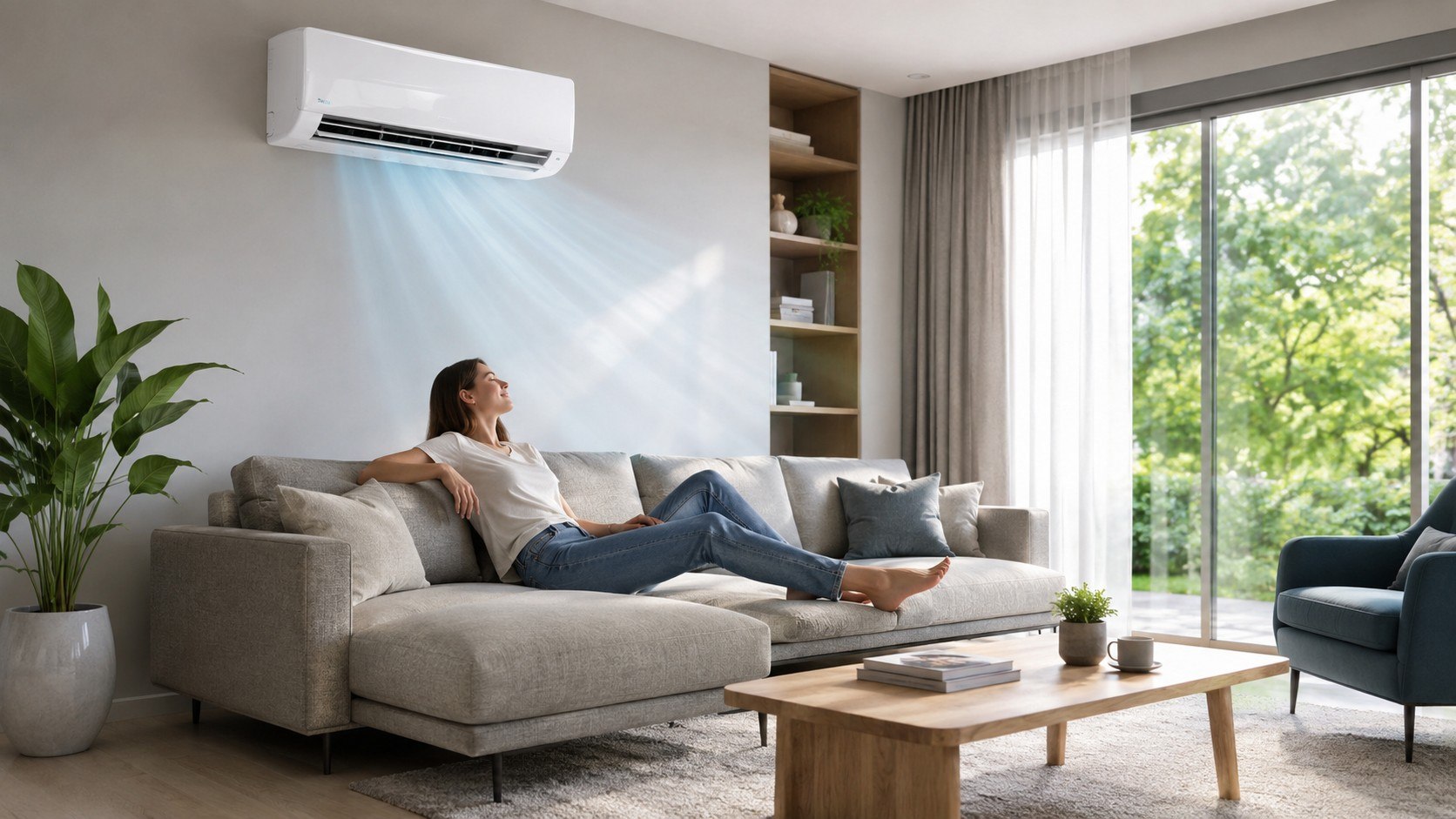
How to choose AC BTU for room size 2026 starts with measuring the space and matching square footage to cooling capacity. For most rooms, the basic calculation takes about 10 minutes with a tape measure and calculator. A 300–350 sq ft room generally needs about 8,000 BTU/h, while 450–550 sq ft usually calls for 12,000 BTU/h, as noted by the Baltimore Chronicle editorial team.
Square footage is only the starting point. Direct afternoon sun, a kitchen, additional occupants, high ceilings, and weak insulation can increase the cooling load. Buying the largest unit that fits the window is not automatically safer because oversized air conditioners may cool too quickly without removing enough humidity.
Key takeaways
The first estimate should always come from the actual room area. After that, adjust for conditions that make the room hotter than average.
- Measure the cooled area first and match it to a recommended BTU range.
- Add capacity for strong sunlight, kitchens, extra occupants, or unusual heat loads.
- Avoid unnecessary oversizing because it can reduce humidity control and efficiency.
These rules mainly apply to window and room air conditioners. Portable AC units may use different capacity labels, while central systems and mini-splits require a more detailed load calculation.
The sizing decision also affects electricity costs. Baltimore Chronicle has previously compared the cost of using an air conditioner and a fan in summer, which can help when planning cooling for several rooms.
What you need before calculating AC size
You do not need professional HVAC equipment for a basic room estimate. A few measurements and details about the space are enough to narrow the correct range.
- Tape measure or laser distance meter
- Calculator or phone calculator
- Room length and width in feet
- Ceiling height
- Number and direction of windows
- Typical number of occupants
- Approximate AC budget
- Window opening dimensions
- Information about the nearby electrical outlet
Measure the window before choosing a model. Window air conditioners have minimum and maximum opening dimensions, and those limits differ between manufacturers.
As of 2026, many small 5,000–8,000 BTU window units sell for roughly $150–$300. Smart and inverter models often cost more, while larger 18,000–24,000 BTU systems may reach $500–$800 or higher.
Brands widely sold in the United States include Midea, GE Appliances, LG, Frigidaire, and Hisense. Price should come after correct capacity, installation requirements, and electrical compatibility.
Step 1: Measure the room in square feet
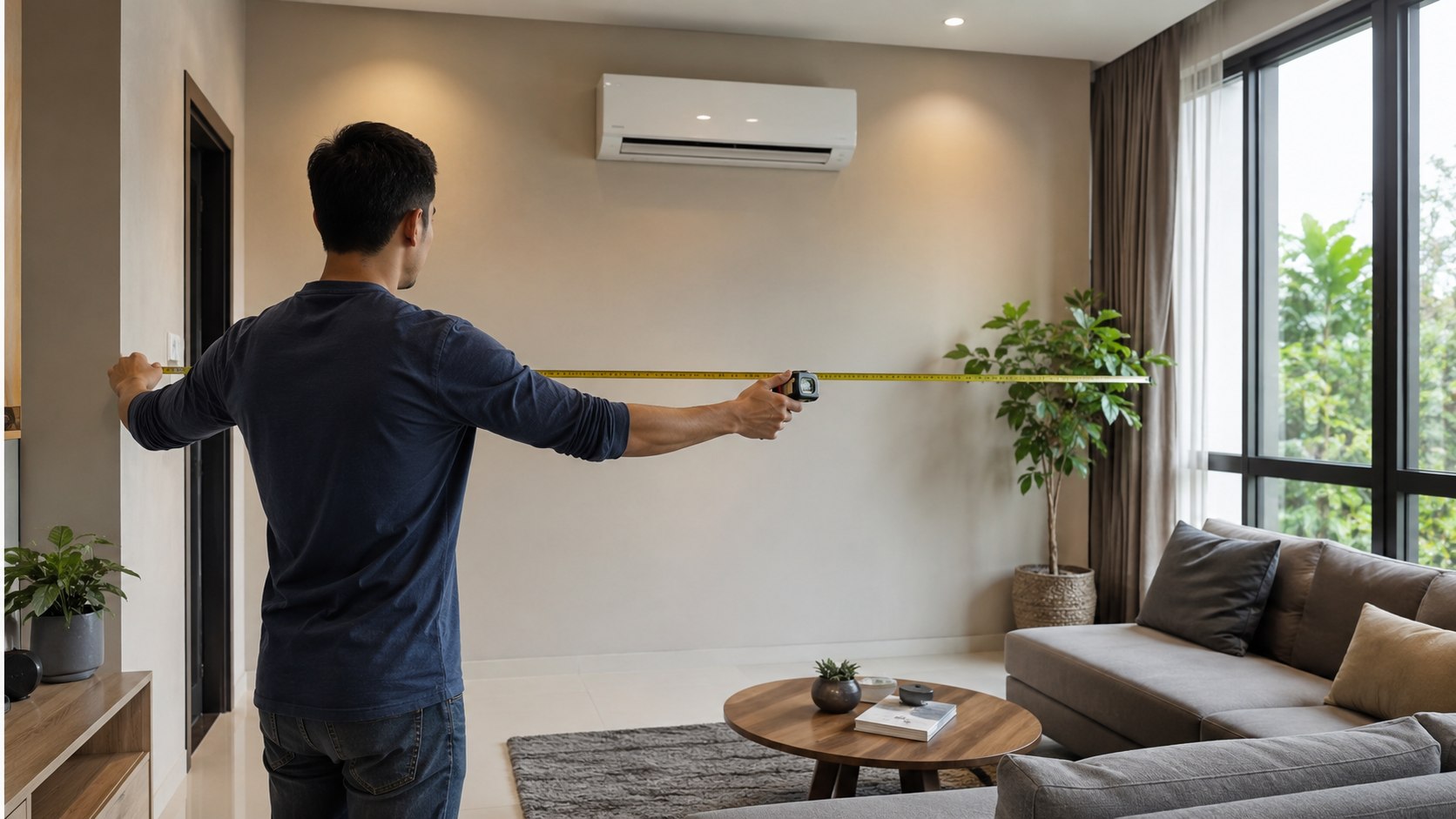
Measure the room’s length and width in feet. Multiply those numbers to calculate the floor area.
A room measuring 16 feet by 20 feet has 320 sq ft. That places it near the 8,000 BTU range under standard room-air-conditioner sizing guidance.
Common mistake: measuring only the central part of a room while ignoring an open alcove, hallway, or connected area.
Irregular rooms may require several smaller measurements. Divide the space into rectangles, calculate each area separately, and then add them together.
Step 2: Use an AC BTU calculator by square footage
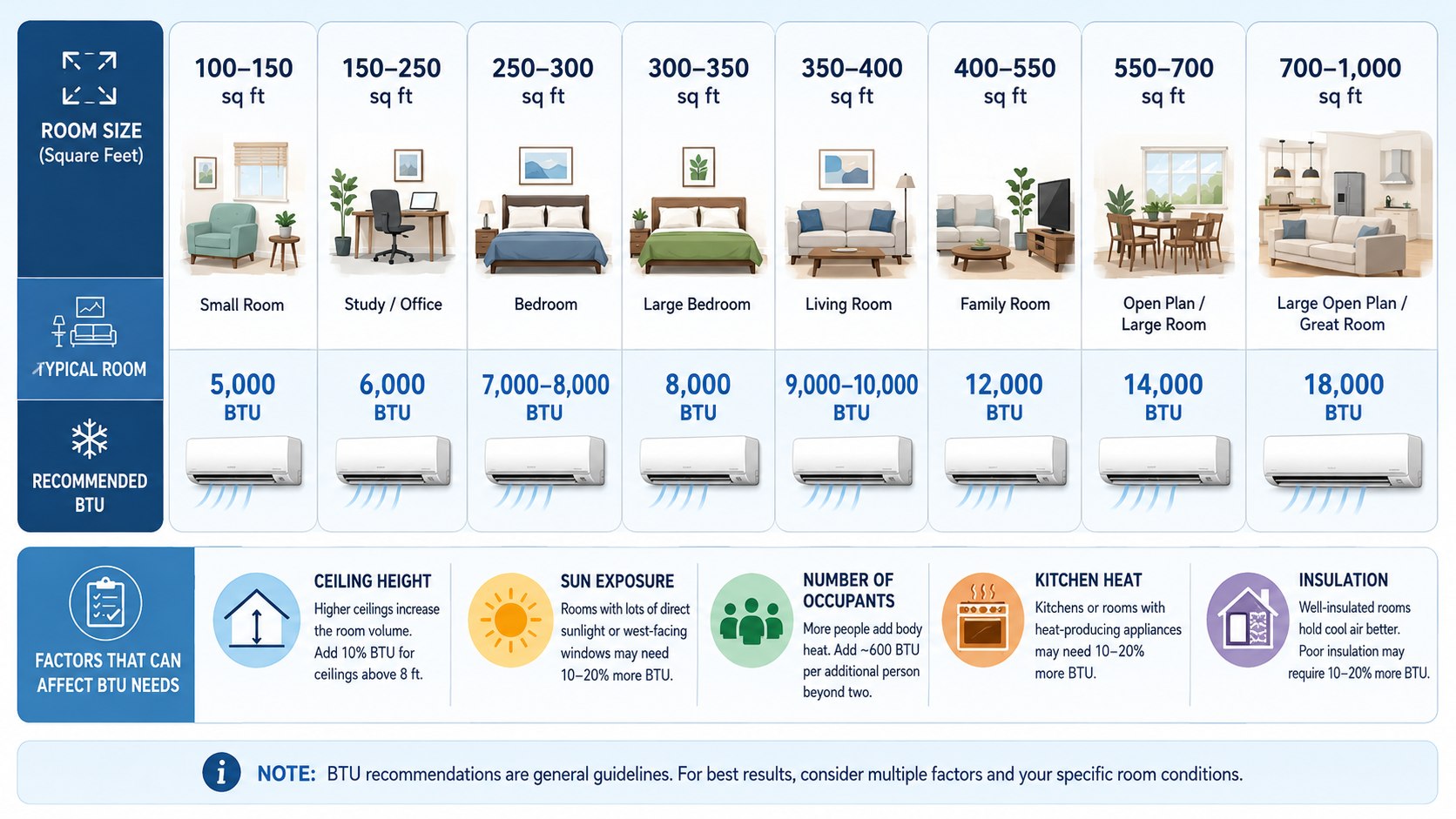
The following ranges provide a practical starting point for AC BTU by room size. They reflect common ENERGY STAR room-air-conditioner sizing guidance rather than a single fixed multiplier.
| Area to cool | Suggested capacity | Typical use |
|---|---|---|
| 100–150 sq ft | 5,000 BTU/h | Small bedroom or office |
| 150–250 sq ft | 6,000 BTU/h | Bedroom or compact studio |
| 250–300 sq ft | 7,000 BTU/h | Medium bedroom |
| 300–350 sq ft | 8,000 BTU/h | Large bedroom or office |
| 350–400 sq ft | 9,000 BTU/h | Small living room |
| 400–450 sq ft | 10,000 BTU/h | Living room |
| 450–550 sq ft | 12,000 BTU/h | Large living area |
| 550–700 sq ft | 14,000 BTU/h | Large open room |
| 700–1,000 sq ft | 18,000 BTU/h | Large open-plan area |
These ranges help prevent a common sizing mistake. A 500 sq ft room does not automatically need 10,000 BTU just because someone multiplied the area by 20.
Room shape also matters. An open 500 sq ft living and dining area may exchange heat differently from a closed rectangular room.
Multiple exterior walls can increase heat gain. Large glass doors may have an even greater effect, especially when they face west or south.
A 350 sq ft room shows why boundary ranges matter. Standard guidance places 300–350 sq ft near 8,000 BTU/h, while the next capacity class begins above that area.
Midea, for example, markets 8,000 BTU window models for spaces around 350 sq ft. Comparable models from LG, GE, and Frigidaire often target similar room sizes.
“A properly sized unit will deliver maximum comfort and savings.”
ENERGY STAR uses this principle in its room air conditioner guidance. Correct capacity is meant to balance cooling performance with moisture removal and energy use.
Step 3: Adjust BTU for sunlight and shade
After finding the base capacity, check how much direct sunlight reaches the room. ENERGY STAR guidance recommends increasing capacity by about 10% for a very sunny room.
A heavily shaded room may need around 10% less capacity. The adjustment should reflect normal conditions rather than one unusually hot afternoon.
A 10,000 BTU starting point becomes roughly 11,000 BTU after a 10% sunny-room adjustment. Available products may not match that figure exactly, so compare nearby capacity classes.
West-facing rooms in Arizona, Nevada, Texas, and inland California can gain substantial heat during the late afternoon.
Climate alone does not determine the answer. A shaded room in Phoenix can behave differently from a glass-heavy west-facing room in the same city.
Step 4: Add capacity for kitchens and extra people
A kitchen requires more cooling because ovens, cooktops, refrigerators, and other appliances release heat. Standard ENERGY STAR guidance recommends adding about 4,000 BTU/h when the air conditioner serves a kitchen.
Occupancy creates another adjustment. If more than 2 people regularly use the room, add about 600 BTU/h for each additional person.
For a practical BTU calculator for room size, use the following order:
- Find the base BTU capacity from square footage.
- Apply the sunlight or shade adjustment.
- Add about 600 BTU/h for each regular occupant beyond 2.
- Add about 4,000 BTU/h if the cooled space is a kitchen.
- Review ceiling height, windows, insulation, and unusual heat sources.
This approach is more useful than relying on square footage alone. The adjustments should describe the way the room is normally used.
Do not add kitchen capacity simply because a living room occasionally receives warm air from another room. The kitchen adjustment is intended for spaces where cooking regularly affects the cooling load.
Likewise, count regular occupants rather than occasional visitors. Otherwise, the calculation may push the purchase toward unnecessary capacity.
Households trying to reduce summer costs can also compare broader electricity-saving strategies before installing separate AC units in several rooms.
Step 5: Check ceiling height, insulation, and room layout
Standard square-foot guides assume fairly ordinary residential conditions. A room with a 12-foot vaulted ceiling contains much more air than a room with an 8-foot ceiling.
That does not mean adding a fixed percentage automatically. Ceiling height interacts with roof exposure, insulation, windows, air leakage, and building construction.
Air conditioner size by square feet becomes less reliable in converted attics, sunrooms, garages, lofts, and rooms with large glass walls. Those spaces can gain considerably more heat than a typical bedroom.
Correct sizing depends not only on floor area but also on the amount of heat entering the space.
This is why identical 400 sq ft rooms may need different cooling strategies. A shaded Maryland basement and a top-floor Texas apartment can behave very differently during summer.
Unusually tall ceilings, poor insulation, or multiple exterior walls are reasons to consider a professional load calculation. This becomes more relevant when several heat-load factors appear together.
Step 6: Avoid buying an oversized air conditioner
More BTUs do not always produce better comfort. An oversized compressor may lower the room temperature quickly and shut off before removing enough moisture.
This problem is especially noticeable in humid states such as Florida, Louisiana, Maryland, and Georgia. Correctly sized units usually run longer cycles and remove more moisture during operation.
Inverter air conditioners can reduce this problem because they can adjust compressor output. Traditional fixed-speed units rely more heavily on full-power cycling.
For anyone asking what BTU AC do I need, the goal should be appropriate capacity rather than the largest affordable model. Noise, efficiency, electrical requirements, and humidity control also belong in the decision.
Avoid jumping several capacity classes “just to be safe.” If the calculation suggests 8,000 BTU, buying 14,000 BTU without a specific reason is usually poor sizing practice.
Step 7: Compare efficiency, electrical needs, and 2026 prices
Once the correct capacity range is established, compare models within that range. Look at energy efficiency, compressor technology, noise ratings, warranty coverage, controls, and installation limits.
In 2026, typical US pricing can vary widely by brand and season.
| AC category | Approximate 2026 price range | Common use |
|---|---|---|
| 5,000–6,000 BTU basic window AC | $150–$250 | Small bedrooms |
| 8,000–10,000 BTU window AC | $200–$400 | Medium rooms |
| 10,000–12,000 BTU inverter AC | $300–$500 | Living rooms |
| 14,000–18,000 BTU room AC | $400–$650 | Large rooms |
| 18,000–24,000 BTU high-capacity unit | $500–$800+ | Large open areas |
Prices change with summer demand, retailer inventory, and regional promotions. Verify the current price before buying.
Efficiency should be compared only after the correct BTU range is known. A highly efficient unit that is too large or too small can still perform poorly.
Electrical requirements are equally important. Larger room air conditioners may need dedicated circuits, while some higher-capacity units use 230-volt power.
Never assume an existing outlet can safely handle a larger model. Check the manufacturer’s specifications before installation.
Homeowners comparing several appliances can also review Baltimore Chronicle coverage of appliance safety and manufacturer instructions in 2026. The same principle applies to AC installation.
Step 8: Match the unit to the window and room layout
BTU capacity is useless if the unit cannot be installed safely. Measure window width, opening height, sill depth, and nearby clearance.
Some window models require a double-hung window. U-shaped systems have different installation requirements, and casement windows often require specialized units.
The airflow path should remain open after installation. Curtains, furniture, beds, and shelving can block cooled air and make a correctly sized unit seem weak.
Place the air conditioner where airflow can reach the main occupied part of the room. Avoid hiding the discharge area behind heavy curtains.
The final buying decision should combine room size, BTU capacity, dimensions, electrical requirements, noise, efficiency, and installation compatibility.
Troubleshooting common AC sizing problems
A room that still feels uncomfortable does not always need a larger air conditioner. Several common problems can mimic incorrect BTU sizing.
- AC runs constantly: capacity may be low, the filter may be dirty, or the room may have heavy heat gain.
- Room feels cold but humid: the unit may be oversized or cycling too quickly.
- One side stays warm: furniture or walls may block airflow.
- Cooling becomes weak in late afternoon: strong western sun may increase the load.
- Breaker trips: stop using the unit and verify electrical requirements.
Start with airflow before assuming the BTU calculation failed. Curtains, furniture, or poor unit placement can restrict circulation.
A dirty filter can also reduce performance. Follow the manufacturer’s maintenance schedule rather than compensating with a larger replacement unit.
Persistent problems may point to air leakage. Older windows and exterior doors are common sources of unwanted heat gain.
Weak insulation can have a similar effect. Rooms directly below poorly insulated roofs often require more cooling than the same floor area on a lower story.
If several unusual conditions appear together, a professional cooling-load assessment becomes more reliable. The room size AC calculator 2026 should be treated as a practical starting point, not a substitute for diagnosing a building problem.
FAQ about choosing AC BTU in 2026
How many BTUs do I need for a 300 sq ft room?
A 250–300 sq ft room generally starts around 7,000 BTU/h. Rooms just above 300 sq ft often move into the 8,000 BTU range.
Sunlight, occupancy, and heat-producing equipment can increase the final requirement.
What size AC is best for 350 sq ft?
About 8,000 BTU/h is a common starting point for 300–350 sq ft. Several US manufacturers sell 8,000 BTU window units specifically for rooms in this range.
How many BTUs are needed for 500 sq ft?
A 500 sq ft room generally falls within the 12,000 BTU/h range. A sunny kitchen or heavily occupied living area may require additional capacity.
Is 12,000 BTU too much for a bedroom?
It can be excessive for a small bedroom. A typical 150–250 sq ft bedroom usually starts near 6,000 BTU/h.
Oversizing may cool the air quickly while removing less humidity.
Should I buy a bigger AC for Texas or Florida?
Climate matters, but location alone does not determine capacity. Solar exposure, insulation, windows, humidity, ceiling height, and building construction all affect the cooling load.
What is the easiest way to calculate AC BTU by square footage?
Measure room length by width, find the corresponding BTU range, then apply justified adjustments. This produces a practical AC BTU calculator by square feet without automatically oversizing the unit.
Earlier we wrote about How to Tip a Lyft Driver in 2026: App Steps, Limits and Amounts