


How to read a lease agreement in USA starts with 3 things: mark every dollar amount, every deadline, and every clause controlling your exit. A careful first review takes about 30–45 minutes and can expose fees, renewal traps, or repair duties before signing, as noted by the editorial team at Baltimore Chronicle.
The fastest method is to ignore legal formatting at first. Read the lease as a schedule of payments, responsibilities, permissions, and penalties. Then compare every verbal promise with the written contract.
Key takeaways
- Calculate the full monthly housing cost, not just advertised rent, including utilities, parking, insurance, pets, and mandatory service fees.
- Find renewal, termination, notice, and early-exit clauses before signing because they control how easily you can leave.
- Check state law when deposits, landlord entry, late fees, repairs, or notice periods appear unusually restrictive.
A lease should answer who pays, who repairs, and when either party can end the tenancy. Those answers may appear in several different sections. Addendums deserve the same attention as the main document. Never assume a standard form contains standard obligations. State and local landlord-tenant laws can also override contract language.
What you need
Gather the complete rental file before reviewing anything. Reading only the signature pages creates unnecessary blind spots.
- The proposed lease and every addendum.
- The original rental listing or written offer.
- A calculator or spreadsheet.
- Your move-in budget and expected utility costs.
- Emails or messages containing landlord promises.
- About 30–45 uninterrupted minutes.
- Your state housing or attorney general website for legal checks.
Keep the advertisement because it can reveal differences between marketing and contract terms. Save any promised parking space, appliance, discount, or repair in writing. Add every recurring charge to the monthly rent. Record every deadline in a calendar before signing. Keep the final signed lease somewhere accessible after moving.
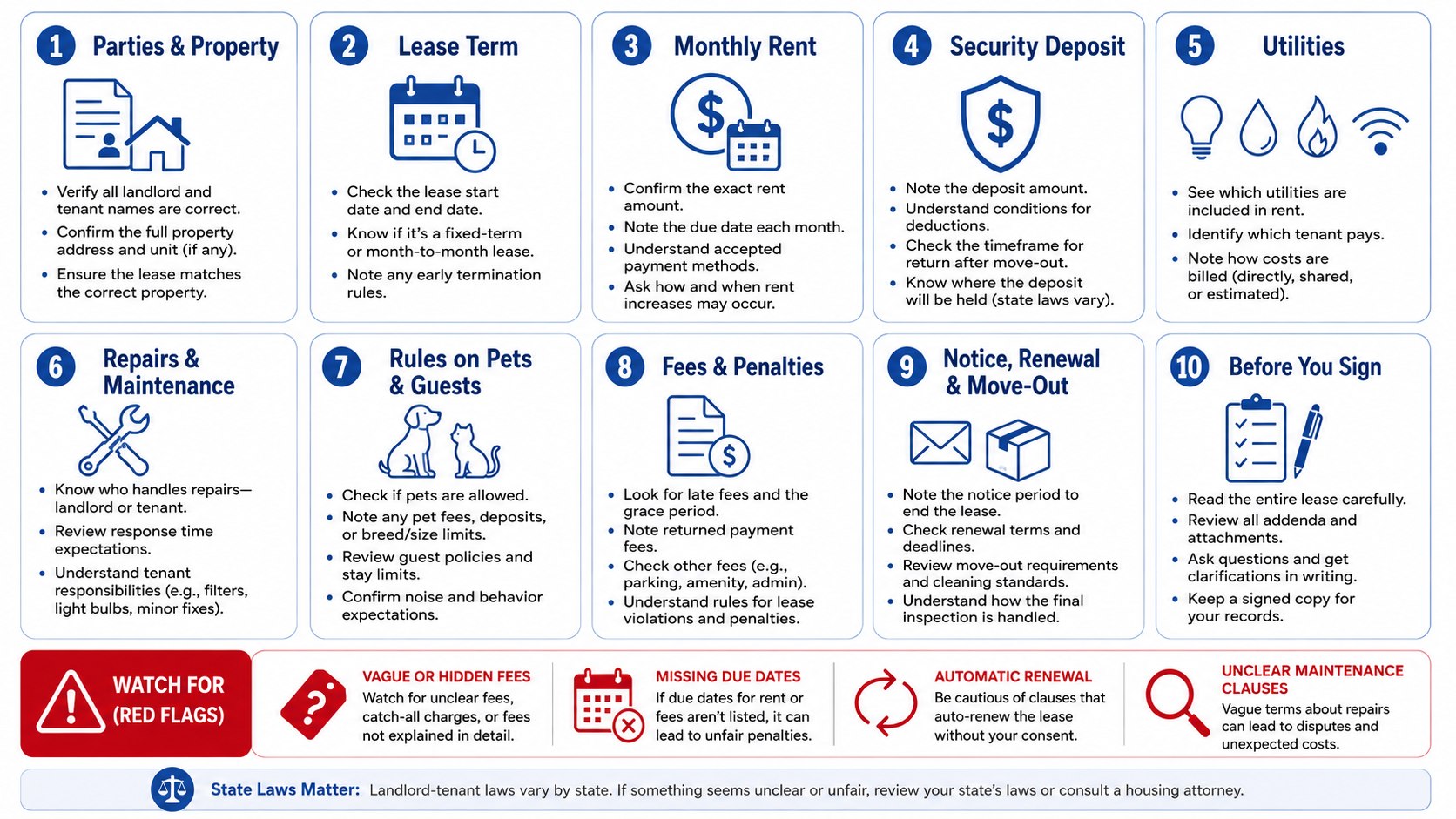
Step 1: How to Read a Lease Agreement in USA From the Top
Start with the legal names, property address, unit number, lease start date, and expiration date. Confirm every adult who should have tenancy rights appears correctly.
Then identify whether the agreement is fixed-term or month-to-month. This matters because the end date does not always end every obligation automatically. A common mistake is assuming the lease expires without requiring written notice.
How to read a rental lease before signing becomes much easier when every date is highlighted first. Mark rent dates, renewal deadlines, inspection windows, and move-out notice requirements.
The Baltimore Chronicle guide on breaking a lease without penalty explains why termination language matters. Moving out physically does not necessarily end contractual liability.
“I recommend that you always request a written lease outlining contractual tenancy.”
Jacob, HUD housing counseling training material, U.S. Department of Housing and Urban Development, guidance on obtaining tenancy.
Step 2: Check Rent, Due Dates and the Real Monthly Cost
Find the base rent, due date, accepted payment methods, grace period, and late-payment language. Search the document for every dollar sign.
Next, build the actual monthly cost. Include required parking, trash, pest control, technology packages, utilities, amenity charges, and renter’s insurance. The mistake is comparing apartments using rent alone.
A $1,800 apartment can cost more than a $1,900 unit when mandatory monthly charges sit outside the advertised rent.
For insurance requirements, Baltimore Chronicle reports that many 2026 renter policies fall around $13–$27 monthly. Actual premiums vary by ZIP code, coverage, deductible, and insurer. Its 2026 renter’s insurance cost guide explains those variables.
Step 3: Find Deposits, Fees and Charges That Can Follow You
Read every section mentioning deposits, cleaning, keys, pets, returned payments, parking, utilities, administration, or move-out charges. This is where lease agreement clauses to watch often hide.
Security deposit rules differ sharply by state. Maryland, New York, California, and Massachusetts do not use identical limits or return procedures. Baltimore Chronicle’s 2026 security deposit guide compares several major state rules.
The key question is whether a charge is refundable. Another is whether it can be deducted automatically. The common mistake is treating anything labeled “deposit” as money that must eventually return.
| Clause | What to identify | Question before signing |
|---|---|---|
| Security deposit | Amount, deductions, return process | What state rule applies? |
| Late fee | Amount and trigger date | Is there a grace period? |
| Pet charge | Deposit, fee, or monthly rent | Which portion is refundable? |
| Utilities | Tenant-paid services and allocation method | Is billing direct or shared? |
| Parking | Space, permit, towing rules | Is parking guaranteed? |
| Move-out charge | Cleaning or administrative costs | What conditions trigger it? |
Separate refundable money from nonrefundable charges. Ask how shared utilities are calculated when the unit lacks an individual meter. Get assigned parking promises into the lease. Check whether pet rent continues throughout the entire tenancy. Treat vague phrases such as “other applicable charges” as questions requiring written clarification.
Step 4: Read Renewal, Notice and Early-Termination Language
Search for “renewal,” “automatic renewal,” “notice,” “termination,” “holdover,” and “month-to-month.” These rental agreement terms explained often determine what happens months after move-in.
A lease may require advance notice even when it lists a clear expiration date. Missing that deadline can create another rental period or additional charges, depending on the agreement and applicable law.
Check exactly how notice must be delivered. Email may not qualify when the lease requires written notice through another method. The common mistake is sending a casual message and assuming it legally ends the tenancy.
If early termination is possible, identify the formula. Some agreements specify a fixed fee, continued rent, reletting costs, or another method. State law can affect whether particular provisions are enforceable.
Step 5: Separate Landlord Repairs From Tenant Maintenance
Find the sections covering plumbing, HVAC, appliances, smoke alarms, pest control, yard work, filters, drains, and damage reporting. Determine which tasks belong to management.
This matters because broad maintenance wording can shift unexpected costs toward the renter. A common mistake is accepting vague language requiring tenants to repair “all damage” without understanding its scope.
The lease should distinguish ordinary upkeep from damage caused by the tenant, household members, pets, or guests.
HUD housing counseling material identifies rent, utilities, pets, guests, parking, maintenance, alterations, and noise among common lease issues. It also emphasizes understanding repair responsibilities and documenting tenancy terms.
Record the procedure for emergency maintenance. Find the phone number or portal used after business hours. A written repair trail can become important if a dispute develops later.
Step 6: Examine Entry, Guests, Pets, Subletting and Liability Clauses
Finish the review by reading restrictions on daily use of the home. An effective apartment lease checklist must cover more than money.
Look for guest limits, occupancy rules, pet restrictions, smoking policies, balcony rules, alterations, home businesses, and subletting. A freelancer should check whether ordinary home-office work conflicts with any business-use clause.
Pay particular attention to “joint and several liability” when renting with roommates. Such wording can affect responsibility when another tenant fails to pay. Never assume each roommate owes only an equal share.
Also inspect indemnification and liability provisions. Terms attempting to transfer unusually broad responsibility deserve closer review under state law.
Finally, confirm landlord-entry rules. Notice requirements differ by jurisdiction and housing program. The mistake is assuming every US state uses the same advance-notice period.
“If anyone pressures you to make a decision quickly, walk away.”
Federal Trade Commission, Consumer Advice, guidance on rental listing scams and pressured payments.

Troubleshooting Common Lease Problems Before Signing
Not every problematic clause means the apartment must be rejected. Many issues can be clarified or corrected before signatures appear.
- The advertised price differs: request a written breakdown of all mandatory monthly charges.
- A promised repair is missing: add the repair, completion date, and responsible party in writing.
- The renewal clause is unclear: ask what notice prevents automatic renewal or month-to-month conversion.
- The deposit language looks excessive: compare it with current state law before paying.
- The landlord demands unusual payment: verify ownership or management before transferring money.
The FTC warns that fake landlords often pressure renters to pay before proper verification. Gift cards, cryptocurrency, and wire transfers deserve particular suspicion in rental scams. Search the property address independently. Verify the management company using its official contact information. Do not rely solely on a phone number supplied inside an online advertisement.
The goal is not to rewrite every unfavorable clause. It is to understand the price and consequences before accepting them. Ask for changes before signing, not after moving in. Preserve the final version and every addendum.
FAQ About Reading a US Lease Agreement
What should I check first in a lease agreement?
Check the rent, lease dates, security deposit, mandatory fees, renewal rules, and move-out notice. Then review repairs, utilities, pets, guests, and landlord entry.
What are the biggest red flags in a rental lease?
Watch for undefined fees, contradictory rent amounts, blank spaces, vague repair duties, extreme liability language, and missing verbal promises. Unclear termination rules also deserve attention.
Can a lease clause override state tenant law?
Not automatically. State and local law can make certain contract terms invalid or unenforceable. Verify questionable provisions with the relevant state agency or legal professional.
How long should I spend reading a lease?
A straightforward residential lease can often receive a useful first review in 30–45 minutes. Longer contracts or numerous addendums may require more time.
Should I sign if the landlord promises to change something later?
Important promises should appear in the signed contract or an executed addendum. A verbal agreement can become difficult to prove after a dispute begins.
Which lease clauses deserve the most attention in 2026?
Focus on total monthly charges, automatic renewal, notice deadlines, deposits, repair responsibilities, entry rights, early termination, and renter’s insurance. Those provisions directly affect money and flexibility.
Security deposit rules 2026 remain state-specific, while breaking a lease without penalty depends on contract language and applicable law. There is no single residential lease rulebook covering every private rental in all 50 states.
Earlier we wrote about Maryland Flag Meaning: How Civil War Symbols Became the State’s 1904 Banner