

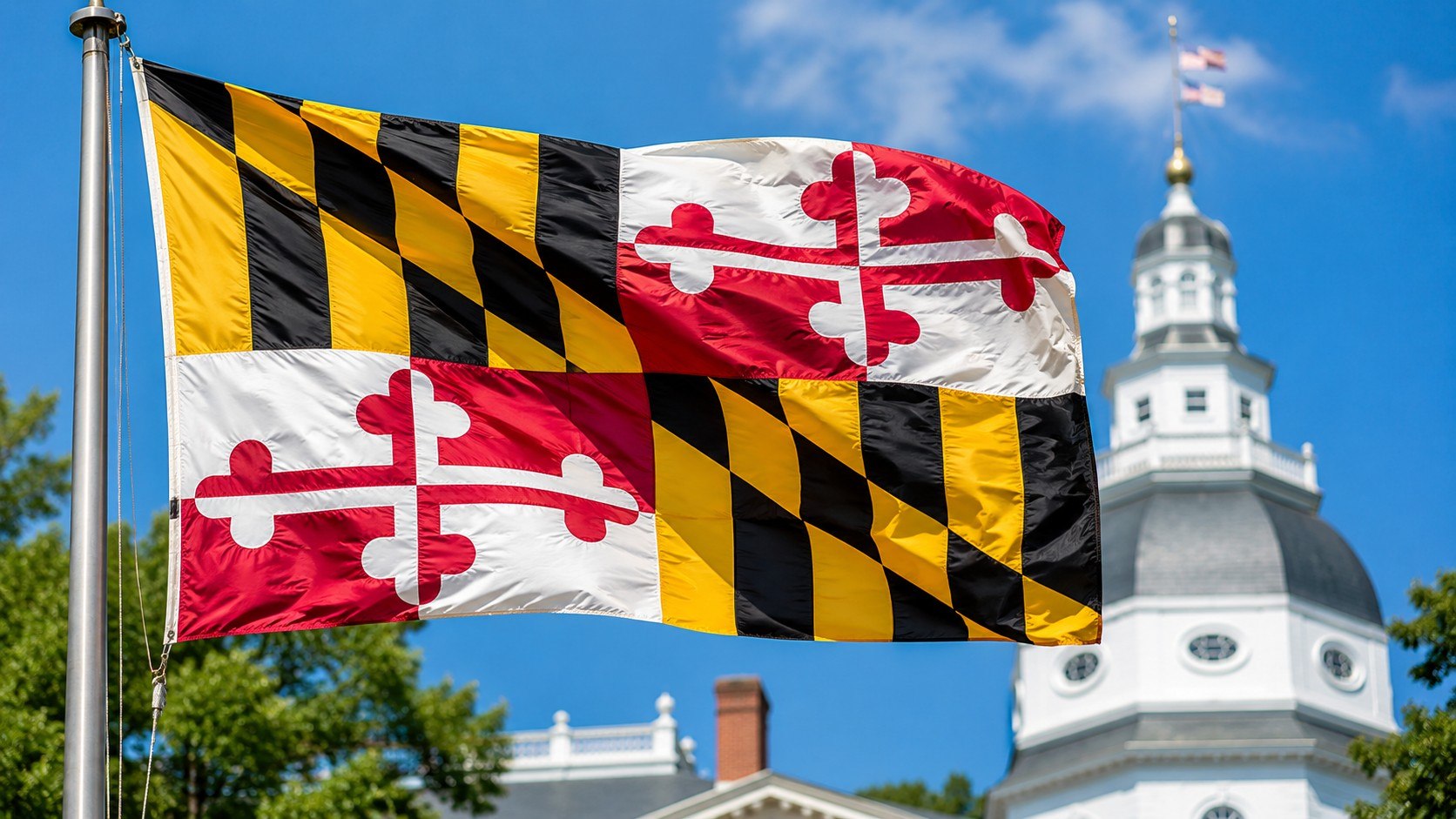
Why is Maryland flag so unusual? Because it is not a modern logo turned into cloth. Maryland flies a 17th-century family coat of arms, divided into 4 competing patterns. Its black-and-gold Calvert colors meet the red-and-white Crossland design linked to Maryland’s Civil War divisions. That combination explains both the flag’s visual complexity and its emotional weight, as the Baltimore Chronicle editorial team notes.
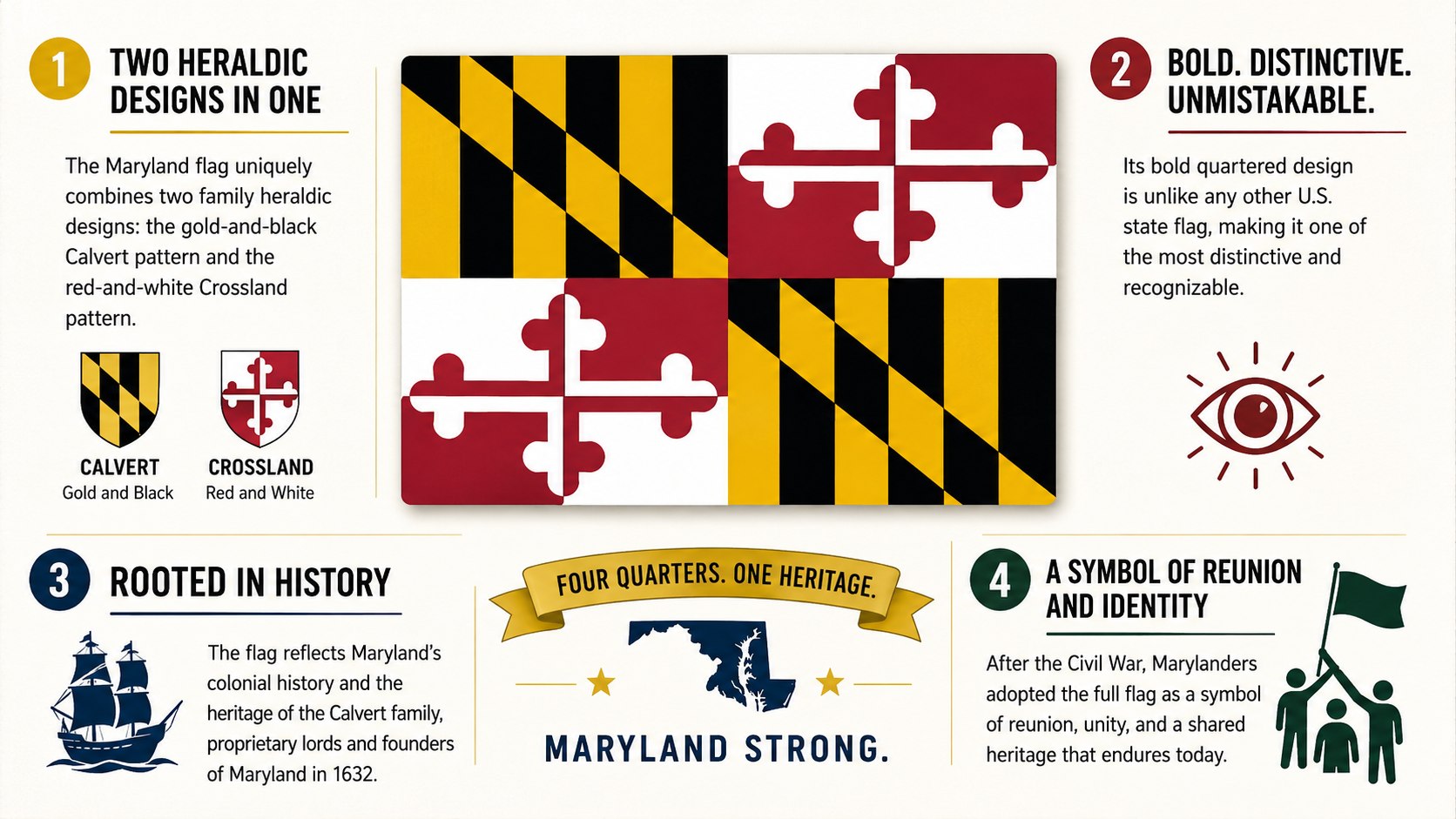
For anyone trying to identify the flag, buy the correct version, explain it to a child, or understand Maryland symbolism, the shortcut is simple. Black and gold represent the Calvert family. Red and white come from the Crossland family. The 4 quarters deliberately combine both.
Key takeaways
- Maryland’s flag comes directly from the heraldic arms associated with the Calvert and Crossland families.
- The competing colors acquired political meaning during the Civil War, then became symbols of postwar reconciliation.
- The current design appeared publicly by 1880 and became Maryland’s official state flag in 1904.
The unusual design becomes easier to read once those 2 family patterns are separated. It also explains why the flag looks more like medieval heraldry than most American state banners.
Why Is Maryland Flag So Unusual Compared With Other State Flags?
Most US state flags rely on seals, stars, state names, or relatively simple geometric forms. The Maryland state flag design does something different. It fills the entire field with heraldic imagery rather than placing a symbol in the center.
The first and fourth quarters contain alternating black and gold sections from the Calvert arms. The second and third use red and white from the Crossland arms. Each Crossland section contains a cross bottony, whose arms end in rounded, bud-like shapes.
The visual noise is not accidental decoration. Every major color and shape belongs to a centuries-old heraldic system.
The Maryland Secretary of State explains that the design derives from the Calvert family coat of arms. George Calvert, the first Lord Baltimore, used arms combining his paternal Calvert imagery with the Crossland arms of his maternal family. The state’s official flag history traces those elements through colonial Maryland, the Civil War, and their later reunion in one banner.
That family connection fits a broader pattern of Maryland oddities. The Baltimore Chronicle’s guide to interesting facts about Maryland in 2026 also places the flag among the state’s most recognizable historical symbols.
The Full Story
17th century: the design begins with the Calverts
The story starts long before Maryland had an official state flag. George Calvert received the title Baron Baltimore in 1625. His family’s heraldic identity later became closely associated with the Maryland colony founded under the Calvert proprietorship.
The black-and-gold pattern represents the Calvert line. The red-and-white pattern comes from the Crossland family of George Calvert’s mother. In heraldic convention, gold can appear as yellow and silver as white.
This origin explains one of the most common searches about the flag: what do Maryland flag colors mean? They were not originally selected as abstract state colors. They belonged to family arms carried into Maryland’s colonial identity.
After independence: Maryland had no single familiar flag
After the American Revolution, the old Calvert colors largely disappeared from official use. Maryland used other banners, including designs showing the state seal on a blue field. No universally established state flag immediately replaced the colonial imagery.
The Calvert arms returned to official prominence during the 19th century. An 1854 Maryland law called for a new Great Seal based on the historic family design. Another revision followed in 1876.
The return of those arms mattered because recognizable black-and-gold banners soon appeared at public events. They became associated with Maryland even without formal legislative status.
The Civil War split the colors politically
Maryland occupied a uniquely difficult position during the Civil War. It was a slave state that remained in the Union, while significant numbers of Marylanders sympathized with or fought for the Confederacy.
That division gave the flag’s 2 heraldic patterns a new political meaning. Black and gold became associated with Maryland’s established state colors. Southern sympathizers adopted red and white, including the Crossland cross bottony, as identifying symbols.
“The red-and-white Crossland arms gained popularity in quite a different way.”
Maryland Secretary of State, official “History of the Maryland Flag,” describing their Civil War-era use.
Maryland-born Confederate soldiers used red-and-white badges and cross bottony imagery. Federal authorities also treated some displays of secession colors as expressions of opposition to the Union government. The same 4-color design that looks decorative today therefore carried political meaning during the 1860s.
1880–1904: rival symbols become one flag
After the war, Maryland faced the problem of bringing former Union and Confederate supporters back into the same civic life. A banner combining Calvert and Crossland quarters gradually appeared at public ceremonies.
The Maryland State Archives records the present combination at an October 11, 1880 parade marking Baltimore’s 150th anniversary. A similar banner appeared at Gettysburg in 1888, during ceremonies for monuments to Maryland regiments. The Fifth Regiment of the Maryland National Guard adopted the pattern as its regimental color in 1889.
What now looks like visual excess once communicated something direct: Maryland’s rival wartime identities occupied the same piece of cloth.
The General Assembly finally made the pattern official in 1904. Its age can therefore be understood in 2 ways. The heraldic components reach back centuries, but the history of Maryland flag in its current state form belongs mainly to the decades after the Civil War.
How to Read the Maryland Flag
The pattern becomes much less confusing when each quarter is treated separately. The arrangement repeats diagonally rather than presenting 4 unrelated panels.
| Position | Colors | Origin | Main feature |
|---|---|---|---|
| Upper left | Black and gold | Calvert family | Diagonal heraldic pattern |
| Upper right | Red and white | Crossland family | Cross bottony |
| Lower left | Red and white | Crossland family | Cross bottony |
| Lower right | Black and gold | Calvert family | Diagonal heraldic pattern |
The diagonal repetition is the easiest recognition trick. Calvert appears in the upper-left and lower-right corners. Crossland occupies the remaining 2 quarters.
The Maryland Secretary of State also specifies official printing colors. Its guidance lists PMS 201 red for coated stock, PMS 193 red for uncoated stock, and PMS 124 yellow. Those details matter for government printing, commercial reproduction, and organizations ordering branded materials in 2026.
Ordinary homeowners do not need Pantone equipment to fly a flag correctly. However, a product using orange instead of gold, or a generic cross, may look noticeably wrong. For schools, businesses, uniforms, and official displays, matching the established pattern is more important.
The same appetite for distinctive local history appears throughout the region. A broader collection of Baltimore history and local facts explains how Maryland’s colonial past remains visible across the city.
What the Cross on the Maryland Flag Actually Is
One common misconception describes the red-and-white element as a generic Christian cross. Heraldically, it is more specific. The state identifies it as a cross bottony Maryland flag design.
Its arms terminate in rounded projections. The Secretary of State’s history notes a technical distinction between the older Crossland arms and the form used on Maryland’s flag. That level of detail is another reason the banner attracts heraldry enthusiasts.
For quick identification, these are the features that matter most:
- 4 alternating quarters rather than a central seal;
- black and gold diagonal Calvert sections;
- red and white Crossland sections;
- a repeated cross bottony in 2 quarters;
- the same 2 designs repeated diagonally.
The colors are therefore not random Maryland branding. They preserve separate genealogical sources. Their arrangement also prevents either design from visually dominating the entire flag.
The cross appears twice because the Crossland arms occupy 2 quarters. The Calvert pattern likewise appears twice. This follows the quartered structure of heraldic arms rather than modern graphic-design minimalism.
That is also why simplifying the image changes its meaning. Removing one family pattern would erase half of the historical structure. Changing the quarter order would alter the established arms.
For trivia purposes, remembering “Calvert black and gold, Crossland red and white” solves most identification questions.
What This Means Today (2026)
The flag is now less politically divisive than its Civil War history suggests. It appears across government buildings, sports culture, clothing, vehicle graphics, boats, homes, and commercial designs. That ubiquity has made Maryland flag meaning part of everyday state identity.
There are still practical rules. Maryland law addresses the ornament placed on top of a staff carrying the state flag. If an ornament is used, the Maryland State Archives says it must be a gold cross bottony. The requirement dates to legislation enacted in 1945.
For residents choosing or displaying one in 2026, a simple sequence helps:
- Confirm that all 4 quarters have the correct diagonal arrangement.
- Check that the Calvert colors appear black and gold, not blue or orange.
- Verify the red-and-white quarters use the proper cross bottony pattern.
- Use a gold cross bottony finial when an ornament tops the flagstaff.
- For official reproduction, check current Maryland specifications before printing.
Most residential flags are sold in familiar sizes such as 3 by 5 feet. Prices vary by fabric, stitching, manufacturer, and retailer in 2026, so there is no useful single statewide price. Buyers comparing products should focus on correct geometry, outdoor material, reinforced grommets, and color accuracy.
Schools and public agencies have another reason to care about precision. A heraldic flag depends on relationships between shapes, not merely recognizable colors. A distorted cross or reversed quarter can make an otherwise professional display historically inaccurate.
The Maryland flag remains unusual because its complexity survived instead of being redesigned away.
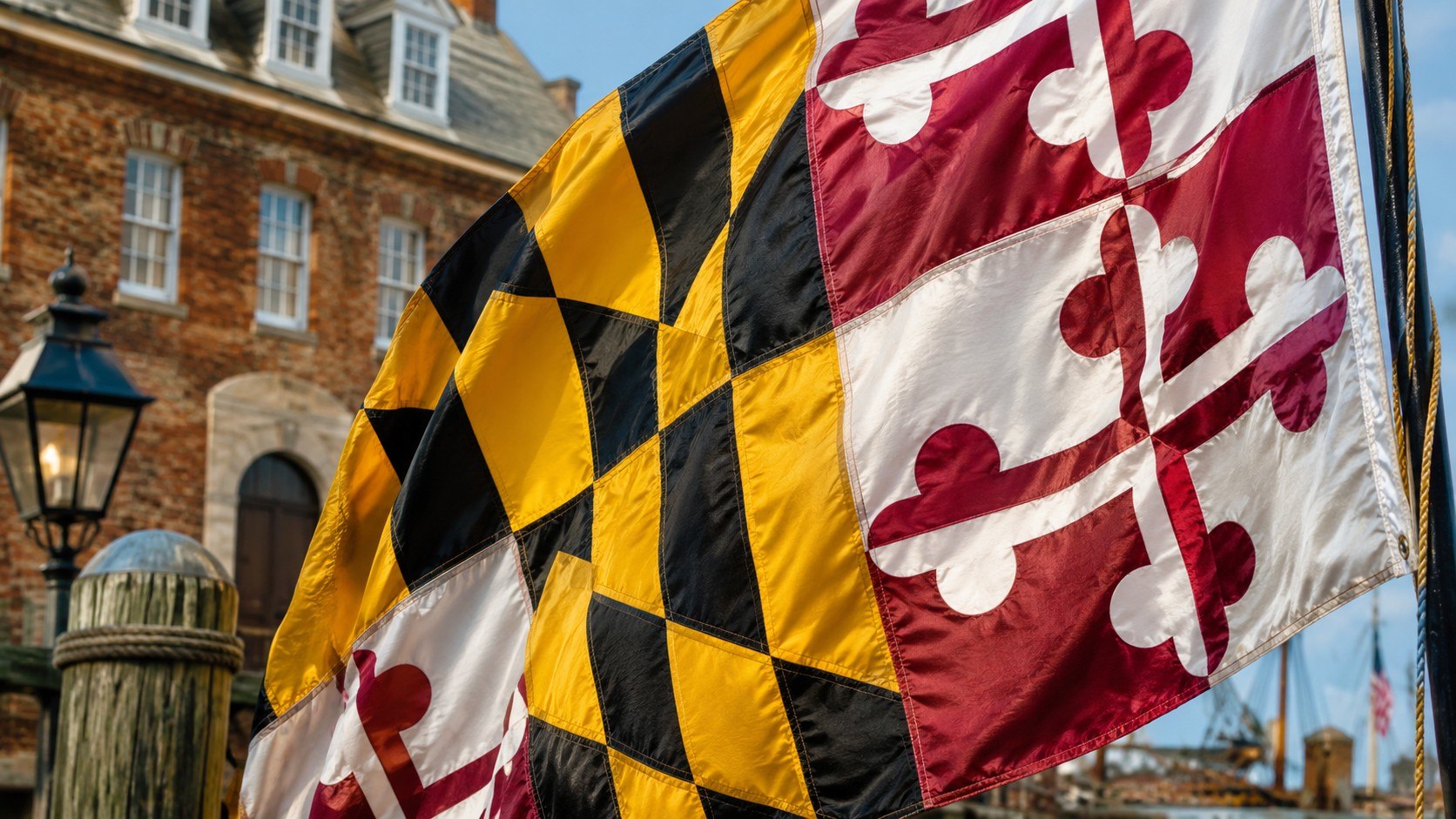
Why Maryland Never Simplified the Design
Many contemporary flag-design discussions favor fewer colors and simpler symbols. Maryland’s banner violates much of that minimalist instinct, yet its complexity is also its strongest advantage.
Its shapes are distinctive enough to recognize from a distance. Its 4-color scheme appears on merchandise without requiring the word “Maryland.” More importantly, simplifying it would sever the visual link to the Calvert and Crossland arms.
“Bold colors, interesting patterns, and correct heraldry.”
Maryland Secretary of State, official Maryland flag history.
The flag also accumulated meaning after its heraldic origins. By combining symbols once associated with opposing Maryland constituencies, the late-19th-century design became connected with reconciliation. That interpretation comes directly from the state’s historical account rather than later advertising mythology.
This is the deeper answer to why Maryland flag looks different. It was not designed to compete with modern state flags. It inherited a visual language developed for aristocratic arms, then acquired an American political story centuries later.
FAQ About the Maryland Flag
Why is the Maryland flag so complicated?
It combines 2 separate heraldic designs. Black and gold represent the Calvert family, while red and white represent the Crossland family.
What do the 4 sections of the Maryland flag mean?
The sections alternate between Calvert and Crossland arms. Each family pattern appears twice, positioned diagonally across the flag.
Why does the Maryland flag have a cross?
The red-and-white sections come from the Crossland arms. Their distinctive symbol is commonly identified in Maryland law and guidance as a cross bottony.
Was the Maryland flag connected to the Civil War?
Yes. Red-and-white Crossland imagery became associated with Confederate sympathizers and Maryland-born Confederate soldiers. Black and gold were associated with Maryland colors in a state that remained in the Union.
When did Maryland adopt its current flag?
The combined design appeared publicly by 1880. Maryland’s General Assembly officially adopted it as the state flag in 1904.
Is Maryland’s flag based on a family coat of arms?
Yes. Its design derives from the heraldic arms associated with the Calvert and Crossland families. That ancestry explains its unusual colors, quarters, and symbols.
Earlier we wrote about Apple iCloud Photos on Windows in 2026: How to Download Originals and Build a Local Backup