


What is a security deposit and how much can a landlord charge? A security deposit is refundable money a renter gives a landlord to protect against unpaid obligations or tenant-caused damage. There is no single nationwide maximum in 2026. State law controls the amount, and some states cap deposits at 1 month’s rent while others use different rules or exceptions, as noted by the editorial team at Baltimore Chronicle.
If your rent is $2,000, a 1-month state cap generally means a standard security deposit cannot exceed $2,000. However, you must check what your state legally counts as a deposit. Last month’s rent, pet deposits, advance rent, and other move-in charges can sometimes fall under the same statutory limit.
Key takeaways
- There is no universal federal security deposit cap for ordinary private rentals across all 50 states.
- Maryland and New York generally limit residential security deposits to 1 month’s rent in 2026.
- Check the law before paying extra deposits because labels like “advance rent” may not avoid statutory limits.
In plain English
Think of a rental security deposit as money placed behind glass. The landlord holds it, but the money does not automatically become the landlord’s income. It remains connected to obligations under the lease and applicable state law.
If you return the apartment without unpaid rent or chargeable damage, you generally expect the refundable balance back. If you leave a broken interior door or owe rent, lawful deductions may reduce the refund.
The deposit is therefore different from ordinary monthly rent. Rent buys the right to occupy the property during a period. A deposit protects against specified losses that might occur during the tenancy.
That distinction becomes critical when renters are preparing several thousand dollars for move-in. Someone considering a difficult rental application can also read Baltimore Chronicle’s guide to renting without a credit score in 2026. A higher deposit may be proposed during screening, but state limits can restrict that option.
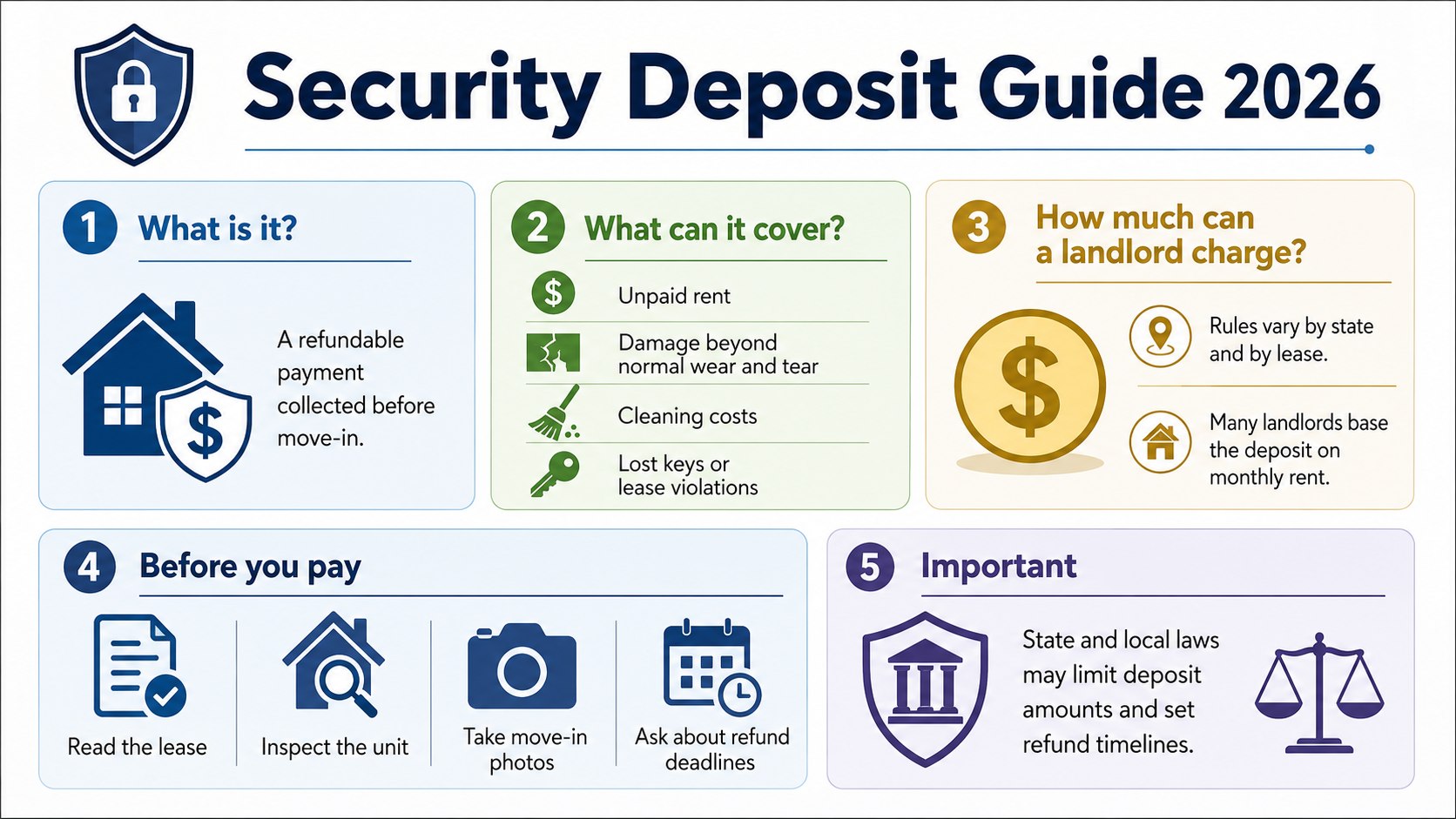
What is a security deposit and how much can a landlord charge by state?
The central mistake is assuming every American renter follows the same deposit rule. Landlord-tenant law remains heavily state-based. Some legislatures cap the amount directly, while others regulate storage, deductions, interest, notices, or return deadlines differently.
The examples below show how sharply the rules can vary. They reflect laws and official guidance available in 2026, but renters should verify their specific property type and local rules.
| State | General 2026 rule | Important detail |
|---|---|---|
| Maryland | Generally 1 month’s rent | A narrow utility-assistance exception can permit up to 2 months under statutory conditions. |
| New York | Generally 1 month’s rent | The limit also affects attempts to demand additional advance payments as a condition of renting. |
| California | Generally 1 month’s rent | Certain qualifying small landlords may demand up to 2 months, subject to statutory restrictions. |
| Massachusetts | Security deposit up to 1 month’s rent | A landlord may separately collect permitted move-in amounts such as first and last month’s rent. |
Maryland provides a particularly useful example for Baltimore renters. State law says a landlord generally cannot impose a security deposit exceeding 1 month’s rent. The current provision appears in Maryland Real Property § 8-203.
“A landlord may not impose a security deposit in excess of the equivalent of 1 month’s rent per dwelling unit.”
Maryland General Assembly, Real Property § 8-203.
The statute also recognizes a limited exception involving qualifying utility assistance, direct utility payments, and written agreement. That exception can permit a deposit reaching 2 months’ rent. It should not be treated as the normal Maryland rule.
California uses another model. Its Civil Code generally sets security at no more than 1 month’s rent. Certain natural-person landlords owning no more than 2 qualifying rental properties and 4 units collectively can use a 2-month limit. Different protection applies when the prospective tenant is a service member.
New York’s Attorney General likewise states that residential security deposits are generally limited to 1 month’s rent. Massachusetts permits a security deposit of up to 1 month’s rent while separately regulating other permitted move-in charges.
How it actually works
The process begins before you receive the keys. A landlord or property manager usually provides a lease showing monthly rent, the security deposit amount, payment deadlines, and conditions affecting deductions.
Suppose a Maryland apartment rents for $1,850 monthly. Under the ordinary 1-month cap, the landlord generally cannot demand a $3,700 cash security deposit simply because the applicant has limited rental history. The statutory ceiling still matters.
After payment, state law may dictate how the landlord holds the money. Maryland requires security deposits to be maintained in qualifying federally insured financial institutions and provides additional rules concerning interest.
During the tenancy, the deposit normally sits untouched unless applicable law permits another treatment. At move-out, the landlord compares the unit’s condition and financial account against lawful deduction categories.
If you are leaving before the lease ends, do not assume the deposit automatically covers your remaining rent. Baltimore Chronicle’s guide to breaking a lease without penalty explains why lease termination and deposit accounting are separate issues.
What landlords can usually deduct from a security deposit
A landlord cannot generally treat the deposit as a convenient renovation budget. Deductions must have a lawful basis. The details vary by jurisdiction, but disputes commonly concern unpaid rent, damage, cleaning, missing property, or another lease obligation.
Before accepting a deduction, compare the claim with these categories:
- Unpaid rent or another qualifying financial obligation.
- Damage caused by the tenant or permitted occupants beyond ordinary wear.
- Necessary cleaning where state law and the lease allow the charge.
- Missing landlord-owned furnishings, fixtures, keys, or other covered property.
- Other documented losses specifically recoverable under applicable law.
Normal deterioration is different from damage. A carpet becoming slightly worn after ordinary use is not equivalent to a large permanent stain. Minor wall aging is not the same as a punched hole.
Documentation matters because many disputes occur after the renter has surrendered possession. Take wide photographs of every room and close-ups of floors, appliances, walls, fixtures, windows, and bathrooms.
Record a continuous move-out video as well. Preserve the original files with metadata rather than relying only on compressed copies from messaging apps.
Ask for the required itemized statement when money is withheld. The timing and documentation rules vary by state. Texas, for example, generally requires return of the remaining deposit within 30 days after surrender, subject to statutory requirements.
A clean record can turn an argument about a $1,500 deduction into a factual comparison. Without photographs, receipts, inspection records, and written notices, both sides may rely on competing memories.
Who it matters to in 2026
Renters signing a new lease
The biggest immediate issue is cash. An apartment advertised at $2,200 monthly can already require substantial move-in funds. You need to distinguish the landlord security deposit limit from first month’s rent and other lawful charges.
Request every required payment in writing before sending money. A vague instruction to transfer “$5,000 for move-in” tells you very little. Ask management to separate rent, deposit, application charges, pet-related amounts, and other fees.
Renters with weak or limited credit
Property managers sometimes reduce risk through guarantors, additional documentation, or deposits. Yet a weak credit score does not override a statutory maximum security deposit.
If state law allows only 1 month’s security, calling another payment a “risk deposit” does not necessarily make the restriction disappear. The legal definition matters more than the marketing label.
This becomes especially relevant for immigrants, students, freelancers, and young adults without extensive US credit files. Screening problems should be solved using lawful alternatives rather than unverified extra charges.
Small landlords and homeowners
Owners renting a condo, basement apartment, duplex, or former home also need the correct state rule. The fact that a property is privately owned does not automatically remove landlord-tenant requirements.
California illustrates why owners must read exceptions carefully. A qualifying small landlord can have different deposit authority from a large property company. However, the exception contains ownership and tenant-specific restrictions.
How to protect your deposit before moving in and out
The strongest deposit dispute is the one prevented before it starts. Create a record from the first day instead of collecting evidence only after management sends deductions.
Use this checklist when accepting and later returning a rental:
- Read the lease section covering deposits and move-out obligations.
- Verify the state security deposit limit before paying.
- Get a receipt or other permanent payment record.
- Photograph every room before moving furniture inside.
- Report existing stains, scratches, cracks, and broken fixtures in writing.
- Keep maintenance requests and management responses.
- Request any inspection available under your state’s law.
- Photograph and video the property again after cleaning.
- Document when and how you returned the keys.
- Provide a forwarding address when applicable.
The move-in photographs are particularly valuable. A dated image showing an existing countertop crack can defeat a later claim that you caused it.
Do not store evidence only inside a landlord’s resident portal. Your access may disappear immediately after the tenancy ends.
Download leases, payment histories, maintenance tickets, inspection forms, and correspondence. Store copies locally or in a cloud account you control.
Keep receipts for repairs or professional cleaning when those services matter to the lease. A credit-card statement proves payment but may not prove exactly what work occurred.
Finally, send important notices through a method that creates delivery evidence. Phone calls are useful for discussion, but they provide weaker evidence than dated written communication.

Common myths
Security-deposit disputes often begin with rules that renters or inexperienced landlords have heard from someone else. Several common assumptions are unreliable across the United States.
- “A deposit is always 1 month’s rent.” No. Limits and exceptions vary by state.
- “The landlord can keep it for repainting.” Ordinary wear is different from tenant-caused damage.
- “I can use my deposit as last month’s rent.” Not automatically. The lease and state law control.
- “Calling it a fee avoids deposit laws.” Statutory definitions can cover payments regardless of their label.
- “Private landlords can charge anything.” State laws can apply to individual owners, although exceptions may exist.
The safest approach is to ignore informal rules of thumb. Find the statute, attorney general guidance, court self-help page, or housing agency resource for your state.
Then identify exactly what the requested payment is called and what it actually does. A refundable payment protecting the landlord against losses may receive different legal treatment from a genuine nonrefundable service fee.
Local rules can add another layer. Cities and counties sometimes regulate rentals beyond state requirements.
Property type can also matter. Subsidized housing, mobile homes, student housing, and other specialized arrangements may operate under additional rules.
That is why the useful question is not simply, “What did my previous landlord charge?” It is, “What can this landlord legally require for this property in 2026?”
FAQ
What is a security deposit?
A security deposit is refundable money held to protect a landlord against qualifying losses. These can include unpaid rent or tenant-caused property damage. State law determines how the deposit may be collected, held, deducted, and returned.
How much can a landlord charge for a security deposit?
There is no single US limit covering every private residential rental. Some states cap the amount at 1 month’s rent. Other jurisdictions have different limits, rules, or exceptions.
Can a landlord charge 2 months’ rent as a security deposit?
Sometimes. The answer depends on state law and the property. California, for example, has a limited 2-month exception for certain qualifying small landlords. Maryland also has a narrow statutory exception involving specified utility-assistance circumstances.
Can a landlord charge first month, last month, and a security deposit?
It depends on the state because advance rent can be regulated differently. Massachusetts permits certain separately regulated move-in payments, while New York’s rules are more restrictive. Always verify the current law before paying.
Can a landlord keep a security deposit for normal wear and tear?
Generally, lawful deposit deductions distinguish tenant-caused damage from ordinary deterioration. California expressly excludes ordinary wear and tear from allowable damage claims against security.
What should I do if my landlord demands too much?
Ask for the amount and legal basis in writing. Compare the charge with your state’s current landlord-tenant statute or official guidance. Preserve the lease and payment request before disputing the charge.
Earlier we wrote about Lyft Pink Membership Worth It 2026? Price, Perks and Break-Even Cost