


How to break a lease in USA without penalty starts with one question: do you have a legal right to leave, or do you need the landlord’s agreement? In many cases, you can settle the issue within several days by checking the lease, documenting your reason, and sending a precise written request, as noted by the editorial team at Baltimore Chronicle.
A job transfer, breakup, medical problem, unsafe apartment, military order, or sudden move does not automatically erase a fixed-term lease. The safest route is to identify a statutory right first. If none applies, negotiate a written release, replacement tenant, assignment, or lease buyout before moving.
Key takeaways
- Check federal and state protections before agreeing to pay an early termination fee.
- A landlord’s written release is far safer than relying on a phone conversation or verbal promise.
- Document the apartment, surrender the keys correctly, and request written confirmation of your final balance.
The central rule is simple: moving out and legally ending your financial liability are not always the same event.
What you need
Before contacting the landlord, collect the records that determine whether you have leverage. Most renters can organize the file in 30–60 minutes.
- Your signed lease and every addendum.
- Current rent ledger and security deposit information.
- Emails, maintenance requests, photographs, and inspection records.
- Military orders or other qualifying documentation, when applicable.
- Police, court, medical, or advocate documentation where state law permits its use.
- Your proposed move-out date and forwarding address.
- A realistic amount available for a negotiated buyout, if necessary.
Read the documents before announcing that you are leaving. Look specifically for “early termination,” “lease break,” “assignment,” “subletting,” and “replacement tenant.” Some leases already provide a predictable exit route.
If your next move involves buying rather than renting, compare the exit expense with Baltimore Chronicle’s guide to how much down payment a house may require in 2026. A lease settlement can materially reduce cash available for closing.
The same applies to transaction expenses. Buyers should separate the cost of ending a rental from closing costs on a house in the USA, because both may become due within weeks.
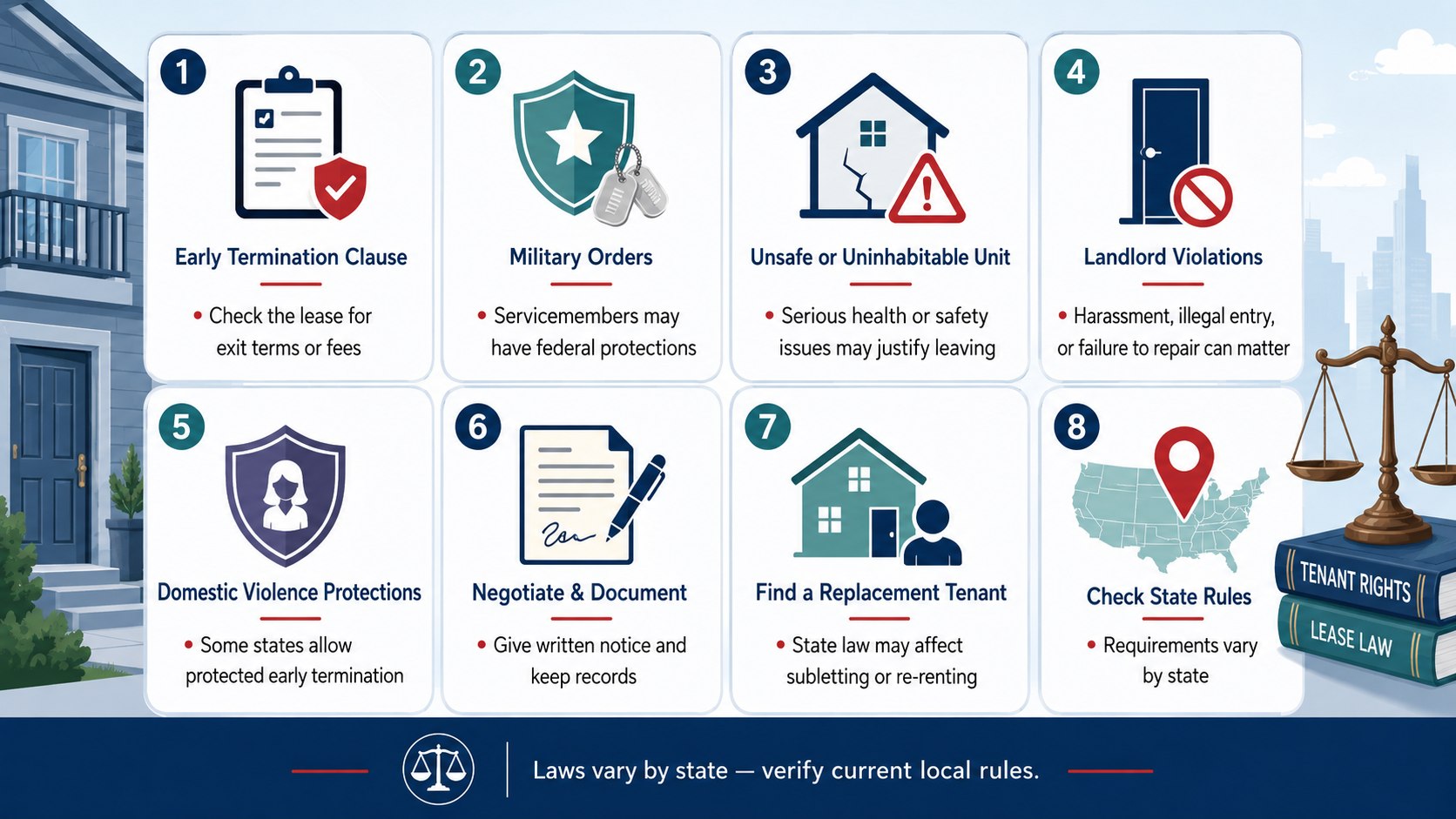
Step 1: Find your legal ground to break the lease
Start by separating inconvenience from a legally protected reason. A new job, cheaper apartment, or desire to relocate usually does not create an automatic federal right to terminate a residential lease.
Federal law does provide specific protections. Under the Servicemembers Civil Relief Act, qualifying servicemembers can terminate residential leases after events including certain military orders. The U.S. Department of Justice explains the requirements in its official SCRA housing guidance.
Why it matters: a valid statutory termination can eliminate an early termination charge that would otherwise appear enforceable under the contract.
Common mistake: assuming that a serious personal reason automatically creates the same lease-breaking right in every state.
Step 2: Check state law before paying a lease-break fee
The answer to how to get out of a lease without penalty changes sharply between California, Texas, New York, Maryland, Florida, and other states. Landlord-tenant law remains heavily state-specific.
California, for example, gives qualifying survivors of domestic violence, sexual assault, stalking, human trafficking, and certain other abuse an early-termination mechanism. Documentation and notice requirements apply. Texas has its own statutory termination provisions and procedures.
Housing covered by federal programs can carry additional protections. HUD explains that the Violence Against Women Act provides protections for survivors in covered housing programs, including emergency-transfer rights in qualifying situations through its VAWA housing program.
The comparison below shows why renters should identify the source of their right before sending notice.
| Possible reason | Automatic nationwide release? | What to check |
|---|---|---|
| Qualifying military orders | Potentially, under federal SCRA | Eligibility, orders, written notice, termination date |
| Domestic violence or stalking | No single rule for every private lease | State law and VAWA coverage |
| Serious habitability problem | No universal federal lease-break rule | State statutes, notices, repair history |
| Job relocation | Usually no | Lease clause or negotiated release |
| Buying a home | Usually no | Early termination clause |
| Landlord agrees to release tenant | Contractual solution | Written termination agreement |
A statutory right usually has procedural conditions. Missing the required notice, documentation, delivery method, or deadline can weaken an otherwise strong case.
Do not rely only on a property manager’s interpretation of the law. Check your state attorney general, court self-help service, housing agency, or legal-aid resources.
If the apartment has serious defects, create a dated paper trail before leaving. Photographs, repair requests, emails, inspection reports, and municipal notices can become critical later.
Keep the original documents. Send copies when evidence is required, unless the applicable procedure specifically requires something else.
Finally, remember that ending the lease does not automatically erase legitimate charges for unpaid rent or tenant-caused damage. Those issues are legally separate.
Step 3: Read the early termination clause line by line
Your lease may offer a simpler solution than litigation. Search for a lease termination clause, buyout option, reletting charge, assignment provision, or subletting procedure.
A contract might require advance notice, a fixed fee, repayment of concessions, or rent through a specified date. Another lease may allow termination after a replacement renter signs.
Why it matters: the contractual exit can sometimes cost less than leaving first and disputing the balance later.
Common mistake: treating the security deposit as the last month’s rent without written authorization. The lease and state law usually determine how that deposit may be applied.
Step 4: Calculate your real cost before negotiating
Do not negotiate around a vague fear of “penalties.” Calculate the maximum exposure under the lease and compare it with the deal you want.
For example, suppose rent is $2,100 per month and 4 months remain. That does not automatically mean the landlord can collect $8,400 regardless of what happens next. State law, the lease, mitigation duties, reletting, and statutory protections can change the result.
A written buyout provision may instead specify a defined charge. Some private leases use amounts equivalent to roughly 1–2 months of rent, but there is no universal national 2026 fee. Your signed contract controls unless law overrides it.
When estimating the move, separate these possible expenses:
- rent through the effective termination date;
- contractual early termination or buyout charge;
- unpaid utilities or other lease obligations;
- documented tenant-caused damage;
- moving and storage costs;
- deposit deductions allowed by state law.
Then compare that figure with the cost of staying. A $2,000 negotiated settlement may be financially rational if the alternative creates several months of unavoidable rent.
Do not offer money before checking whether you already possess a statutory right to leave without that fee. That is especially important for servicemembers and renters protected by specific state statutes.
Ask for every proposed charge in writing. A line-item calculation is easier to challenge or negotiate than a vague demand for “all remaining rent.”
Keep screenshots or PDFs from the resident portal. Access may disappear shortly after the account closes.
If you are moving because your transportation costs changed, Baltimore residents can also compare neighborhoods through the Chronicle’s guide to living car-free in Baltimore.
Step 5: Negotiate a written lease release
If no automatic legal right applies, negotiation is often the fastest route to breaking a rental lease legally. Give the landlord a proposal that reduces vacancy risk instead of simply announcing your departure.
Useful offers include an agreed move-out date, professional cleaning, flexible showing access, or help finding a qualified replacement tenant. A renter with strong payment history has more leverage than someone who stops paying without notice.
Ask for a document stating that the lease terminates on a specific date. It should also state what rent, fees, and other amounts remain due.
For qualifying SCRA terminations, the Justice Department states that a landlord may not impose an early termination fee after proper termination.
U.S. Department of Justice, Servicemembers and Veterans Initiative, residential lease guidance.
Why it matters: the document converts an informal understanding into evidence that can be used if collections appear later.
Common mistake: accepting “you’re good to move” by phone while the management company’s accounting system continues charging rent.
Step 6: Offer a replacement tenant, assignment, or sublet
A replacement renter can solve the landlord’s biggest concern: an empty unit. Ask whether the lease permits assignment, subletting, or a formal replacement-tenant process.
Do not privately hand the keys to another person without approval. Unauthorized occupancy can create a new lease violation instead of solving the old one.
The candidate should normally be ready for the landlord’s regular screening process. Large property managers may use services from companies such as TransUnion, Experian, or Equifax when evaluating applicants.
Why it matters: quickly restoring rental income can make a landlord more willing to release the original tenant.
Common mistake: promising that a friend will “take over the lease” before the landlord has approved the person and signed the necessary paperwork.
Step 7: Send formal notice and document the move-out
Once the legal or negotiated route is clear, send a written lease termination notice. Include the property address, tenant names, intended termination date, legal or contractual basis, and required supporting documents.
Follow the delivery method required by your lease or applicable law. Email alone may be insufficient in some situations, while certain federal protections expressly recognize additional delivery methods.
Before returning possession:
- Photograph every room, appliance, wall, floor, window, and fixture.
- Record a continuous move-out video.
- Complete any available pre-move inspection.
- Save receipts for agreed cleaning or repairs.
- Record the date and method used to return every key.
- Provide your forwarding address in writing.
- Request an itemized final account statement.
Good evidence matters because a lease dispute often emerges after the renter has lost access to the unit. Wide photographs establish overall condition, while close-ups document specific surfaces.
Do not photograph only damaged areas. A complete record can show that hundreds of other surfaces were left in acceptable condition.
Save metadata and originals rather than only compressed copies sent through messaging apps. Store the lease, notices, photographs, and final statement together.
Do not discard this file immediately after receiving the deposit. A billing dispute or collection notice may appear later.
Your strongest position is not “I told the manager I was leaving.” It is a dated record showing exactly why, when, and under what agreement the tenancy ended.

Step 8: Troubleshooting common lease-breaking problems
Problems usually arise when the tenant and landlord disagree about the reason, effective date, replacement renter, or final balance. Deal with each issue separately rather than arguing about the entire lease at once.
- Landlord ignores your request: resend it using the notice method specified in the lease and preserve proof of delivery.
- Landlord demands all remaining rent: request the contractual and statutory basis for the amount in writing.
- Replacement renter is rejected: ask which written screening criterion the applicant failed.
- Habitability is disputed: organize repair requests, photographs, inspection records, and dates before escalating.
- Collections appear after settlement: dispute inaccurate information using your signed release and payment records.
Do not stop paying rent merely because negotiations have started. Until the lease legally terminates, your obligations may continue.
If management changes during the process, resend the complete record to the new manager. Do not assume internal notes moved with the account.
For high-value disputes, a short consultation with a landlord-tenant attorney can cost less than months of disputed rent. Local legal-aid organizations may also assist eligible renters.
A court filing should not be the first negotiation tactic. It becomes relevant when significant money or enforceable tenant rights remain genuinely disputed.
The objective is a clean paper trail: effective termination date, final amount owed, possession returned, and security-deposit handling documented.
FAQ: Breaking a lease without penalty in the USA
Can I break my apartment lease because I got a new job?
Usually, a job transfer alone does not create a nationwide federal right to terminate without penalty. Check your lease and state law, then negotiate a release or replacement renter.
Can a landlord charge all remaining rent after I leave?
Not automatically in every situation. The answer depends on state law, the contract, statutory protections, reletting, and any duty to mitigate damages.
Can military orders let me terminate a lease without penalty?
Yes, qualifying servicemembers can receive federal protection under the SCRA. Specific eligibility, notice, orders, and termination-date rules apply.
Can I break a lease because the apartment is unsafe?
Potentially, but habitability remedies vary by state. Document serious defects and written repair requests before relying on that argument.
Does domestic violence allow early lease termination?
It can. Several states provide special termination rights, while VAWA protects survivors in covered federal housing programs. Documentation and notice requirements vary.
Will breaking a lease damage my credit?
The act of moving out does not automatically create a credit entry. Unpaid balances sent to collections or resulting judgments can create separate financial consequences.
The safest way to break a lease without paying a penalty is to establish your legal position before surrendering possession. Check the lease, verify state law, document the reason, negotiate in writing, and obtain a final release whenever possible.
Earlier we wrote about Buying vs Leasing a Car: 2026 Costs, Mileage Limits and Hidden Fees Explained