


Lease vs buy a car 2026: most drivers should buy if they plan to keep a vehicle beyond 6 years. Leasing suits low-mileage drivers who prioritize lower payments and predictable warranty coverage, as Baltimore Chronicle notes.
The practical answer comes down to 4 numbers: expected mileage, ownership period, cash available now, and total monthly budget. Buy when you drive heavily, keep cars longer, or want an asset without mileage restrictions. Lease when you drive predictably and prefer replacing your vehicle every 2–4 years.
Key takeaways
- Buying normally wins over a long ownership period because payments eventually end while the vehicle still has value.
- Leasing can reduce monthly costs, but mileage limits, acquisition fees, disposition charges, and wear costs change the calculation.
- Compare total 3-year or 6-year spending, not the advertised monthly payment shown in a dealer promotion.
A driver keeping the same Toyota Camry, Honda CR-V, or similar vehicle for 8 years usually benefits from ownership. The buyer absorbs depreciation but keeps the remaining resale value. A lessee repeatedly starts another payment cycle.
Leasing can still be rational for someone changing vehicles frequently. It also reduces uncertainty about resale value and expensive repairs after warranty coverage expires. Your job, commute, family size, and expected moves matter as much as financing rates.
State costs also affect the calculation. Registration, sales tax, property taxes, inspection rules, and lease taxation vary across the USA. Maryland drivers can review Maryland vehicle registration requirements for 2026 before calculating their full acquisition cost.
At a glance
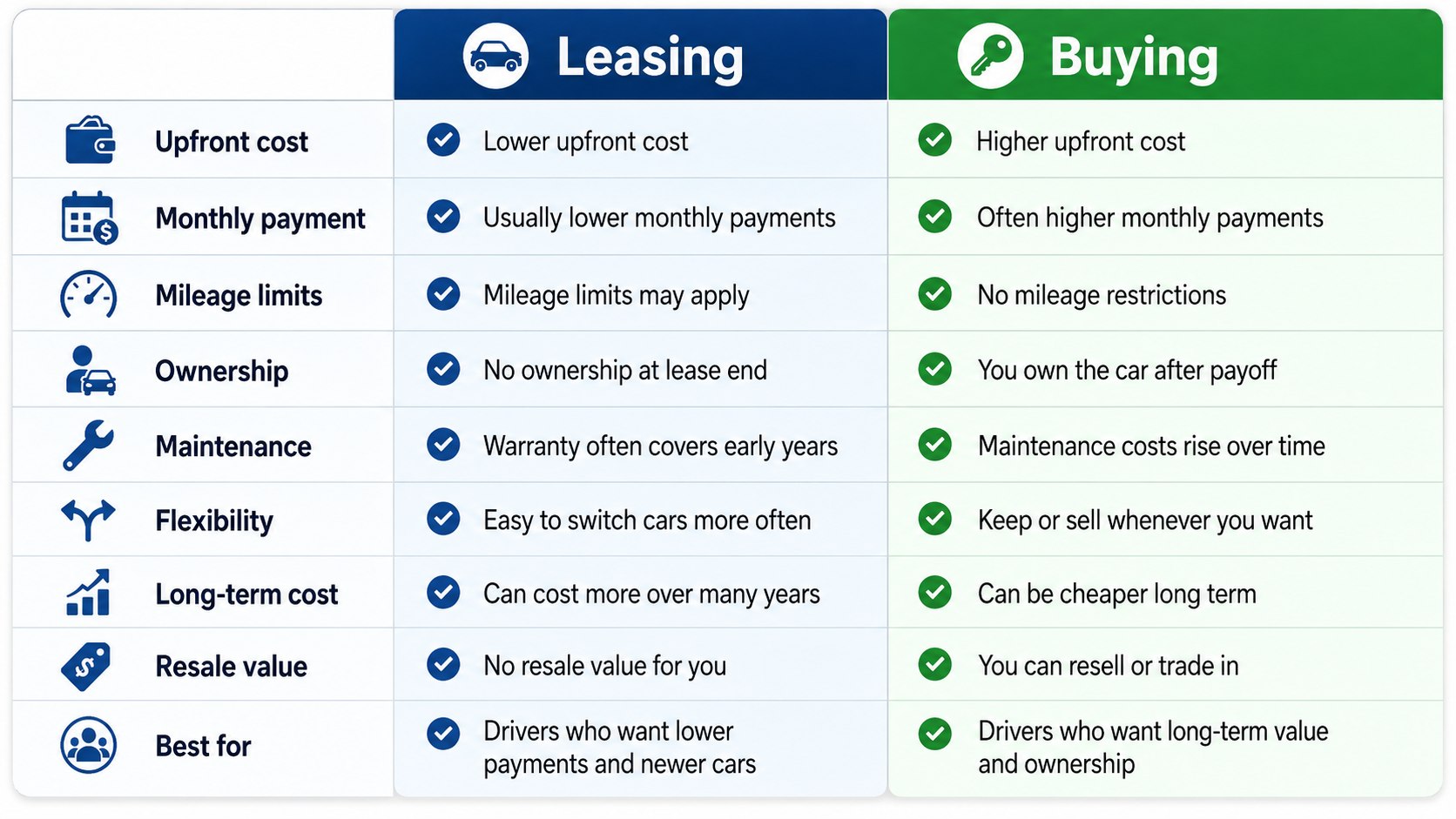
The monthly payment alone gives an incomplete picture. The comparison below focuses on the costs and restrictions that usually decide whether leasing or purchasing works better.
| Factor | Lease | Buy |
|---|---|---|
| Monthly cost | Usually lower for the same new vehicle | Usually higher while financing |
| Upfront cost | First payment, fees, taxes, possible down payment | Down payment, taxes, title, registration |
| Typical commitment | Often 24–48 months | Loan commonly lasts several years |
| Mileage | Contract limit applies | No contractual mileage limit |
| Ownership | No ownership unless purchased later | You build equity as debt falls |
| Repairs | Often mostly within warranty period | Owner carries post-warranty risk |
| Customization | Restricted | Generally unrestricted |
| Long-term value | No asset after return | Vehicle retains resale or trade-in value |
| Best lifestyle fit | Predictable mileage and frequent upgrades | Long-term ownership and heavy driving |
A 36-month comparison should include every dollar due at signing. Add taxes, acquisition fees, expected mileage charges, insurance differences, and disposition costs. For buying, calculate interest, depreciation, maintenance, taxes, and expected resale value.
Do not assume a $399 lease automatically beats a $599 loan payment. The buyer may finish payments and continue driving for another 4 years. The lessee usually needs another vehicle and another contract.
The cheapest monthly payment and the cheapest transportation cost are often 2 different numbers.
Insurance also deserves attention. Lessors commonly require specific coverage levels because they own the vehicle. Buyers with loans also face lender requirements, although those restrictions disappear after payoff.
Maryland residents should also keep licensing paperwork current. The Baltimore Chronicle guide to Maryland driver license renewal in 2026 covers online, kiosk, mail, and in-person options.
Lease vs buy a car 2026: how the math actually works
A car lease mainly charges you for expected depreciation during the contract. Rent charges, taxes, and fees are added. Your payment therefore depends heavily on the vehicle’s projected residual value.
“When you lease a car, you’re paying for the right to use it for an agreed amount of time and miles.”
Federal Trade Commission, Consumer Advice, “Financing or Leasing a Car.” Source: FTC guidance for consumers.
The buying equation is different. You finance the purchase price after your down payment and trade-in. Interest is charged on the financed balance, but you eventually own the remaining asset.
Consider a simplified example. Assume 2 comparable vehicles each effectively cost $35,000 before taxes and unrelated fees. These figures illustrate the calculation and are not dealer offers.
- Lease scenario: $450 monthly for 36 months plus $3,000 at signing equals $19,200 before other charges.
- Purchase scenario: $650 monthly for 60 months plus $3,000 upfront equals $42,000 before resale value.
- If the purchased car later sells for $18,000, the owner’s effective vehicle cost changes substantially.
- If the lessee starts another lease after 36 months, payments continue rather than disappearing.
This is why comparing only $450 against $650 produces the wrong conclusion. Ownership creates residual value for the consumer. Leasing transfers residual-value risk to the leasing company.
However, depreciation can punish buyers who trade frequently. Someone buying a new SUV and selling after 30 months may absorb heavy early depreciation. That driver may discover that a carefully negotiated lease was competitive.
Interest rates also matter. As of 2026, actual auto APRs vary significantly by credit profile, lender, term, vehicle, and manufacturer incentive. Compare bank or credit-union preapproval against dealer financing before signing.
The FTC recommends obtaining the written out-the-door price before discussing financing. That approach exposes dealer add-ons and makes competing offers easier to compare.
Leasing a car in 2026: pros, cons and ideal driver
Car leasing in 2026 works best when your driving pattern is highly predictable. A short commute and stable lifestyle reduce the risk of mileage penalties.
The biggest attraction is cash flow. Because you mainly finance depreciation rather than the entire purchase price, payments can be lower. Many leased vehicles also remain under manufacturer warranty during most of the contract.
Advantages of leasing
- Lower monthly payment can provide access to a newer vehicle.
- Warranty coverage reduces exposure to some major repair bills.
- You avoid personally managing resale when the contract ends.
- Changing vehicles every few years is comparatively simple.
- Residual-value risk generally remains with the leasing company.
These features can suit urban professionals, retirees, or households with a second vehicle. They can also suit drivers expecting technological changes in EVs and hybrids.
There is another benefit that receives less attention. Leasing makes future vehicle costs more predictable during the contract. That can matter when a family wants fewer repair surprises.
Still, the convenience has a price. You are paying continuously for access rather than progressing toward payment-free ownership.
Disadvantages of leasing
Mileage is the obvious restriction. The FTC says most standard leases permit no more than 15,000 miles annually. Some advertised leases use lower allowances.
Driving 18,000 miles each year can therefore change an attractive contract quickly. Excess mileage is usually charged according to the signed agreement.
Wear is another issue. Dents, damaged wheels, poor tires, cracked glass, or missing equipment can create lease-end charges. Early termination may also be expensive.
A lease works best when your life remains roughly as predictable as the mileage estimate you signed 3 years earlier.
Buying a car in 2026: pros, cons and ideal driver
Buying a car in 2026 gives you one major advantage: time eventually starts working in your favor. Once financing ends, the vehicle can provide years without a loan or lease payment.
That matters for drivers who keep dependable models for 7, 8, or 10 years. Toyota, Honda, Subaru, Ford, Chevrolet, Hyundai, and other brands sell vehicles commonly kept well beyond initial financing terms.
Advantages of buying
- No contractual annual mileage limit
- Freedom to sell whenever market conditions suit you
- Trade-in or resale value belongs to you
- No lease-end wear inspection
- Freedom to modify or customize the vehicle
- Potential years without monthly vehicle payments
High-mileage drivers should pay particular attention to that first point. A 20,000-mile annual schedule creates no mileage penalty on an owned car. The cost appears instead through depreciation, fuel, maintenance, and repairs.
Ownership is also easier when circumstances change unexpectedly. A new job in another state can double your commute. A child may require a larger vehicle. You remain free to sell or trade.
The disadvantage arrives through depreciation and repair risk. A financed buyer can also become upside down when the loan balance exceeds market value.
What mileage does to the lease-versus-buy decision
Your annual mileage may decide the argument before financing enters it. Estimate driving from real behavior rather than an optimistic future commute.
Check your current odometer and compare it with the reading 12 months earlier. Then add foreseeable vacations, school transportation, client visits, family trips, and weekend driving.
- Calculate your actual annual mileage.
- Add a 10% buffer for unexpected driving.
- Compare that number with every proposed lease allowance.
- Read the contract’s per-mile excess charge.
- Estimate the worst realistic mileage bill before signing.
A remote employee driving 7,000 miles annually has far more lease flexibility than a sales representative covering 25,000 miles. Parents can also underestimate school, sports, errands, and vacation mileage.
Freelancers and self-employed drivers have an additional tax consideration. The IRS business mileage rate changed during 2026.
For eligible business use, the rate became 76¢ per mile on July 1, 2026. It was 72.5¢ from January through June. Details appear in the IRS mileage-rate guidance.
That deduction concerns qualifying business use, not ordinary personal driving. Leasing does not automatically create a larger deduction than buying. Recordkeeping and the chosen tax method matter.
Hidden costs to calculate before signing
A good lease vs finance comparison includes costs that dealership advertising often places in smaller print. Ask for a complete written breakdown for both alternatives.
- Vehicle selling price or capitalized cost
- Cash due at signing
- APR or lease money factor
- Acquisition and disposition fees
- Sales or use tax
- Title and registration
- Mileage allowance and excess-mile rate
- Purchase-option price at lease end
- Dealer-installed products and optional protection packages
Then calculate total spending for the same time horizon. Comparing a 3-year lease with a 6-year loan without adjustment produces misleading results.
Use 6 years for both scenarios. A buyer may make 60 or 72 payments and retain the car. A lessee could complete 2 consecutive 36-month contracts.
Also test a bad-case scenario. Assume your commute grows, insurance increases, or you must exit the vehicle early. The better contract should survive realistic changes.
Never place a large down payment on a lease merely to manufacture a low monthly figure. Cash paid upfront increases your financial exposure if the vehicle is lost early.
Which should you buy in 2026?
The decision becomes simpler once mileage and ownership duration are known. Use these rules before comparing individual offers.
- If you keep cars for 6–10 years, then buying usually makes more financial sense.
- If you drive above typical lease mileage, then buy unless a high-mileage lease is unusually competitive.
- If you replace vehicles every 3 years, then compare leasing against short-term ownership using total cost.
- If predictable warranty-era driving matters most, then leasing deserves serious consideration.
- If your job or family situation may change, then buying generally provides greater flexibility.
There is no universal winner across California, Texas, Florida, Maryland, New York, or the other states. Taxes and registration systems differ. Manufacturer incentives can also vary by ZIP code.
Ask dealers for the complete purchase price and complete lease worksheet. Keep the vehicle, trim, mileage assumptions, taxes, and upfront cash identical. Otherwise, you are comparing different products.
The strongest long-term financial position usually comes from buying a reliable vehicle and keeping it after payoff. The strongest leasing case involves predictable low mileage and frequent vehicle replacement.
FAQ about leasing vs buying a car
Is it cheaper to lease or buy a car in 2026?
Leasing often costs less monthly for the same new vehicle. Buying can cost less over many years because payments eventually stop.
How many miles can you drive on a lease?
The allowance depends on the contract. FTC guidance says standard leases commonly limit annual mileage to 15,000 miles or less.
Is leasing bad if I drive 20,000 miles per year?
Usually, it becomes harder to justify. Compare a high-mileage lease with ownership before signing because excess mileage can become expensive.
Should I put money down on a car lease?
Minimize unnecessary capital-cost reductions. A large upfront payment lowers the displayed monthly payment but does not necessarily reduce risk.
Is buying better if I keep cars for 10 years?
Usually, yes. Long ownership allows you to spread depreciation across more years and enjoy payment-free driving after the loan ends.
Can freelancers deduct a leased car in 2026?
Eligible business vehicle expenses may qualify under IRS rules. The method depends on business use, records, and the deduction approach selected.
Earlier we wrote about Cancel Apple One in 2026 or Downgrade? US Prices, Family Sharing and iCloud Explained