

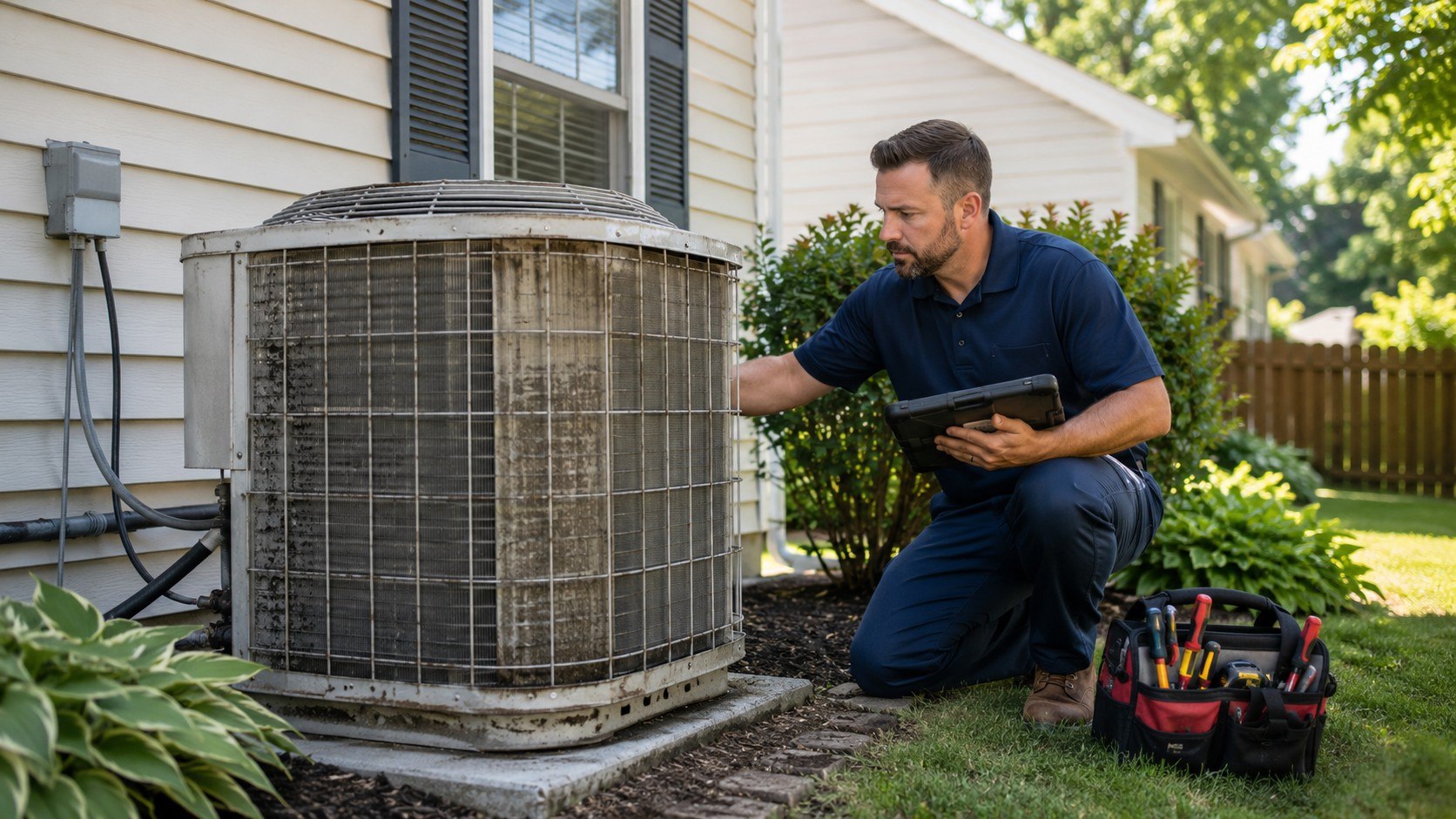
When to replace your AC unit in USA? For a planned replacement, September through November is often the strongest window. Replace sooner if the system is 10–15 years old, needs repeated repairs, struggles to hold temperature, or causes sharply higher electricity use. Do not wait for a July compressor failure simply because the AC still turns on, as noted by Baltimore Chronicle.
A working air conditioner is not necessarily a healthy one. If an aging system needs a major compressor, coil, or refrigerant repair, compare that bill with replacement quotes before authorizing the work. In 2026, many AC-only projects fall somewhere around $4,000–$14,000, while premium or complicated installations can exceed that range.
Key takeaways
- Start planning around year 10, especially when repairs, humidity problems, or electricity costs begin increasing.
- September through November often gives homeowners more time to compare contractors before another summer emergency.
- For 2026 replacements, refrigerant type, SEER2 efficiency, installation quality, and sizing matter as much as brand.
Calendar at a glance
There is no federal rule declaring one universal AC replacement month. Climate changes the calculation. A homeowner in Phoenix uses cooling equipment differently from someone in Baltimore, Boston, or Seattle.
| Period | What to do | Replacement outlook |
|---|---|---|
| January–February | Inspect records and collect system information | Good planning period in colder states |
| March–April | Schedule inspection and request quotes | Strong pre-summer window |
| May | Act quickly on known problems | Demand may begin rising |
| June–August | Replace failed or unreliable systems | Often the least flexible period |
| September–November | Compare replacement options | Often best for planned replacement |
| December | Review off-season quotes and next-year needs | Potentially useful outside warm climates |
September does not automatically mean a discount. Labor availability, local weather, equipment inventory, and contractor workload determine the actual quote. Florida and southern Texas can maintain heavy cooling demand well into fall.
For that reason, treat the calendar as a planning tool rather than a pricing guarantee. Begin collecting estimates before the old system becomes an emergency. Compare the same capacity, equipment scope, warranty, controls, permits, and efficiency level.
Homeowners comparing total project costs can use Baltimore Chronicle’s guide to new HVAC costs in the USA in 2026. The difference between replacing only central AC and replacing an entire HVAC system can reach thousands of dollars.
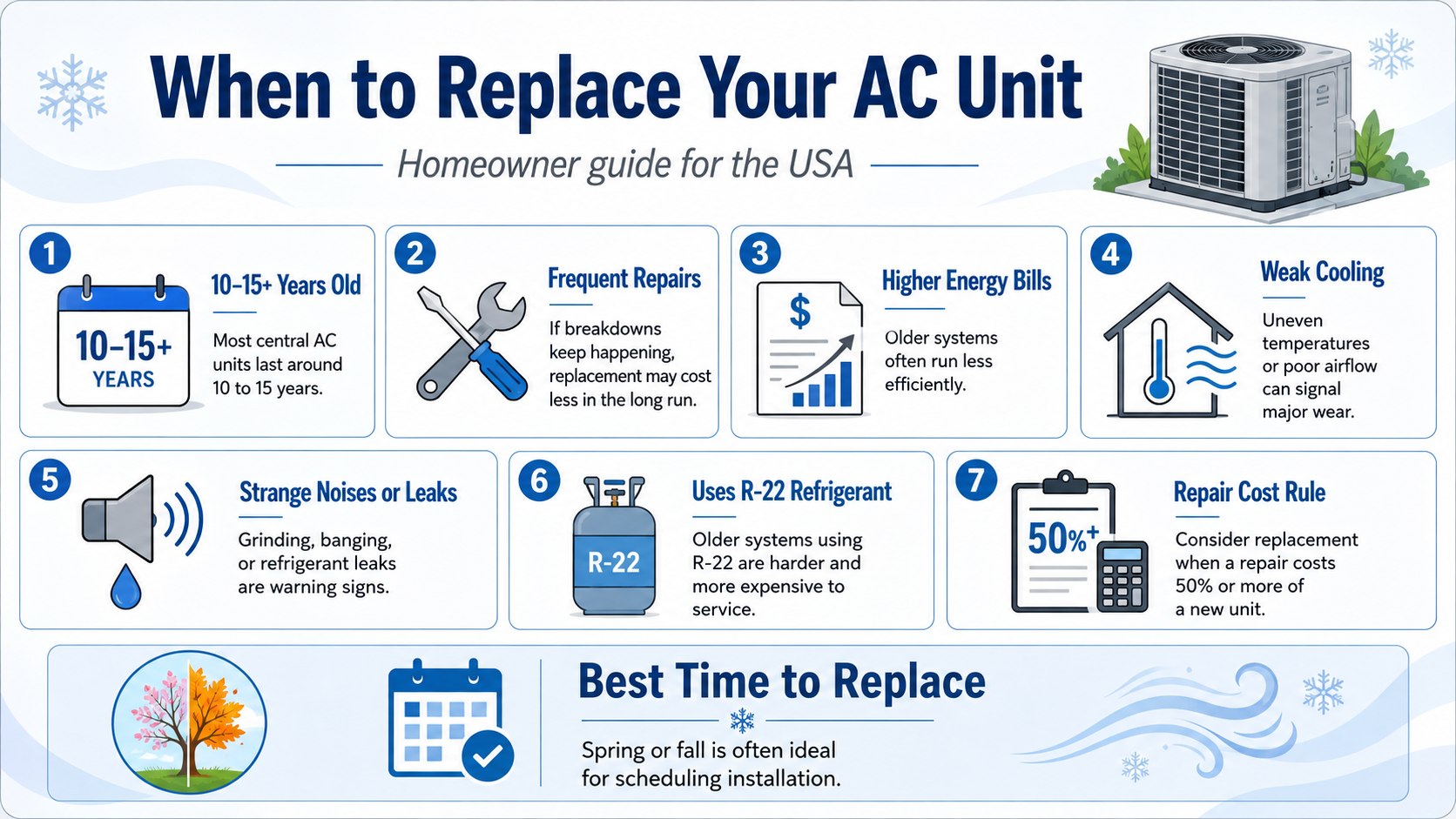
When to replace your AC unit in USA: the signs that matter
Age alone should not condemn a functioning air conditioner. Yet age changes the economics of every repair. ENERGY STAR says homeowners should consider replacement when an air conditioner is more than 10 years old, especially when repairs or energy costs are increasing.
“Your heat pump or air conditioner is more than 10 years old.”
ENERGY STAR, guidance for residential heating and cooling equipment.
A 12-year-old AC that cools evenly and has needed little more than routine maintenance presents a different case from a 9-year-old unit with refrigerant leaks and compressor trouble.
These are the strongest reasons to request a replacement assessment rather than another quick repair:
- The system is around 10–15 years old and major components are failing.
- Repairs have become frequent during the last 2 cooling seasons.
- The compressor or evaporator coil needs an expensive repair.
- The AC runs for long periods but cannot maintain the thermostat setting.
- Some rooms remain noticeably warmer despite normal airflow adjustments.
- Indoor humidity stays uncomfortable while the system operates.
- Electricity consumption rises without a clear change in weather or usage.
- The system short-cycles, repeatedly starting and stopping.
One symptom does not prove the equipment is finished. Poor insulation, leaking ducts, blocked filters, thermostat problems, or incorrect refrigerant charge can imitate a failing AC. A technician should diagnose the cause before recommending thousands of dollars in equipment.
Room-to-room temperature differences deserve particular attention. They can indicate duct leakage or bad balancing rather than a dying condenser. Replacing equipment without correcting the duct problem may leave the homeowner with the same uncomfortable rooms.
Likewise, a large electricity bill should be compared with weather and actual consumption. Look at kilowatt-hours, not merely the dollar total. Higher utility rates can raise a bill even when the AC uses the same amount of electricity.
Homebuyers facing an older system should also review Baltimore Chronicle’s 2026 home inspection guide. An aging HVAC system can materially change repair negotiations before closing.
Why timing matters
Replacing before complete failure is mainly about controlling the decision. An emergency changes the homeowner’s leverage, available equipment, and tolerance for comparing proposals.
1. You can compare contractors instead of taking the first opening
When indoor temperatures reach 90°F and the compressor has stopped, speed becomes more important than research. A planned project gives you time to request 3 comparable proposals and verify exactly what each contractor includes.
2. You can investigate efficiency before paying for it
A higher SEER2 rating can reduce electricity use, but the highest rating is not automatically the best financial choice. Cooling hours, electricity rates, climate, equipment price, and expected ownership period determine the payback.
3. You can correct problems before sizing the new equipment
Replacing an old 4-ton unit with another 4-ton unit without checking the home’s actual cooling load is risky. Insulation, windows, additions, air sealing, and duct modifications may have changed since the original installation.
A replacement should solve the house’s current cooling load, not reproduce a sizing decision made 15 years ago.
How age and efficiency change the replacement decision
The practical threshold begins around year 10, but there is no universal expiration date. The U.S. Department of Energy uses an 18-year average residential central-air-conditioner life in some life-cycle cost calculations. Real equipment can fail earlier or continue working longer.
The useful question is therefore not “Is my AC old?” It is “What will keeping this AC probably cost compared with replacing it?” Four numbers help answer that question: system age, current repair estimate, recent repair history, and annual electricity consumption.
| Situation | Repair may make sense | Replacement deserves priority |
|---|---|---|
| Under 8 years | Minor electrical or control problem | Major repeated failures or severe damage |
| 8–12 years | Low-cost isolated repair | Expensive repair plus comfort problems |
| 12–15 years | Well-maintained unit with inexpensive fault | Compressor, coil, leakage, repeated service calls |
| 15+ years | Minor repair may buy useful time | Major repair often warrants replacement comparison |
These ranges are decision guides, not mechanical expiration dates. Maintenance history can move the answer substantially. Coastal corrosion, extreme Arizona heat, dirty coils, poor airflow, and short-cycling can shorten service life.
Do not use a simplistic formula such as “repair cost multiplied by equipment age.” It ignores efficiency, remaining component condition, warranties, climate, and replacement prices. Ask for the diagnosis and repair price in writing.
If the quotes are difficult to compare, Baltimore Chronicle explains how to read a contractor estimate, including exclusions, allowances, permits, disposal, and missing work.
What AC replacement costs in 2026
AC replacement cost in 2026 varies too much for one national price to be reliable. Current published manufacturer and market estimates place many central-air replacements between roughly $4,000 and $14,000.
Those figures should be treated as planning ranges. A proposal changes with tonnage, SEER2 level, indoor coil compatibility, refrigerant lines, electrical work, condensate drainage, permits, access, thermostat choice, and duct modifications.
Brand also matters, but not enough to choose equipment from the logo alone. Carrier, Trane, Lennox, Rheem, Goodman, York, and American Standard all sell equipment across different efficiency and price tiers. Local installer quality and correct commissioning can matter more than moving between similarly positioned brands.
Before signing, ask the contractor to identify:
- Exact outdoor condenser and indoor coil model numbers.
- Cooling capacity in tons and Btu/h.
- Matched-system SEER2 rating.
- Refrigerant used by the new system.
- Whether existing ducts and refrigerant lines will remain.
- Permit, disposal, electrical, thermostat, and startup costs.
- Equipment, labor, and compressor warranty terms.
- How the contractor determined the required system size.
A 3-ton system represents about 36,000 Btu/h of nominal cooling capacity. That does not mean every 1,800 or 2,000 sq ft home needs 3 tons. Climate, insulation, solar exposure, ceiling height, windows, air leakage, and occupancy alter the load.
The installer should also explain whether the indoor and outdoor components form a properly matched system. A high-efficiency condenser cannot deliver its advertised performance when paired carelessly with incompatible components.
Edge cases in 2026
The 2026 replacement market has several complications that older AC advice does not address. Three dates are especially useful when reviewing recommendations found online.
January 1, 2026: the refrigerant transition affects new systems
EPA rules now matter when replacing a complete residential split system. After January 1, 2026, a newly installed system generally must use refrigerant below the applicable global-warming-potential limit.
Legacy R-410A equipment did not suddenly become illegal to repair. EPA allows R-410A components to remain available for servicing existing systems. Homeowners should therefore ask whether a quote represents a repair or installation of an entirely new system.
December 31, 2025: the old federal 25C credit ended
Many older articles still advertise a federal Energy Efficient Home Improvement Credit for qualifying central AC systems and heat pumps. That information can be outdated for a 2026 purchase.
The IRS states that Section 25C is not allowed for property placed in service after December 31, 2025. Do not subtract an expired federal credit from a 2026 contractor proposal. State, utility, manufacturer, and local rebate programs may still exist.
January 1, 2023: SEER2 remains the relevant efficiency language
Older systems and articles often discuss only SEER. Current equipment uses the revised SEER2 testing framework introduced under federal efficiency standards.
When comparing 2026 proposals, make sure contractors are comparing like-for-like ratings rather than mixing old SEER values with SEER2 figures.
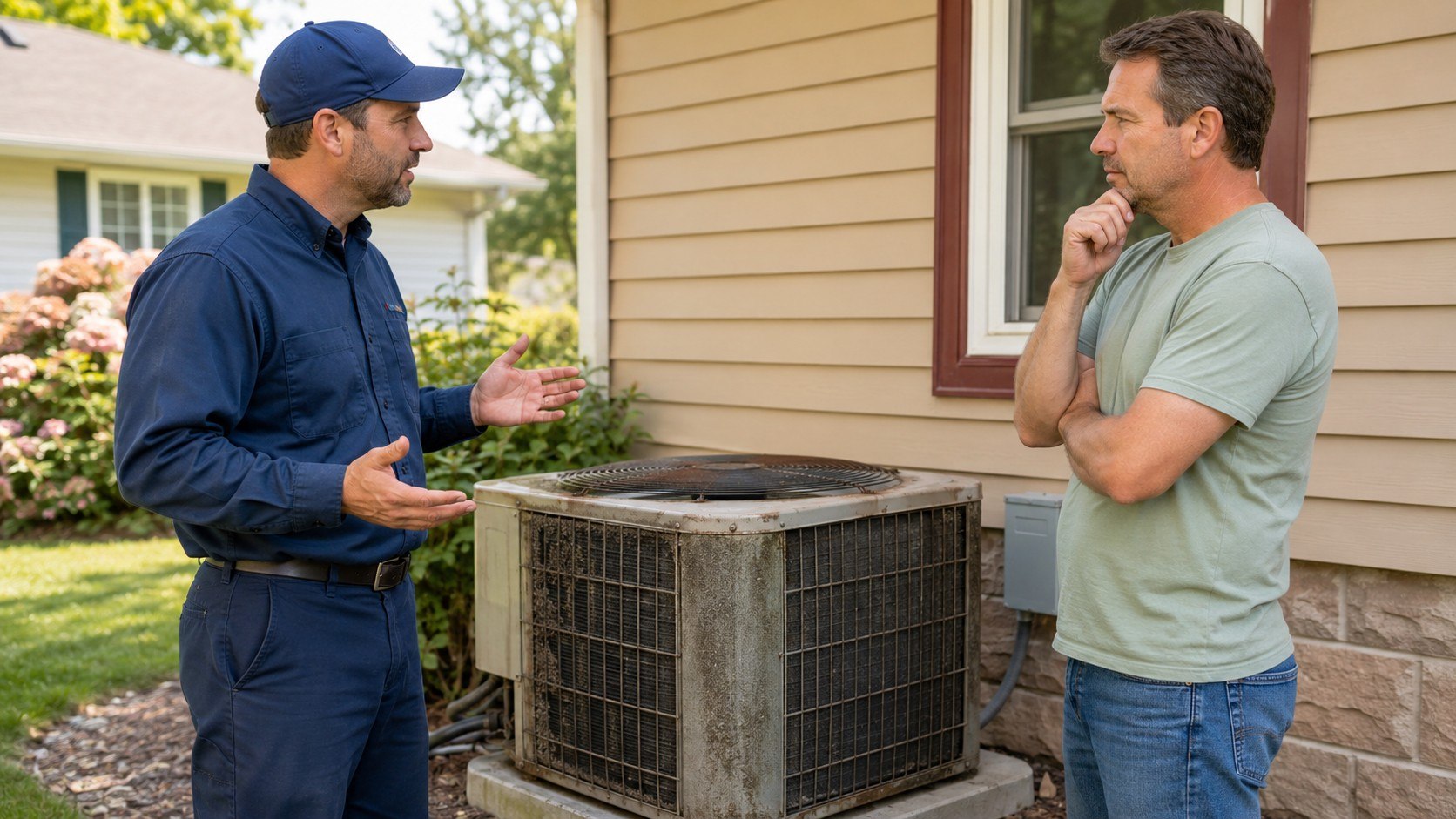
Repair or replace? Use this 15-minute decision check
Start with evidence rather than fear of another breakdown. Gather the model number, serial number, repair history, utility usage, and current diagnostic report.
- Confirm the equipment’s manufacturing or installation year.
- Ask what component actually failed and why.
- Request the complete repair price before authorizing work.
- Check whether the failing component remains under warranty.
- Review repair spending from the previous 2–3 years.
- Compare summer electricity use with similar weather periods.
- Get replacement quotes if the repair is substantial.
- Ask whether duct or insulation defects are contributing to the problem.
For a young system with one failed capacitor, contactor, sensor, or fan component, replacement can be unnecessary. For a 14-year-old system with repeated refrigerant leaks and an expensive coil problem, another repair deserves much more scrutiny.
Renters should normally report cooling failures to the property owner or manager rather than commissioning replacement equipment themselves. Lease terms and state habitability rules determine responsibilities.
The objective is not to replace an AC at the earliest possible age. It is to avoid putting major money into a system whose reliability, comfort, and operating cost are all deteriorating at the same time.
FAQ about AC replacement in the USA
How old should an AC unit be before replacing it?
Begin evaluating replacement at about 10 years. ENERGY STAR specifically identifies systems older than 10 years as candidates for professional assessment. Good maintenance may extend useful life.
What is the best month to replace an AC unit?
September through November is often a useful planning window in much of the country. Spring can also be good. In Florida, Arizona, southern Texas, and other hot regions, local contractor workload matters more than the calendar.
Should I replace a 15-year-old air conditioner that still works?
Not automatically. However, a 15-year-old unit deserves replacement quotes before any major repair. Compare reliability, electricity consumption, comfort, refrigerant issues, and repair history.
How much does replacing central AC cost in 2026?
Many projects fall roughly within $4,000–$14,000, although simpler installations can cost less and premium projects can cost more. Capacity, SEER2, region, labor, ducts, permits, and equipment configuration move the final price.
Can an R-410A air conditioner still be repaired in 2026?
Yes. EPA guidance permits R-410A components to be used for servicing existing R-410A systems. The restriction concerns creating new systems that exceed the applicable refrigerant GWP limit.
Is a higher SEER2 rating always worth the extra cost?
No. Higher efficiency reduces electricity consumption under comparable conditions, but financial payback depends on climate, cooling hours, electricity prices, equipment premium, and ownership period.
Earlier we wrote about Apartment Rental Scams in 2026: How to Verify Zillow and Apartments.com Listings