


How to get out of credit card debt 2026 starts with one practical decision: choose a repayment method that reduces interest without breaking your monthly budget. Most borrowers can build a workable plan in 30–60 minutes, then automate payments for the months ahead, as Baltimore Chronicle notes.
The main choices are the debt avalanche method, debt snowball, and a 0% balance transfer. Keep every account current, stop adding new balances, and direct every spare dollar toward one selected card.
Key takeaways
- Avalanche targets the highest APR first and usually reduces total interest costs.
- Snowball targets the smallest balance first and creates faster psychological wins.
- A balance transfer can temporarily reduce interest, but fees and promotional deadlines matter.
No repayment method works if minimum payments are missed. Late fees can appear, promotional terms may change, and missed payments can damage credit. The safest approach starts with automatic minimum payments on every card, while extra money goes to one target balance.
Homeowners preparing for a mortgage should also be careful about opening several new accounts. Baltimore Chronicle’s guide to checking a credit score for free in 2026 explains what to review before applying for additional credit.
Debt repayment is an arithmetic problem first. Motivation matters, but interest continues accumulating while a borrower waits for the perfect month to begin.
What you need
Before building a payoff plan, collect the information that shows exactly where the money is going.
- Latest statements for every credit card
- Current balances, minimum payments, APRs, and due dates
- Checking account records and recent household expenses
- Calculator or spreadsheet
- Online access to issuers such as Chase, Citi, Discover, Capital One, or American Express
- About 30–60 minutes for the first review
- Around 10 minutes each week for updates
Use statement figures rather than estimates from memory. Separate purchase APRs from cash-advance rates and promotional balances because one account can carry several different rates.
Include cards with small balances, even when they appear insignificant. Rent, mortgage payments, utilities, food, insurance, medication, and transportation remain ahead of extra debt payments.
A realistic monthly plan will usually outperform an aggressive target that survives only 2 paychecks.
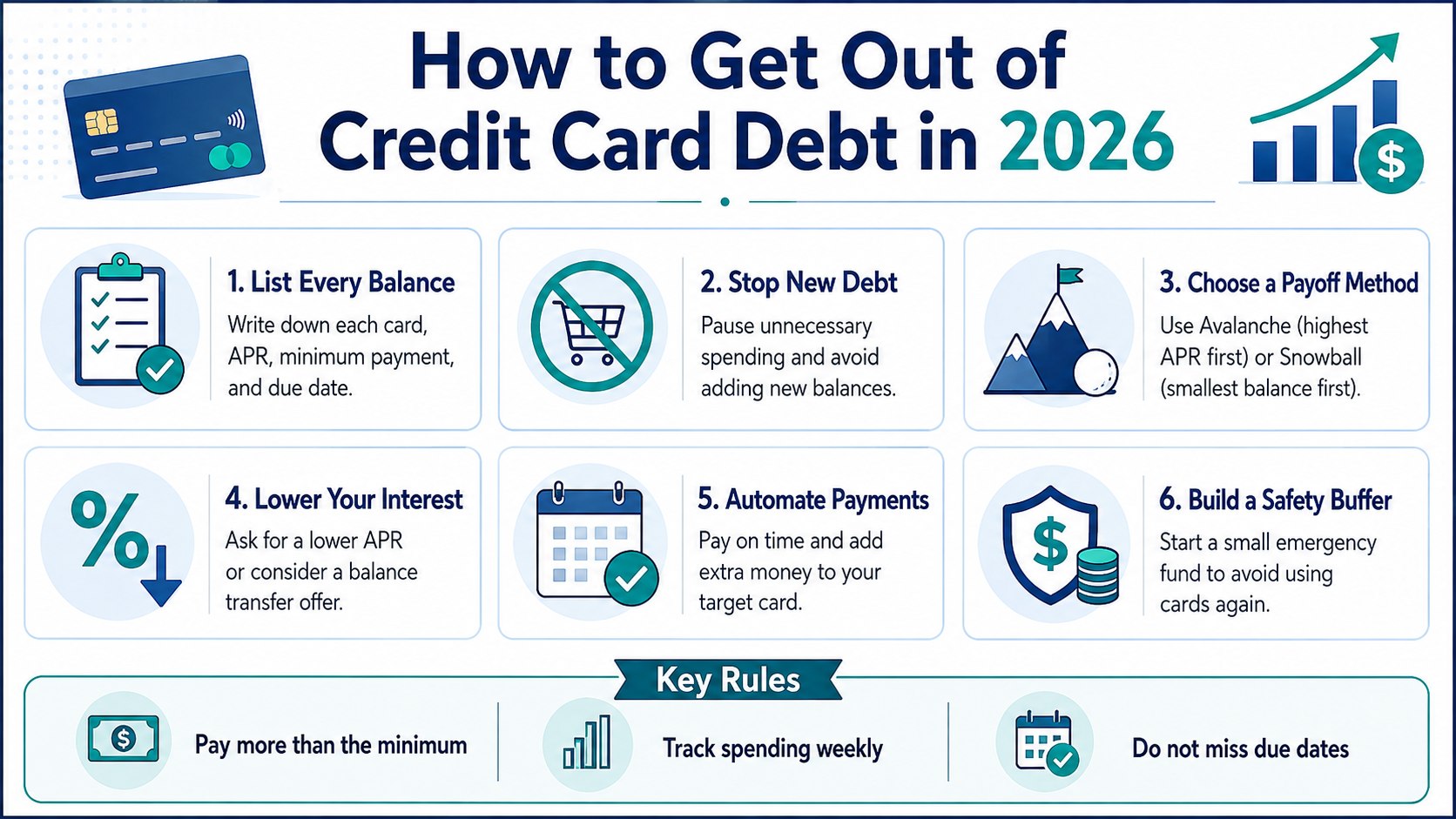
Step 1: Map how to get out of credit card debt 2026
Write down every card, balance, APR, minimum payment, and due date. Then calculate how much cash remains after essential bills and required debt payments.
This matters because credit card debt payoff plans collapse when the proposed extra payment exceeds real monthly cash flow. A household with $600 available should not create a $900 repayment target and then put groceries back on a credit card.
Borrowers rebuilding their finances can also use Baltimore Chronicle’s personal budget framework before deciding how much money can consistently go toward debt.
The most common mistake is treating overtime, bonuses, tax refunds, or freelance invoices as guaranteed monthly income. Unpredictable income is better used as an additional payment after the money actually arrives.
Step 2: Protect every minimum payment before paying extra
Set automatic payments for at least the minimum amount on every card. When cash flow allows, schedule the withdrawal several days before the due date.
The Consumer Financial Protection Bureau explains that paying only minimums extends repayment and increases interest costs. Missing even that minimum creates a different problem, including possible fees and credit damage.
Use this order every month:
- Pay housing, food, utilities, insurance, transportation, and essential medical costs.
- Pay the required minimum on every credit card.
- Send the remaining debt budget to one target card.
This order prevents a repayment strategy from creating another financial emergency. Keeping a small checking-account cushion can also reduce the risk of overdrafts from automatic payments.
Do not send the rent payment to Visa simply because the card has a 29% APR. Essential bills still come first.
Avoid splitting extra money evenly across 4 or 5 cards unless their balances and rates are almost identical. Concentrating the payment makes the selected strategy work faster.
Step 3: Choose avalanche, snowball, or balance transfer
The best strategy depends on interest rates, account balances, credit eligibility, and personal behavior. How to pay off credit card debt efficiently is therefore not the same question for every borrower.
| Method | First target | Main advantage | Main risk |
|---|---|---|---|
| Avalanche | Highest APR | Usually reduces interest cost | First payoff may take longer |
| Snowball | Smallest balance | Creates early account payoffs | Can cost more interest |
| Balance transfer | Eligible high-APR balance | Temporary low or 0% promotional APR | Transfer fee and expiration date |
Avalanche is usually the mathematical default when reducing interest is the main objective. Snowball may work better for borrowers who repeatedly abandon long repayment plans.
A balance transfer is different because it changes the cost of the debt rather than only changing payment order. The Consumer Financial Protection Bureau notes that balance transfers can involve percentage-based fees and promotional rates that last only for a limited period.
Once that period ends, the issuer’s standard APR can apply to the remaining balance. Terms vary by card and should be checked directly with the issuer in 2026.
If $8,000 moves to a promotional card, calculate the required monthly payment using the balance after any transfer fee. Do not assume the minimum payment will eliminate the debt before the promotion expires.
Step 4: Use avalanche when APR is the biggest problem
With a credit card debt avalanche, minimums continue on every account while extra money attacks the card with the highest APR. When that balance reaches $0, its entire former payment moves to the card with the next-highest rate.
Consider 3 cards with balances of $2,000, $4,500, and $7,000. If their APRs are 19%, 28%, and 23%, the $4,500 balance becomes the first target even though it is not the smallest debt.
Credit card interest is commonly calculated using daily balances. Paying part of a revolving balance earlier can therefore reduce the amount of interest generated.
“The sooner you pay off all or some of your balance, the less interest you will pay.”
Consumer Financial Protection Bureau, consumer guidance on credit-card interest calculations.
The common mistake is changing targets whenever a new statement arrives. Choose the APR order and keep it unless interest rates, promotional terms, or balances change enough to alter the calculation.
Step 5: Use snowball when progress keeps stalling
The debt snowball method ignores APR order and targets the smallest balance first. A household owing $450, $2,700, and $9,000 would eliminate the $450 account before moving to the next balance.
This approach can remove one required payment relatively quickly. That freed payment then joins the amount attacking the second debt, creating a larger monthly payment without requiring additional income.
The snowball is not automatically cheaper. Its value is behavioral because a visible $0 balance can make a long repayment plan easier to continue.
This method can fit people who have started and abandoned several repayment plans. A quick win can provide a clear sign that the strategy is producing results.
The mistake is automatically closing every paid-off card without considering account age, annual fees, spending temptation, and future borrowing plans. Someone preparing for a mortgage can first review Baltimore Chronicle’s guide to building and maintaining credit in 2026.
Step 6: Use a balance transfer only with an exit date
A 0% balance transfer can work when a borrower qualifies for a promotional offer and can repay the transferred debt before the introductory period ends. Offers from major issuers vary in 2026, so applicants need to verify the transfer fee, promotional duration, credit limit, and standard APR.
Divide the transferred balance plus the fee by the number of promotional months available. A $6,000 transferred balance would require $400 per month to disappear in 15 months before adding any transfer fee.
This calculation matters because promotional financing saves money only when the fee and new terms cost less than leaving the balance on the existing card. A transfer that simply creates new room for spending can make the debt problem larger.
“The promotional interest rate for most balance transfers lasts for a limited time.”
Consumer Financial Protection Bureau, official consumer guidance on consolidating credit card debt.
Avoid making new purchases on the transfer card unless the terms clearly support that use. Promotional balance transfers and new purchases can be treated differently under the card agreement.
The common mistake is calculating affordability from the required minimum payment instead of the promotional deadline. Set the automatic payment using the planned payoff date.

Troubleshooting common credit card debt problems
Even a good repayment strategy can fail when income falls, a transfer application is denied, or spending returns to old habits. The problem itself should determine the next action.
- Minimum payments are unaffordable: contact the issuer before missing payments and ask about hardship options.
- Balance-transfer application was denied: continue avalanche or snowball payments instead of submitting several applications quickly.
- Income suddenly fell: protect essential expenses and minimums first, then reduce the extra-payment target.
- Cards keep getting reused: remove stored card details from shopping accounts and move routine spending to checking or debit.
- A debt-relief company demands money upfront: stop and verify the company before sharing financial information.
Some card issuers may provide hardship programs that change monthly payments, fees, interest rates, or due dates. The available terms depend on the creditor, the account, and the borrower’s financial situation.
The Federal Trade Commission warned consumers in March 2026 about debt-relief companies making aggressive promises. Its 2026 debt-relief scam guidance identifies upfront payment demands and unrealistic settlement promises as warning signs.
A hardship program offered by a lender is not the same product as debt settlement. Read agreements before stopping payments or authorizing withdrawals.
Keep copies of emails, letters, revised account terms, and payment confirmations. Documentation becomes especially useful if a promised rate reduction or fee waiver does not appear on a later statement.
FAQ
What is the fastest way to get out of credit card debt in 2026?
Keep every minimum payment current, then send all available extra money to one target balance. Avalanche usually prioritizes lower interest costs, while snowball prioritizes faster individual account payoffs.
The fastest method also depends on monthly cash flow. Adding $500 every month consistently is more effective than promising $1,000 and repeatedly borrowing money back.
Is the avalanche method better than the snowball method?
Avalanche generally makes more mathematical sense when cards have different APRs because it attacks the most expensive debt first. It can reduce total interest when payments and other conditions remain equal.
Snowball may still work better for someone who needs quick milestones to stay consistent.
Is a 0% balance transfer worth it in 2026?
It can be worthwhile when the transfer fee is lower than the interest avoided and the balance can be repaid before the promotional APR expires.
Check the actual 2026 offer directly with the issuer. Promotional periods, transfer fees, credit limits, and standard APRs differ between products and applicants.
Should I stop using credit cards while paying them off?
Usually, stopping new revolving purchases makes repayment easier because balances can move in only one direction.
Keeping one card available for genuine emergencies can be reasonable if it does not lead to routine spending. Removing saved card numbers from retail websites can reduce impulse purchases.
What if I cannot afford my credit card minimum payments?
Contact each issuer before the account becomes late and ask whether hardship assistance is available. Explain the income problem and ask for any proposed terms in writing.
Reputable nonprofit credit counseling may also be an option. Avoid companies demanding upfront fees or guaranteeing that large amounts of debt will disappear quickly.
Earlier we wrote about Top Surgeons in Baltimore 2026: Leading Specialists at Johns Hopkins, MedStar, Mercy and UMMC