

Baltimore City has spent the better part of a decade suing some of the biggest companies in the country, from oil producers and drug distributors to soda makers, a gun dealer, prediction markets and Elon Musk’s X. The results are now in on several of those cases, and they are mixed: more than $400 million in opioid settlements, a record gun-dealer verdict that became a $2 million settlement, and high-profile losses on climate change and plastic pollution.
The question city taxpayers are now asking, raised in a Baltimore Sun report that FOX45 republished Monday, is simple: what does this legal strategy cost, and is it paying off? The Sun said it had requested city spending figures on the litigation for the past two years and that the requests had not been fulfilled as of publication, according to the report.
Which companies has Baltimore City sued?
Here is where the city’s best-known cases stand, based on court rulings, city announcements and local news reports.
| Case | Filed | Main defendants | Where it stands |
|---|---|---|---|
| Opioid crisis | 2018 | Drug makers, distributors and pharmacies | $402.5 million in settlements with other defendants; $152 million verdict against McKesson and Cencora vacated, case dropped in 2026 |
| Climate change | July 2018 | 26 oil and gas companies, including BP and Chevron | Dismissed by the Supreme Court of Maryland in March 2026 |
| Ghost guns | 2022 | Polymer80; Hanover Armory | $1.2 million from Polymer80; $62 million jury verdict against Hanover Armory settled for $2 million in April 2026 |
| Plastic pollution | June 2024 | PepsiCo, Coca-Cola, Frito-Lay and plastics firms | Dismissed by a Baltimore City Circuit Court judge in July 2026 |
| AI deepfake images | March 2026 | X and Musk’s xAI | Pending in Baltimore City Circuit Court |
| Prediction markets | August 2026 | Kalshi and Polymarket | Pending |
How much money has Baltimore actually collected?
The opioid litigation is the clear financial win. Ahead of and during trial, the city reached settlements with a series of companies, including Teva, CVS, Cardinal Health and Walgreens. When the Walgreens deal was announced in September 2024, the mayor’s office said total recoveries had reached $402.5 million. That money goes into the city’s Opioid Restitution Fund.
The two holdouts, distributors McKesson and Cencora (formerly AmerisourceBergen), went to trial. A jury awarded the city more than $260 million in late 2024, which a city judge later reduced to about $152 million. This spring, the Supreme Court of Maryland vacated that verdict, and the city dropped the remaining case, the Maryland Daily Record reported. A spokesperson for Mayor Brandon Scott told the paper the city strongly disagreed with the rulings but was bound by them. We covered that decision in detail in why Baltimore dropped its opioid lawsuits.
The ghost gun cases brought in far less cash but came with conditions. Polymer80, a major kit maker, settled before trial for $1.2 million. In 2025 a jury awarded the city $62 million against Hanover Armory, an Anne Arundel County dealer, which the city called the largest verdict ever against a gun dealer. The dealer appealed, and in April 2026 the city settled for $2 million plus sales restrictions and reporting requirements, The Baltimore Banner reported.
Why did the climate and plastic lawsuits fail?
Both cases leaned on public nuisance law, and Maryland courts were not persuaded.
In the climate case, the Supreme Court of Maryland ruled that the suits from Baltimore, Annapolis and Anne Arundel County were in effect attempts to regulate interstate greenhouse gas emissions, a matter governed by the federal Clean Air Act, Maryland Matters reported. The court also found the state-law claims fell short. Not all justices agreed: Justice Peter Killough dissented.
“No amount of creative pleading can masquerade the fact that the local governments are attempting to utilize state law”
Justice Brynja Booth, majority opinion, Supreme Court of Maryland, via Maryland Matters
The plastic pollution suit argued that littered bottles and wrappers break into microplastics that harm the city’s soil, water and tax base. Chief Judge Audrey Carrión of the Baltimore City Circuit Court dismissed the last remaining claim in July, writing that Maryland law does not allow public nuisance liability for such indirect and generalized effects, according to the Daily Record. The mayor’s office said it was evaluating its options.
Who pays the lawyers?
This is the part residents cannot yet see in full. Cities commonly hire outside firms on contingency, meaning the firm is paid a share of any recovery rather than an hourly bill, but the terms vary case by case. In the X and xAI lawsuit, for example, the city is working with the firm DiCello Levitt alongside its own Law Department, WMAR reported.
The Sun’s unanswered records request is the key gap. Without the city’s spending figures, it is not possible to say how much staff time and money has gone into the cases that were lost, or what share of the opioid recoveries went to outside counsel. If the city releases those numbers, they will be the clearest test of whether the strategy has paid for itself.
What cases are still pending?
- X and xAI: Filed in March 2026 over sexualized deepfake images created with the Grok chatbot. The city is asking a Baltimore City Circuit Court judge to order changes to the platform.
- Kalshi and Polymarket: Filed in August 2026, claiming the prediction markets offer illegal sports betting and violate consumer protection law. Maryland’s own fight with Kalshi is before the 4th U.S. Circuit Court of Appeals. See our earlier explainer on the prediction market suits.
What does this mean for Baltimore residents?
The opioid money is real, and the restitution fund it feeds is meant to pay for treatment, recovery and prevention programs. The gun settlements produced new oversight and reporting rules for a dealer the city had accused of selling untraceable gun kits. The climate and plastic cases, after years of litigation, produced no money and binding rulings that make similar suits harder in Maryland.
Residents who want to follow the spending question can watch the Board of Estimates agendas, where outside legal contracts are typically approved, and any response to the Sun’s records request. The city has not publicly released a total cost for its affirmative litigation program.
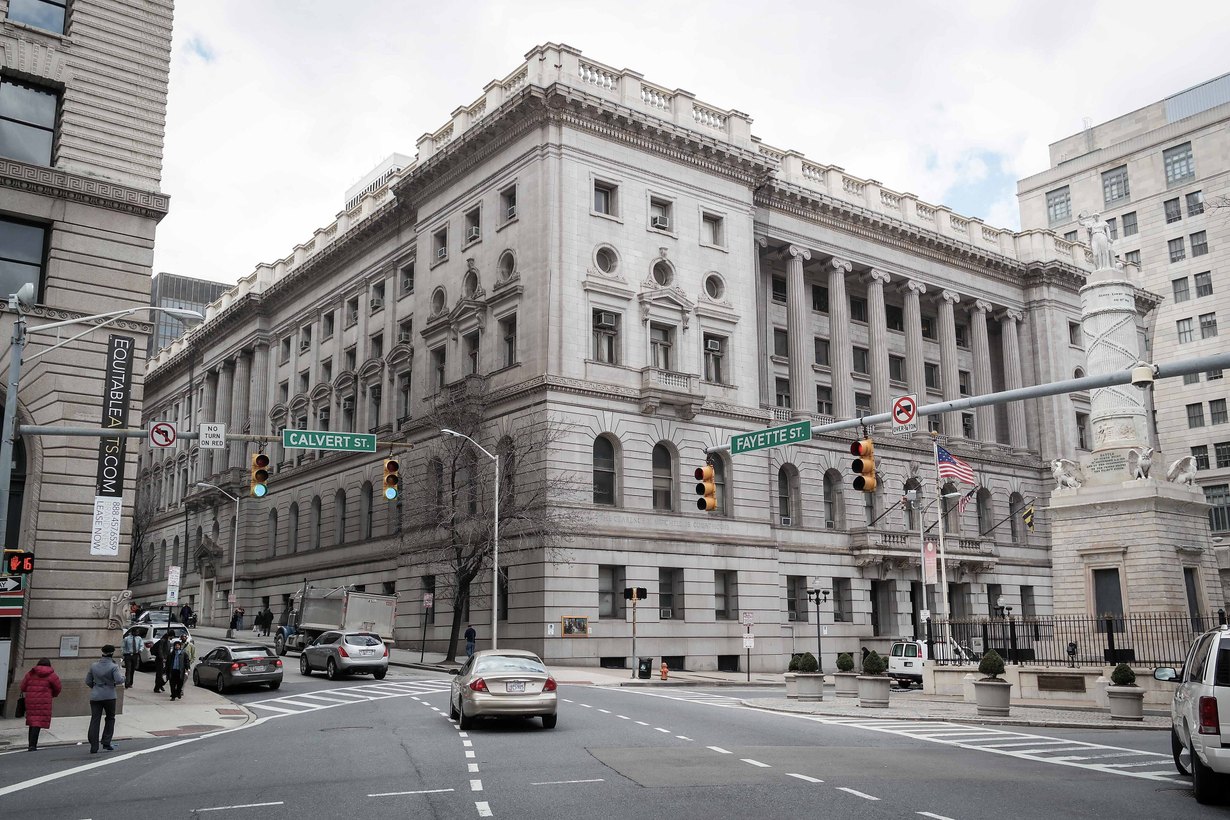
Featured image: The Clarence M. Mitchell Jr. Courthouse on Calvert Street, home of the Circuit Court for Baltimore City. Photo: Smash the Iron Cage / Wikimedia Commons, CC BY-SA 4.0.