


Starlink vs fiber vs cable 2026 comes down to a simple choice for most US households. Pick fiber when it reaches your address, choose cable when fiber is unavailable, and consider Starlink when wired broadband is weak or absent, as the Baltimore Chronicle editorial team notes.
Fiber usually delivers the strongest mix of speed, upload performance, latency, and predictable capacity. Cable remains a practical second choice across many cities and suburbs. Starlink solves a different problem: getting capable broadband to rural homes where running new wire may not be economical.
Key takeaways
- Fiber is usually the strongest choice for remote work, gaming, cloud backups, and households moving large files daily.
- Cable can deliver hundreds of Mbps at competitive prices, but upload speeds and neighborhood congestion can vary.
- Starlink makes the most sense where DSL, fixed wireless, and wired broadband cannot provide dependable service.
The address matters more than any national ranking. A fiber offer in Texas may differ from one in California. Cable promotions can change by ZIP code, account history, and installation type. Starlink plans also vary by location and network capacity. Before ordering anything, compare the provider’s Broadband Facts information against the final checkout price.
Households changing providers should also plan the handoff carefully. Baltimore Chronicle’s guide to switching internet providers without downtime recommends testing the new connection before canceling the old service.
At a glance
The biggest differences appear beyond headline download speed. Upload capacity, latency, installation, reliability, and long-term pricing affect daily use more than a single advertised number.
| Category | Fiber | Cable | Starlink |
|---|---|---|---|
| Typical 2026 price range | About $35–$100+ monthly | About $30–$100+ monthly | About $55–$130 monthly |
| Download capability | 300 Mbps to multi-gigabit | 100 Mbps to multi-gigabit | Roughly 100 Mbps to 400+ Mbps by plan and conditions |
| Upload performance | Often symmetrical | Usually below download speed | Generally below fiber |
| Latency | Usually lowest | Usually low | Higher because traffic reaches satellites |
| Installation | Fiber line and optical equipment | Coax line and modem or gateway | Dish, router, power, and clear sky view |
| Weather exposure | Low at the home connection | Low to moderate | Outdoor dish remains exposed |
| Repair dependency | Local fiber network | Local cable network | Dish, power, satellites, and ground network |
| Best fit | Heavy connected households | Most suburban and urban homes | Rural and difficult-to-wire properties |
These figures are comparison ranges, not universal quotes. Fiber and cable companies regularly change introductory offers by market, while Starlink pricing can vary by location and available capacity. Taxes, equipment terms, installation charges, and local promotions can change the total.
Always enter the exact service address before comparing providers. An apartment across the street can have different infrastructure, speeds, and promotional pricing.
The fastest advertised plan is not automatically the fastest connection inside a home. Router placement, Wi-Fi interference, device hardware, and building materials still matter.
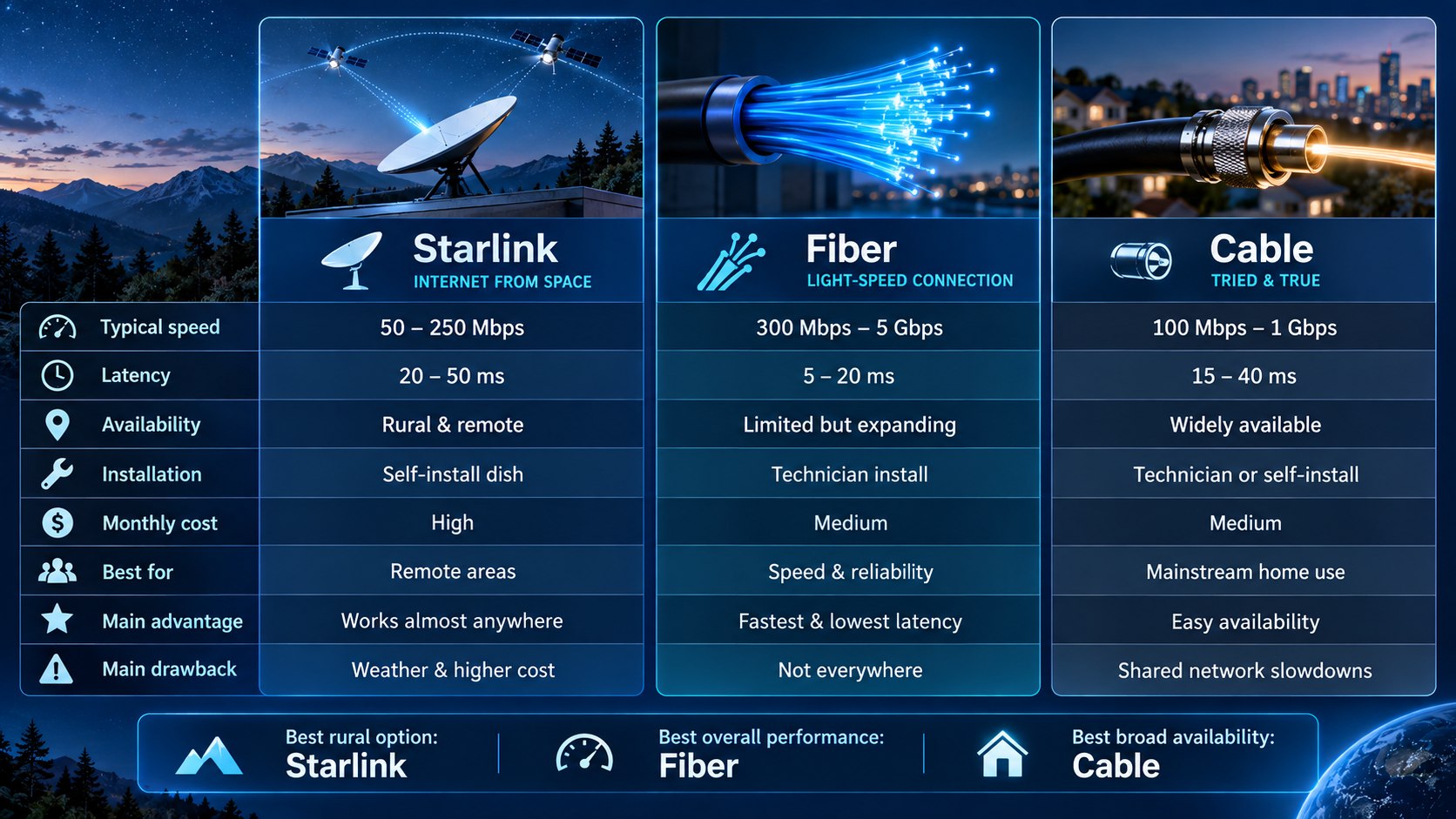
Starlink vs fiber vs cable 2026 on speed and cost
The central difference is how each network reaches the house. Fiber carries data through optical lines. Cable commonly uses fiber deeper in the network and coaxial cable for the final connection. Starlink sends traffic through a constellation of low-Earth-orbit satellites.
That architecture explains why fiber internet vs Starlink is rarely a pure speed contest. Fiber can provide very high capacity without sending traffic through space. It also tends to deliver stronger upload performance and lower latency.
Starlink can still provide speeds that are more than adequate for streaming, browsing, video calls, and many work-from-home tasks. Performance depends on local network capacity, obstructions, weather, and plan type.
“Clear, accurate, and concise information” is the FCC’s stated objective for broadband consumer labels.
Federal Communications Commission, broadband-label policy.
The FCC requires major broadband providers to disclose important plan information through Broadband Facts labels. Consumers can use the FCC broadband-label resources when comparing recurring prices, data terms, speeds, and other conditions.
Fiber internet: the strongest wired option where available
Fiber internet 2026 has one advantage that matters increasingly for home offices: upload capacity. Many fiber networks offer equal or near-equal download and upload speeds. That helps with cloud backups, video production, large attachments, livestreaming, and several simultaneous video calls.
Multi-gigabit service is available in some US markets, although most households do not need the fastest tier. A 300 Mbps or 500 Mbps fiber plan can already cover several users, 4K streaming, remote work, gaming, and smart-home devices.
Fiber pros, cons, and ideal user
Fiber’s main benefits are low latency, high capacity, strong uploads, and limited sensitivity to local coax congestion. It is especially attractive for freelancers, gamers, content creators, large families, and households that transfer large files.
Availability remains the biggest limitation. A provider may serve one neighborhood while skipping another block. Installation can also require a technician when a property lacks an optical network terminal or usable fiber drop.
For a household that regularly uploads hundreds of gigabytes, a lower-priced symmetrical fiber tier may be more useful than a faster cable download tier.
Cable internet: broad availability and competitive pricing
Cable internet vs fiber remains a relevant comparison because cable infrastructure reaches many US homes that still lack fiber-to-the-premises. Modern cable networks can deliver gigabit-class downloads without replacing every coaxial line inside a property.
Cable pricing is often aggressive in areas with several competing providers. Introductory rates can start low, although the monthly bill may increase when a promotional period ends. Equipment rental and optional service bundles can also affect the final price.
Cable pros, cons, and ideal user
Cable works well for streaming households, renters, families, and remote workers who mostly download rather than upload. Installation is often straightforward when a usable coax outlet already exists.
The tradeoff is asymmetry. Upload speeds can be substantially lower than download speeds on many cable plans. Local network conditions can also affect evening performance, although major providers continue upgrading their infrastructure.
For households comparing total monthly costs, internet should be considered alongside electricity, water, mobile service, and other recurring expenses. The cheapest advertised internet plan is not always the cheapest plan after equipment and promotional discounts expire.
Starlink: broadband where the cable ends
Starlink home internet should be judged against the alternatives actually available at the property. Comparing it with a multi-gigabit fiber connection misses the main reason many households buy satellite internet.
A rural property in Montana, Wyoming, West Virginia, or northern Maine may have few wired choices. Starlink can provide broadband without waiting for a new cable or fiber construction project. The equipment needs electricity and a sufficiently unobstructed view of the sky.
Residential plans generally include substantial or unlimited household use, depending on the current service terms and plan. Performance can vary by location and local network demand.
The service also has physical limitations. Trees, rooflines, terrain, heavy precipitation, or an unsuitable mounting position can affect performance. Satellite capacity differs geographically, so users comparing Starlink internet speed 2026 should check their exact address rather than rely on a single nationwide figure.
Starlink states that residential performance can vary with congestion, location, network conditions, and environmental factors.
SpaceX, Starlink residential service information.
Current plans and address availability are published on the official Starlink residential site. Hardware promotions may differ by location, so the checkout page is more useful than an older quoted equipment price.

Which should you buy in 2026
A practical decision can be made quickly once every provider available at the address is known.
- If symmetrical fiber reaches the home at a competitive price, start with fiber.
- If fiber is unavailable but cable offers 300 Mbps or more, compare cable pricing and upload requirements.
- If wired options are slow, unstable, or absent, check Starlink availability and obstruction requirements.
- If remote work pays the bills, compare latency, upload speed, outage history, and backup options before price alone.
- If renting, confirm installation permissions before drilling, exterior mounting, or adding new wiring.
Do not compare only introductory monthly rates. Check the price after any promotion ends. Confirm whether equipment is included or rented. Review installation charges and cancellation conditions. Compare the Broadband Facts label with the checkout screen. Save the final order summary before submitting payment.
A 100 Mbps connection can handle many ordinary households. A gigabit tier becomes more useful when several users move large files simultaneously. Paying for 2 Gbps rarely fixes weak Wi-Fi in a distant bedroom. In that situation, better router placement or a wired access point may produce a larger improvement.
FAQ
Is Starlink faster than fiber in 2026?
Usually not. Fiber can offer multi-gigabit speeds, strong uploads, and very low latency. Starlink becomes more attractive where comparable wired service does not reach the property.
Is cable cheaper than Starlink?
It often can be in competitive urban and suburban markets. Cable providers regularly offer lower introductory rates, while Starlink includes the additional cost of satellite hardware and service infrastructure.
Is Starlink good enough for working from home?
Yes, for many households with a clear installation site and adequate local capacity. Fiber remains preferable when frequent uploads, very low latency, or highly consistent performance is required.
Should renters choose fiber or cable?
Either can work well. Renters should first check existing wiring, equipment requirements, installation permissions, and the cost of ending service after a move.
How much internet speed does a household actually need?
Many homes function comfortably on 100–300 Mbps. Heavy simultaneous downloads, several 4K streams, large cloud transfers, and many active devices can justify higher tiers.
What is the first thing to check before changing providers?
Enter the complete street address and unit number on each provider’s website. Then compare Broadband Facts labels and final recurring prices before scheduling installation.
Earlier we wrote about How to Cancel NYTimes Subscription in 2026 Without Missing Apple, Google or Athletic Billing