

Baltimore voters will decide this fall whether the city should permanently set aside money for families with newborns. Question I, the “Baltimore Baby Fund” charter amendment, would steer an estimated $15 million a year into a dedicated fund, but it does not say who would qualify or how much any family would receive.
The measure is the last of nine city questions on the Nov. 3 ballot, and it is the second attempt by the same group of organizers. The first version, a $1,000 “baby bonus,” was struck from the 2024 ballot by Maryland’s highest court. Here is what is different this time and what a “for” or “against” vote would actually do.
What does Question I say?
According to the official Baltimore City ballot published by the Maryland State Board of Elections, the charter amendment would create a separate city fund limited to supporting the economic stability of families with newborns. Each year’s city budget would have to put in at least 3 cents for every $100 of taxable property value in Baltimore.
The money could not be used to replace newborn-related spending already in the city budget, could not be moved to other purposes, and would stay in the fund until spent. The fund could also accept grants and donations. A “for” vote creates the fund; an “against” vote leaves the charter unchanged.
How much money are we talking about?
Nate Golden, the math teacher who founded the Maryland Child Alliance and leads the campaign, estimates the set-aside would generate about $15 million a year, WYPR reported on Thursday. The Baltimore Banner’s voter guide uses the same projection.
Golden says the measure would not raise property taxes; it would dedicate part of the money the city already collects. Because the contribution is tied to taxable property values, it would rise or fall with the city’s assessable base rather than staying fixed.
To put the formula in perspective: on a property assessed at $200,000, 3 cents per $100 works out to $60 a year. In 2024, Baltimore’s real property tax rate was $2.248 per $100 of assessed value, according to WYPR, so the fund would be the equivalent of roughly 1.3% of that rate. That is an illustration of the formula, not a new charge on the bill.
What changed from the 2024 ‘baby bonus’?
| 2024 “Baby Bonus” | 2026 “Baby Fund” (Question I) | |
|---|---|---|
| Benefit | At least $1,000 cash per newborn | Not specified; could be cash, child care subsidies or supplies |
| Who sets the details | Written into the amendment | Mayor and City Council |
| Funding | Not specified in coverage of the measure | At least 3 cents per $100 of taxable property value (about $15M a year) |
| Mayor Brandon Scott | Sued to keep it off the ballot | Endorses it |
| Outcome | Removed by the Maryland Supreme Court, Aug. 29, 2024 | On the Nov. 3, 2026 ballot |
On Aug. 29, 2024, the Maryland Supreme Court upheld Baltimore City Circuit Court rulings that kept the original proposal, along with a separate property tax cut measure, off that year’s ballot, WYPR reported at the time. The court found the amendment improperly limited the authority of city lawmakers.
The rewritten version leaves implementation to elected officials. Organizers turned in 13,890 petition signatures collected in 2025 and 2026, and the elections board told the campaign in July that it had cleared the 10,000-valid-signature minimum, Baltimore Fishbowl reported.
Why do supporters want it?
The Maryland Child Alliance frames the fund as an anti-poverty measure aimed at children who are already born. The campaign says it favors direct cash payments so parents can decide what their babies need, though the final design would be up to City Hall.
“Many of the issues we see in our schools are really economic issues.”
Nate Golden, Maryland Child Alliance, to WYPR
Scott, who fought the 2024 version in court, now backs the measure. His office described it to FOX45 as a “natural evolution” of the city’s guaranteed income pilot and said administrative and oversight costs should be kept limited.
What do critics say?
Taxpayer advocate David Williams told FOX45 the proposal is “not something that is ready for prime time,” citing a lack of safeguards, details and data. He also questioned whether a city with one of the highest property tax rates in Maryland can afford a new dedicated fund, and argued that middle- and higher-income families could end up qualifying.
Other critics have argued that people should not have children they cannot afford, according to WYPR. Organizers say they respond by focusing on babies who are already here.
What happens if Question I passes?
The charter would require the contribution in future city budgets, but several key questions would still have to be answered by the mayor and City Council:
- Eligibility: whether the benefit would be universal or limited by income.
- Form of help: cash, child care subsidies, diapers or a mix.
- Amount per family: no figure is set in the amendment.
- Oversight and administration: who runs the fund and how much goes to overhead.
- Start date: the ballot language does not set one.
If the measure fails, the city would not be required to create the fund, though officials could still fund newborn programs through the regular budget.
When and where can Baltimore voters weigh in?
Early voting runs Oct. 22 through Oct. 29, from 7 a.m. to 8 p.m., and polls are open 7 a.m. to 8 p.m. on Election Day, Nov. 3, according to WMAR-2 News. Requests for mail-in ballots are due Oct. 27 by mail or fax and Oct. 30 by email. See our guide to Maryland voting deadlines.
Question I appears alongside four bond questions and four other charter amendments. For the borrowing measures, see what Questions A through D on Baltimore’s 2026 ballot would pay for.
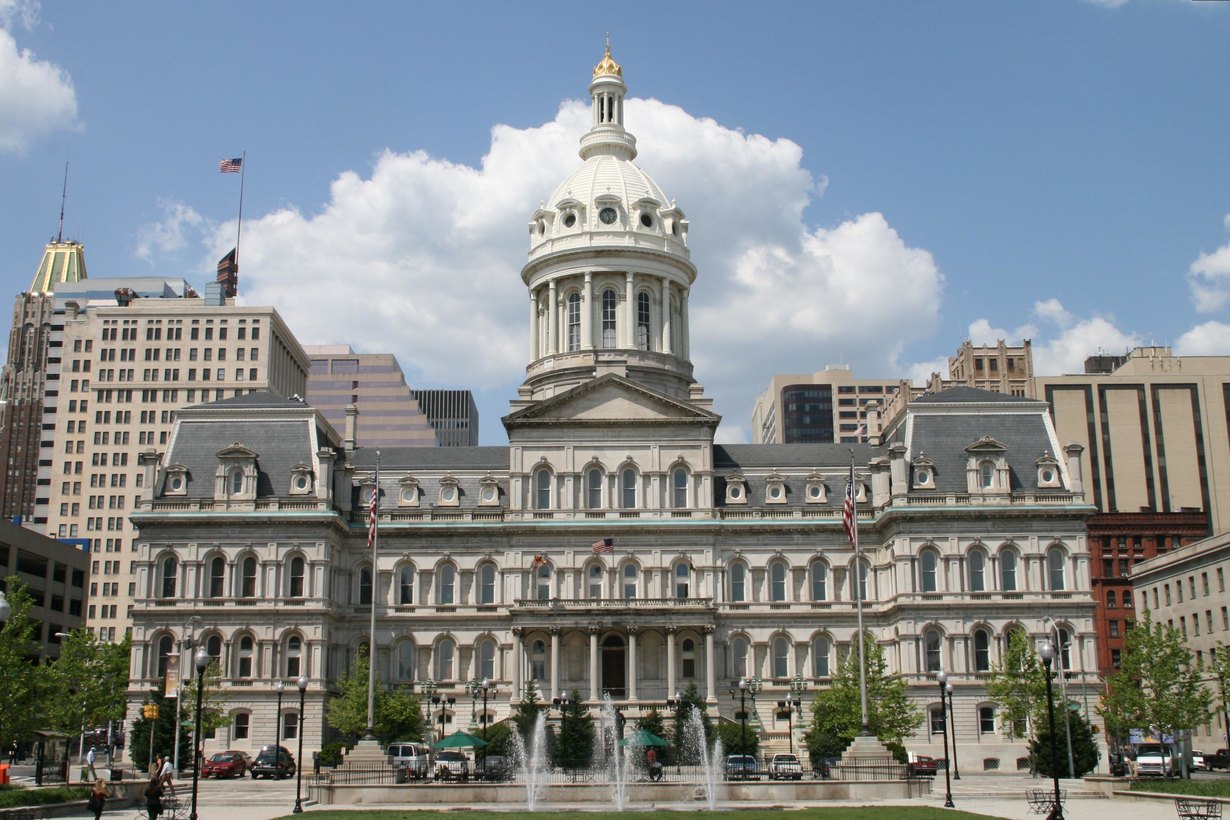
Featured image: Baltimore City Hall on Holliday Street. Photo: Marylandstater / Wikimedia Commons, public domain.