


How to sell on Etsy in 2026 starts with 3 decisions: choose a product Etsy permits, calculate every fee before pricing, and build listings around phrases buyers already search. A basic shop can be prepared in 1 weekend, although product photography, verification, and inventory may require several additional days, as noted by Baltimore Chronicle.
You do not need a warehouse, an LLC, or hundreds of products. You need a verified Etsy account, a bank account, at least 1 finished item, clear photographs, and enough margin to absorb marketplace fees. The steps below cover shop setup, Etsy seller fees, product pricing, shipping, and Etsy SEO.
Key takeaways
- Start with 5–10 related listings rather than filling a shop with unrelated products.
- Calculate transaction, processing, listing, shipping, and advertising costs before setting a retail price.
- Use specific buyer phrases across titles, tags, attributes, descriptions, and product photographs.
What you need before opening an Etsy shop
Gather the essential information before starting Etsy’s registration process. Matching legal, banking, and tax details reduces the risk of verification delays.
- An email address and secure Etsy account.
- A valid government-issued photo ID.
- A US residential address and phone number.
- A checking account that can receive Etsy Payments deposits.
- A debit or credit card for seller charges.
- A Social Security number or business tax identification number.
- At least 1 completed product and several original photographs.
- Packaging supplies, shipping measurements, and product weights.
- A starting budget for materials, listings, labels, and possible setup charges.
- About 4–8 hours for the initial shop and listing setup.
An LLC is optional for many new US sellers. A sole proprietor can usually begin selling under their legal name, subject to state and local requirements. However, a seller using a separate brand name may need a fictitious-name or “doing business as” registration.
Requirements differ between California, Texas, New York, Florida, Maryland, and other states. Check state, county, and city rules for business licenses, home occupations, and sales activities. Etsy generally calculates and remits marketplace sales tax where marketplace-facilitator laws apply, but that does not replace income-tax obligations.
Keep business income and expenses separate from the beginning. A dedicated checking account makes refunds, material costs, postage, and taxable profit easier to document.
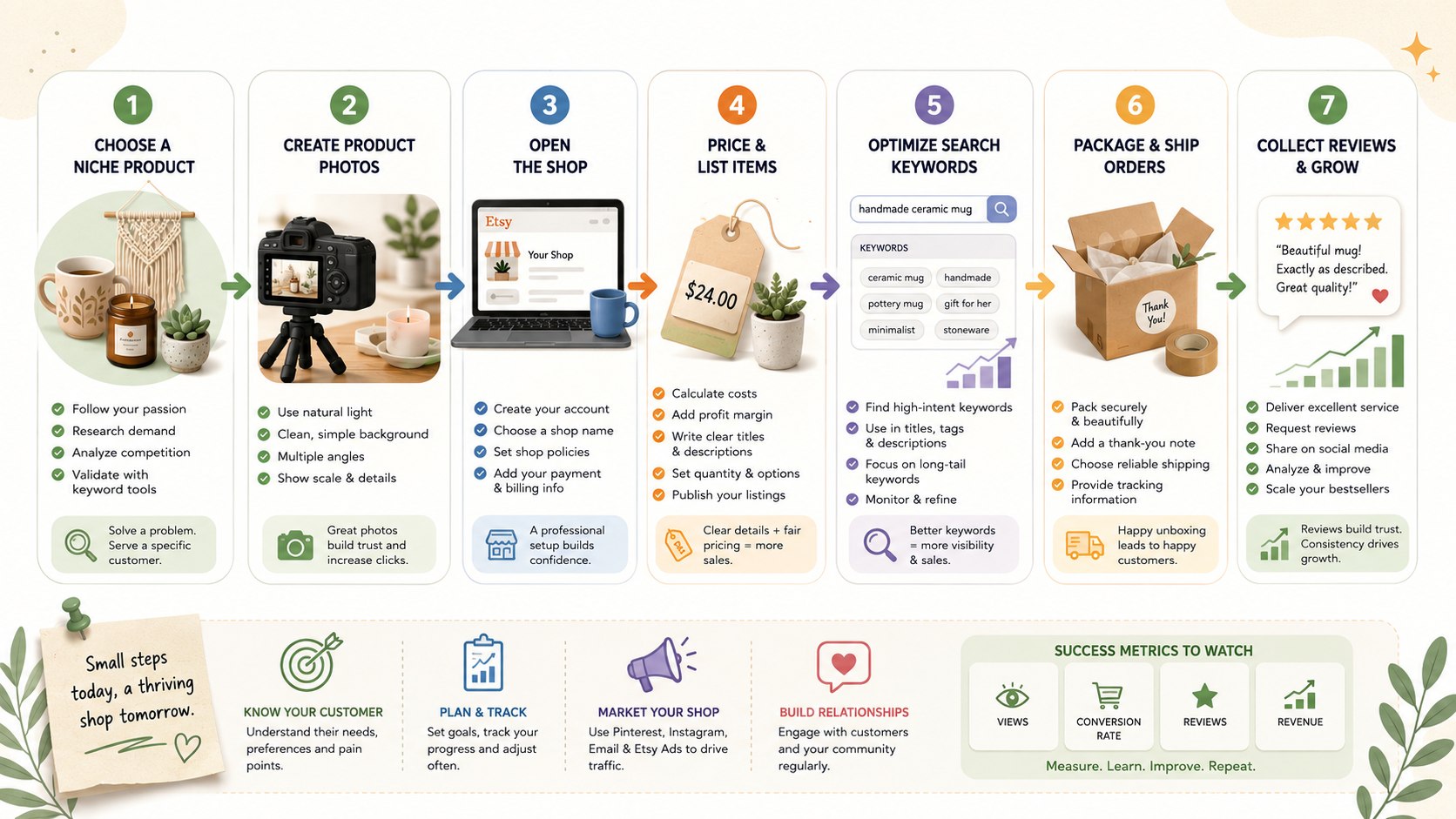
Step 1: Choose a product that belongs on Etsy
Choose a focused product category that fits Etsy’s current creativity standards. Etsy is designed for items made, designed, selected, or sourced by sellers within the platform’s permitted categories.
Promising options include handmade jewelry, personalized gifts, printable planners, original wall art, craft supplies, wedding accessories, and qualifying vintage items. Generic mass-produced merchandise may violate Etsy policies when it is presented as handmade.
The product should solve a recognizable buying need. “Personalized walnut dog memorial frame” gives shoppers a clearer reason to purchase than “wooden frame.” This specificity also produces better search phrases.
Common mistake: choosing a product only because it appears popular. Competition, production time, breakage, returns, and intellectual-property risks can erase the apparent opportunity.
Step 2: Calculate Etsy fees and set a profitable price
Etsy charges several separate fees rather than one simple commission. As of 2026, its standard listing fee is $0.20, while the transaction fee is 6.5% of the order amount covered by Etsy’s policy. US Etsy Payments processing has commonly included a percentage plus a fixed amount, but sellers should confirm the displayed rate before publishing.
A one-time, nonrefundable shop setup fee may also appear during onboarding. Etsy states that the amount can vary by location. Advertising, currency conversion, shipping labels, subscriptions, and other optional services can create additional costs.
| Cost | Typical 2026 structure | When it applies |
|---|---|---|
| Listing fee | $0.20 per listing | When an item is published or automatically renewed |
| Transaction fee | 6.5% | Applied to the covered order total, including charged shipping |
| US payment processing | Percentage plus fixed fee | Each order processed through Etsy Payments |
| Offsite Ads | 15% or 12% of an attributed order | Only when an eligible sale comes through an offsite advertisement |
| Shop setup | Variable one-time charge | Displayed during onboarding when applicable |
| Etsy Ads | Seller-controlled daily budget | When the seller activates on-platform advertising |
Suppose an item sells for $40 with $6 charged shipping. Do not calculate profit from the $40 product price alone. The fee base may include the shipping charge, while packaging and postage remain real business costs.
Add material costs, labor, packaging, expected defects, and advertising exposure. Then subtract estimated marketplace and payment charges. A product that costs $14 to make and $8 to ship cannot safely be priced at $25 merely because competing items appear near that figure.
Offsite Ads require special attention. Shops below $10,000 in Etsy revenue during the relevant 365-day period may generally opt out. Once a shop crosses Etsy’s threshold, participation can become mandatory, with a lower 12% attributed-order rate instead of 15%.
Common mistake: offering “free shipping” without adding the expected shipping expense to the product price. Free shipping changes what the customer sees, not what USPS or UPS charges.
Step 3: Open and brand your Etsy shop
Visit Etsy’s seller setup area, choose the shop language, country, and currency, and select a shop name. The name should be readable, memorable, and broad enough to support related products later.
Complete identity verification with accurate legal information. Connect the bank account used for deposits and add a valid billing card. A mismatch between an ID, taxpayer record, bank account, and shop owner can delay approval.
Add a recognizable shop icon, banner, short announcement, About section, and seller profile. Explain what you make, where it is produced, and what distinguishes the materials or process. Buyers often inspect the shop before trusting an unfamiliar seller.
This preparation resembles other forms of digital self-employment covered in Baltimore Chronicle’s guide to earning extra money online. Etsy offers marketplace traffic, but the seller remains responsible for costs, fulfillment, records, and customer service.
Common mistake: using an extremely narrow name tied to 1 product. A name such as “MiaWeddingSigns” becomes restrictive if the shop later expands into invitations or home décor.
Step 4: Create listings that answer buying questions
A strong listing removes uncertainty. Buyers should understand the item’s size, materials, color, contents, processing time, customization choices, and limitations without sending a message.
Photograph physical products in soft natural light. Show the entire item first, then include close-ups, scale references, packaging, variations, and practical use. Etsy allows multiple listing images, so use them to answer questions rather than repeating the same angle.
- Lead with a clean image showing the complete product.
- Add close-ups that reveal texture, finish, stitching, or print quality.
- Show scale beside a familiar object or within a realistic room.
- Display every available color or style accurately.
- Include a simple measurement graphic where dimensions may confuse buyers.
- Show packaging when the product is intended as a gift.
- Add a short video demonstrating movement, shine, fit, or customization.
The description should begin with the practical value of the item. Follow with dimensions, materials, production method, personalization instructions, processing time, care, and package contents.
State whether props in photographs are included. For digital downloads, explain file types, dimensions, printing requirements, and the fact that no physical item will ship. For personalized products, tell buyers exactly where to enter names, dates, or wording.
A listing should reduce hesitation before it tries to sound clever. Specific measurements and honest photographs usually build more trust than promotional adjectives.
Common mistake: copying a competitor’s title, description, photographs, or design. Besides weakening the shop’s identity, copying can trigger copyright or trademark complaints.
Step 5: Use Etsy SEO to reach qualified buyers
Effective Etsy SEO in 2026 begins with buyer intent. Use phrases that describe the object, recipient, occasion, material, style, or problem being solved.
A weak title such as “Beautiful Custom Gift” gives Etsy little context. “Personalized leather wallet for dad, engraved anniversary gift” identifies the product and several plausible searches.
Etsy says keywords across titles, descriptions, tags, categories, and attributes help match listings with shopper queries. Complete the relevant attributes because they give the platform additional information about color, size, occasion, material, and recipient.
- Place the clearest product phrase near the beginning of the title.
- Use all relevant tags without repeating identical wording unnecessarily.
- Select the most precise category available.
- Complete applicable attributes, even when similar words appear in tags.
- Write descriptions for people while naturally confirming the main product terms.
- Review Etsy search suggestions for useful wording, but do not copy irrelevant phrases.
- Compare search visits, favorites, and orders inside Etsy Stats.
SEO cannot rescue an unattractive first photograph or an uncompetitive offer. Search visibility and conversion work together. Etsy can observe whether shoppers click, favorite, purchase, or leave.
A new listing also needs time to collect reliable performance data. Avoid rewriting every title after 2 days. Review results over a reasonable period and change 1 major element at a time.
Internal records matter when marketplace sales become consistent. Baltimore Chronicle’s guide to reporting Cash App and marketplace income explains why payment forms do not replace complete sales records.
Common mistake: filling titles with awkward keyword fragments. Search terms must remain accurate, while titles should still help a customer identify the item quickly.
Step 6: Set shipping, returns, and customer policies
Measure the packaged product, not only the product itself. Enter accurate weight and box dimensions so calculated shipping does not underestimate USPS, UPS, or FedEx charges.
Set a processing time you can meet during busy weeks. A handmade item requiring 5 business days should not promise next-day dispatch to compete with factory-made products.
Shop policies should explain cancellations, returns, exchanges, damaged packages, lost shipments, and personalized orders. Federal and state consumer rules still apply, so a shop policy cannot remove rights provided by law.
Use tracking where practical and keep photographs of valuable or fragile orders before shipment. For expensive products, consider insurance and signature confirmation. A clear shipping record helps when a buyer reports non-delivery or damage.
Common mistake: treating the shipping price as pure postage. Boxes, mailers, labels, protective material, tape, and the seller’s handling time also affect fulfillment cost.
Step 7: Launch, measure results, and handle taxes
Launch with a small, coherent collection rather than 1 isolated product. Five to 10 related listings provide more search entry points and make the shop appear intentional.
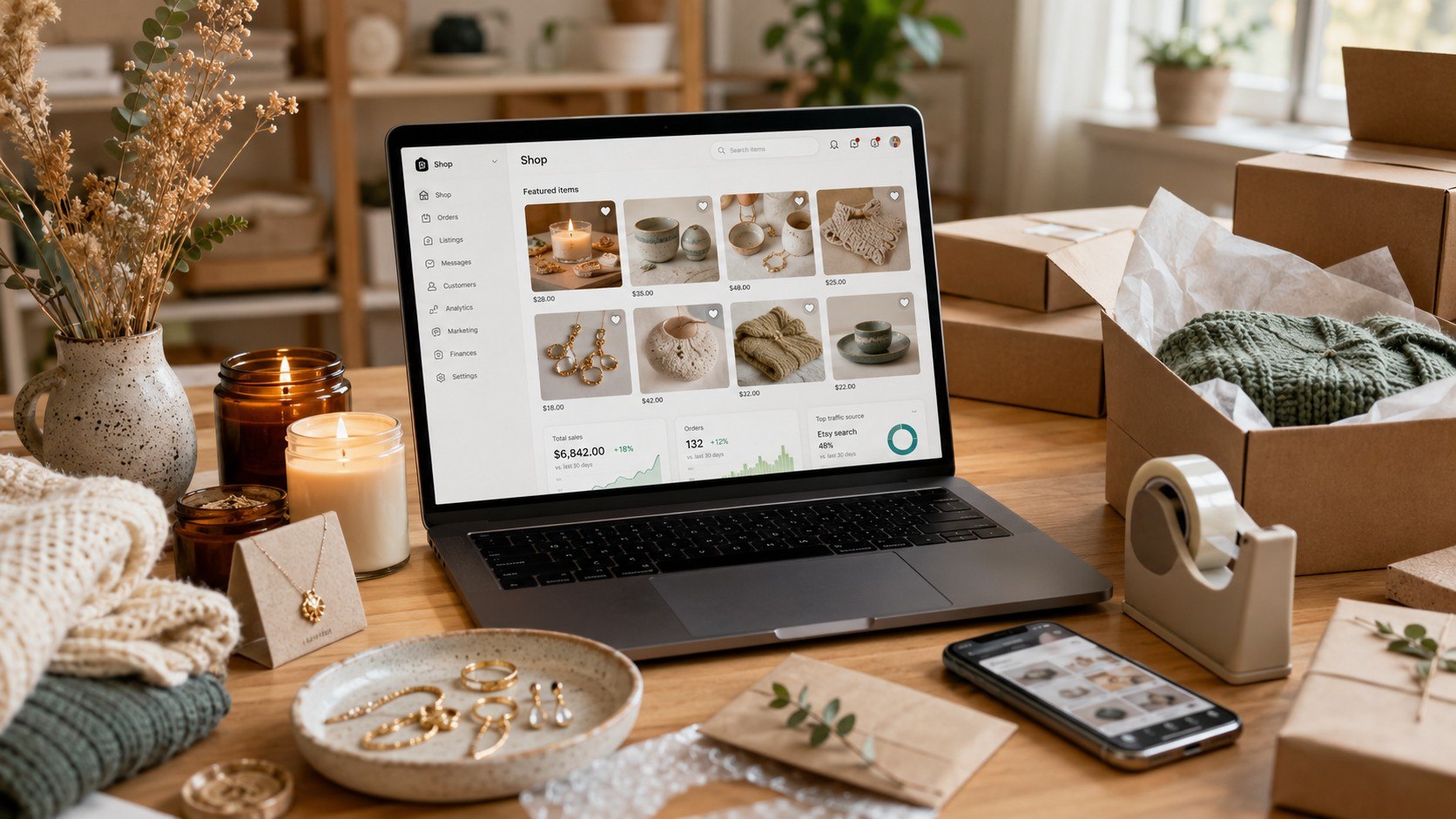
Check Etsy Stats for search terms, visits, favorites, orders, and traffic sources. A listing with impressions but few clicks may need a stronger first image or clearer title. A listing with clicks but no orders may have a price, shipping, trust, or description problem.
Keep receipts for materials, packaging, postage, platform fees, software, advertising, and qualifying business mileage. The IRS states that income from online marketplaces must be reported even when the seller does not receive Form 1099-K.
For 2026 federal reporting, the IRS says the third-party settlement threshold has reverted to more than $20,000 and more than 200 transactions. Platforms may still issue forms below that level, and some states have lower reporting thresholds. Receiving no form does not make profit tax-free.
Review the difference between gross payments and actual profit. Form 1099-K can include amounts before refunds, fees, and other adjustments. Baltimore Chronicle’s guide on filing taxes for free in 2026 also outlines records commonly needed by freelancers and marketplace sellers.
Common mistake: waiting until January to reconstruct expenses from bank statements. Update a spreadsheet or bookkeeping app at least monthly.
Troubleshooting common Etsy shop problems
- Your shop is not verified: check that your legal name, address, ID, taxpayer information, and bank details match.
- Listings receive views but no sales: review total price, shipping, first photograph, delivery estimate, policies, and buyer questions.
- Listings receive almost no search traffic: use more specific keywords, complete attributes, improve categories, and add related products.
- Profit is lower than expected: recalculate processing, transaction, advertising, packaging, postage, discounts, and refund costs.
- Orders take too long to fulfill: extend processing times, reduce variations, batch production, or limit available quantities.
Diagnose the stage where buyers disappear. Low impressions usually point toward search relevance or limited demand. Impressions without clicks often indicate weak photography, an unclear title, or an uncompetitive displayed price.
Clicks without purchases require a different review. Examine shipping charges, delivery timing, variation menus, policies, personalization instructions, and shop credibility. Buyers may like the product but remain uncertain about what arrives.
A surge in orders can also expose operational weaknesses. Extend processing times before missing deadlines, and temporarily reduce inventory when production capacity is limited. Reliable fulfillment protects reviews and prevents avoidable customer disputes.
FAQ about selling on Etsy in 2026
How much money do I need to start selling on Etsy?
A digital-product seller may begin with less than $50 if suitable software and equipment are already available. A physical-product shop may need $100–$500 or more for materials, prototypes, packaging, listings, and postage. Etsy may also display a variable setup fee during registration.
Do I need an LLC to sell on Etsy?
No. Many US sellers begin as sole proprietors. An LLC may offer organizational and liability benefits, but it does not replace insurance, bookkeeping, licenses, or tax filings.
What percentage does Etsy take from a sale?
The base cost includes a 6.5% transaction fee, the $0.20 listing charge, and payment-processing fees. Advertising and other services may increase the total. Verify current charges through Etsy before setting prices.
How many products should a new Etsy shop launch with?
There is no required number beyond the listing needed to open the shop. Starting with 5–10 related products is often more practical because it creates several search opportunities without overwhelming production.
How long does it take to make the first Etsy sale?
There is no reliable standard. A distinctive product with strong photography may sell quickly, while a competitive category may require weeks of testing. Demand, price, trust, shipping, seasonality, and keyword relevance all influence timing.
Can I sell digital downloads on Etsy?
Yes, when the files comply with Etsy policies and intellectual-property rules. State the file format, dimensions, permitted use, and printing requirements. Make clear that the buyer will not receive a physical shipment.
Earlier we wrote about USDA Income Limits and Eligible Areas in 2026: What Homebuyers Must Check Before an Offer