

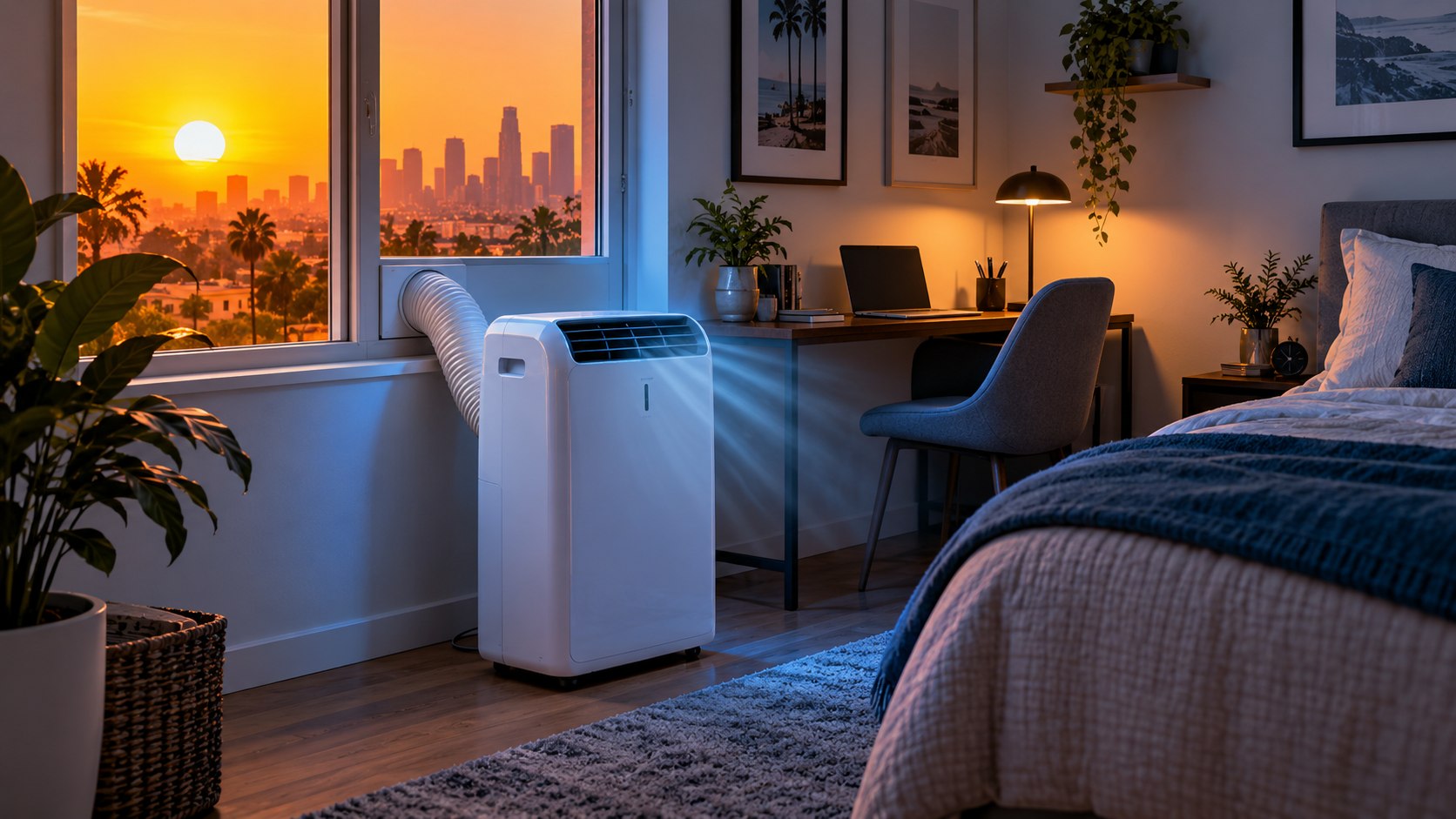
Best portable AC 2026 USA models were ranked by DOE/SACC cooling capacity, room coverage, hose design, inverter technology, noise, controls, and verified 2026 pricing. Preference went to units that solve a specific cooling problem without relying on inflated ASHRAE ratings, as noted by the editorial board of Baltimore Chronicle.
For most households, the Midea Duo MAP14S1TBL is the strongest all-around choice. Its 12,000 BTU DOE rating suits spaces up to 550 sq ft, while the dual-hose inverter system addresses 2 common portable-AC weaknesses: pressure loss and compressor noise. Renters needing cheaper bedroom cooling should consider smaller 6,000–8,000 BTU SACC models instead.
Portable ACs remain compromises compared with efficient window units. They make the most sense when a landlord prohibits window-mounted equipment, windows cannot support one, or cooling must move between rooms.
Key takeaways
The ranking favors practical cooling capacity rather than the biggest number printed on retail packaging. Buyers should compare DOE or SACC ratings between portable units.
- Midea Duo MAP14S1TBL leads for large rooms because it combines 12,000 BTU DOE capacity with inverter and dual-hose operation.
- LG LP1419IVSM is a strong bedroom and office option for buyers prioritizing quieter inverter cooling and mature smart controls.
- Budget buyers should size conservatively and avoid paying for 14,000 ASHRAE BTU when the corresponding SACC rating is much lower.
A portable unit must still vent outdoors. Its wheels do not make it independent of a window, sliding door, or another approved exhaust opening. The exhaust hose should remain short and reasonably straight because hot ductwork radiates heat back indoors.
Humidity also changes the buying decision. Florida, Louisiana, and Gulf Coast homes create more condensate than dry rooms in Arizona or Nevada. Drain access therefore deserves more attention in Miami than in Phoenix.
Electricity prices differ by state and utility territory. The most useful comparison is the yellow EnergyGuide label rather than a generic national operating-cost estimate.
For a bedroom used every night, paying more for an inverter compressor can matter more than buying the highest advertised BTU rating.
Best portable AC 2026 USA ranked
1. Midea Duo MAP14S1TBL — best overall
The Midea Duo MAP14S1TBL delivers 12,000 BTU under the DOE rating and is specified for rooms up to 550 sq ft. Its hose-in-hose system handles intake and exhaust through one combined assembly, while variable-speed inverter operation reduces the constant full-power cycling common to basic portable units.
This is the model to consider for a large bedroom, apartment living area, or home office where window AC installation is impossible. Similar Midea Duo configurations generally occupy the upper-middle portable-AC price tier in 2026, so current retailer pricing should be checked before purchase.
2. LG LP1419IVSM — best premium inverter model
LG’s LP1419IVSM carries a 10,000 BTU SACC rating, a 14,000 BTU ASHRAE rating, and stated coverage up to 500 sq ft. It also offers ThinQ Wi-Fi controls, Alexa and Google Assistant integration, auto evaporation, and an inverter compressor.
The price is substantial, but its value is easier to justify in a room used daily. This quiet portable air conditioner stands out for bedrooms and workspaces where compressor cycling becomes irritating during long sessions.
3. Whynter ARC-1280WX — best dual-hose alternative
The Whynter NEX ARC-1280WX uses inverter technology and a dual-hose layout for spaces up to 500 sq ft. In 2026, pricing commonly sits in the mid-$400 to low-$500 range, depending on retailer promotions.
Its combination of 10,000 BTU SACC-class cooling, Wi-Fi, and dual-hose operation makes it competitive with Midea and LG. It particularly suits renters who want a strong dual hose portable AC without moving into permanent mini-split installation.
4. Midea Duo MAP12S1TBL — best for medium rooms
The smaller Midea Duo MAP12S1TBL provides 10,000 BTU DOE cooling for spaces up to 450 sq ft. It keeps the same inverter concept, integrated dual-hose design, washable filter, Wi-Fi controls, and low-noise operation.
At roughly 73 lbs, it is portable mainly in the sense that it rolls. Moving it between floors is another matter. Current 2026 listings vary widely, with examples around $499 and above, making seasonal pricing an important part of the decision.
5. Whynter ARC-14S — best proven non-inverter dual hose
Whynter’s long-running ARC-14S remains relevant because its specifications are straightforward: 14,000 BTU ASHRAE, 9,500 BTU SACC, dual hoses, and claimed coverage up to 500 sq ft. The model typically sells around the $500 mark in 2026.
It lacks the refinement of newer inverter machines, yet its separate intake and exhaust paths remain useful in hotter rooms. The design is especially relevant in Texas, California, and the Southwest, where a weak single-hose unit may struggle during afternoon heat.
“Compliance with the new standards … is required beginning on January 10, 2025.”
U.S. Department of Energy, Building Technologies Office, portable air conditioner efficiency standards. Official DOE guidance.
6. LG LP1023BSSM — best straightforward smart model
LG’s LP1023BSSM offers 10,000 BTU SACC cooling for rooms up to 450 sq ft, plus Wi-Fi, dehumidifying, fan operation, and auto-swing airflow. In 2026, retail pricing generally sits around the $500 range.
It lacks the dual-inverter hardware of the LP1419IVSM, but that simplifies the proposition. Buyers seeking a familiar portable AC for apartment use get substantial capacity without moving into the highest price tier.
7. BLACK+DECKER BPACT14WT — best basic high-capacity option
The BPACT14WT carries 14,000 BTU under the older ASHRAE figure and 7,700 BTU under its more useful portable-unit rating. It includes cooling, fan, dehumidifier, auto evaporation, a 24-hour timer, washable filter, remote, casters, and a window kit.
This model makes sense when uncomplicated controls matter more than Wi-Fi or inverter technology. Its lower SACC figure is also a useful reminder that a large ASHRAE number does not automatically make a machine suitable for a large open-plan room.
2026 specifications and prices at a glance
The figures below use SACC or DOE capacity where available. Prices reflect typical 2026 manufacturer or retailer listings and can vary by region, inventory, and promotions.
| Model | DOE/SACC capacity | Claimed room size | Design | 2026 price reference |
|---|---|---|---|---|
| Midea MAP14S1TBL | 12,000 BTU | Up to 550 sq ft | Inverter, dual hose-in-hose | Verify current price |
| LG LP1419IVSM | 10,000 BTU | Up to 500 sq ft | Dual inverter | About $699 |
| Whynter ARC-1280WX | 10,000 BTU class | Up to 500 sq ft | Inverter, dual hose | About $425–$510 |
| Midea MAP12S1TBL | 10,000 BTU | Up to 450 sq ft | Inverter, dual hose-in-hose | About $499 and up |
| Whynter ARC-14S | 9,500 BTU | Up to 500 sq ft | Dual hose | About $510 |
| LG LP1023BSSM | 10,000 BTU | Up to 450 sq ft | Single hose, Wi-Fi | About $499–$519 |
| BLACK+DECKER BPACT14WT | 7,700 BTU | Depends on room conditions | Single hose | Varies |
The biggest lesson is the difference between headline capacity and standardized portable-AC capacity. A unit promoted as 14,000 BTU ASHRAE may deliver only 7,700–10,000 BTU under another applicable rating method.
DOE/SACC therefore offers the cleaner starting point when comparing competing portable machines. This makes it easier to compare models that use different marketing figures on their packaging.
Price should be compared against expected usage. Spending another $150–$250 for inverter hardware is difficult to justify for a guest room cooled only a few weeks each year.
The calculation changes for a remote worker running an AC throughout a humid Maryland summer. Baltimore Chronicle has also covered ways to save water and electricity without sacrificing comfort, which provides useful context for appliances that run many hours each day.
Consumers should also inspect the EnergyGuide label before checkout. It offers a standardized basis for comparing estimated energy use rather than relying on marketing language.
How to choose the right portable air conditioner
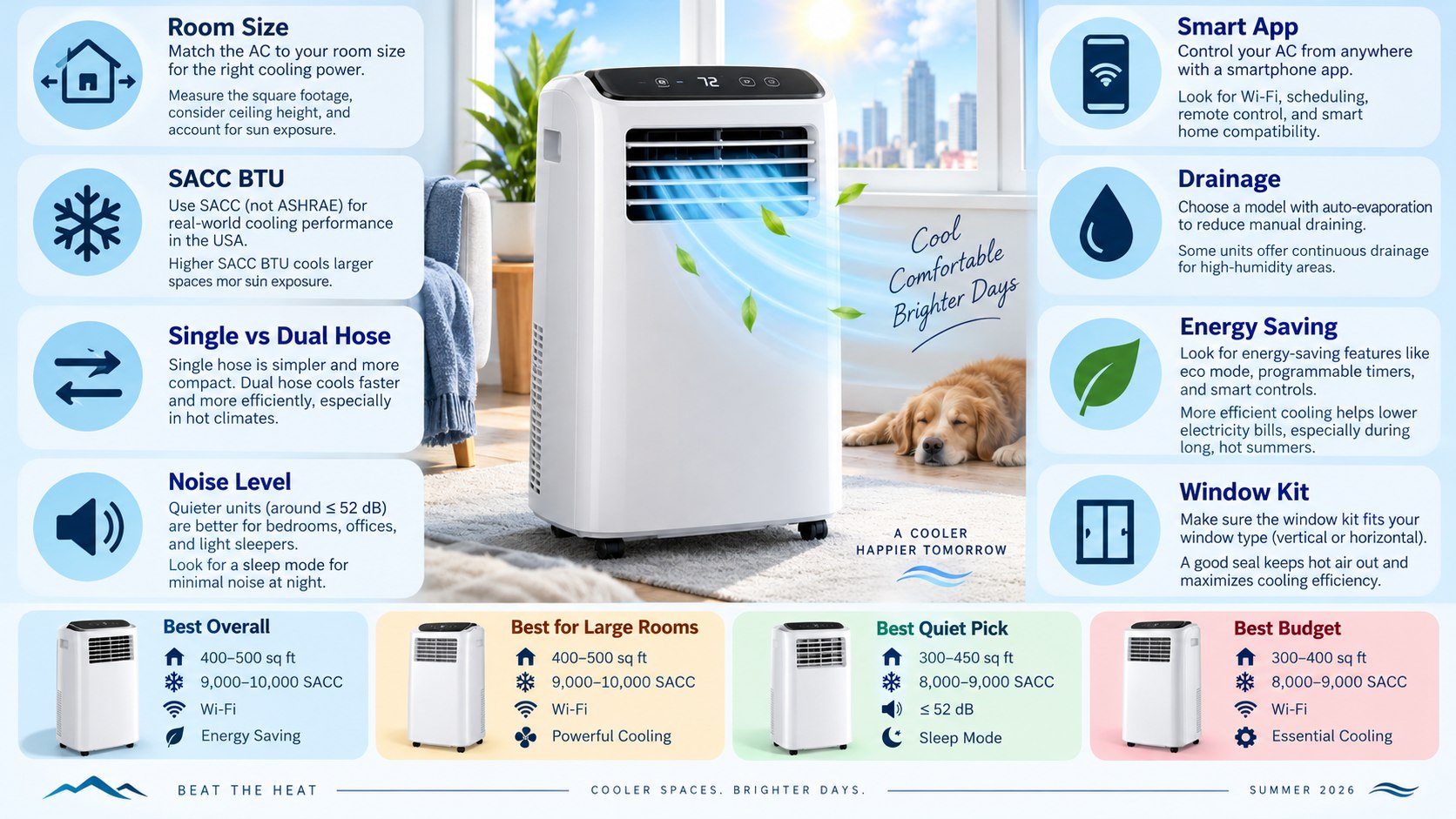
The best portable air conditioner for home is not necessarily the largest unit available. Start with the room, then narrow the list by SACC capacity, ventilation, noise, drainage, and electrical requirements.
- Measure the room’s floor area in sq ft and note high ceilings or connected spaces.
- Check DOE or SACC BTU before comparing the larger ASHRAE number.
- Confirm that the supplied window kit fits the actual opening.
- Prefer dual-hose or inverter designs for long daily operating periods.
- Check drainage instructions if the home is in a humid state.
- Compare EnergyGuide information before estimating electricity costs.
- Measure the cabinet and hose path before ordering a heavy 70-lb unit.
Window configuration deserves attention before payment. A standard double-hung window is usually easy, while casement windows often require a different sealing solution. A poorly sealed opening can undermine an otherwise powerful AC.
Extension cords should not become the default solution. Check the manufacturer’s electrical requirements and place the machine near an appropriate wall outlet.
Parents should also think about hose temperatures and floor clearance. A portable cabinet can occupy several square feet once space for the hose and airflow is included.
Freelancers working beside the machine should prioritize minimum noise and variable compressor output. Full-speed compressor cycling is more distracting at a desk than across a large living room.
One portable AC can solve a difficult room well, but buying several units for an entire house may erase the convenience advantage.
Why EnergyGuide matters more in 2026
The Federal Trade Commission requires EnergyGuide information for covered household appliances, including portable air conditioners. The label helps shoppers compare estimated energy consumption and operating expense among similar models.
“Your cost will depend on how you use the appliance and your local energy price.”
Federal Trade Commission, consumer guidance on EnergyGuide labels and household appliance operating costs. FTC Consumer Advice.
This distinction matters across the USA because electricity rates, climate, and operating hours vary substantially. A machine used occasionally in Maine has a different annual cost profile from the same model running daily in Florida.
Since January 10, 2025, covered portable air conditioners have been subject to current DOE efficiency standards. Those rules make standardized comparisons more useful for 2026 inventory.
The yellow label still cannot predict an individual household bill. A sunny west-facing room, poor insulation, frequent door opening, or an undersized unit can increase runtime substantially.
Honorable mentions
Several models miss the main ranking because they overlap heavily with higher-ranked options or serve narrower use cases. They can still make sense when the price or feature mix is right.
- Midea MAP14HS1TBL: 12,000 BTU DOE Duo model with heat for buyers needing seasonal heating from the same cabinet.
- BLACK+DECKER BPACT14HWT: cooling, heating, dehumidifying, and fan modes in a simpler 4-in-1 design.
- GE APFD06JAWW: 6,100 BTU cooling for rooms up to 250 sq ft, most relevant when discounted remaining inventory appears.
The heating function is useful only when operating conditions match the manufacturer’s instructions. It should not be treated as a substitute for a whole-home heating system.
Small GE units are easier to justify in bedrooms than large living areas. Their modest capacity helps avoid paying for cooling output that a small enclosed room does not require.
BLACK+DECKER’s heated model favors simplicity over advanced inverter controls. That can be acceptable for seasonal or occasional-use spaces.
Remaining inventory also changes value quickly. A discontinued or older model can become attractive at clearance pricing, but replacement accessories should remain available.
For most buyers, the ranking still centers on Midea Duo, LG’s inverter models, and Whynter’s dual-hose machines. Those platforms address several of the weaknesses that separate portable air conditioners from efficient window equipment.
FAQ
What is the best portable AC in the USA for 2026?
Midea Duo MAP14S1TBL is the strongest overall pick for many larger rooms. It combines 12,000 BTU DOE cooling, inverter control, a dual-hose design, and coverage up to 550 sq ft.
Is 14,000 BTU enough for 500 sq ft?
Check which rating produced that 14,000 BTU figure. A 14,000 BTU ASHRAE portable AC may carry a substantially lower DOE/SACC rating, which is more useful for comparing portable units.
Are dual-hose portable air conditioners better?
They often reduce the negative-pressure problem associated with single-hose designs. A portable AC for 500 sq ft is therefore more convincing when it combines adequate SACC capacity with dual-hose airflow.
How much does a good portable AC cost in 2026?
Many capable models in this ranking fall around $400–$700. Basic units can cost less, while inverter, Wi-Fi, heat, and dual-hose systems generally move prices upward.
Can a portable AC work without a window?
A refrigerated portable air conditioner must reject heat outside the room. A window is the normal exhaust route, although another manufacturer-approved exterior opening may sometimes work.
Should renters buy a portable AC or window AC?
A window AC usually makes more sense when installation is permitted and efficiency matters. A portable model becomes the practical choice when lease rules, window design, or temporary occupancy prevent conventional mounting.
Earlier we wrote about How Much Does a Shingle Roof Cost in 2026? US Prices From $3.50 per Sq Ft