


Are ADUs legal in Maryland 2026? Yes, but the practical answer depends on the county, the property, and the permit date. Maryland law requires local governments with planning and zoning authority to authorize accessory dwelling units by October 1, 2026. Some counties already have working ADU systems, while others were still changing their codes in September 2026, as the Baltimore Chronicle editorial team notes.
An accessory dwelling unit, or ADU, is a smaller independent home on the same property as a primary house. It may be inside the house, attached to it, or built as a separate backyard structure. A homeowner should therefore check county zoning before ordering plans, excavation, utilities, or prefabricated components.
Key takeaways
- Maryland law requires qualifying local jurisdictions to authorize ADUs by October 1, 2026.
- County rules still control permits, setbacks, parking, utilities, rental licensing, and construction review.
- Montgomery, Howard, and Anne Arundel already allow ADUs, while other counties were revising local rules during 2026.
Are ADUs legal in Maryland 2026 under state law?
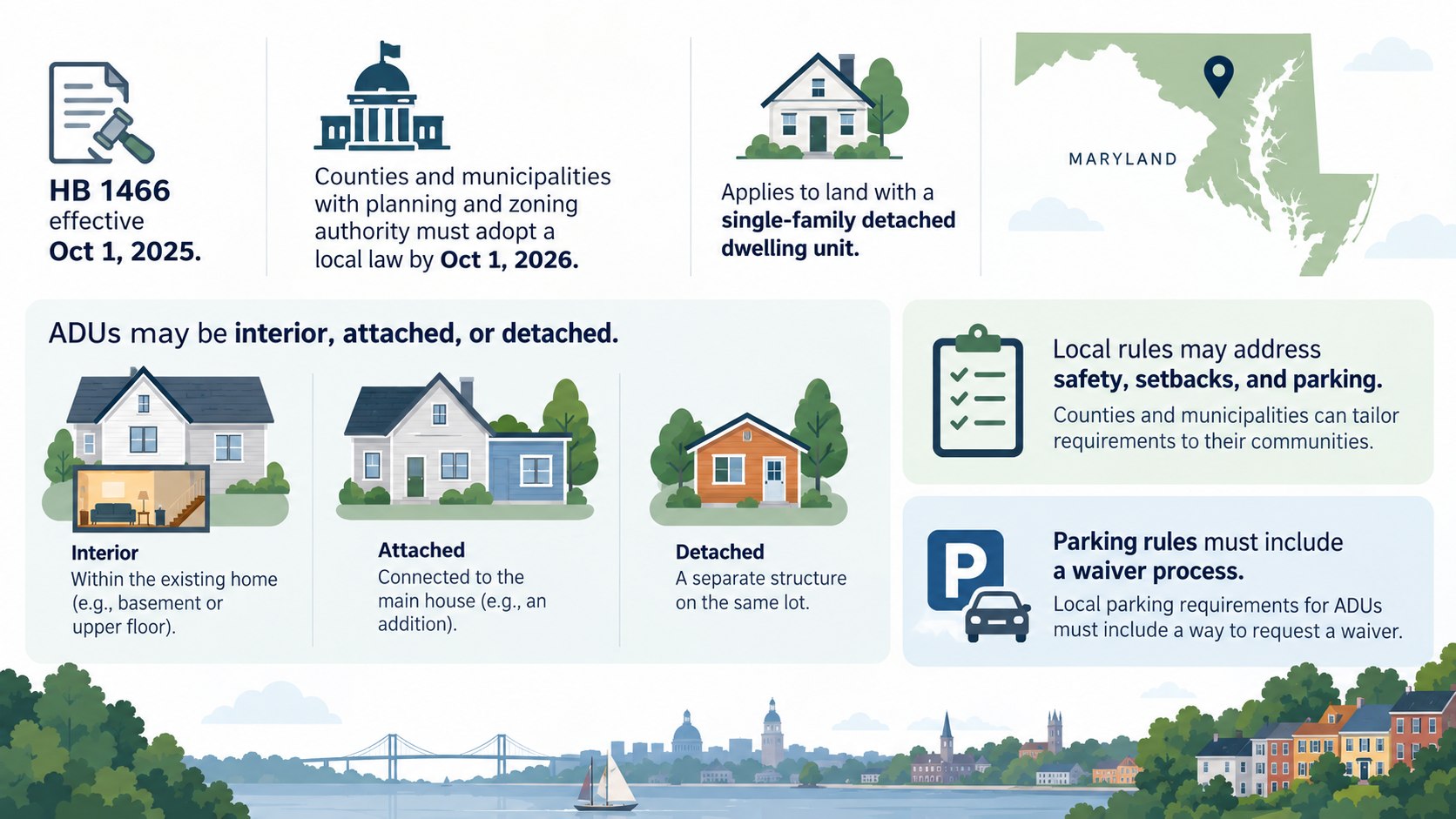
The legal shift comes from Maryland HB 1466, enacted during the 2025 legislative session. The law took effect October 1, 2025. It requires covered counties and municipalities to adopt local legislation authorizing ADUs by October 1, 2026.
Under the state definition, an ADU sits on the same lot as a primary single-family detached home. It must remain subordinate to that house and cannot exceed 75% of the primary dwelling’s size. Maryland permits both attached and detached units.
“It is the policy of the State to promote and encourage the creation of accessory dwelling units.”
The wording comes from Maryland’s Land Use law. The important distinction is that the state did not create one identical permit standard for every address. Local governments still administer zoning and building review.
State legalization is the floor, not a statewide building permit. A legal ADU still has to satisfy the rules governing the parcel where it will sit.
In plain English
Think of Maryland’s 2026 ADU law as a rule requiring local governments to make room for this type of housing. The state says counties cannot simply exclude ADUs from residential policy. Each county can still control permits, setbacks, safety standards, utilities, and other site-specific requirements.
That distinction explains why searches for Maryland ADU laws by county produce different answers. Montgomery County has an established approval path. Howard County adopted major new rules effective April 8, 2026. Anne Arundel County already permits ADUs in most residential districts.
Prince George’s County illustrates why timing matters. Its planning framework remained in transition during 2026 as Maryland’s October 1 compliance deadline approached.
A backyard cottage also remains a permanent residential structure. Calling it a “tiny house,” “studio,” or “granny pod” does not remove zoning, electrical, plumbing, foundation, fire-safety, or utility requirements.
How it actually works
The first step is identifying the authority that controls the property. Maryland has counties, incorporated municipalities, historic districts, utility service areas, and private communities. Their requirements can overlap.
Next comes zoning. The planning office determines whether the proposed location, building type, lot coverage, setbacks, height, and other site conditions comply. A converted basement creates different questions than a new 800 sq ft backyard building.
Building review follows. Plans may need structural, electrical, plumbing, mechanical, energy-code, fire-separation, and stormwater review. Products from brands such as James Hardie or CertainTeed do not change the permit requirement simply because they are standard residential materials.
Finally, owners planning to rent the unit may face rental licensing or occupancy rules. Howard County, for example, requires zoning approval before an owner seeking to rent an ADU proceeds through its rental-license process. Its ADU zoning application fee was listed at $25 in 2026.
The practical order is:
- Confirm the parcel’s zoning and municipality.
- Ask whether attached, internal, and detached ADUs are permitted.
- Obtain the county’s setback, size, parking, and utility requirements.
- Prepare a site plan and construction drawings.
- Secure zoning and building approvals before construction.
- Complete inspections and any required rental licensing.
Do not start with a prefab purchase. A $100,000 structure that cannot meet a setback remains a $100,000 problem. Site conditions can also add excavation, utility trenching, retaining walls, drainage work, or foundation engineering.
Septic properties may require additional capacity review. Public sewer properties can face connection questions. Historic review can also restrict exterior changes.
Homeowners comparing permanent construction with temporary backyard uses can also review this guide to temporary structures in a yard. The legal systems differ, but the distinction between temporary equipment and permanent construction remains useful. Broader home-related coverage appears in the site’s home section.
Maryland ADU rules by county in 2026
County differences matter more than a generic answer to can you build an ADU in Maryland. The status below reflects rules and official materials available in September 2026.
| County | 2026 status | Important rule or development |
|---|---|---|
| Montgomery | Allowed | Mostly by-right process; one ADU per lot under existing rules |
| Howard | Allowed | CB3-2026 effective April 8; attached and detached units permitted under defined conditions |
| Anne Arundel | Allowed | Permitted in residential districts except R22, subject to county conditions |
| Prince George’s | Transitioning | Local planning rules were being aligned with the state compliance deadline |
| Carroll | Rules being revised | County considered ADU code amendments during 2026 |
| Frederick | Legislation in progress | Local ADU legislation was considered in September 2026 |
| Baltimore County | Existing accessory-apartment framework | County policy work considered broader ADU authorization |
Montgomery County provides one of Maryland’s clearest established systems. County planning materials describe ADU development as mostly by right. Detached units remain subject to size, lot-coverage, setback, stormwater, and related standards.
Existing guidance also applies detailed size limits. Depending on the property and zoning framework, a detached unit can face a maximum size below what state law would otherwise allow.
Howard County changed its regulations through CB3-2026. The law became effective April 8, 2026. It generally limits a property to one ADU and requires owner occupancy of either the primary dwelling or the ADU.
Short-term rental use is treated separately. Owners considering Airbnb-style use should not assume that a legal long-term ADU can automatically operate as a short-term rental.
Anne Arundel County permits ADUs in many residential districts, subject to conditions. Construction requirements can include fire-rated separation when an attached ADU lacks free-flowing access to the main dwelling.
What state law changes for setbacks, parking and HOAs
Maryland’s law does more than set a deadline. Local ADU rules cannot establish side or rear setbacks greater than those imposed on comparable accessory structures.
A jurisdiction also cannot simply add extra ADU parking requirements without following the process required by state law. Parking remains one of the details homeowners should verify before paying for final plans.
The law addresses private restrictions as well. Maryland limits unreasonable deed, HOA, contract, or similar restrictions that effectively prevent a qualifying ADU.
Short-term rental restrictions are treated differently. Historic properties may also face separate requirements.
“Local laws must follow the intent of HB 1466, which is to promote and encourage ADUs.”
That position appears in guidance from the Maryland Department of Planning. The agency also explains that jurisdictions can use by-right approval or another approval process, including conditional use or special exception.
A homeowner should treat zoning approval, building approval, HOA review, and rental permission as separate questions. Approval in one category does not automatically settle the others.
Who it matters to in 2026
Homeowners creating space for family
A parent moving closer to adult children is a common ADU use case. An internal suite may avoid the cost and site work of detached construction.
It still needs lawful cooking, sanitation, sleeping, ventilation, and egress arrangements. Converting an existing room does not automatically make the space a legal dwelling unit.
Owners planning rental income
Anyone researching Maryland ADU rental rules 2026 should check owner-occupancy and licensing requirements before calculating rent. Howard County requires the owner to live in the primary home or ADU when the other unit is rented.
Montgomery County also connects its ADU system with licensing and occupancy requirements. Rental assumptions should therefore be based on county rules, not only on expected monthly rent.
Buyers comparing properties
A large backyard does not guarantee development rights. Buyers should examine zoning, easements, septic capacity, utility corridors, stormwater constraints, historic status, and recorded restrictions before paying a premium for supposed ADU potential.
A useful pre-purchase file includes:
- current zoning designation and parcel map;
- property survey with lot dimensions;
- utility and sewer or septic information;
- recorded easements and HOA documents;
- county ADU ordinance and permit checklist;
- historic-district information, when applicable.
Those documents can reveal problems before architectural work begins. A drainage easement may occupy the best building area. A septic field can restrict detached construction.
A narrow lot may satisfy state policy yet fail another local site standard. Existing garages also need structural review before conversion. Insurance and lender requirements can create another layer after zoning approval.
Common myths
The new law has created several misleading shortcuts. These claims can turn into expensive mistakes when a homeowner starts design work too early.
- ADUs are legal everywhere in Maryland — State policy requires authorization, but local procedures and 2026 implementation dates still matter.
- “No zoning permit is needed” — Counties continue to review land use, setbacks, coverage, and site conditions.
- “An HOA can always ban an ADU” — Maryland limits unreasonable private restrictions on qualifying ADUs.
- “A shed becomes an ADU when a kitchen is added” — Habitable units must satisfy residential building and safety requirements.
- “Every county allows Airbnb use” — Short-term rental rules remain local and can differ from long-term ADU permissions.
The safest interpretation is also the simplest. An ADU is housing, not an upgraded shed. Kitchens, bathrooms, sleeping rooms, electrical loads, heating systems, emergency escape, and plumbing trigger requirements that storage buildings do not face.
Detached units also alter impervious surface and drainage. Conversions can require fire separation. A legal design therefore begins with the parcel rules rather than a floor-plan catalog.
FAQ
Are ADUs legal in Maryland in 2026?
Yes. Maryland adopted statewide ADU policy through HB 1466 and requires qualifying local jurisdictions to authorize them by October 1, 2026. County permitting rules still apply.
How large can an ADU be in Maryland?
State law defines a qualifying ADU as no more than 75% of the size of the primary single-family detached dwelling. Local rules can impose additional site and construction standards.
Can I build a detached backyard ADU?
State law recognizes detached ADUs, but the parcel must meet local zoning and building requirements. Setbacks, utilities, stormwater, lot coverage, and access can determine whether construction is practical.
Can an HOA prohibit my ADU?
Maryland law restricts deeds, HOA bylaws, contracts, and similar documents from imposing unreasonable limitations that effectively prohibit qualifying ADUs. Historic properties and short-term rental restrictions require separate review.
Do Maryland ADUs require extra parking?
Not automatically statewide. Local governments must follow Maryland requirements before imposing certain additional ADU parking obligations.
What should I do before paying an architect or builder?
Ask the county zoning office for a parcel-specific determination. Confirm ADU type, maximum size, setbacks, parking, utilities, owner-occupancy rules, and required permits before commissioning final construction drawings.
Earlier we wrote about How to Grow Instagram Followers 2026: Real Tactics Using Reels, Insights and Profile Conversion