


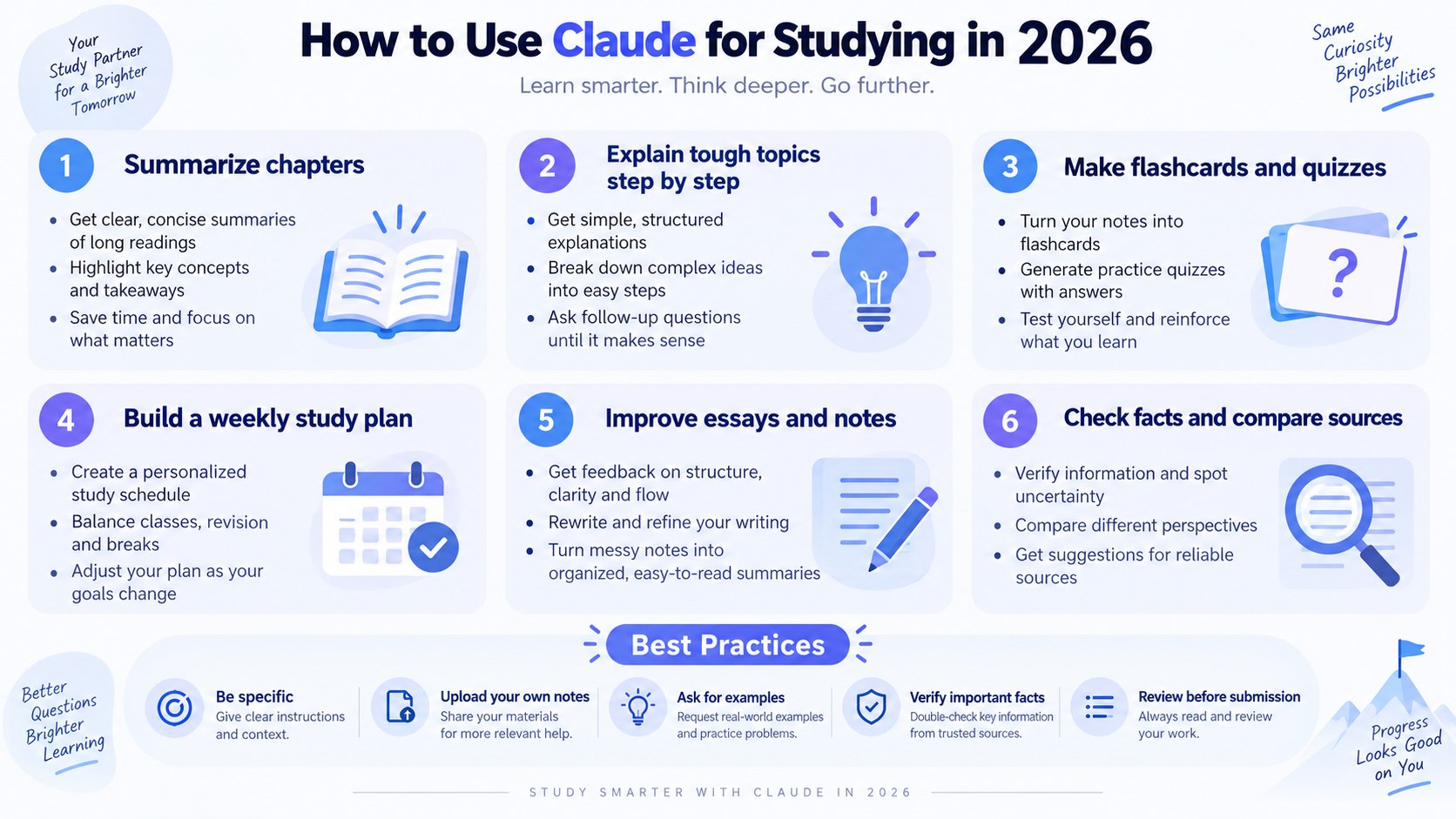
How to use Claude for studying 2026 starts with a simple rule: make Claude test your thinking instead of replacing it. A useful setup takes about 15 minutes, then supports reading, exam practice, note review, and writing. The strongest workflow uses your actual course materials, specific prompts, and repeated self-testing, as the editorial team at Baltimore Chronicle notes.
Claude works best as a study partner when each session has one measurable goal. Instead of asking for a chapter summary, ask it to question you about that chapter. Instead of requesting an essay, give it your draft and request criticism. This approach keeps the difficult thinking on your side of the screen.
Key takeaways
- Upload course materials when permitted, then tell Claude to base explanations only on those sources.
- Use retrieval questions, practice problems, and feedback prompts before asking for summaries or polished notes.
- Separate learning from assignment submission, and always follow your school’s rules for AI-assisted work.
That distinction matters because polished AI output can create an illusion of understanding. Recognition is easier than recall. A student may understand Claude’s explanation yet struggle to reproduce the idea during an exam. Good prompts therefore make Claude withhold answers, challenge assumptions, and ask follow-up questions. The goal is active recall rather than passive reading.
What you need
You can start with a free Claude account and material you already use for class. Paid access becomes useful when longer projects or heavier workloads exceed free limits.
- A Claude account at Claude.ai.
- Your syllabus, lecture notes, textbook excerpts, or instructor-approved readings.
- A clear study target, such as one exam chapter or one problem set.
- About 30–60 minutes for a focused study session.
- Your school’s academic-integrity policy.
Do not upload documents merely because they are available. Start with the smallest set that covers the topic you need. Label materials clearly, especially when several lectures discuss similar concepts. Keep answer keys separate until you actually want feedback. Remove personal information from documents when it is unnecessary. A focused source set usually produces cleaner study sessions than an indiscriminate file dump.
Step 1: How to Use Claude for Studying 2026
Begin by telling Claude how it should behave during the session. The first prompt should define the course, source material, learning objective, and limits.
A practical opening prompt is: “Act as my study coach for introductory biology. Use only the uploaded materials. Ask one question at a time. Do not reveal the answer until I attempt it.”
This matters because “teach me biology” gives Claude too much freedom. A constrained prompt keeps the conversation tied to your course. The common mistake is requesting broad tutoring without stating what material your instructor actually covers.
Anthropic describes its education-focused Learning mode as an approach that guides students through reasoning rather than immediately supplying answers. Its official Claude for Education information also emphasizes Socratic questioning and conceptual understanding.
“Guiding rather than answering.”
Anthropic, description of Learning mode for Claude for Education.
This is also a useful principle outside a university-managed Education account. A student can reproduce much of that behavior through careful prompts. The important part is asking for questions before explanations. Request hints in stages rather than complete solutions. Then explain the answer back to Claude in your own words.
Step 2: Turn Notes Into an Active-Recall Workflow
Upload or paste a manageable section of your notes. Then ask Claude to create questions without showing the answers until you respond.
The method works because Claude study prompts can convert static material into repeated retrieval practice. Avoid asking for 100 flashcards immediately. Large generated sets often contain low-value questions you never revisit.
The most useful prompt depends on what you are trying to learn.
| Study task | Prompt pattern | Best use |
|---|---|---|
| Recall | “Quiz me one question at a time from these notes.” | Facts, definitions, dates |
| Explanation | “Ask me to explain each concept in plain English.” | Conceptual courses |
| Application | “Create a new scenario requiring this principle.” | Law, science, business |
| Error review | “Track my mistakes and retest them later.” | Exam preparation |
| Writing | “Challenge my thesis with 3 counterarguments.” | Essays and research |
Start with 5–10 questions rather than generating an enormous deck. Answer without reopening your notes. Ask Claude to score the reasoning, not grammar. Save missed concepts for a second round. Change the wording when you retest them. That makes memorized phrasing less useful than actual understanding.
For another example of prompt-driven document work, Baltimore Chronicle’s guide to using ChatGPT for resumes follows the same useful principle: give an AI evidence before requesting output.
Step 3: Build a Claude Project for One Course
If Projects are available on your account, create one workspace for each major course. Add the syllabus, key readings, lecture notes, and your own study instructions there.
Claude Projects for students are useful because related conversations can draw from a shared knowledge base. Anthropic says Projects support uploaded materials and custom project instructions. Account limits depend on the plan.
Think of a Project as a well-organized course binder, not a digital attic filled with every file from the semester.
Give the Project a standing instruction such as: “Prioritize the professor’s terminology. Separate facts from interpretation. Tell me when the supplied material does not answer a question.” This reduces confident improvisation when your course materials are incomplete.
The common mistake is mixing unrelated classes in one knowledge base. Economics notes, chemistry slides, and literature readings create unnecessary context. Keep the Project narrow enough that a question has an obvious source.
Step 4: Use Claude to Explain Difficult Material Without Doing the Work
When a topic does not make sense, do not immediately request “a simpler explanation.” First identify the exact point where your understanding breaks.
For example, write: “I understand what standard deviation measures, but I do not understand why squaring removes negative deviations. Explain only that step.” This gives Claude a smaller reasoning problem.
A useful Claude tutoring workflow has several passes:
- Explain the concept in ordinary language.
- Give one concrete example.
- Ask the student to restate the idea.
- Identify any error in that explanation.
- Give a new problem that tests the same principle.
This sequence makes the student produce information instead of merely reading it. The restatement stage exposes gaps that a smooth explanation can hide. The correction stage should identify the exact faulty step. The new example checks whether learning transfers beyond the original wording. If the second problem still fails, request a hint rather than a finished solution. Repeat until the reasoning works without support.
The common mistake is repeatedly requesting easier explanations without ever answering anything yourself. That can feel productive while leaving recall weak.
Step 5: Prepare for an Exam With Adaptive Practice
Several days before an exam, give Claude a topic list and ask for a diagnostic quiz. Tell it to increase difficulty only after correct answers.
A strong prompt is: “Create a 12-question diagnostic from these objectives. Mix recall and application. Ask one question at a time. Afterward, group my errors by concept.”
The valuable output is not the score. It is the list of concepts that repeatedly fail under slightly different questions.
Use that error list for the next session. Ask for new questions that test the same ideas from different angles. For a math course, change the numbers and context. For history, compare causes, consequences, and competing interpretations. For biology, move from definitions to experimental scenarios.
Students looking for a broader routine can also combine AI practice with deliberate breaks. Baltimore Chronicle has separately covered study focus and pre-study routines for readers managing academic stress.
Step 6: Use Claude for Papers Without Outsourcing Your Voice
For writing assignments, use Claude primarily before and after drafting. Brainstorm questions, test arguments, find weak transitions, and request objections to your thesis.
A useful Claude essay feedback prompt is: “Do not rewrite this paragraph. Identify its claim, evidence, assumption, and weakest sentence. Explain why the weak sentence fails.”
This preserves authorship while still providing editorial help. It also produces feedback you can evaluate rather than replacement prose you may not understand.
Anthropic’s guidance for university users states that Claude should not complete assignments students are expected to do independently. The practical rule is simple: use AI to expose weaknesses in your reasoning, not to hide them behind polished prose.
Check your instructor’s rules before using generated wording, citations, or analysis. AI policies vary between schools, departments, and individual assignments. Never assume that permitted brainstorming means permitted drafting.
Claude Pro is listed at $20 per month or $200 annually, while Max starts at $100 per month. The free tier remains enough for many lighter study sessions. Heavy users may value higher limits, but paying does not improve a weak study method. Current pricing should be checked on Claude’s official pricing page before subscribing.

Troubleshooting Common Claude Study Problems
Most problems with using Claude for school come from prompts that are too broad or sessions that demand answers too quickly.
- Claude gives answers immediately: tell it to ask a question first and reveal solutions only after your attempt.
- Responses feel generic: supply the syllabus, learning objectives, or instructor terminology before asking for help.
- Claude contradicts your notes: request source-bound answers and ask it to flag conflicts instead of resolving them silently.
- Quizzes are too easy: request application, comparison, and “explain why” questions instead of definition-only prompts.
- You keep rereading explanations: close the explanation and reproduce the concept from memory before continuing.
When Claude produces an uncertain factual claim, verify it against course material or the original source. Do not treat polished phrasing as proof. Ask which uploaded document supports the answer. Request page or section references when the source structure allows it. If Claude cannot point to support, treat the statement as unverified. This habit matters most for citations, technical definitions, formulas, and historical details.
FAQ About Using Claude for Studying in 2026
Is Claude free for students in 2026?
Claude has a free consumer tier. Universities may also provide institution-sponsored Claude for Education access. Individual Pro costs $20 monthly or $200 annually according to current listed pricing.
What is the best Claude prompt for studying?
Start with: “Use only these materials. Quiz me one question at a time. Do not reveal answers before I respond. Track mistakes and retest them.” Adapt the subject and difficulty afterward.
Can Claude make flashcards from my notes?
Yes. Ask for short question-and-answer pairs, then review every card against the source. Higher-value cards should test relationships and applications, not only isolated definitions.
Can I upload PDFs and class notes to Claude?
Claude supports common document formats used for study materials. File, account, and usage limits can vary by plan, so check the current Claude support documentation before building a large course library.
Is using Claude considered cheating?
That depends on the assignment and school policy. Tutoring, brainstorming, or feedback may be permitted where generated answers are not. Follow the specific instructor’s rules.
Should I use Claude or ordinary flashcards?
They solve different problems. Flashcards are efficient for repeated recall. Claude is more useful when you need explanations, adaptive questions, counterexamples, or feedback on reasoning.
Earlier we wrote about Best High Yield Savings Accounts 2026 USA: 7 Accounts Ranked by APY, Fees and Rules