

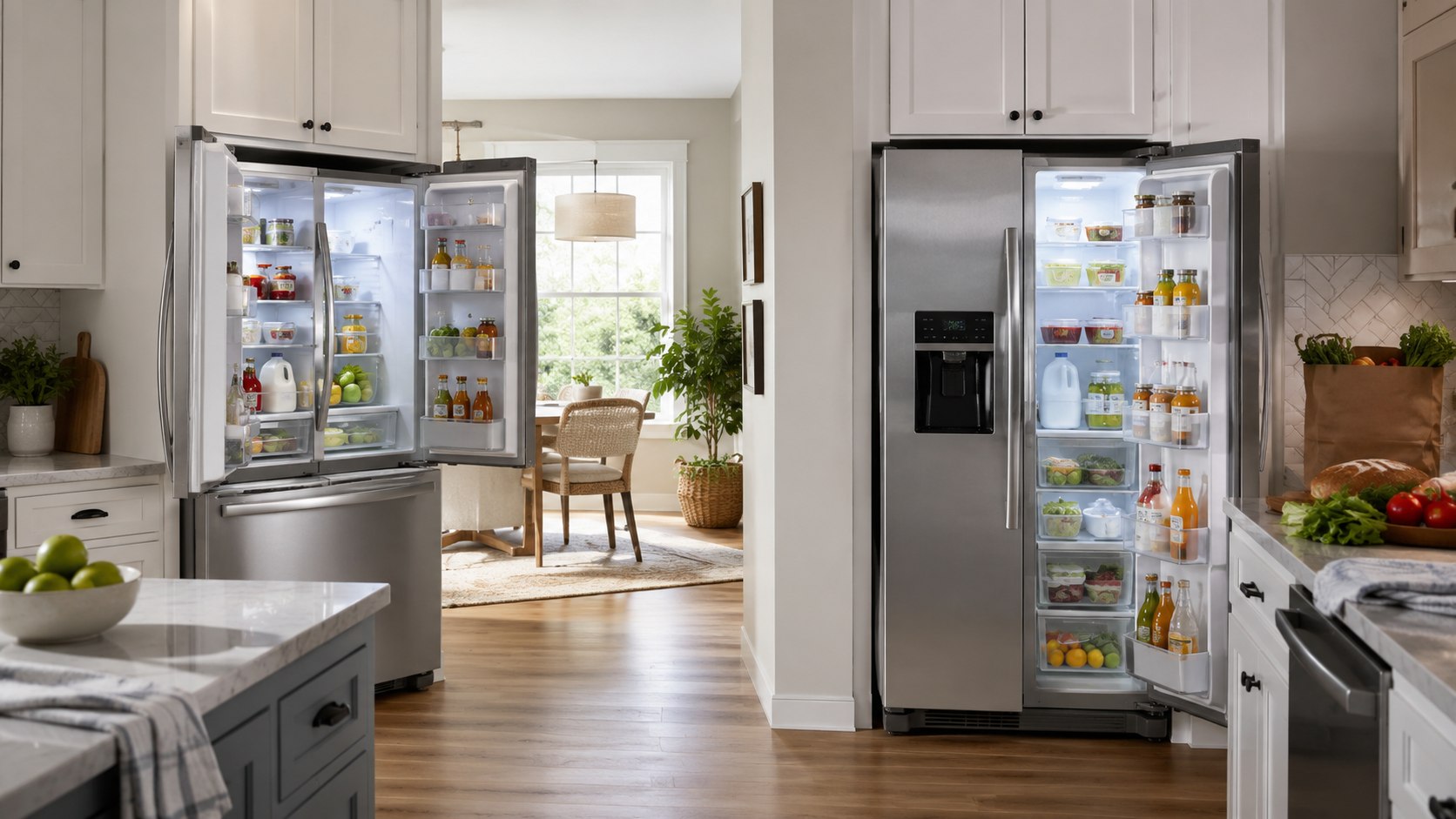
Most US households should pick a French door refrigerator in 2026 if fresh-food space, wide shelves, and lower day-to-day energy waste matter most. A side-by-side fridge is better if the kitchen has a narrow walkway, the household uses frozen food every day, or the buyer wants a lower upfront price, аs noted by Baltimore Chronicle.
The practical answer to french door vs side by side fridge 2026 comes down to door swing and storage habits. French door models usually fit pizza boxes, sheet pans, party trays, and produce bins more easily, while side-by-side models keep frozen items at eye level and need less clearance in front of the appliance.
Key takeaways
- Choose French door if fresh groceries, leftovers, and wide containers create the daily storage problem.
- Choose side-by-side if the kitchen is tight, the freezer is used constantly, or the budget is closer to $1,100–$1,800.
- Check the yellow EnergyGuide label before buying; style matters less than size, ice maker, dispenser, and actual kWh rating.
A refrigerator decision often comes up during a larger kitchen or housing budget. Baltimore Chronicle’s guide to how much it costs to build a house in the USA in 2026 is useful for buyers comparing appliance costs against cabinets, flooring, and installation.
French door vs side by side fridge 2026: At a glance
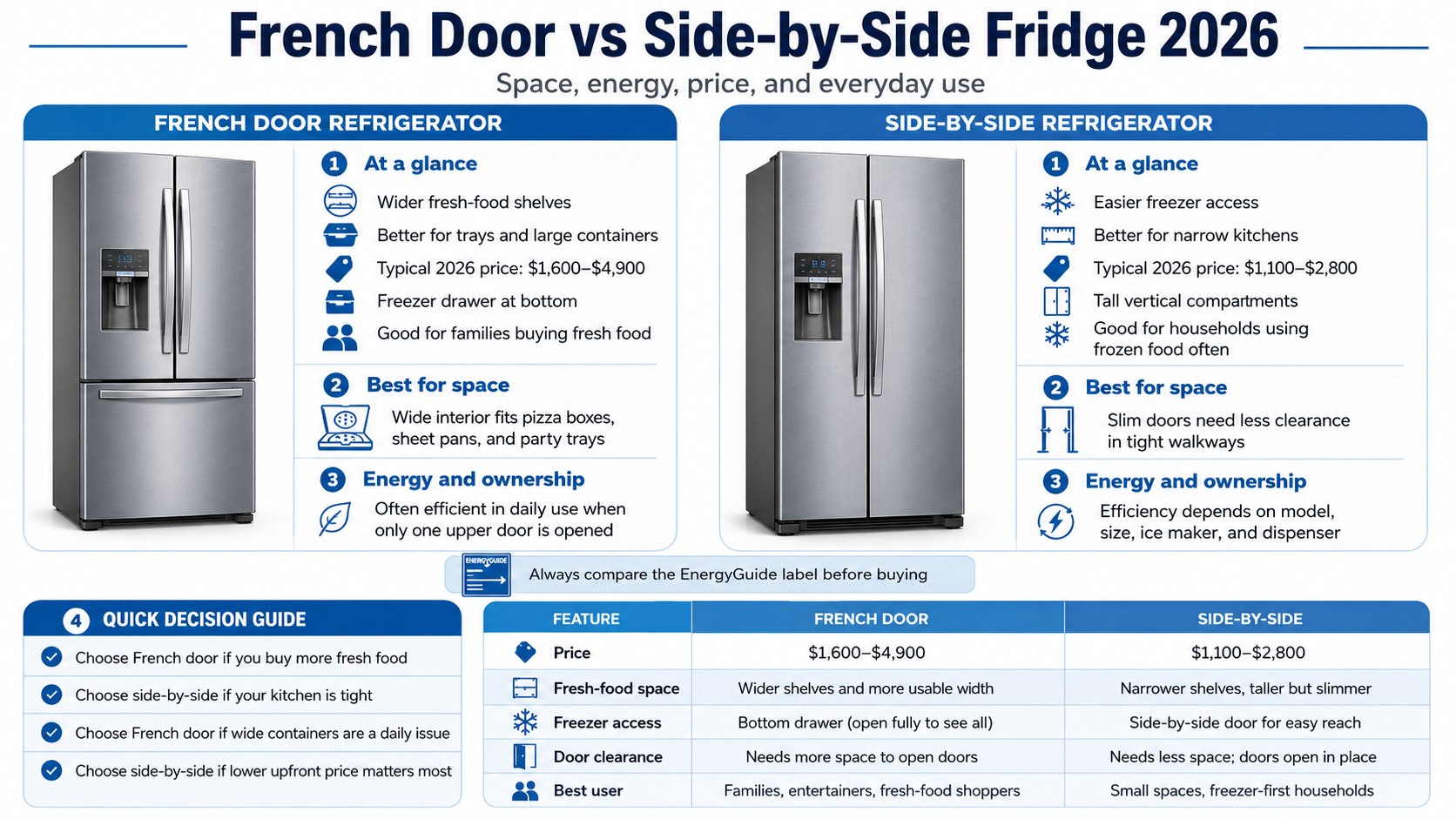
| Factor | French door fridge | Side-by-side fridge |
|---|---|---|
| Typical 2026 price in the US | About $1,600–$4,900, with premium GE Profile, LG, Samsung, Café, and KitchenAid models higher | About $1,100–$2,800, with Whirlpool, Frigidaire, GE, LG, and Samsung common in this range |
| Best space advantage | Wide fresh-food section for trays, produce, and large containers | Vertical freezer storage with easier access to frozen items |
| Door clearance | Needs room for two upper doors and a pull-out freezer drawer | Narrower doors work better in galley kitchens and apartments |
| Energy use | Often efficient in daily use because one upper door can open at a time | Can be efficient by model, but tall narrow compartments may lose cold air quickly when fully opened |
| Install complexity | Standard install, but freezer drawer clearance and counter-depth fit need measurement | Usually straightforward, especially in older 36-inch refrigerator openings |
| Lifespan expectation | Often 10–15 years with gasket care, coil cleaning, and normal compressor performance | Often 10–15 years, with fewer drawer mechanisms than many premium French door models |
| Repair risk | Higher on models with dual ice makers, smart screens, cameras, and convertible drawers | Moderate; through-door ice and water remain common repair points |
| Climate fit | Good for families in hot states like Texas, Florida, Arizona, and Georgia who stock fresh food weekly | Good for households that freeze bulk food, meal prep, or warehouse-club purchases |
How space changes the buying decision
Refrigerator style is partly about cubic feet, but usable space matters more than the capacity number on the sales tag. A 27 cu ft French door refrigerator can feel larger than a similar side-by-side because the fresh-food area is wide and uninterrupted.
French door models solve the common homeowner problem of wide items. A party tray, full-size casserole dish, watermelon, or 18-inch pizza box usually fits more naturally in the upper compartment.
Side-by-side models solve a different problem. They divide the appliance vertically, so frozen vegetables, ice cream, meat, smoothie packs, and school-lunch items are easier to see without bending into a lower drawer.
Measure the kitchen before comparing brands
Most full-size refrigerators are roughly 30–36 inches wide, but the real constraint is clearance. Measure width, height, depth, hinge space, baseboard trim, cabinet overhang, island distance, and the path from the front door to the kitchen.
A counter-depth French door refrigerator may look cleaner in a renovated kitchen, but it usually gives up interior depth. A standard-depth side-by-side may hold more total food but can protrude several inches beyond cabinets.
- Measure the cabinet opening in inches at the top, middle, and bottom.
- Leave room for hinges, leveling legs, water line, and ventilation.
- Open the dishwasher, oven, and refrigerator doors in the layout before buying.
- Check whether delivery requires stair turns, elevator clearance, or door removal.
French door refrigerators: pros, cons, and ideal user
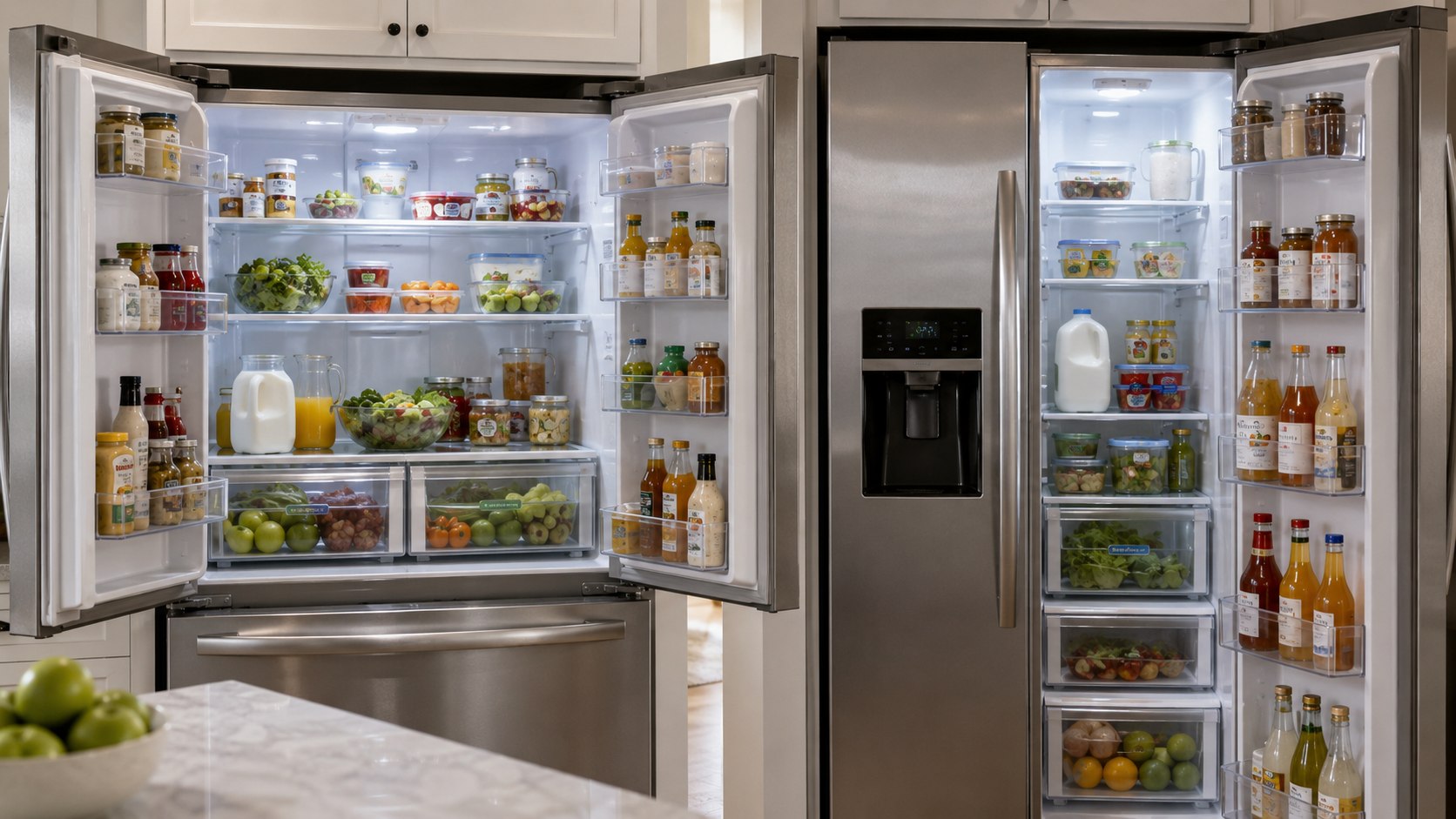
A French door refrigerator comparison starts with fresh-food access. The upper section puts milk, produce, leftovers, condiments, and snacks at a comfortable height, which helps parents, renters, and busy households see food before it spoils.
French door refrigerators also suit people who cook at home. Wide shelves hold baking sheets, meal-prep containers, stockpots, and large serving dishes without the awkward shelf shuffle common in narrow compartments.
The main drawback is price. As of 2026, mainstream French door models from GE, Whirlpool, LG, Samsung, and Frigidaire commonly sit above comparable side-by-side units, while premium smart models can move toward $4,000–$5,000 depending on finish and features.
Another drawback is the freezer drawer. Some buyers like the deep bin; others lose small items in stacked layers. Families that buy frozen food in bulk may need drawer dividers or a separate garage freezer.
- Best for households that buy more fresh food than frozen food.
- Best for wide containers, produce-heavy grocery trips, and family leftovers.
- Less ideal for buyers who want the lowest purchase price.
- Less ideal for people who dislike bending for frozen food.
The smartest refrigerator purchase is usually the model with the right dimensions, fewer fragile extras, and an EnergyGuide label that fits the household’s real use.
Side-by-side refrigerators: pros, cons, and ideal user
A side by side refrigerator 2026 makes sense when the kitchen is narrow. The doors are slimmer, so they do not swing as far into a walkway, island, or apartment galley.
The freezer is the biggest daily advantage. Frozen food stays visible from top to bottom, and the vertical layout works well for families that buy frozen meals, meat, vegetables, and ice frequently.
Side-by-side refrigerators are often easier to find at lower prices. In 2026, a basic full-size Whirlpool, Frigidaire, GE, LG, or Samsung side-by-side can cost hundreds less than a similarly sized French door model, though stainless finishes, water dispensers, and smart features narrow the gap.
The tradeoff is width inside each compartment. Large platters, sheet cakes, wide pizza boxes, and oversized produce containers can be frustrating because the refrigerator side is tall but narrow.
- Best for narrow kitchens, rentals, condos, and older homes with tight appliance openings.
- Best for households that want freezer visibility without a chest freezer.
- Less ideal for large fresh-food containers and wide leftovers.
- Less ideal for buyers who want the most flexible fresh-food storage.
Energy use and the 2026 EnergyGuide check
The energy efficient fridge USA question cannot be answered by door style alone. The US Federal Trade Commission requires EnergyGuide labels for refrigerators, and those labels show estimated yearly energy cost using Department of Energy test procedures.
French door models can save energy in daily use when one upper door opens briefly instead of the whole fresh-food section. That advantage can disappear if the model has dual ice makers, large through-door dispensers, bright displays, cameras, or oversized capacity.
Side-by-side refrigerators can also be efficient, especially in simpler configurations. A smaller side-by-side with no second ice maker may use less electricity than a larger premium French door model with connected features.
In hot states such as Florida, Texas, Louisiana, Nevada, and Arizona, placement matters. A refrigerator near direct sun, a range, poor ventilation, or an unconditioned garage has to work harder, regardless of door design.
What to compare on the label
Look for annual kWh, estimated yearly cost, capacity, and whether the model is ENERGY STAR certified. Compare similar cubic-foot sizes; a 22 cu ft counter-depth model and a 28 cu ft full-depth model are not the same energy decision.
Energy use also connects to the broader home design choice. Baltimore Chronicle’s comparison of custom home cost vs production home in 2026 helps explain why layout, insulation, utility planning, and appliance placement can change long-term household costs.
Price, repairs, and ownership costs in 2026
The best refrigerator for small kitchen is not always the cheapest model. A refrigerator that blocks a walkway, prevents an oven door from opening, or forces poor food organization can become expensive through waste and frustration.
French door refrigerators usually cost more upfront because they often include premium layouts, wider shelves, filtered water, dual evaporators, flexible drawers, and smart controls. GE Profile, Café, Samsung Bespoke, LG InstaView, and KitchenAid models can push the price higher in 2026.
Side-by-side refrigerators remain the value pick for many US buyers. Whirlpool, Frigidaire, and GE sell practical models with ice and water dispensers at prices that are easier for renters, first-time homeowners, and landlords to justify.
| Cost category | French door | Side-by-side |
|---|---|---|
| Upfront price | Higher on average | Lower on average |
| Delivery and installation | Similar, unless doors or drawers must be removed | Similar, often easier in tight doorways |
| Common repair points | Ice maker, drawer rails, sensors, screens, water systems | Ice maker, dispenser, fan, door gasket, water line |
| Energy cost | Depends heavily on size and features | Depends heavily on size and features |
Buyers comparing refrigerator energy cost 2026 should avoid paying for features they will not use. A second ice maker, glass door, Wi-Fi screen, or craft-ice system can add cost and repair complexity without solving a space problem.
Which should you buy in 2026
Use the decision tree below before comparing finishes or brand promotions.
- If fresh groceries, wide leftovers, and produce storage are the problem, buy a French door refrigerator.
- If the kitchen has a narrow aisle, island, or apartment walkway, buy a side-by-side refrigerator.
- If the budget is under about $1,500 before tax and delivery, start with side-by-side models.
- If the household freezes bulk meat, frozen meals, and warehouse-club items, choose side-by-side or add a separate freezer.
- If resale appearance matters in a renovated kitchen, compare counter-depth French door models first.
For many US families, a practical 25–28 cu ft French door model with one ice maker is the balanced pick. For renters, landlords, and tight kitchens, a 33–36 inch side-by-side refrigerator gives better clearance and lower upfront cost.
A counter depth refrigerator vs standard depth choice can matter more than French door versus side-by-side. Counter-depth improves walkway space and appearance, while standard-depth usually gives more storage per dollar.
Brand and model notes for US buyers
GE, Whirlpool, Frigidaire, LG, Samsung, KitchenAid, Bosch, and Café dominate many US retail comparisons in 2026. The best brand depends less on logo and more on the exact model, local service access, warranty terms, and parts availability.
In Maryland, Pennsylvania, New York, Illinois, and California, service availability is usually broad. In rural areas, buyers should check whether authorized repair is available within reasonable driving distance before choosing a premium smart refrigerator.
Smart refrigerators deserve extra caution. Cameras, touchscreens, voice features, and grocery apps can be useful, but they should not outrank cooling performance, shelf layout, gasket quality, and energy use.
Kitchen planning rarely stops at one appliance. Buyers refreshing the full room can compare refrigerator finish, cabinet color, and dining storage against Baltimore Chronicle’s guide to the best furniture stores in the USA ranked for 2026.
FAQ
Is a French door fridge better than a side-by-side fridge in 2026?
A French door fridge is better for most households that prioritize fresh-food storage, wide shelves, and a modern kitchen layout. A side-by-side fridge is better for narrow kitchens and households that use the freezer every day.
Which refrigerator style uses less energy?
Neither style wins automatically. Compare the EnergyGuide label, annual kWh, capacity, ice maker setup, and ENERGY STAR certification for the exact models under consideration.
Is a side-by-side refrigerator cheaper to repair?
It can be cheaper when the design is simpler. However, any refrigerator with through-door ice and water can have dispenser, valve, filter, and ice maker repairs.
What refrigerator size is best for a family?
Many families look at 25–28 cu ft full-size refrigerators, but layout matters more than the number alone. A smaller French door model may store fresh food better than a larger side-by-side with narrow shelves.
Should renters buy French door or side-by-side?
Renters should usually choose side-by-side or a simple top-freezer model if budget, delivery clearance, and future moves matter. French door makes more sense when the rental has a stable long-term kitchen layout.
Are smart fridges worth it in 2026?
Smart features are worth it only when they solve a real household problem, such as inventory checks or water dispensing. For most buyers, shelf layout, energy use, quiet operation, and service access matter more.
Earlier we wrote about Move to iOS Android to iPhone Transfer Guide 2026