

USPS First-Class Mail is the standard low-cost service for sending letters, postcards, and lightweight documents across the United States, аs noted by Baltimore Chronicle.
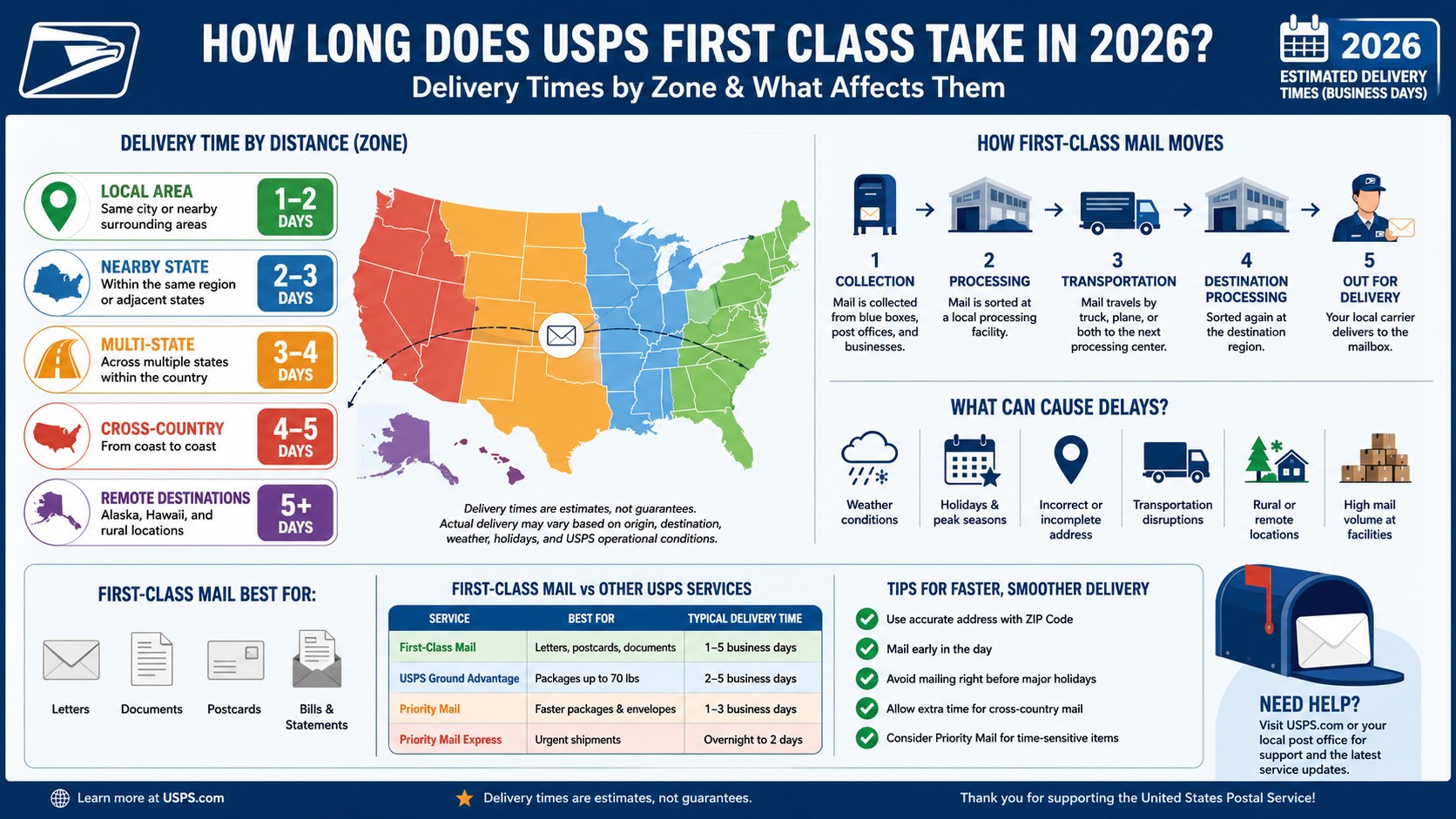
If the question is how long does USPS first class take 2026, the working answer is 1–5 business days in most domestic cases. Local and nearby-state mail often arrives in 1–3 business days. Cross-country mail can take 4–5 business days, especially when it moves through several processing hubs.
Key takeaways
- Local First-Class Mail usually arrives faster than mail moving across multiple USPS regions.
- First-Class Mail is not date-guaranteed, so urgent documents may need Priority Mail Express.
- ZIP Code accuracy, holidays, weather, and forwarding requests can add days.
How long does USPS first class take 2026 by zone?
USPS does not show First-Class Mail zones to consumers the same way it does for some package pricing. Still, delivery time usually follows distance.
| Mailing distance | Typical 2026 delivery time | Example route |
|---|---|---|
| Local area | 1–2 business days | Baltimore to Baltimore County |
| Nearby state | 2–3 business days | Maryland to Pennsylvania |
| Multi-state route | 3–4 business days | Texas to Ohio |
| Cross-country | 4–5 business days | California to Florida |
| Remote destination | 5+ business days | Alaska, Hawaii, rural routes |
These are practical estimates, not delivery guarantees.
For current USPS service details, the official source is USPS.com. For readers comparing mail options, Baltimore Chronicle coverage on USPS rates in 2026 gives useful context on First-Class and Priority Mail costs.
In plain English
First-Class Mail works like a flight with connections.
A letter does not move directly from one mailbox to another. It goes from collection to sorting, then to transportation, then to another sorting facility, then to the local post office.
A letter from Maryland to Virginia has fewer “connections.” A letter from Washington state to Georgia has more distance, more facilities, and more chances for delay.
That is why USPS First Class delivery time depends more on route than on the stamp itself.
How it actually works
USPS collects mail from blue boxes, post offices, business pickups, and carrier routes.
The mail enters a processing facility, where automated systems read the address and sort pieces by destination.
Longer-distance mail moves by truck, air transport, or both. The route depends on distance, capacity, and USPS network schedules.
At the destination region, the mail is sorted again and sent to the local post office.
The local carrier delivers it during the normal daily route.
Who it matters to in 2026
Homeowners and renters
Households still receive tax forms, insurance notices, medical letters, bank documents, and government mail through First-Class Mail.
People moving homes should factor in forwarding time. Baltimore Chronicle’s guide on USPS Informed Delivery signup may help households track expected mail more easily.
Freelancers and small businesses
Freelancers often mail contracts, checks, invoices, W-9 forms, and client documents.
A 2-day delay can affect payment timing or deadlines, especially when clients still rely on mailed paperwork.
Parents and families
Schools, colleges, clinics, insurers, and local agencies still use mail for notices that may require action.
For documents with firm deadlines, First-Class Mail delivery by zone is useful for planning but not enough for guaranteed arrival.
What affects First-Class Mail delivery?
Several factors can change the delivery window.
- Distance between origin and destination
- Correct ZIP Code and full street address
- Apartment, suite, or unit number
- Weather along the route
- Federal holidays
- Peak mailing periods
- Rural or remote delivery routes
- Mail forwarding or address changes
Holiday timing matters. If mail enters the system before a federal holiday, it may sit longer before moving to the next processing stage.
Baltimore Chronicle’s article on Memorial Day 2026 mail service explains how federal holidays affect USPS operations.
First-Class Mail vs other USPS services
| Service | Typical use | Typical speed |
|---|---|---|
| First-Class Mail | Letters, postcards, documents | 1–5 business days |
| USPS Ground Advantage | Small and medium packages | 2–5 business days |
| Priority Mail | Faster packages and envelopes | 1–3 business days |
| Priority Mail Express | Urgent mail | Overnight to 2 days in many areas |
USPS First-Class Mail 2026 is best for regular letters and documents that are important but not urgent.
Priority Mail is usually better when tracking, speed, and packaging options matter.
Priority Mail Express is the safer choice for legal, financial, or time-sensitive documents that must arrive by a specific date.
Common myths
- First-Class Mail always arrives in 3 days. Correction: some routes take longer.
- Nearby states always mean next-day delivery. Correction: processing schedules still matter.
- Delayed mail is lost. Correction: most delayed mail continues moving and arrives later.
- All First-Class Mail travels by plane. Correction: USPS uses both ground and air transport.
- A Forever Stamp guarantees fast delivery. Correction: postage pays for service, not a guaranteed date.
When should you worry about delayed First-Class Mail?
A local letter that has not arrived after a full week may justify a closer look.
A cross-country letter can reasonably take longer, especially around holidays or storms.
For missing mail, Baltimore Chronicle’s guide on how to file a USPS Missing Mail search gives the next steps.
Before filing a search, confirm the recipient’s address, ZIP Code, apartment number, and whether forwarding is active.
FAQ
How long does USPS First-Class Mail take in 2026?
Most domestic First-Class Mail takes 1–5 business days, depending on distance, routing, holidays, and local delivery conditions.
Is USPS First-Class Mail guaranteed?
No. USPS First-Class Mail does not include a guaranteed delivery date.
How long does First-Class Mail take across the country?
Cross-country First-Class Mail often takes 4–5 business days under normal conditions.
Is First-Class Mail faster than Ground Advantage?
For letters, First-Class Mail is the standard service. Ground Advantage is mainly for packages.
What is the best way to track incoming First-Class Mail?
USPS Informed Delivery can show previews of eligible incoming letter mail before delivery.
Should urgent documents go by First-Class Mail?
Urgent documents should usually go by Priority Mail Express or another guaranteed service.
Earlier wenwrote about Sell Used Furniture Fast in the USA: Facebook Marketplace, OfferUp & Consignment Tips for 2026