

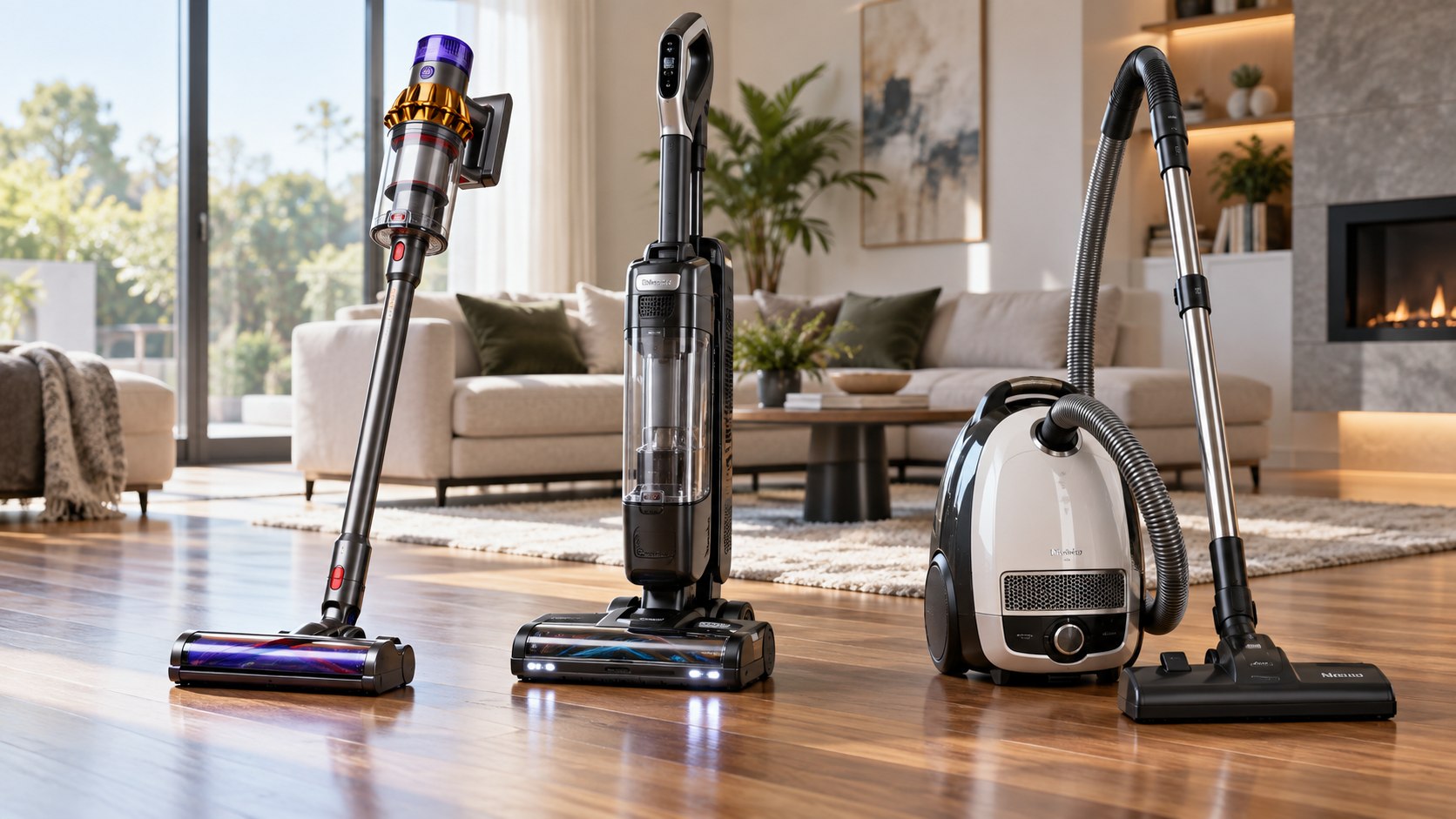
Dyson vs Shark vs Miele vacuum 2026 comes down to 3 practical questions: how much suction is needed, how much ownership should cost, and what happens when something breaks. Most readers should pick Shark for its balance of price, cleaning features, and warranty coverage. Dyson makes more sense when cordless convenience and filtration matter most. Miele suits buyers who prefer a corded canister and conventional servicing, as the Baltimore Chronicle editorial team notes.
For this comparison, the useful reference points are the Dyson Gen5detect, Shark PowerDetect IP1251, and Miele’s current canister range. In 2026, these brands occupy very different price positions. Shark commonly sits in the midrange, Dyson competes at the premium cordless end, and Miele stretches from entry-level canisters to four-figure systems.
Key takeaways
- Shark gives many households the lowest entry cost without giving up modern floor detection or extended warranty coverage.
- Dyson prioritizes cordless mobility, filtration, dust detection, and replaceable batteries, but those features raise the purchase price.
- Miele appeals to buyers who value sustained corded power, bags, serviceable components, and traditional appliance ownership.
Vacuum costs also fit into a larger household budget. Baltimore Chronicle’s guide to dehumidifier ownership costs in 2026 shows why purchase price rarely tells the whole appliance story. Consumables, repairs, and expected service life matter over several years.
At a glance
The comparison below focuses on ownership rather than marketing claims. Suction cannot be reduced to one universal number because brands use different testing methods. Floor heads, airflow, seals, carpet depth, and battery mode also change real cleaning performance.
| Category | Dyson Gen5detect | Shark PowerDetect IP1251 | Miele canister range |
|---|---|---|---|
| Typical 2026 price | Premium, often around $1,000 | Roughly $350–$450 | About $400 to $1,500+ |
| Power source | Cordless | Cordless | Mostly corded |
| Maximum claimed runtime | Up to 70 minutes | Up to 70 minutes | No battery limit |
| Dust collection | Bagless | Bagless | Mostly bagged, some bagless |
| Floor system | Multiple heads, dust illumination | Dual brushroll, floor detection | Model-specific floorheads |
| Warranty reference | 2-year limited | 5-year limited on IP1251 | Depends on series |
| Setup | Charging area or dock | Charging area | No charging setup |
| Main repair concern | Battery and powered components | Battery and floorhead components | Hoses, heads, motor components |
Prices change with promotions, bundles, and inventory. That makes the difference between brands more important than any single sale price. A Shark bought near $400 can leave several hundred dollars in the household budget compared with a flagship Dyson.
Miele cannot be treated as one price tier. A basic Classic C1 configuration and a premium powered-floorhead model solve different problems. Buyers should compare the exact included floorhead rather than the Miele name alone.
Runtime claims require similar caution. Dyson and Shark can advertise comparable maximum figures, yet those results depend on power mode and accessory use. Higher suction settings usually reduce operating time.
The important comparison is not which motor sounds strongest. It is how much usable cleaning performance the household gets before maintenance and repairs enter the bill.
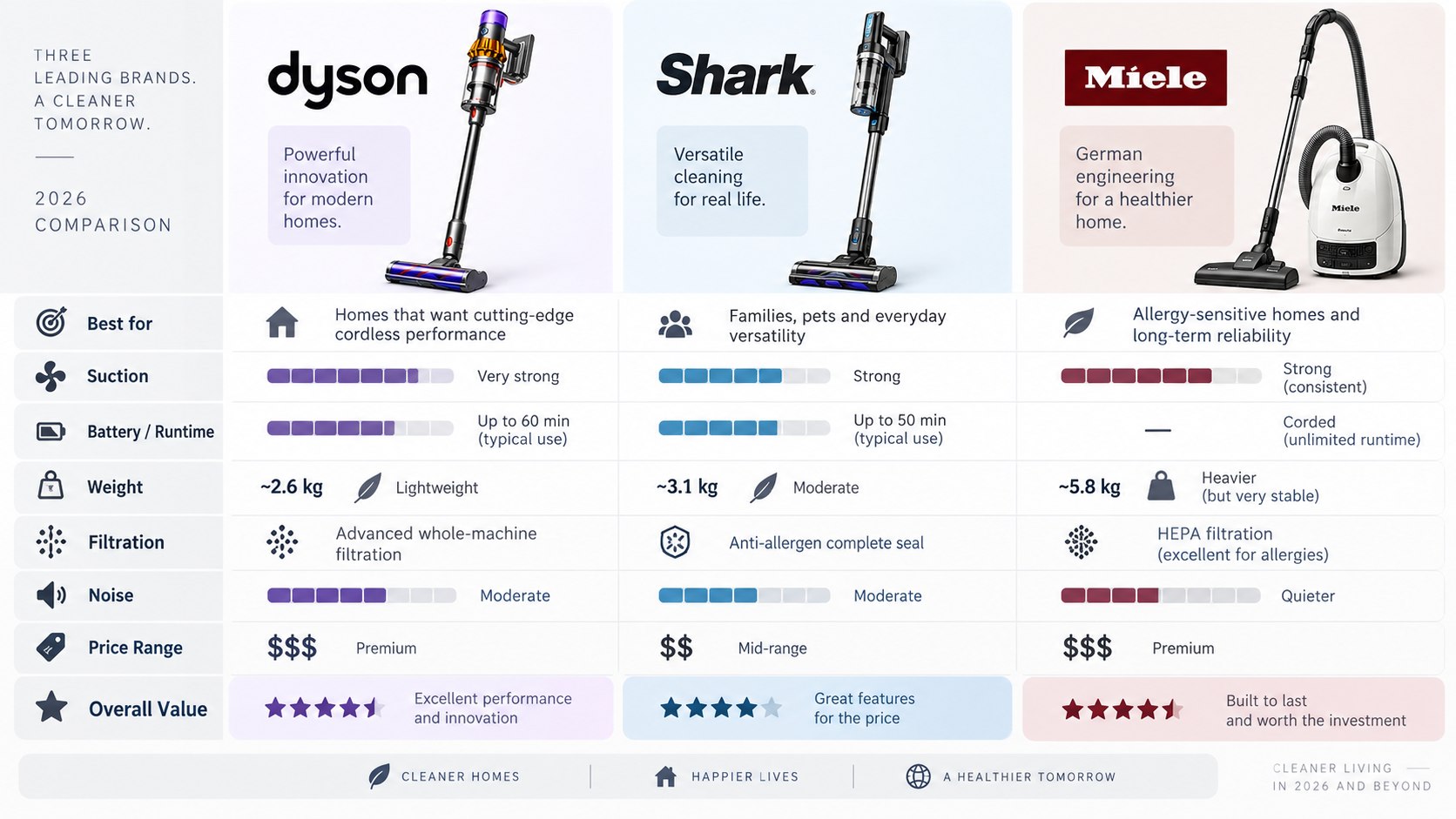
Dyson vs Shark vs Miele vacuum 2026 on suction
Dyson positions the Gen5detect as a high-output cordless vacuum. Its system combines powerful cordless suction with specialized cleaner heads. The Fluffy Optic head is designed to make fine debris easier to see on hard flooring.
Dyson vs Shark suction is more complicated than comparing wattage or marketing labels. Shark PowerDetect models use sensors that respond to debris, flooring, edges, and cleaning direction. The dual-brushroll design also affects pickup because agitation matters on carpet and rugs.
Miele uses a different approach. Its corded canisters do not need to conserve battery energy during long cleaning sessions. Users can keep cleaning at a consistent power level without pausing to recharge.
Where each design works best
- Choose Dyson when stairs, cars, quick pickups, and cordless movement dominate weekly cleaning.
- Choose Shark when mixed flooring, pet hair, and price matter more than premium materials.
- Choose Miele when long sessions, rugs, hard floors, and uninterrupted power matter most.
A 900 sq ft apartment creates a different use case from a 2,800 sq ft suburban house. Cordless runtime is much less restrictive in a smaller home. Larger homes create more opportunities for the battery to run low before every room is finished.
Pets also change the equation. Hair pickup depends heavily on brushroll design, not maximum suction alone. A strong motor cannot compensate for a floorhead that wraps long hair around its roller.
Miele buyers need to pay particular attention to accessories. A suction-only floorhead can work well on hardwood but may disappoint on dense carpet. A powered electrobrush improves carpet performance but raises the purchase price.
Dyson: premium cordless cleaning at a premium price
The Dyson Gen5detect sits at the expensive end of this comparison. In 2026, the listed price can approach or exceed $1,000 depending on promotions. That makes it substantially more expensive than many Shark cordless models.
The price buys a complete cordless system rather than suction alone. Dyson includes specialized tools, dust illumination, filtration, a charging solution, and a replaceable battery architecture.
Dyson advantages
- Strong cordless performance without a power cord.
- Replaceable battery improves long-term service options.
- Multiple tools cover stairs, furniture, hard floors, and hair.
- Official replacement components are available for major models.
The battery is one of the most important ownership details. Lithium-ion batteries are consumable components, even when they last for years. Replacing one is usually much cheaper than replacing the complete vacuum.
Dyson’s US cordless warranty commonly covers 2 years. Current terms should be checked through Dyson’s official warranty information before purchase.
The main weakness is economic. A cordless vacuum costing around $1,000 needs to deliver enough daily convenience to justify that premium. Buyers interested mainly in routine floor cleaning have cheaper alternatives.
Shark: the cost-conscious middle ground
Shark occupies the broad middle of the US vacuum market. PowerDetect cordless models combine modern floor sensing, strong brushroll systems, and relatively accessible pricing.
Shark vacuum repair cost cannot be expressed with one national number. A failed battery, motorized head, hose, or control board will produce different bills. The more useful starting point is the warranty.
Shark lists a 5-year limited warranty for certain PowerDetect models. That is longer than the standard Dyson cordless warranty, although exclusions and component-specific terms still apply.
Shark markets PowerDetect around automatic floor and debris sensing rather than maximum suction alone. That distinction matters because cleaning performance depends on how the floorhead reacts to real surfaces.
The practical advantage is price flexibility. Shark sells cordless sticks, uprights, self-emptying systems, and pet-focused configurations. Buyers can prioritize features without automatically moving into four-figure pricing.
Shark disadvantages
- Model names and retailer bundles can be difficult to compare.
- Discounts change frequently during the year.
- Complex floorheads contain more moving components than basic vacuums.
- Some replacement parts can be model-specific.
Shark works especially well for households seeking modern cleaning features without Dyson pricing. Homes with pets and mixed flooring are a natural fit.
The longer warranty on some models is also relevant. A warranty does not guarantee low lifetime ownership costs, but it can reduce financial exposure during the first several years.
For buyers working within a $500 vacuum budget, Shark often preserves the most useful features without forcing a major compromise.
Miele: corded power and a different repair philosophy
Miele is more difficult to compare because its US lineup covers a wide price range. Entry-level canisters can start near $400, while premium models with powered carpet heads can climb well above $1,000.
Miele vacuum reliability is often discussed in terms of canister construction and long ownership. The clearest structural advantage is simpler: most Miele canisters do not depend on a large traction battery.
That removes one expensive wear component from the ownership equation. Bagged designs also isolate collected dust from much of the internal airflow system.
The tradeoff is recurring spending on bags and filters. Households with pets or heavy debris can use bags faster than low-traffic apartments.
Miele warranty periods vary by product family. Buyers should verify the exact machine through Miele USA because different canister series can carry different coverage.
The other tradeoff is mobility. A canister follows the user across the floor, and the power cord must be moved between outlets. Stairs and quick 2-minute cleanups are usually easier with a cordless stick.
Miele makes the most sense for households that treat a vacuum like a conventional appliance. It suits long cleaning sessions, substantial hard-floor areas, rugs, and buyers comfortable storing bags.
Cost and repair: what the sticker price misses
Vacuum repair cost 2026 should be considered before any premium purchase. Batteries, hoses, filters, powered floorheads, brushrolls, switches, and motors do not fail at the same rate or cost.
A practical ownership check can prevent expensive surprises:
- Check the warranty for the exact model number.
- Search the manufacturer’s parts catalog before buying.
- Confirm local authorized service using your ZIP code.
- Price filters, bags, and batteries over several years.
- Keep the receipt and serial number after purchase.
Battery replacement is the clearest cordless example. A new battery can extend the life of an otherwise healthy machine. That is much less expensive than replacing the complete vacuum.
Bagged Miele ownership creates the opposite pattern. There is no cordless battery to replace, but bags and filters create predictable recurring costs.
Shark sits between those approaches. Its lower initial price limits financial exposure, while longer limited warranties on selected models can reduce early ownership risk.
Location matters mainly for service access. A buyer in California, Maryland, Texas, Florida, or New York should check whether authorized repair is available nearby.
Independent repair labor varies by city and state. Written estimates should separate diagnostics, labor, parts, and any repair warranty.
A machine with available replacement components can stay economical long after its factory warranty expires. A cheaper vacuum with an unavailable floorhead may become uneconomical after one failure.
Baltimore Chronicle’s discussion of repair versus replacement for major appliances follows the same principle. The lowest purchase price is not always the lowest ownership cost.
Which should you buy in 2026
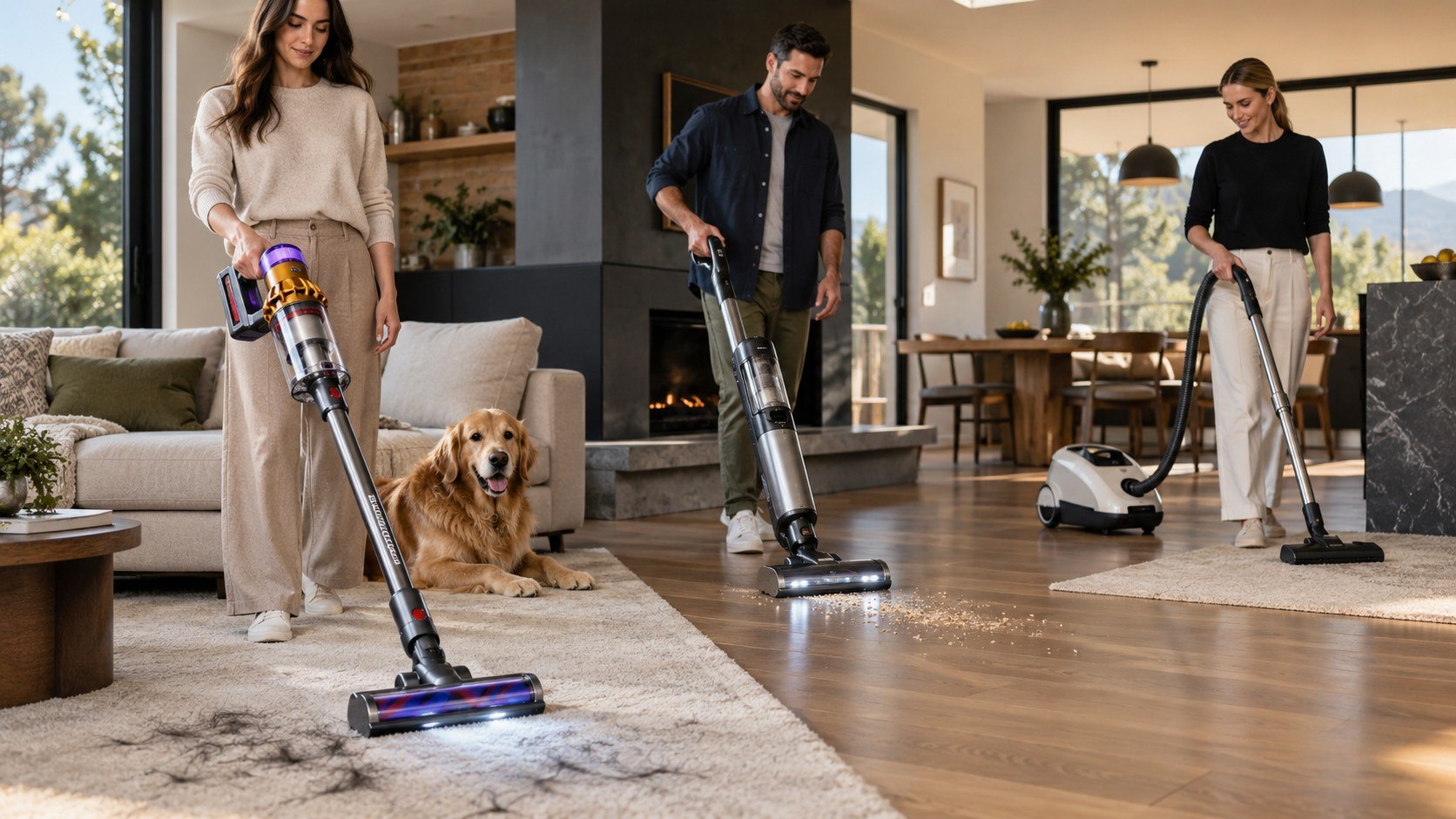
There is no reason to build a complicated scoring formula. Match the vacuum design to the household, floor surfaces, budget, and tolerance for maintenance.
- Best vacuum for pet hair 2026: start with Shark PowerDetect or a Miele equipped with a suitable powered floorhead.
- If cordless convenience matters more than price, choose Dyson Gen5detect.
- If the budget is around $500, Shark offers a strong combination of features and flexibility.
- If uninterrupted cleaning matters most, choose a corded Miele.
- If battery replacement is unacceptable, avoid cordless designs entirely.
For many US households, Shark is the logical starting point because its price stays below most premium Dyson models. That does not make it the right machine for every floor plan.
Dyson makes more sense when portability is used every day. A cordless vacuum that regularly cleans stairs, cars, kitchen spills, and pet hair can replace several smaller tools.
Miele suits buyers who clean on a schedule rather than in short bursts. Its corded format works best for longer sessions where continuous power matters more than instant mobility.
Cordless vs canister vacuum is therefore more useful than simple brand loyalty. The machine format determines much of the ownership experience before suction specifications even enter the discussion.
FAQ
Is Dyson better than Shark in 2026?
Dyson offers a more premium cordless package with advanced filtration, tools, and engineering. Shark usually costs less and still provides modern floor detection and strong cleaning performance.
Is Miele more powerful than Dyson?
There is no universal answer because the brands use different motor systems and testing methods. Miele provides continuous corded power, while Dyson focuses on high-performance cordless cleaning.
Which vacuum is cheapest to own?
Shark often has the lowest initial purchase price among these 3 brands. Long-term cost also depends on filters, bags, batteries, repair availability, and service life.
Which brand has the better vacuum warranty?
Some Shark PowerDetect models include a 5-year limited warranty. Dyson cordless vacuums typically carry 2 years. Miele coverage varies by product series.
Is a Miele vacuum worth buying for carpet?
Yes, if the chosen model includes a suitable powered floorhead. Buyers with thick carpet should avoid assuming every Miele canister includes the same carpet-cleaning system.
Should you repair or replace a vacuum?
Repair usually makes sense when the main motor and chassis remain sound and the failed component is readily available. Replacement becomes more reasonable when several expensive assemblies fail together.
Earlier we wrote about US Roof Replacement Costs in 2026: Metal Lasts Longer, Asphalt Starts Cheaper