


Best high yield savings accounts 2026 USA shoppers face a simple problem: the highest advertised rate often comes with conditions. For many savers, Axos ONE stands out for its promotional yield, while Openbank offers a simpler high-rate structure. Marcus, Capital One, and Ally sacrifice some yield for fewer requirements, as noted by Baltimore Chronicle.
Accounts were ranked by usable APY, fees, qualification rules, minimum balances, access, and federal deposit protection. Promotional rates received less weight when maintaining them required substantial monthly activity.
Key takeaways
- The highest headline APY is not automatically the best deal once subscriptions, deposits, and balance limits enter the calculation.
- Axos ONE can reach 5.00% APY for qualifying new customers, while Openbank advertises a simpler temporary 4.15% rate.
- For emergency savings, access rules and FDIC coverage can matter more than another few tenths of a percentage point.
A saver keeping $20,000 should focus on the rate applying to the entire balance, not an oversized promotional headline. Someone holding $80,000 faces a different calculation because balance tiers become more important. Monthly fees can also erase a noticeable share of extra interest.
Readers building their first cash reserve can review Baltimore Chronicle’s guide to how high-yield savings accounts work. Those reorganizing broader household finances may also need a structured expense-tracking system.
Best high yield savings accounts 2026 USA ranked
The 7 accounts below solve different problems. The ranking considers both interest and the effort required to earn the advertised return.
| Rank | Account | 2026 advertised APY | Main condition | Best fit |
|---|---|---|---|---|
| 1 | Axos ONE Savings | Up to 5.00% promotional APY | Qualifying checking activity and promotional rules | Active bank switchers |
| 2 | Openbank High Yield Savings | Up to 4.15% promotional APY | New-customer offer | Simple online saving |
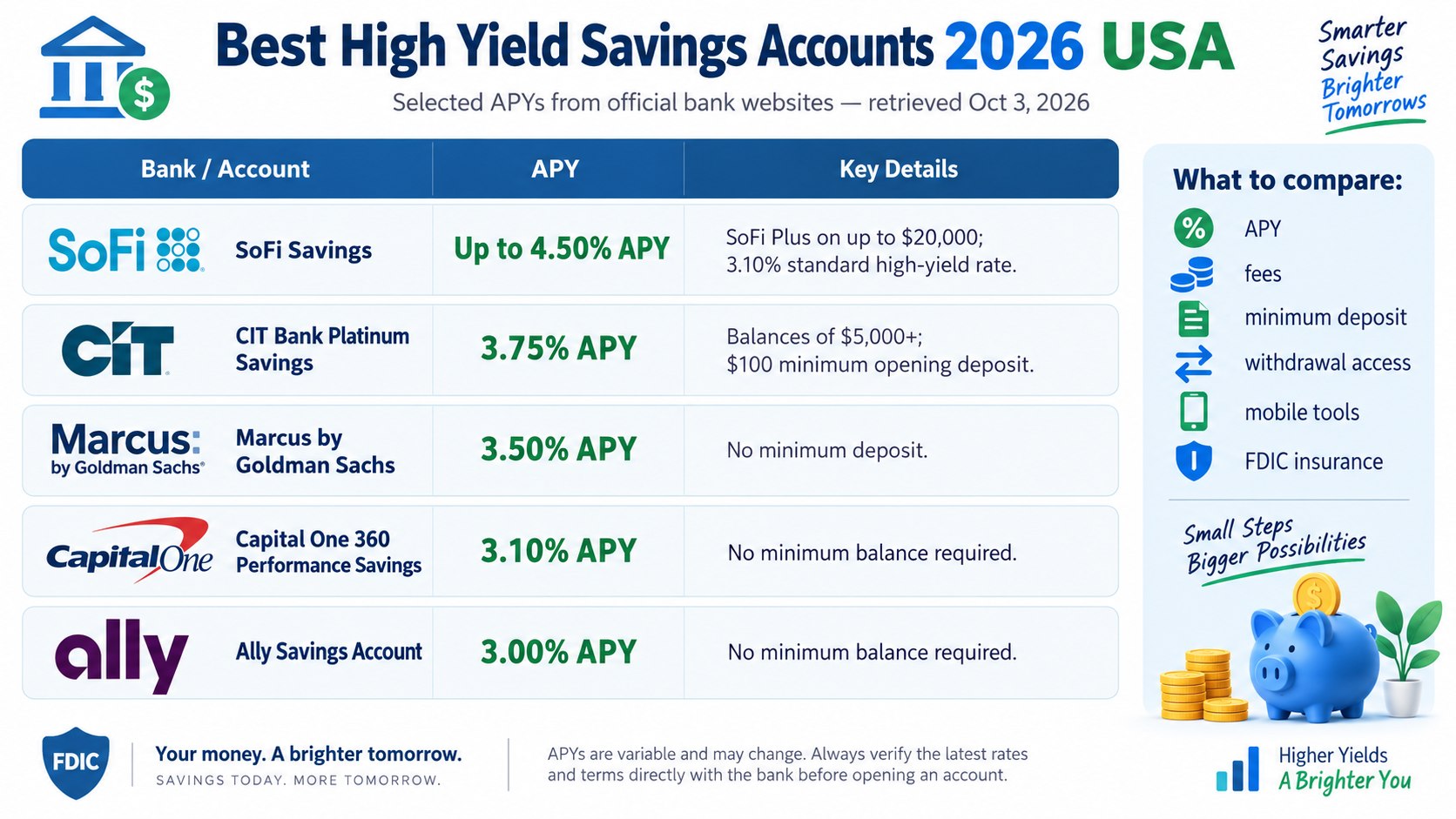
| 3 | SoFi Savings | Up to 4.50% on eligible balances | SoFi Plus terms | Existing SoFi users |
| 4 | CIT Bank Platinum Savings | 3.75% on $5,000 or more | $5,000 balance for top tier | Larger emergency funds |
| 5 | Marcus Online Savings | 3.40% | No minimum deposit | Low-friction savings |
| 6 | Capital One 360 Performance Savings | 3.10% | No minimum balance | Customers wanting broader bank access |
| 7 | Ally Savings | 3.00% | No minimum balance | Goal-based digital saving |
Variable APYs can change after an account opens. That makes the standard rate almost as important as the introductory offer. A strong temporary APY has less value when the account later falls far behind comparable products.
The differences look modest until balances become larger. A 1-percentage-point spread on $50,000 represents roughly $500 yearly before taxes and changes in rate. That gap deserves attention when qualification rules fit normal household cash flow.
The calculation should also account for fees. A $10 monthly subscription costs $120 per year. On smaller balances, that can consume much of the extra interest generated by a higher APY.
Qualification rules deserve equal attention. Direct deposits, minimum balances, bundled checking accounts, and promotional caps can all change the real return.
An uncomplicated 3.40% account can outperform a 5.00% promotion when the saver repeatedly misses monthly qualification requirements.

1. Axos ONE Savings: highest promotional ceiling
Axos ONE earns the first position because qualifying new customers can reach a 5.00% promotional APY. The strongest rate applies only under defined promotional conditions, so it should not be treated as an automatic return for every customer.
The account works best for people willing to move part of their everyday banking relationship. Qualification can depend on using Axos ONE Checking together with the savings account and meeting activity requirements.
This creates a clear trade-off. The potential yield is strong, but maintaining it requires more involvement than opening a standalone savings account.
For a customer already planning to switch checking banks, those requirements may be manageable. Someone seeking only a place for emergency cash may prefer fewer moving parts.
The account therefore stands out in 2026 for its rate ceiling, not for simplicity.
2. Openbank High Yield Savings: strong rate with fewer moving parts
Openbank, the digital banking operation backed by Santander, has offered one of the stronger savings rates among nationally available online products. Promotional APYs can exceed the standard rate for eligible new customers.
The structure is relatively straightforward compared with offers requiring checking activity. The main considerations are promotional eligibility, the opening period, and the rate that applies after the introductory boost ends.
That simplicity gives Openbank a strong position among high yield savings rates 2026. A customer moving an emergency reserve does not need to redesign monthly payroll activity merely to understand the yield.
Promotional expiration still matters. Savers should compare the temporary rate with the standard variable APY before transferring a large balance.
For someone who wants competitive interest without extensive account management, Openbank can be one of the more practical options.
3. SoFi Savings: compelling for people already using SoFi
SoFi presents a different proposition. Higher savings rates can be linked to SoFi Plus membership or other eligibility conditions, while different balance tiers may receive different APYs.
That structure makes the account more attractive to customers already using the SoFi ecosystem. Existing users may receive value from the broader package rather than judging the savings account in isolation.
A subscription fee changes the calculation for smaller balances. A saver should compare the annual cost with the additional interest earned through the higher APY.
“There is no minimum balance requirement.”
SoFi states that its checking and savings structure does not require a minimum account balance. The more important issue is which rate applies under the customer’s specific eligibility status.
Someone holding $5,000 should perform different math from a customer keeping $50,000. Fixed monthly costs matter more when the balance is small.
4. CIT Bank Platinum Savings: built for balances above $5,000
CIT Bank Platinum Savings uses balance tiers. The stronger APY applies when the account maintains at least $5,000, while lower balances can earn much less.
That dividing line matters more than it might appear. An account frequently dropping below the threshold can produce a very different annual return from the headline rate.
This makes CIT more suitable for established emergency reserves. A household keeping several months of mortgage, rent, insurance, or childcare expenses may find the threshold easy to maintain.
Freelancers can face a different situation. Irregular income or quarterly tax payments can cause balances to move sharply during the year.
The strongest savings account is often the one whose qualification threshold stays comfortably below the cash amount that must remain available.
5. Marcus Online Savings: uncomplicated terms
Marcus by Goldman Sachs remains competitive because of its relatively simple structure. Its online savings account does not rely on a complicated balance threshold for basic access to the advertised rate.
Marcus does not necessarily lead the market on raw APY. It stands out because fewer conditions can make the account easier to manage over long periods.
“No fees. No minimum deposit.”
That structure appeals to savers who do not want another account requiring recurring transactions or bundled services. Simplicity can matter when the account is intended for emergency cash rather than active banking.
Someone comparing online savings accounts USA should also consider transfer speed. A high rate loses practical value when accessing cash becomes difficult during a repair, medical bill, or job interruption.
For many households, Marcus works as a straightforward reserve account rather than a promotional-rate strategy.
6. Capital One 360 Performance Savings: useful hybrid access
Capital One 360 Performance Savings combines online banking with access to a larger financial brand. The account generally avoids monthly service fees and minimum balance requirements.
That makes it easier to understand than many promotional products. Customers do not need to monitor a qualification threshold simply to avoid a monthly charge.
Capital One also differs from many digital-only rivals because customers may have access to physical banking locations in selected markets. Coverage varies significantly across the country, so availability should be checked locally.
The APY can trail the top promotional offers. However, the account may still appeal to customers who prefer a familiar banking environment with fewer conditions.
Baltimore Chronicle’s reporting on banking protections and financial scams also shows why security should be considered alongside yield.
7. Ally Savings: strongest for organizing several goals
Ally Savings is designed around simple digital money management. The account typically carries no monthly maintenance fee and does not require a minimum opening balance.
Its strongest practical feature is the ability to organize money into separate savings goals. Customers can divide funds into categories without opening a completely new account for each target.
That can be useful for households saving simultaneously for taxes, home repairs, insurance deductibles, vacations, and emergency expenses.
The APY may sit below the strongest promotional offers. The account instead competes through organization, ease of use, and predictable account management.
For savers who value structure more than constant rate chasing, that approach can be useful.
How to choose an FDIC-insured savings account in 2026
Rate shopping should begin only after confirming deposit protection. The Federal Deposit Insurance Corporation generally insures eligible bank deposits up to $250,000 per depositor, per insured bank, per ownership category.
That limit does not simply mean $250,000 per person across the entire banking system. Ownership categories and separate insured institutions can change total coverage.
Use this sequence before moving an emergency fund or other short-term savings:
- Confirm that the bank itself is FDIC insured.
- Check the standard APY after every temporary promotion expires.
- Calculate monthly fees against expected annual interest.
- Review direct-deposit, balance, and transaction requirements.
- Check ACH transfer timing and withdrawal rules.
- Confirm how existing deposits affect the $250,000 insurance calculation.
A saver with $10,000 does not need the same account as someone holding $200,000. Small balances make monthly fees particularly damaging. Larger balances make APY differences more expensive to ignore.
Liquidity also deserves a place beside yield. Emergency cash should not depend on selling investments during a market decline.
A FDIC insured high yield savings account keeps cash separate from stock-market fluctuations. That makes it useful for expenses expected within a relatively short period.
Taxes are another practical detail. Bank interest generally creates taxable income, and savers may receive Form 1099-INT when reporting requirements apply.
How much does a higher APY actually matter?
Headline percentages become clearer when translated into dollars. The examples below assume a stable rate and no withdrawals during the year.
| Balance | 3.00% APY | 4.00% APY | 5.00% APY |
|---|---|---|---|
| $5,000 | About $150 yearly | About $200 yearly | About $250 yearly |
| $20,000 | About $600 yearly | About $800 yearly | About $1,000 yearly |
| $50,000 | About $1,500 yearly | About $2,000 yearly | About $2,500 yearly |
The difference grows with the balance. Moving $5,000 for a temporary rate advantage may produce only a modest increase in annual interest.
Moving $50,000 can make the difference more noticeable. Even then, fees and qualification rules must be included in the calculation.
Promotional caps matter too. A 5.00% rate applying only to part of the balance cannot be compared directly with 4.00% paid across the full account.
The same principle applies to subscription-based offers. Extra interest should exceed the annual cost of maintaining eligibility.
This is why the best savings account for emergency fund use may not occupy first place on an APY chart.
Honorable mentions
Several additional national accounts remain worth checking when their live rates or features better match a household’s needs.
- Synchrony High Yield Savings: often emphasizes no monthly fee and broad digital access.
- American Express High Yield Savings: known for a straightforward online savings structure.
- EverBank Performance Savings: another nationally available online option worth comparing by current APY.
Synchrony may appeal to customers who value flexible access. American Express can make sense for households already using the company’s financial products.
EverBank provides another alternative for customers comparing nationally available online savings. Its value depends heavily on the live rate offered when the account is opened.
Current APYs should always be checked before applying. Variable savings rates can change without requiring a customer to open a new account.
A difference of 0.10 percentage points is rarely enough reason for constant account switching. Fees, poor transfer access, or restrictive conditions usually matter more.
FAQ
What is the best high-yield savings account in the USA in 2026?
Axos ONE can offer one of the strongest promotional ceilings for customers who meet its requirements. Openbank may appeal more to savers seeking a simpler structure. The better choice depends on balance size and qualification preferences.
Are high-yield savings accounts safe?
Eligible deposits at FDIC-insured banks receive federal insurance within applicable limits. The standard coverage amount is generally $250,000 per depositor, per insured bank, per ownership category.
Can a high-yield savings APY change after opening?
Yes. Most high-yield savings accounts use variable rates. Banks can raise or lower APYs after an account opens according to account terms.
Is 4% APY good for savings in 2026?
A 4% variable APY can remain competitive among online savings products in 2026. Fees, promotional expiration dates, and qualification requirements should still be compared.
How much money should stay in a high-yield savings account?
Many households use these accounts for emergency reserves and expenses expected within several years. The appropriate balance depends on spending, income stability, debts, and insurance deductibles.
Do I pay taxes on high-yield savings interest?
Bank interest is generally taxable income for federal purposes. Financial institutions may issue Form 1099-INT when applicable.
Earlier we wrote about Garage Conversion to Living Space Cost 2026: Why Permits, Plumbing and Code Can Double the Budget