

A Baltimore judge has thrown out the three second-degree murder counts against James Barnett, the 58-year-old West Baltimore man accused of setting the January 2022 fire on South Stricker Street that killed three city firefighters. The case is not over: jurors were expected to begin weighing arson, involuntary manslaughter and reckless endangerment charges on Wednesday, Oct. 14, and the outcome will decide whether anyone is held criminally responsible for one of the deadliest days in the Baltimore City Fire Department’s modern history.
The ruling, made Tuesday after the defense asked the court to toss the murder counts, was reported by FOX45 and by WJZ and The Baltimore Banner. A spokesperson for the Baltimore City State’s Attorney’s Office said the court will release a written opinion explaining the decision. As of Wednesday morning, that reasoning had not been made public.
What charges does James Barnett still face?
Barnett has maintained his innocence. With the murder counts gone, prosecutors are asking the jury to consider nine remaining counts. The table below shows what was dismissed, what remains and the maximum penalty Maryland law sets for each offense. Maximums are rarely imposed, and sentencing would only come into play if the jury convicts.
| Charge | Counts | Status | Maximum penalty under Maryland law |
|---|---|---|---|
| Second-degree murder | 3 | Dismissed by judge Oct. 13 | Up to 40 years per count |
| Second-degree arson | 1 | Goes to jury | Up to 20 years and/or $30,000 fine |
| Involuntary manslaughter | 3 | Goes to jury | Up to 10 years per count |
| Reckless endangerment | 5 | Goes to jury | Up to 5 years and/or $5,000 fine per count |
The difference between the dismissed and remaining charges matters. Second-degree murder in Maryland generally requires proof of intent to kill, intent to cause serious physical injury, or extreme indifference to human life. Involuntary manslaughter covers an unintended killing caused by grossly negligent conduct or during an unlawful act. Arson focuses on whether a person willfully and maliciously set fire to a building. The jury will not be asked whether Barnett meant for anyone to die.
What happened at 205 S. Stricker Street?
Before dawn on Jan. 24, 2022, crews responded to a fire in a vacant three-story rowhome in the 200 block of South Stricker Street in the Mount Clare neighborhood of Southwest Baltimore. The building partially collapsed while firefighters were inside, trapping six of them.
Lt. Paul Butrim, Lt. Kelsey Sadler and EMT/Firefighter Kenny Lacayo were killed. Others were pulled to safety, and EMT/Firefighter John McMaster was seriously injured.
How did investigators connect Barnett to the fire?
According to testimony and court records described by WJZ, the Banner and FOX45, the case rests largely on surveillance video and physical evidence:
- Mosque camera footage. ATF Special Agent Adam St. John testified that video from a nearby mosque showed a person walking toward the back of the home and a series of flashes of light inside over roughly 20 seconds. Investigators believe the person was inside for about eight minutes. Smoke and flames appeared later.
- The ATF finding. Court documents say the ATF classified the fire as “incendiary,” meaning it was intentionally set, and found the light source consistent with sparks and flame from a butane lighter.
- A jacket and a shopping cart. Maryland State Fire Marshal investigator Melissa Decker testified that on Feb. 25, 2022, investigators spotted Barnett pushing a shopping cart and followed him to a vacant rowhome on Ashton Street. Under a search warrant, they recovered items including two jackets, gloves and a cellphone. Prosecutors say a blue and yellow coat matches the one seen on video.
- Barnett’s own account. According to court records, he told investigators in 2022 that he had lived in the Stricker Street home years earlier and had access to it, but denied setting the fire or being the person in the video.
“We all know that fires don’t start themselves.”
Assistant State’s Attorney Daniel Salem, in opening statements, as reported by The Baltimore Banner
Assistant Public Defender Jason Rodriguez told jurors they would hear a “puzzling case” that “doesn’t add up,” and argued the evidence would show his client is innocent.
Why did it take nearly four years to bring the case to trial?
Investigators were following Barnett about a month after the fire, according to trial testimony, but he was not arrested until Nov. 14, 2025, more than three and a half years later. At a bail review after the arrest, a judge ordered him held without bond. Prosecutors have not publicly explained the timing of the charges. The trial opened in early October 2026 before Circuit Judge Alan Lazerow and was expected to last about three weeks.
| Date | Event |
|---|---|
| Jan. 24, 2022 | Fire and collapse at 205 S. Stricker St.; three firefighters killed |
| Feb. 25, 2022 | Investigators follow Barnett to an Ashton Street vacant and recover clothing under a warrant |
| December 2022 | Fire Chief Niles Ford resigns; Board of Inquiry report later released |
| 2024 | Firefighters’ families sue Baltimore City; suit later dismissed |
| Nov. 14, 2025 | Barnett arrested and held without bond |
| Early October 2026 | Trial begins in Baltimore City Circuit Court |
| Oct. 13, 2026 | Judge dismisses three second-degree murder counts |
| Oct. 14, 2026 | Remaining charges expected to go to the jury |
What did the city learn from the Stricker Street collapse?
The criminal trial is only one piece of the fallout. A 314-page Board of Inquiry report, released after Ford’s resignation, found gaps in training and communication, difficulty controlling the scene after the collapse, and a “competitive culture” in the department. It concluded that units went inside despite signs of a previous fire and structural instability, according to CBS Baltimore.
Among its recommendations: proper size-ups before interior attacks, and reinstating “Code X-Ray,” a program discontinued in 2013 that marked vacant buildings considered too dangerous to enter. For a city with thousands of vacant rowhomes, that question goes beyond one block in Mount Clare.
The families of the three firefighters have also tried to hold the city responsible in civil court. Judge Matthew Maddox dismissed a 2024 wrongful death suit, then in early 2026 dismissed a second suit alleging the city withheld information that the building was dangerous. He called the allegations “tragic and alarming” but said they were not enough to support the claims, WEAA reported.
What happens next?
- Jury deliberations. The remaining arson, manslaughter and reckless endangerment counts were expected to be submitted to the jury Wednesday.
- Written opinion. The court’s explanation for dismissing the murder counts is still to come.
- Sentencing, if convicted. A conviction on any count would lead to a separate sentencing hearing at a later date. An acquittal would end the state’s case.
For more on how the city is reshaping its emergency services, see our report on Baltimore’s new emergency response department.
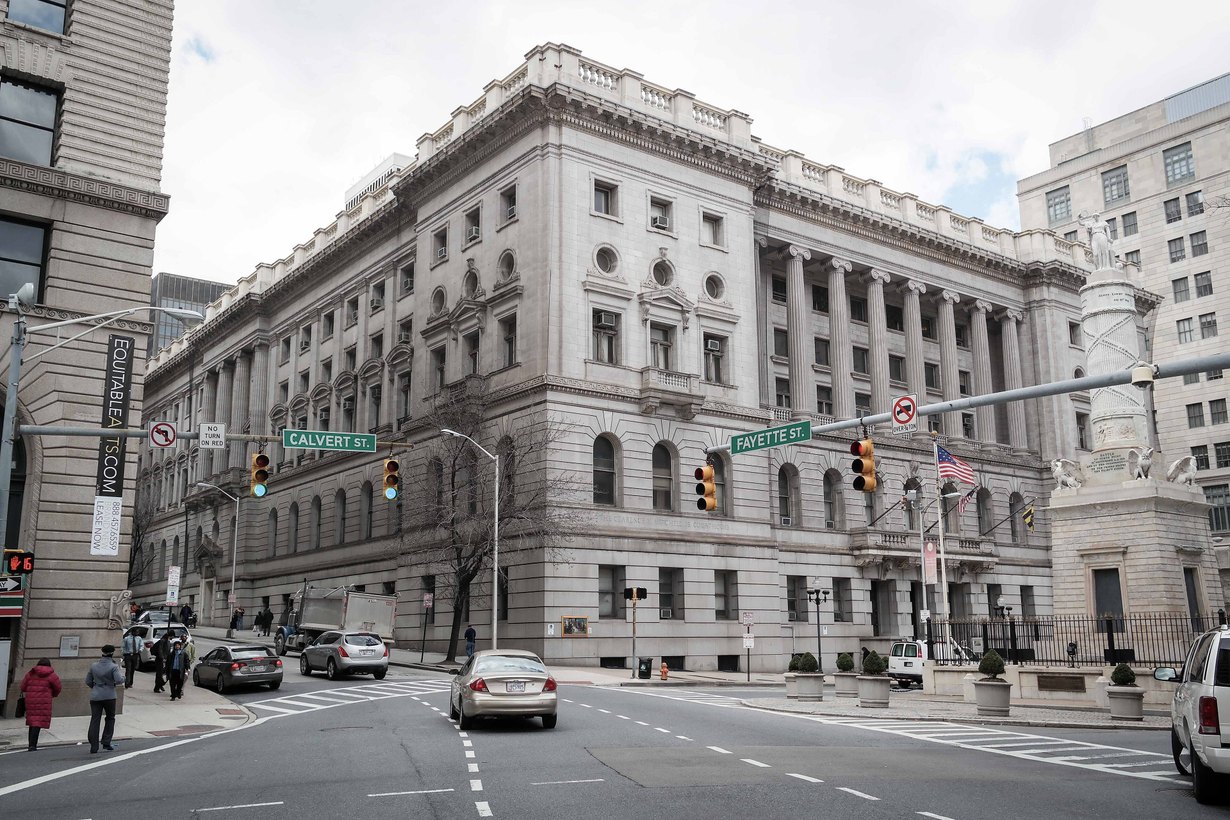
Featured image: The Clarence M. Mitchell Jr. Courthouse in downtown Baltimore, home of Baltimore City Circuit Court. Photo: Smash the Iron Cage / Wikimedia Commons, CC BY-SA 4.0.